
Table of Contents
Autonomyware Investment Report
Product Hunt launch date: 2026/09/30
Company: Autonomyware | Legal entity: Autonomyware B.V. (Netherlands)
Product Hunt: https://www.producthunt.com/products/autonomyware
Official site: https://www.autonomyware.ai/
Research date: 2026-10-08
Investment Snapshot
| Metric | Assessment |
|---|---|
| Category | AI-native CAD, mechanical design, and systems-engineering workflow |
| Stage | Newly launched open beta; technical proof-of-concept, commercial traction unverified |
| Target user | Makers, product designers, small hardware teams; future engineering organizations |
| Core product | Natural-language-to-CAD workflow with exact-geometry kernel, assemblies, BOM, and engineering traceability |
| Business model | Credit-metered SaaS: Explore €19.99/month, Create €49.99/month, Engineer enterprise sales |
| Launch signal | Product Hunt #6 day rank, 203 points in listing snapshot; no visible review count |
| Recommendation | Watch until output reliability, paid use, and engineering scope are validated |
Executive Summary
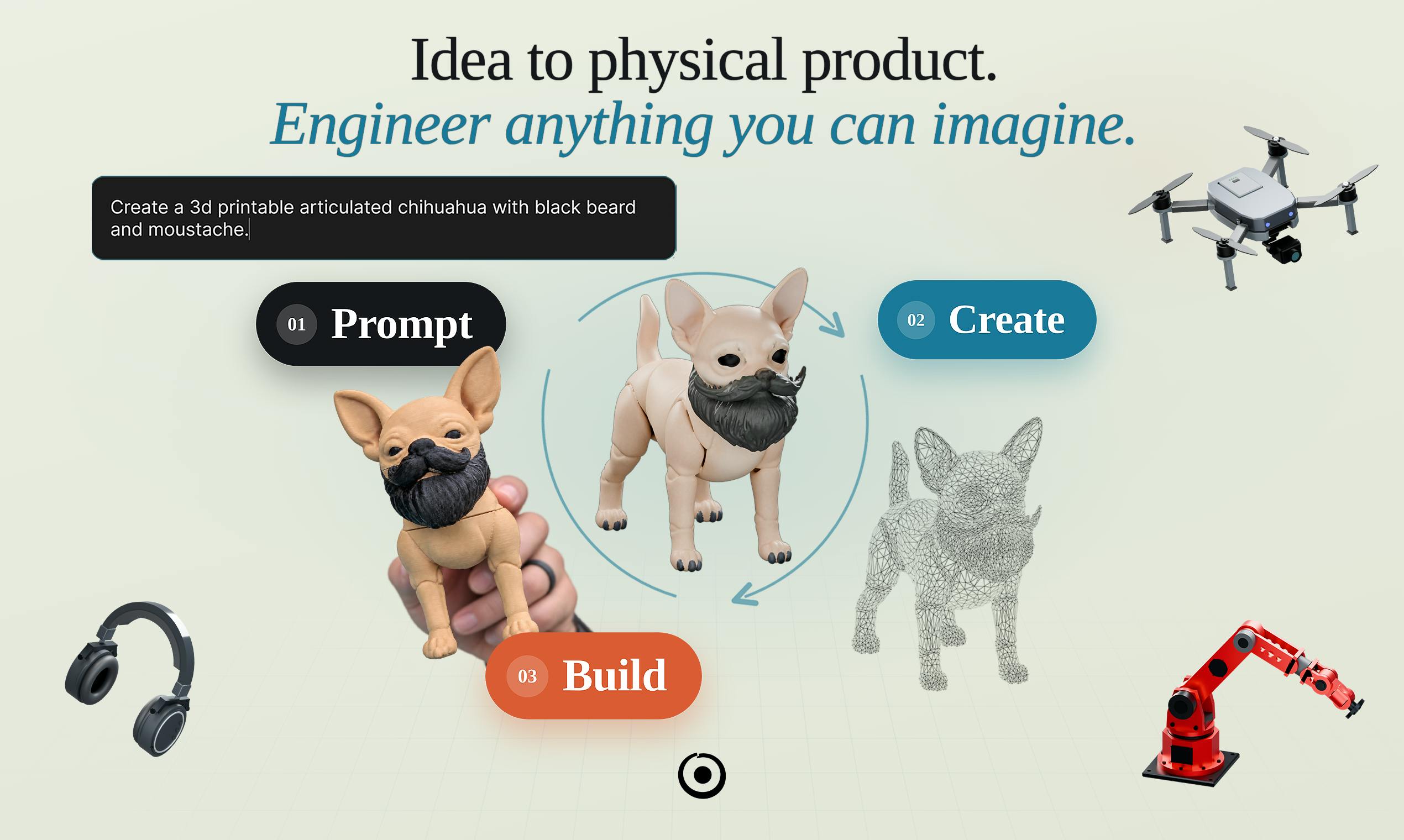
Autonomyware turns product prompts into CAD parts/assemblies and related artifacts such as BOMs, architecture, risk analysis, and manufacturing files. Its claimed differentiator is an in-house exact-geometry kernel plus traceable engineering context. The initial wedge is printable parts and prototypes; the broader vision is an autonomous engineering OS.
Product Hunt showed #6 day rank, 203 points, open-beta language, a 20% launch discount, and examples from sculptures to assemblies; no reviews were visible. Ranking is awareness, not PMF. Explore costs €19.99/month, Create €49.99/month, and enterprise is custom-priced.
Company materials narrow the current scope: the FAQ says it is strongest in mechanical work and cannot produce a complete complex machine in one step. A research note calls the system a proof of concept; legacy-file interpretation remains open. Terms say outputs are untested, may be wrong, and require independent engineering verification before manufacture.
The three Product Hunt makers cite experience in 3D technical art and physical/regulated engineering. An official page credits EU/SNN support for related research; grant amount and equity financing were not found. Final Decision: Watch: revisit after paid repeat use and independent validation of technical reliability.
Product and Customer Problem
Users prompt Forge and inspect/refine geometry; makers say output can be exported, and the library offers STEP examples. However, the FAQ says export options are still expanding out of alpha. Confirm user-generated export availability. The site highlights B-rep, assemblies, BOMs, traceability, and enterprise collaboration.
CAD’s real difficulty is functional geometry, fit, tolerances, and manufacturability—not attractive meshes. Autonomyware targets that gap, but its FAQ limits today’s scope to mechanical parts/assemblies, not one-click complex machines; research says legacy-file interpretation is early. Treat full systems engineering and compliance as unproven until independently demonstrated.
Founder and Team Assessment
Theo cites eight years in 3D/technical art; Vlad and Yannick each cite seven years in physical systems or regulated engineering processes. This mix is relevant, but public evidence does not establish team size, prior shipped products, kernel benchmarks, safety certification expertise, or sales leadership. Verify kernel ownership and independent validation capacity.
Autonomyware B.V. is the Dutch legal operator. It says inputs/outputs are not used for model training, though selected providers process inputs; output ownership is subject to IP law and novelty/third-party-rights are not guaranteed. Its research page credits EU/SNN support, while a detailed note describes a feasibility study submitted for regional funding. Clarify scope/status; neither is evidence of product revenue or equity funding.
Market Opportunity
Autonomyware spans 3D creation, CAD, and systems engineering. A sensible wedge is non-safety-critical parts/prototypes for makers and small hardware teams; editable, coherent geometry could reduce early CAD iteration. Enterprise value from traceability, risk review, and legacy archives depends on proven reliability.
Tripo/Meshy focus on generative 3D assets; Autodesk Fusion and Onshape combine professional CAD workflows with generative or AI-assisted design. Incumbents have formats, simulation, and distribution. Autonomyware’s potential edge is its exact-geometry kernel and product graph, only defensible if independent engineers verify accuracy and assembly reasoning.
At 10× ARR, €1B value implies €100M ARR: about 166,700 full-year Create accounts at €49.99/month, before VAT, churn, discounts, and compute. This is illustrative, not a forecast; no adoption evidence supports a unicorn case.
Traction and Growth Signals
Product Hunt showed #6 and 203 points, with open-beta language and a launch discount. No customer cohort, paid usage, ARR, retention, or enterprise-contract data was public. The model library demonstrates examples, not independently verified manufacturing success; EU/SNN support is research evidence, not commercial traction.
Business Model and Unit Economics
Explore is €19.99/month for 1,000 credits; Create is €49.99 for 2,500 credits and exact-geometry features; Engineer is custom-priced. The site values 1,000 credits at €10, but usage depends on task. No credit-burn, API-cost, margin, conversion, or refund metrics were found.
Terms describe the standard license as single-user and require a separate agreement for team/organizational use, despite team-facing plans. Clarify what €49.99 buyers actually receive. Also determine whether enterprise delivery scales as software or becomes services.
Valuation Assessment
No public round, valuation, ARR, or equity terms were found. Grant support is not equity financing. Open beta and absent customer economics make valuation unsupported; request cap table, grants, IP assignments, runway, and billing evidence.
Key Risks
- Engineering correctness: A visually convincing model may still fail fit, tolerance, load, or manufacturability tests.
- Safety and product liability: Terms place testing, conformity, and safety obligations on customers and advise independent review for safety-critical uses.
- Maturity gap: The broad autonomous-engineering promise exceeds the FAQ’s current scope and the research note’s proof-of-concept description.
- No verified PMF: Product Hunt points and demo outputs do not establish repeat usage, paid retention, or customer ROI.
- Incumbent competition: Autodesk and Onshape can extend established CAD platforms with AI while preserving data, simulation, and team workflows.
- Kernel execution risk: A proprietary geometry kernel is potentially valuable but costly to build, benchmark, and support across edge cases.
- Inference economics: Credit consumption varies by workload; model and compute costs could overwhelm low-priced plans.
- Enterprise sales friction: Compliance, auditability, cybersecurity, and integration requirements may lengthen sales cycles.
- Contract/packaging mismatch: Single-user legal terms may not match team and enterprise pricing descriptions.
- Grant-status ambiguity: Public research references both EU/SNN support and a proposed feasibility study; scope, amount, and status need reconciliation.
- Output/IP exposure: Terms disclaim novelty and third-party-rights guarantees, relevant to designs intended for commercial manufacture.
- Founder/team capacity: Deep CAD, AI, safety validation, and enterprise sales require more disciplines than current public staffing confirms.
Scorecard
| Dimension | Score | Rationale |
|---|---|---|
| Market | 15/20 | Valuable CAD/prototyping and engineering workflow; adoption unproven |
| Traction | 5/20 | Early open beta and launch interest; no verified commercial metrics |
| Team | 11/15 | Complementary self-reported 3D and engineering backgrounds |
| Product | 12/15 | Ambitious exact-geometry workflow with visible scope limits |
| Distribution | 7/15 | Launch, maker-led demos, and library; acquisition engine unproven |
| Business model | 6/10 | Clear tiering and credit meter; economics and team rights unclear |
| Defensibility | 8/10 | In-house kernel could differentiate if validated; substantial execution risk |
| Total | 64/100 | Technical option value, but not yet commercially underwritable |
Evidence Confidence
Medium-low (0.56). Product, pricing, entity, terms, and caveats are first-party; founder claims and launch metrics are not independent validation. Benchmarks, customer references, and financials are absent. Clarify grant status.
Final Assessment
Final Decision: Watch. Monitor the kernel and CAD workflow, but do not underwrite autonomous manufacturing yet. Revisit when a narrow parts/assembly workflow has repeat paying users, verified margins, and independent engineering sign-off.
Upgrade to DD if: independent CAD/engineering tests show reliable editable outputs; paid users repeat monthly and export/manufacture designs successfully; team licenses and IP ownership are clear; and contribution margin is attractive.
Downgrade to Pass if: outputs routinely fail real fit/manufacturing checks, the kernel has no measurable advantage over mainstream CAD, launch signups do not convert, or team usage remains contractually unsupported.
Due-Diligence Questions
- Which founders are full-time, what are their roles, and who owns/created the geometry kernel and related IP?
- What is the current number of registered users, active workspaces, paid subscribers, repeat users, and enterprise pilots?
- What do paid conversion, month-1/3/6 retention, credits consumed per session, refunds, and gross margin look like by plan?
- On a blind benchmark, what percentage of generated parts pass B-rep validity, dimensions, fit, tolerance, and export/import checks in external CAD systems?
- How often do assemblies meet their declared interfaces and manufacturing constraints, and who independently verifies those claims?
- Which current workflows work reliably today versus roadmap—sculpting, mechanical parts, systems architecture, BOM, code, verification, and legacy-CAD interpretation?
- What customer segments have paid, for which jobs, and what alternatives did they replace?
- What exact license does a team buying Create receive, given the standard terms’ single-user restriction?
- What model providers, compute infrastructure, and cost drivers sit behind a credit, and how can customers forecast job cost?
- What EU/SNN grant or feasibility funding has been awarded, in what amount and to which project/entity; what milestones and IP terms apply?
- What product safety, conformity, export-control, and liability processes exist for outputs used in commercial goods?
- What are the current cash runway, financing history, cap table, hiring needs, and milestones for the enterprise tier?
Sources
- Product Hunt launch, maker backgrounds, points/rank, open-beta and launch claims: https://www.producthunt.com/products/autonomyware
- Autonomyware product overview and examples: https://www.autonomyware.ai/
- Autonomyware plans, features, and credits: https://www.autonomyware.ai/pricing
- FAQ on current scope, complex-machine limits, and safety caveat: https://www.autonomyware.ai/faq
- Software Agreement (entity, credits, single-user terms, output ownership and disclaimers): https://www.autonomyware.ai/terms
- Privacy Policy and entity details: https://www.autonomyware.ai/privacy
- Research hub (EU/SNN support reference): https://www.autonomyware.ai/research
- Company engineering note on proof-of-concept scope and limits: https://www.autonomyware.ai/research/product-is-not-shapes
- Autonomyware product library and STEP examples: https://www.autonomyware.ai/library
- Autodesk Fusion generative design: https://help.autodesk.com/view/fusion360/ENU/?contextId=GD-OVERVIEW
- Onshape AI/CAD platform: https://www.onshape.com/en/
- Tripo AI 3D generation: https://www.tripo3d.ai/
- Meshy AI 3D generation: https://www.meshy.ai/