Table of Contents
Orato Investment Report
Category: Consumer AI speech coaching / education
Company Stage: Early commercial product; independently developed
Founder or Founders: Petros Tepoyan
Headquarters: Not publicly disclosed
Funding: Not publicly disclosed; no reliable funding announcement found
Business Model: Freemium consumer subscription with monthly, annual, and lifetime in-app purchases
Product Hunt Launch Date: August 31, 2026
Report Date: September 3, 2026
> Identity note: This report evaluates the Product Hunt product made by Petros Tepoyan and distributed under Apple App Store ID 6765897278. A separate speech-coaching application also uses the Orato name under App Store ID 6740540874 and seller Sumukha Hegde. The overlapping name and category create material brand and legal diligence questions.
| Investment Metric | Assessment |
|---|---|
| Venture Potential | 47/100 |
| Unicorn Path | Improbable |
| Valuation Attractiveness | Not Assessable |
| Evidence Confidence | 52/100 |
| Final Decision | Watch |
Executive Summary
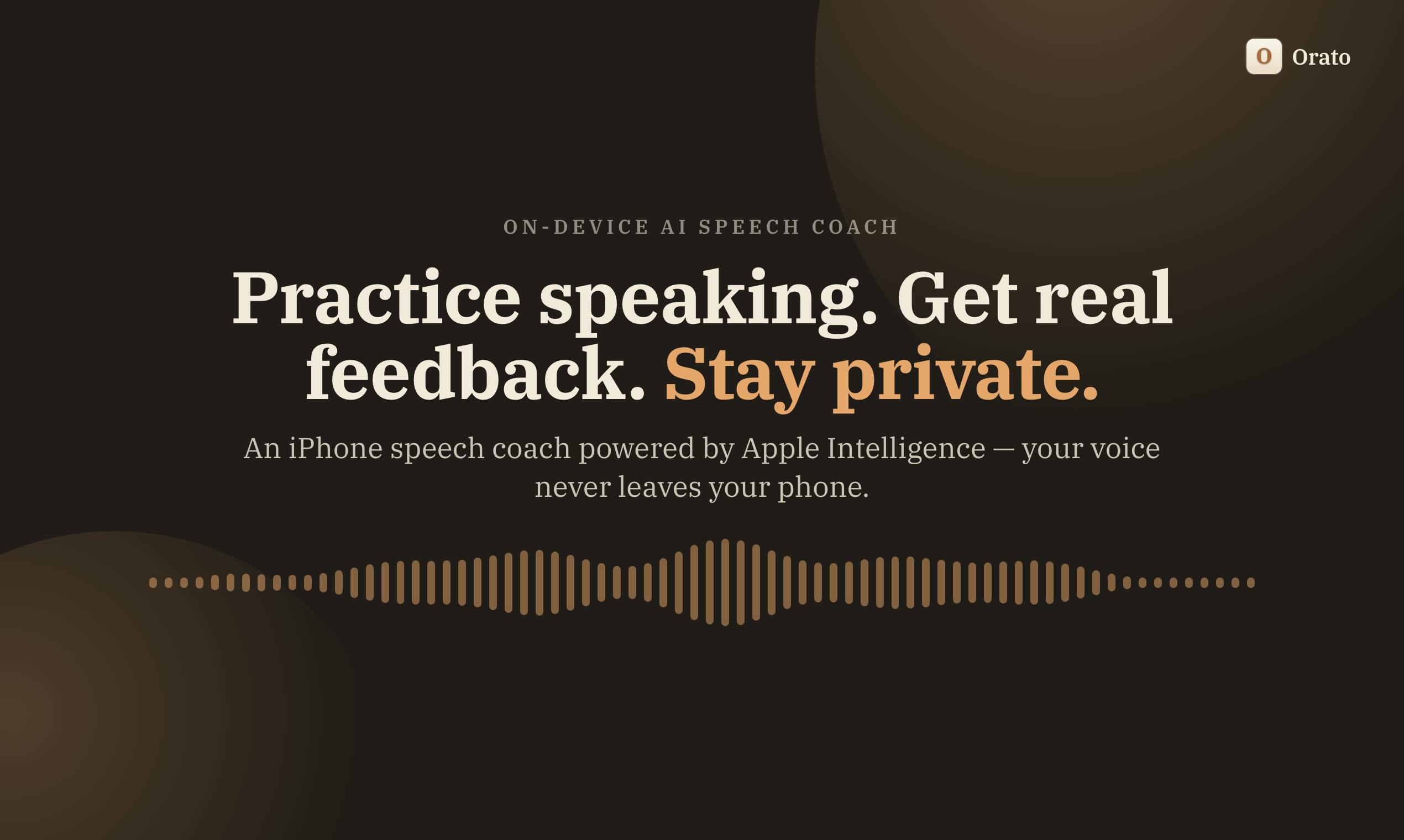
Orato is an iPhone speech-coaching application that gives users short speaking drills and feedback on pacing, fluency, filler words, vocabulary, clarity, and coherence. Its six modes cover impromptu speaking, debate, interview questions, storytelling, elevator pitches, and reading aloud. The product is aimed at professionals, job seekers, founders, students, Toastmasters, and English learners (official website, App Store).
The product’s strongest feature is privacy-preserving, on-device processing. On supported iPhones, transcription and coaching use Apple’s local speech-recognition and intelligence capabilities, allowing sessions to operate without uploading audio. Optional cloud coaching sends transcript text—not audio—through a Cloudflare Worker to OpenAI (privacy policy). This is meaningful product differentiation in a category involving sensitive voice recordings.
The strongest company signal is rapid product execution by a founder with relevant iOS engineering experience. Version 2.1 added topic packs, comparison of repeated attempts, weekly reviews, sharing, and 16 interface languages shortly after the Product Hunt launch. However, these releases demonstrate development velocity rather than commercial traction.
The primary investment concern is the almost complete absence of verified business metrics. Revenue, paid subscribers, retention, downloads, conversion, customer-acquisition cost, and founder commitment are unknown. The US App Store did not yet show enough ratings for an aggregate score. Product Hunt launch attention—approximately 133 upvotes in a third-party snapshot and a daily leaderboard position around eighth—does not compensate for this missing commercial evidence (Product Hunt, leaderboard).
The product could become a useful, profitable consumer application, but its current $17.99 annual price and iPhone-only distribution imply that venture-scale revenue would require millions of paying subscribers. Enterprise communication training, education licensing, or a broader cross-platform coaching platform could improve the economics, but none is currently verified. The appropriate decision is Watch pending evidence of retention, paid conversion, distribution, brand ownership, and founder commitment.
Product Overview
Public-speaking improvement typically involves human coaching, group programs such as Toastmasters, recording oneself without structured feedback, or using competing AI coaching software. Orato compresses this workflow into repeated 30–90 second exercises with immediate feedback.
The product offers:
- Six structured speaking drills.
- Detection of filler words and extended pauses.
- Scores for pacing, fluency, vocabulary, clarity, and coherence.
- Timestamped, read-along transcripts.
- Three actionable coaching recommendations after a session.
- Practice history, streaks, reminders, and two-week progress views.
- Topic packs for interviews, pitches, toasts, and other scenarios.
- Side-by-side comparison of repeated attempts.
- Support for 16 interface languages (App Store).
The free plan includes three coached sessions every seven days. US App Store prices are $1.99 monthly, $17.99 annually, or $59.99 lifetime. Pro removes session limits; the App Store listing also advertises a seven-day trial.
Orato is available only on iPhone and requires iOS 18. Its complete on-device coaching experience depends on Apple Intelligence-compatible hardware. Older supported devices may use an opt-in cloud path for transcript analysis. No Android, web, team dashboard, or enterprise product was found for this specific Orato application.
Product Quality Assessment: Strong early implementation and unusually clear privacy design, but effectiveness has not been validated through independent testing, substantial reviews, or longitudinal user outcomes.
Founder and Team Assessment
Product Hunt and the App Store identify Petros Tepoyan as the maker and seller. His public LinkedIn profile describes him as a senior iOS engineer at Alfa-Bank, with earlier iOS experience and education at the American University of Armenia (LinkedIn). The profile supports relevant mobile engineering capability but does not establish full-time commitment to Orato.
Apple lists several other applications under Tepoyan’s developer account, including Papaya and Memorio, indicating repeated mobile-product execution rather than a first application (Apple developer page). His public GitHub profile contains 39 repositories, although Orato’s production source code is not public and the repositories do not independently demonstrate commercial traction.
No co-founders, employees, advisers, hiring activity, legal entity, or institutional investors were identified. This appears to be a solo or very small independent product, although team size is not verified. A solo developer can operate a consumer application efficiently, but product, support, marketing, compliance, and continuity are concentrated in one person.
Founder Assessment: Relevant mobile engineering capability is evident, but full-time commitment, commercial experience, and the supporting team remain unverified.
Market Opportunity
The narrow initial segment is English-speaking iPhone owners actively preparing for presentations, interviews, pitches, meetings, debates, or speeches. These users have episodic but meaningful anxiety and may pay for private practice before a high-stakes event.
Competitor pricing demonstrates willingness to pay: Yoodli charges $8–$20 per month on annual plans, Orai advertises approximately $49.99 annually, Speeko advertises roughly $100 annually, and Poised charges $13 monthly when billed annually. Orato’s $17.99 annual price is therefore inexpensive, which may assist conversion but restrict revenue per subscriber.
An illustrative bottom-up market—not a verified company forecast—is:
- 3–5 million reachable iPhone users with recurring interest in structured speaking practice;
- 3%–5% paid conversion;
- $17.99 gross annual subscription price;
- approximately $1.6 million–$4.5 million gross annual subscription revenue.
A broader scenario with one million annual subscribers would generate about $18 million gross revenue before App Store fees, taxes, refunds, and discounts. This could support a meaningful company but remains well below typical unicorn-scale revenue.
Expansion opportunities include Android and web applications, interview coaching, language-specific delivery coaching, manager and sales training, school licensing, team analytics, live roleplay, and enterprise communication programs. Enterprise and education distribution are likely more important to venture scale than the existing consumer subscription alone.
Traction and Growth Signals
Available signals include:
- Product Hunt launch on August 31, 2026, with the official daily leaderboard placing Orato approximately eighth.
- A third-party Product Hunt archive reported approximately 133 upvotes. This is launch attention, not evidence of retention or revenue.
- The Product Hunt page showed roughly 155–156 followers in indexed results, but follower count should not be confused with votes or active users.
- The US App Store stated that the application had not received enough ratings or reviews to display an aggregate score.
- Version 2.1 was released around August 31, adding topic packs, repeat-attempt comparison, weekly reviews, sharing, and localization.
- The founder has published multiple applications, demonstrating shipping capability.
- No verified figures were found for downloads, active users, paying users, revenue, conversion, churn, engagement frequency, or organic growth.
- No customer case studies, enterprise contracts, partnerships, hiring, or financing were identified.
A separate Orato application claims 35,000 users and a 4.8 rating at getorato.com, but those figures belong to the product sold by Sumukha Hegde—not the Product Hunt application evaluated here. They must not be attributed to Tepoyan’s Orato.
Traction Assessment: Active product development is evident, but commercial traction is unverified.
Competitive Position
Direct competitors include Yoodli, Orai, Speeko, Poised, and VirtualSpeech. Indirect alternatives include human communication coaches, Toastmasters, interview-preparation platforms, voice-recording applications, and general AI assistants that can review transcripts. Apple could also extend its system-level intelligence and transcription tools into communication feedback.
Orato’s principal advantages are:
- No account required on compatible devices.
- Audio remains on the device.
- Offline operation.
- Very low subscription price.
- Short, habit-oriented exercises.
- Low marginal AI cost when processing runs locally.
Its disadvantages are a narrow hardware footprint, no team product, minimal distribution evidence, no demonstrated proprietary dataset, and limited switching costs. Progress history is stored locally, making the application privacy-friendly but potentially reducing data-based personalization and customer lock-in.
“If the largest platform in this market launched the same feature within six months, why would customers continue using this product?” Current answers are interface quality, privacy, habit formation, and specialized drills. These are useful but not yet durable. A stronger answer would require proprietary assessment quality, demonstrably better outcomes, a recognized coaching brand, or institutional distribution.
The existence of another AI speech coach using the identical Orato name is an additional weakness. It may create search confusion, App Store confusion, trademark disputes, and inefficient brand spending.
Defensibility Assessment: Low
Business Model and Economics
Orato uses a consumer freemium model. Free users receive three weekly sessions; paid users receive unlimited access. The $59.99 lifetime option generates immediate cash but introduces an indefinite support obligation and weakens recurring-revenue quality.
On-device processing should produce favorable inference economics for compatible devices. Variable cloud expense applies primarily when transcript text is optionally sent through Cloudflare and OpenAI. Exact inference cost, cloud usage rate, and daily limits are not publicly disclosed.
Apple controls billing and distribution. Standard App Store commissions can be 30%, while qualifying developers in Apple’s Small Business Program may pay 15% (Apple). Consequently, Orato’s $17.99 annual plan could produce approximately $12.59–$15.29 in developer proceeds before taxes, refunds, support, and other operating expenses.
Customer acquisition is the more important economic risk. At such low annual revenue per subscriber, paid advertising may be uneconomic unless retention is high, acquisition is predominantly organic, or users upgrade to higher-value services. Expansion into teams or professional coaching could raise annual contract value but would also require sales, administration, security, and support capabilities.
Unicorn Path
A 5× net-revenue multiple is assumed. This is more generous than a mature, slow-growth consumer subscription multiple but reflects the possibility of strong software margins. Platform dependence and likely consumer churn prevent using a premium enterprise-SaaS multiple.
Required net annual revenue:
$1 billion ÷ 5 = $200 million
At current pricing:
- Annual plan: $17.99 gross; approximately $12.59–$15.29 after a 15%–30% App Store commission.
- Required annual subscribers: approximately 13.1–15.9 million.
- Monthly plan: $23.88 gross annually; approximately $16.72–$20.30 after commission.
- Required continuously retained monthly subscribers: approximately 9.9–12.0 million.
These calculations exclude taxes, refunds, discounting, cloud costs, and customer support. The lifetime plan cannot support a recurring-revenue valuation without continuous new sales.
Orato would need cross-platform availability, materially higher pricing, team and enterprise contracts, proprietary coaching models or outcome data, and repeatable global distribution. Even at a hypothetical $100 enterprise seat price per year, two million paid seats would be required for $200 million revenue.
Unicorn Path: Improbable
Valuation Assessment
No verified funding round, investors, SAFE cap, valuation, acquisition offer, or current fundraising process was identified. Revenue and growth are also unknown.
Valuation Attractiveness: Not Assessable
A responsible assessment requires current revenue, paid subscribers, subscription mix, retention cohorts, gross proceeds after Apple fees, cloud costs, founder ownership, burn, runway, round size, valuation cap, and investment terms.
Key Risks
- No commercial validation: Revenue, paid conversion, retention, and usage frequency are unknown.
- Name collision: Another active AI speech-coaching product uses the Orato name and has an earlier App Store listing.
- Weak distribution: No evidence yet of repeatable acquisition outside Product Hunt.
- Low revenue per customer: The $17.99 annual plan leaves limited room for paid acquisition.
- Low defensibility: Core speech metrics and transcript analysis are widely replicable.
- Apple dependency: Distribution, billing, hardware support, commissions, and on-device capabilities depend on Apple.
- Founder concentration: Product development and continuity appear dependent on one maker.
- Episodic demand: Users may subscribe before an interview or presentation and then churn.
- Outcome uncertainty: No independent evidence demonstrates lasting communication improvement.
- Cloud privacy risk: Optional transcript processing introduces third-party processors despite the broader privacy positioning.
Final Assessment
Venture Potential: 47/100
| Category | Score |
|---|---|
| Market Size and Expansion Potential | 12/20 |
| Traction and Growth Evidence | 4/20 |
| Founder and Team | 8/15 |
| Product Strength | 8/10 |
| Distribution Potential | 5/15 |
| Business Model and Economics | 6/10 |
| Defensibility | 4/10 |
| Total | 47/100 |
The strongest elements are product execution, privacy, low inference costs, and founder-mobile fit. The weakest are traction, distribution, defensibility, low pricing, solo-founder exposure, and the conflicting brand identity.
Evidence Confidence: 52/100
The product, seller, pricing, features, privacy design, platform requirements, Product Hunt date, and founder’s public engineering profile are verifiable. Product Hunt voting is available only through a secondary snapshot, while the App Store has insufficient reviews.
Revenue, users, downloads, retention, funding, team size, legal entity, founder commitment, unit economics, and valuation are unavailable. Confusion with a separate Orato product materially reduces confidence.
Final Decision: Watch
Orato is a promising application but currently fits the profile of an early independent consumer product rather than a verified venture-scale company. Product quality is stronger than the investment case. Formal due diligence would become appropriate only after evidence of retention, organic acquisition, meaningful recurring revenue, and a credible expansion beyond low-priced individual subscriptions.
Upgrade Conditions
- At least $25,000–$50,000 MRR with verified subscription data.
- More than 60% six-month subscriber retention.
- At least 100,000 monthly active users with sustained growth.
- Repeatable organic acquisition independent of Product Hunt.
- Android or web expansion without weakening the privacy proposition.
- Team or education contracts producing materially higher annual revenue per customer.
- Resolution of naming and trademark risks.
- Demonstrated founder full-time commitment and additional product or growth capacity.
Downgrade Conditions
- Weak free-to-paid conversion or rapid post-event churn.
- Continued absence of App Store reviews and organic adoption.
- Trademark or App Store action arising from the duplicate Orato name.
- Apple launching closely comparable native coaching functionality.
- Cloud inference or support costs exceeding subscription proceeds.
- Reduced development cadence or evidence that Orato is one of several non-core side projects.
- Misleading privacy, traction, or performance claims.
Questions for Further Diligence
- What are current MRR, total subscription revenue, and monthly growth?
- How many monthly, annual, and lifetime customers are active?
- What are free-to-paid conversion and 30-, 90-, and 180-day retention?
- How many users complete at least three sessions per week?
- What proportion of sessions use on-device versus cloud coaching?
- What are cloud and support costs per active free and paid user?
- Which channels generated installs after the Product Hunt launch?
- Is Petros working full-time on Orato, and who else contributes?
- Has a trademark search been completed given the competing Orato speech-coaching app?
- What evidence shows that scores and coaching improve real-world speaking outcomes?
- Is there a roadmap for Android, web, education, or enterprise distribution?
- What are the legal entity, cap table, current financing terms, burn, and runway?
Sources
- Product Hunt — Orato
- Product Hunt daily leaderboard — August 31, 2026
- Official product website
- Apple App Store — target Orato application
- Official privacy policy
- Official support and product requirements
- Petros Tepoyan — LinkedIn
- Petros Tepoyan — GitHub
- Petros Tepoyan — Apple developer page
- Separate Orato product creating the name conflict
- Yoodli pricing
- Orai pricing
- Apple App Store Small Business Program