
Table of Contents
Velozity Investment Report
Category: Team collaboration and AI workflow automation
Company Stage: Bootstrapped, per founder; public product with free and paid tiers
Founder or Founders: Ishu Darshan (co-founder) and Akash Mandal (CTO/maker)
Headquarters: Not publicly disclosed; founder lists Bengaluru, India
Funding: No external round verified; founder described the team as bootstrapped
Business Model: Freemium workspace with per-user modules and usage limits
Product Hunt Launch Date: 2026/10/07
Report Date: 2026-10-10
| Investment Metric | Assessment |
|---|---|
| Venture Potential | 64/100 |
| Unicorn Path | Conditional |
| Valuation Attractiveness | Not Assessable |
| Evidence Confidence | 53/100 |
| Final Decision | DD |
Executive Summary
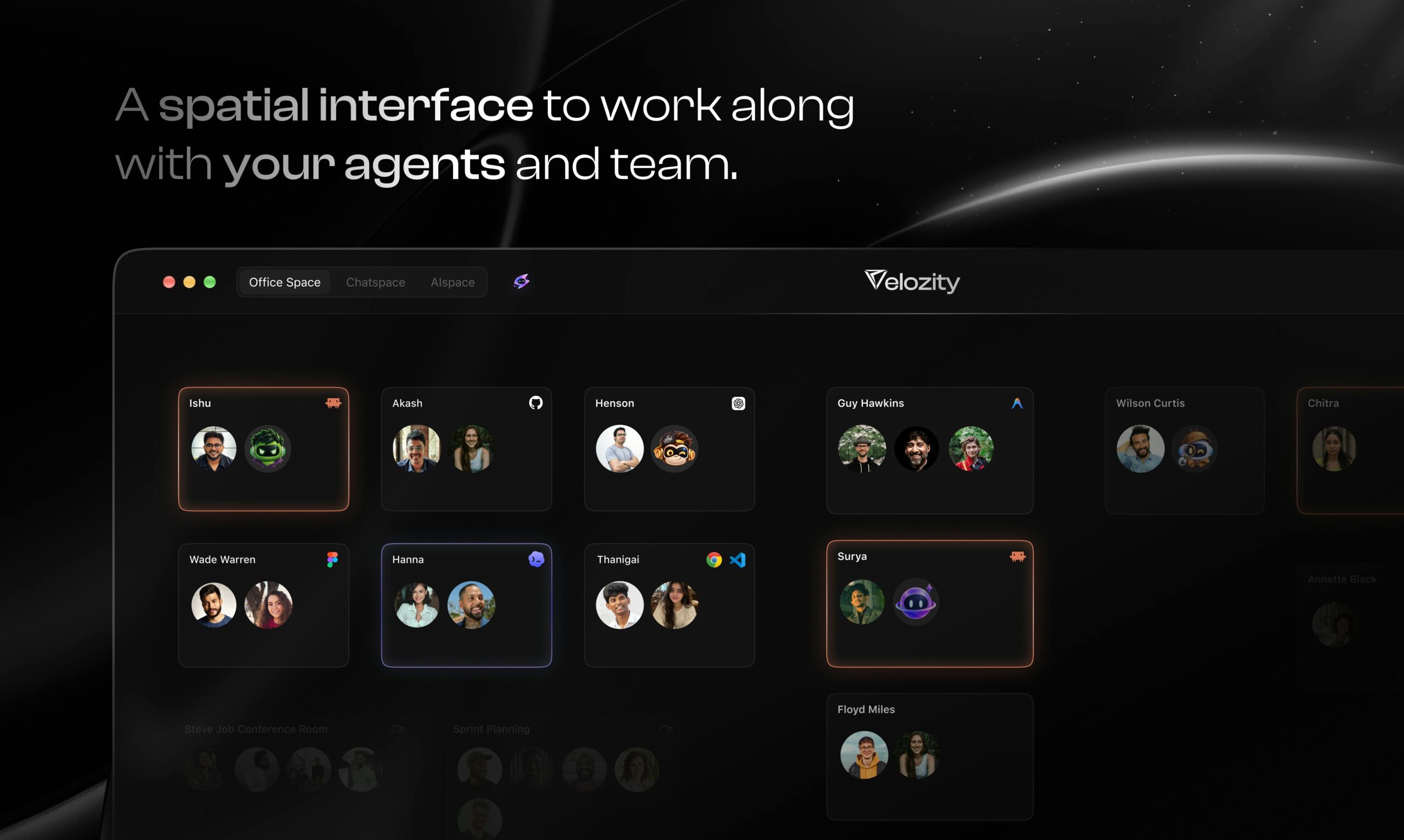
This report assesses the product at the supplied URL: Velozity, “The Multiplayer AI Office where your team and agents work.” It combines chat, calls, transcripts, tasks, calendar, files, integrations, and AI agents in shared project Spaces. Its thesis is that teams should share context with agents instead of isolating AI work in individual chats. This listing is different from an older Product Hunt product for AI user research; its activity should not be conflated.
The current Product Hunt page showed 460 upvote points and a #3 daily rank. The company offers a free workspace and paid modules: Workspace Pro $6.99, AI Space Pro $7.99, and Co-Worker Pro $15 per user monthly. Launch votes show attention, not adoption or retention. Product Hunt · Pricing
The web product, Android listing, published prices, and active founder responses provide credible signs of shipping. Darshan has said Velozity had early paying customers and 20% monthly growth, and described a seven-person bootstrapped team. These are founder claims without revenue, period, baseline, or cohort data; the growth claim may predate the current AI office.
A successful shared-agent workspace could reduce coordination friction. Yet the product enters a crowded market and has enterprise governance questions: makers say there are no per-file permissions within a Space, while Google Play’s developer disclosure says data cannot be deleted. Decision: DD. The product merits focused diligence, but investability depends on verifying current paid use, retention, security, data deletion, and margins.
Product Overview
Velozity offers a virtual office with chat, audio/video, meetings and transcription, tasks, calendar, files, and shared AI agents. Its “Speed” agent can search connected sources, create briefs and tasks, and prepare actions. The company says it supports more than 100 integrations and can use existing AI subscriptions; verify coverage and quality in a demo. Official site
The Android app and web workspace are available. Free tiers limit actionables, transcription, AI credits, and missions. Paid modules are listed at $6.99, $7.99, and $15 per user monthly. The product aims to replace parts of Slack, Zoom, Notion, and task tools while adding shared agent context. Published prices do not establish paid conversion.
Founder and Team Assessment
Product Hunt identifies Ishu Darshan as co-founder and Akash Mandal as CTO. Darshan’s LinkedIn says he co-founded Growhut, a consulting studio, and describes Velozity as bootstrapped with seven core team members. Independent founder histories, full-time commitment, prior exits, and commercial experience are not established. Darshan profile · Product Hunt maker discussion
Darshan has discussed a shift from a general collaboration workspace toward a shared AI office, showing active iteration but making earlier traction harder to compare with the current product. Founder Assessment: Active product leadership is visible; operating history and current commercial results need independent verification.
Market Opportunity
The initial buyer is a remote-first startup, software company, or digital agency with roughly 5–100 people coordinating across meetings, chat, docs, tasks, and AI tools. The pain is fragmented context and follow-up work. Buyers may pay if Velozity replaces licenses and improves execution.
A scenario, not a measured TAM: 100,000 teams averaging 20 paid seats at an assumed $15 per seat monthly would imply $360 million annual revenue potential. Customer count and blended price are assumptions. Larger accounts and international reach expand the market but require stronger security, administration, migration, and compliance. Existing collaboration suites make willingness to switch the key question.
Traction and Growth Signals
The Product Hunt page showed 460 points and a #3 rank; its 1.1K followers are an audience signal, not active users. The Android listing was updated September 17, 2026, and the official site publishes user testimonials. Those quotes and advertised savings are company-selected, without independent methodology. Google Play
Darshan’s claim of early paying customers and 20% month-over-month growth lacks a baseline, date range, and revenue definition, and may relate to a prior version. No verified ARR, customer count, retention, conversion, or unit economics are public. Traction Assessment: A live product and founder-reported sales merit checking, but current-product traction is unverified.
Competitive Position
Competitors include Slack, Microsoft Teams, Google Workspace, Zoom, Notion, ClickUp, and agents embedded in major AI platforms. Free or bundled tools can cover much of the collaboration stack.
Velozity’s proposed edge is a shared context layer for people and agents, with human approval before external actions. Its makers say files in a Space are visible to all members and their agents, while personal email/calendar access remains scoped to each user; there are no per-file permissions today. That model is simple but may fail enterprise access requirements. Product Hunt governance discussion
If Microsoft or Slack adds shared agent context, Velozity must show better task follow-through, cross-tool context, or lower total cost to justify migration. Network effects and switching costs remain unproven.
Defensibility Assessment: Low to Medium
Business Model and Economics
Free seats funnel users toward paid Workspace, AI Space, and Co-Worker modules. Buying all three at listed prices would be $29.98 per user monthly, but attach rates, packaging, discounts, and realized revenue are unknown. Existing AI subscriptions may reduce model expense, while the built-in agent, transcription, and cloud services still cost money.
Gross margin, model and transcription cost per seat, conversion, churn, CAC, and support burden are undisclosed. Low seat pricing favors self-serve growth; larger accounts require governance and admin features. Claims of replacing multiple tools should be tested against actual customer spend.
Unicorn Path
At an illustrative 10× ARR multiple, a $1 billion valuation requires $100 million ARR. At an assumed blended $15 monthly per seat, that is about 556,000 paid seats; at $30, about 278,000. These are scenarios, not forecasts. Scale would require durable team retention, broad distribution, module expansion, and measurable replacement of existing tools. This path is Conditional on proving per-seat value and moving beyond early adopters.
Valuation Assessment
No external funding round, investor, or valuation was verified. The founder has called the company bootstrapped. Revenue, burn, runway, ownership, and fundraising status remain unknown. Valuation Attractiveness: Not Assessable. Request ARR, growth, retention, gross margin, CAC, runway, cap table, and current round terms before assessing price.
Key Risks
- Teams may not migrate from established bundled suites.
- Lack of per-file permissions may block enterprise adoption.
- Google Play says users cannot request data deletion; actual retention needs clarification.
- Agent features may not improve execution enough to justify a new subscription.
- A broad product surface increases reliability and support costs.
- Founder-reported growth may predate the current product.
- Model and transcription costs may pressure margins.
- Dependence on external AI subscriptions and integrations creates platform risk.
Final Assessment
Venture Potential: 64/100
| Category | Score |
|---|---|
| Market Size and Expansion Potential | 15/20 |
| Traction and Growth Evidence | 10/20 |
| Founder and Team | 9/15 |
| Product Strength | 8/10 |
| Distribution Potential | 8/15 |
| Business Model and Economics | 8/10 |
| Defensibility | 6/10 |
| Total | 64/100 |
The product has a clear shared-agent thesis, shipped collaboration features, and accessible pricing. Its largest gaps are verified current-product demand, enterprise governance, and differentiation from suites customers already use.
Evidence Confidence: 53/100
Product features, public prices, the Android listing, and Product Hunt activity are verifiable. Founder identity and growth are self-reported; testimonials are company-selected. Revenue, retention, margins, financing, valuation, and security audit results are unavailable. Market calculations are explicit scenarios.
Final Decision: DD
Request a focused data room and customer references. Confirm the early paid users and growth apply to this version, and resolve data deletion and access controls before an investment case.
Upgrade Conditions
- Verify paid customers, ARR growth, and six-month seat retention for the current product.
- Show repeat agent use and measurable task completion gains.
- Provide data deletion, security testing, audit controls, and a file-permission roadmap.
- Demonstrate healthy margins and a repeatable acquisition channel.
Downgrade Conditions
- Weak paid conversion or rapid churn.
- Inability to delete data or meet customer security requirements.
- Cross-Space access or approval failures.
- Growth claims cannot be reconciled to billing and cohort records.
Questions for Further Diligence
- How many paid companies and seats use the current AI Office, and what are ARR and monthly growth?
- Does the 20% monthly-growth claim apply to this version; what were the period and baseline?
- What are conversion, 30/90/180-day retention, and expansion rates by module?
- What are gross margins after model, transcription, cloud, and support costs?
- What data can users delete, and what does Google Play’s “data can’t be deleted” disclosure mean?
- When will per-file permissions, SSO, audit export, and data residency be available?
- How are agent permissions scoped and actions logged across Spaces and integrations?
- What are CAC, channel payback, current burn, runway, cap table, and fundraising plans?