
Table of Contents
Samepage Artifacts Investment Report
Category: AI-native product-management intelligence and collaborative writing SaaS
Company Stage: Early-stage, venture-backed
Founder or Founders: Sahil Jain, Jason Wu, and Paul Wicker
Headquarters: San Francisco, California, United States
Funding: $4.85 million from Craft Ventures, Freestyle VC, Glasswing Ventures, and angel investors including Justin Kan and Matt Mullenweg
Business Model: Freemium, per-seat SaaS subscription
Product Hunt Launch Date: August 17, 2026
Report Date: August 20, 2026
| Investment Metric | Assessment |
|---|---|
| Venture Potential | 68/100 |
| Unicorn Path | Conditional |
| Valuation Attractiveness | Not Assessable |
| Evidence Confidence | 64/100 |
| Final Decision | DD |
Executive Summary
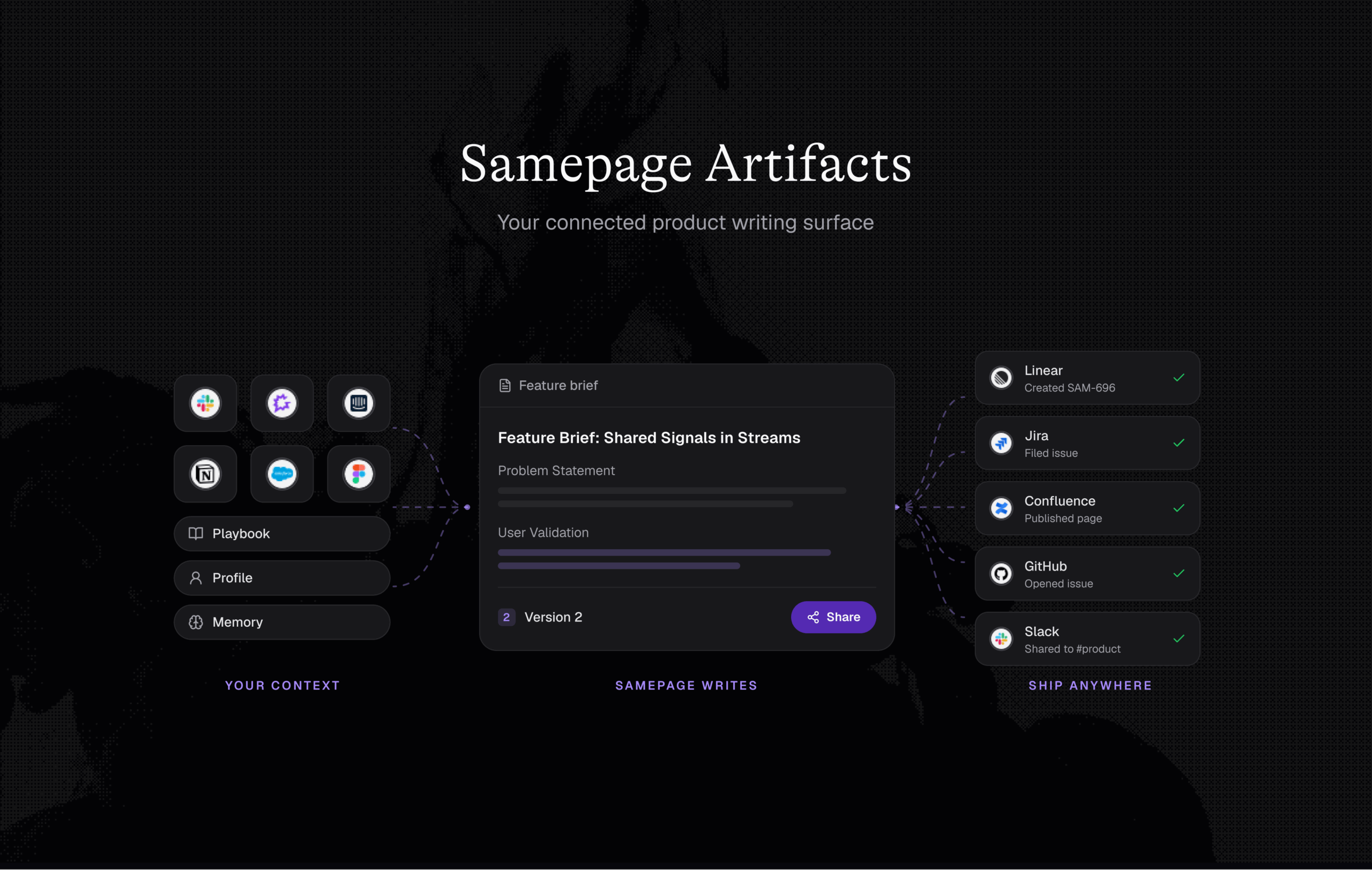
Samepage Artifacts is a context-aware writing environment for product teams. It uses information collected by Samepage Signals from tools such as Jira, Linear, Slack, Notion, Gong, Salesforce, Productboard, and GitHub to draft product requirements documents, feature requests, release notes, bug tickets, status updates, and related product documentation. Users can edit drafts collaboratively and publish them back into operational systems such as Jira, Asana, Confluence, GitHub, Slack, and email (Artifacts product page; launch announcement).
The product addresses a recognizable workflow problem: product managers repeatedly gather fragmented customer, engineering, sales, and roadmap context before writing documents that restate much of the same information. Samepage’s combination of proactive Signals, context-aware drafting, and bidirectional workflow integrations is more useful than an isolated AI text generator. The product nevertheless overlaps substantially with Productboard Spark, Atlassian Rovo and Jira Product Discovery, Linear’s AI workflows, Notion AI, and general-purpose tools such as Claude and ChatGPT.
The strongest investment signal is the founding team. The three founders report working together for more than a decade and previously built AdStage, which was acquired by TapClicks in 2020. TapClicks independently confirms the acquisition and identifies Sahil Jain and Jason Wu as AdStage’s co-founders and incoming operating executives (TapClicks). The founders therefore bring prior B2B SaaS experience, integration expertise, venture fundraising history, and an exit—unusually strong team evidence for a company at this stage.
The main investment concern is missing commercial validation. Samepage says it tested Signals with hundreds of product leaders, but no revenue, paying-customer count, retention, conversion, product usage, enterprise contracts, or customer case studies are publicly disclosed (funding and launch announcement). At $15 per month for an individual and $25 per user per month for teams, the current pricing implies that Samepage must achieve significant seat volume or introduce higher-value enterprise contracts to support a unicorn outcome (pricing).
The decision is DD rather than Invest. Samepage has a credible repeat-founder team, institutional funding, a functional product, transparent self-service pricing, and a potentially expandable product-intelligence platform. Formal diligence is warranted, but investment cannot be recommended without verifying revenue, retention, enterprise security readiness, gross margin, current financing terms, and whether cross-system context creates sustained differentiation.
Product Overview
Product managers commonly collect feedback and decisions from meetings, customer conversations, tickets, analytics, roadmaps, and internal messages before producing PRDs, release notes, feature briefs, and status reports. The manual alternative is to search each source, copy relevant material into Notion or Google Docs, prompt a general-purpose AI assistant, and then recreate the final output in Jira, Linear, Confluence, or another system.
Samepage first connects to organizational data and generates “Signals”—proactive summaries or findings judged relevant to a product leader. Artifacts converts those Signals into editable documents using the organization’s existing product context. The editor supports inline AI rewriting, a Copilot side panel, research across connected sources, image generation, version history, public sharing, and publication into downstream tools (official launch article).
Samepage reports more than 35 data-source integrations, including Jira, Linear, Productboard, Slack, Notion, Gong, and Salesforce (company announcement). Artifacts is available as part of the browser-based Samepage workspace; no dedicated App Store or Google Play application was identified.
Pricing is transparent:
- Free: One user, three data sources, 50 Signals and 15 artifact generations per month.
- Pro: $15 per month, billed annually, with unlimited data sources, 500 Signals and 150 artifact generations.
- Teams: $25 per user per month, billed annually, with a two-user minimum, shared Streams, permissions, collaboration, and per-seat Pro allowances.
All tiers include bounded AI usage, which should reduce uncontrolled inference expense. The primary customer benefit is not generic writing assistance, but reducing the time required to reconstruct context before writing and distributing product documents.
Product Quality Assessment: Coherent workflow and useful integration strategy, but output accuracy, time savings, and sustained user engagement remain unverified.
Founder and Team Assessment
Samepage identifies Sahil Jain as CEO, Jason Wu as CTO, and Paul Wicker as CPO. The company says the founders spent more than a decade building B2B software together, including eight years at AdStage (Samepage About).
TapClicks confirms that it acquired AdStage in April 2020 and incorporated its team and technology. Jain joined TapClicks as general manager of marketing intelligence, while Wu joined as vice president of engineering for that business. AdStage had raised more than $15 million, according to the acquisition announcement; the acquisition price was not disclosed (TapClicks).
This history supports founder-market fit. The current problem—aggregating data from multiple SaaS systems and converting it into operational intelligence—resembles AdStage’s work integrating and normalizing fragmented marketing data. Jain provides fundraising and commercial experience, Wu has demonstrated integration and engineering leadership, and Wicker brings product and go-to-market experience, according to company materials.
LinkedIn lists Samepage as founded in 2023, headquartered in San Francisco, with five associated employees and a size range of 2–10. LinkedIn headcount should be treated as directional rather than definitive (LinkedIn company profile). No reliable public hiring plan or detailed organization chart was found. The small team creates key-person risk but also indicates capital efficiency if the product is already operational.
Founder Assessment: Strong repeat-founder and technical-commercial execution history; current team depth and scaling capacity require verification.
Market Opportunity
The initial customer is a product manager or product-operations team at a software or digitally enabled company using several product, engineering, CRM, support, and collaboration systems. The economic buyer may be a head of product, chief product officer, or product-operations leader.
A bottom-up scenario can be constructed, but the inputs are analyst assumptions rather than verified market figures. If Samepage can address approximately 25,000–100,000 organizations, with an average of 5–20 paid product seats at the current Teams price of $300 per seat annually, the theoretical seat-based opportunity is:
25,000–100,000 organizations × 5–20 seats × $300 = approximately $37.5 million–$600 million annually.
The lower end would support a meaningful SaaS company but not necessarily a large venture outcome. The upper end requires broad international adoption, high penetration among product teams, and limited displacement by incumbent platforms.
Expansion opportunities include enterprise-wide product intelligence, customer-feedback analysis, engineering and go-to-market alignment, competitive monitoring, product-repository search, automated workflow execution, and MCP/API access. Enterprise security, governance, analytics, and administrative features could lift annual contract value materially above the current self-service pricing.
Market timing is favorable because product information is increasingly fragmented while AI reduces the cost of drafting and summarization. However, the same technology shift makes basic context-aware writing easier for established collaboration and product-management vendors to reproduce.
Traction and Growth Signals
Samepage launched Signals publicly in June 2026 and Artifacts on Product Hunt on August 17, 2026. A secondary Product Hunt tracker recorded Artifacts at approximately #9 for the day and #11 for the week; another secondary snapshot showed approximately 104 votes. These figures should be treated only as launch-interest indicators because the primary Product Hunt page did not expose stable statistics during research (Product Hunt; Launly, secondary source).
The company reports that Signals was tested in beta by “hundreds of product leaders.” This is a company-reported usage claim, not an independently verified customer or paid-user figure (Samepage funding announcement). Samepage’s launch cadence—Signals in June, Artifacts in August, plus a product-management MCP—indicates active product development.
The $4.85 million financing from established venture firms is a positive external signal about the team and opportunity, but funding is not customer traction. No verified ARR, growth rate, paying organizations, free-to-paid conversion, cohort retention, weekly active usage, generated-document volume, or case-study outcomes were found. Product Hunt currently reports no substantive product reviews, and no meaningful independent Reddit or Hacker News evaluation was identified.
Traction Assessment: Active product execution and credible pre-launch testing, but commercial traction remains unverified.
Competitive Position
Direct competitors include Productboard Spark, Dovetail, Zeda.io, and other AI product-intelligence platforms. Adjacent competitors include Jira Product Discovery with Rovo, Linear’s product-intelligence workflows, Notion AI enterprise search, Coda AI, and general-purpose Claude or ChatGPT workspaces. Manual alternatives include searching Slack, Gong, Jira, and customer-feedback repositories before drafting in Notion or Google Docs.
Productboard Spark can already use workspace documents, customer feedback, product data, and connected integrations to produce context-aware responses (Productboard). Jira Product Discovery uses AI to organize, surface, summarize, and transform product content (Atlassian). Linear also converts conversations and feedback into structured product issues (Linear).
Samepage’s current differentiation is cross-platform neutrality: it aims to understand information across multiple systems rather than requiring customers to consolidate into a single product suite. Bidirectional publication and its Signals-to-Artifact workflow could create deeper habitual usage. Over time, accumulated organizational context, user preferences, and integration mappings may improve output quality.
However, switching costs are presently uncertain, and no proprietary model, exclusive data source, or network effect is evident. If Atlassian, Productboard, or Notion launched an equivalent feature within six months, customers might retain Samepage only if its cross-system context and output quality were materially better. That superiority has not yet been demonstrated publicly.
Defensibility Assessment: Medium-Low
Business Model and Economics
Samepage uses freemium product-led growth with per-seat subscriptions. Annual list revenue is $180 for Pro users and $300 per Teams seat. Payments are processed through Stripe, avoiding App Store commissions but incurring ordinary payment-processing costs (pricing; privacy policy).
Potential gross margins should resemble SaaS, but variable costs include LLM inference, embeddings, search indexing, connector maintenance, data storage, observability, and customer support. Usage limits on Signals, Artifacts, and Copilot provide cost controls. Whether revenue rises faster than AI and indexing costs cannot be assessed without cost-per-generation and usage data.
The current pricing is inexpensive relative to the value of a product manager’s time, which may support adoption but constrains ACV. Enterprise revenue will likely require SSO, audit logs, granular permissions, data residency, administrative controls, and verified security compliance. No SOC 2 report was publicly verified. Samepage states that customer data is not used to train generalized AI models, but its privacy policy permits retention where needed and describes a maximum general retention period of four years (privacy policy).
Unicorn Path
An illustrative 10× ARR multiple is appropriate for a high-growth AI SaaS company with strong retention and SaaS-like gross margins. This multiple is a scenario assumption, not Samepage’s current valuation.
Required ARR = $1 billion ÷ 10 = approximately $100 million.
At current annual pricing:
- At $180 per Pro user, approximately 556,000 paying users would be required.
- At $300 per Teams seat, approximately 333,000 paying seats would be required.
- At a hypothetical $30,000 enterprise ACV, approximately 3,300 enterprise customers would be required.
The first two scenarios demand large-scale global product-led distribution. The enterprise scenario requires packaging and capabilities not yet publicly offered. Discounts, churn, payment fees, AI costs, and customer support would increase the practical scale requirement.
A unicorn outcome therefore requires Samepage to become a broader product-intelligence and workflow layer rather than remain primarily a PM writing tool. Necessary developments include enterprise contracts, larger cross-functional seat counts, proprietary organizational context, deeper workflow automation, international distribution, and demonstrably high retention.
Unicorn Path: Conditional
Valuation Assessment
Samepage has disclosed $4.85 million in funding from Craft Ventures, Freestyle VC, Glasswing Ventures, Justin Kan, Matt Mullenweg, and others. The round’s valuation, SAFE cap, ownership, liquidation preferences, and detailed terms are not public. Revenue and growth are also undisclosed.
Valuation Attractiveness: Not Assessable
Responsible assessment requires current ARR, growth, gross margin, cohort retention, burn, runway, financing structure, cap table, round size, post-money valuation, investor ownership, and liquidation preferences. Product quality and founder history alone are insufficient to establish an attractive investment price.
Key Risks
- No verified revenue, retention, or paid-customer data.
- Strong feature overlap with Productboard, Atlassian, Linear, and Notion.
- Current pricing produces low ACV and requires substantial seat volume.
- Unproven switching costs and no demonstrated proprietary data advantage.
- Security risk from indexing sensitive customer, roadmap, sales, and engineering information.
- Unknown LLM, indexing, and connector costs relative to subscription revenue.
- Small-team and founder key-person risk.
- Potentially high connector-maintenance burden across 35-plus external systems.
- AI-generated product documents may contain inaccurate or outdated context.
- Product Hunt and beta interest may not convert into sustained paid usage.
Final Assessment
Venture Potential: 68/100
| Category | Score |
|---|---|
| Market Size and Expansion Potential | 16/20 |
| Traction and Growth Evidence | 8/20 |
| Founder and Team | 14/15 |
| Product Strength | 8/10 |
| Distribution Potential | 9/15 |
| Business Model and Economics | 8/10 |
| Defensibility | 5/10 |
| Total | 68/100 |
The strongest elements are the repeat-founder team, coherent product architecture, transparent pricing, and expansion from insights into workflow execution. The weakest are absent commercial metrics, low initial ACV, and competitive exposure to incumbent platforms.
Evidence Confidence: 64/100
Founder identities, prior acquisition, headquarters, funding, investors, pricing, integrations, privacy terms, and product functionality are reasonably well verified. Beta usage and product benefits are company-reported. Market size and unicorn calculations are analyst scenarios. Revenue, retention, customer count, gross margin, burn, runway, valuation, cap table, and financing terms remain unavailable.
Final Decision: DD
Samepage is sufficiently credible to justify a founder meeting and formal diligence. The decision is not Invest because valuation, revenue quality, retention, unit economics, and enterprise readiness are unknown. The venture case depends on Samepage becoming a durable cross-platform product-intelligence layer rather than a replaceable AI writing feature.
Upgrade Conditions
- Verified ARR approaching or exceeding $1 million with sustained growth.
- At least 20 referenceable paying organizations.
- Strong six-month organizational and seat retention.
- Gross margin above 70% after inference and indexing costs.
- Enterprise contracts materially above self-service ACV.
- Evidence that customers retain Samepage despite having incumbent AI tools.
- SOC 2 or comparable enterprise-security readiness.
- Repeatable acquisition beyond Product Hunt and founder networks.
Downgrade Conditions
- Beta users fail to convert to paid accounts.
- Weak usage or renewal after the initial launch period.
- Atlassian, Productboard, or Notion eliminates the differentiation gap.
- AI and connector costs materially depress gross margin.
- Security incidents involving connected organizational data.
- Product activity slows or a founder leaves.
- Company-reported customer or usage claims prove misleading.
Questions for Further Diligence
- What are current ARR, MRR, and monthly revenue growth?
- How many organizations and seats are paying, free, active weekly, and active monthly?
- What are 30-, 90-, and 180-day retention by organization and by user?
- What percentage of beta users converted to paid subscriptions?
- How many Artifacts does the median retained user create and publish monthly?
- What are gross margin and inference, indexing, and connector costs per paid seat?
- Which acquisition channels produce retained customers, and what is CAC by channel?
- How many customers use five or more integrations, and does integration depth correlate with retention?
- What enterprise security certifications, data-residency controls, and model-provider agreements are in place?
- What are current burn, runway, team plan, and founder ownership?
- What are the current round’s valuation, structure, preferences, and pro-rata rights?
- What proprietary data or workflow advantage will prevent incumbent product suites from commoditizing Artifacts?
Sources
- Product Hunt – Samepage Signals and Artifacts
- Samepage Artifacts product page
- Official Artifacts launch announcement
- Samepage pricing
- Samepage founders and company
- Samepage funding announcement
- PR Newswire funding and product announcement
- TapClicks acquisition of AdStage
- Samepage privacy policy
- LinkedIn company profile
- Productboard Spark
- Atlassian Jira Product Discovery
- Linear AI workflows