
Table of Contents
Venture Investment Research Report: Supademo AI Demo Agent
Product Hunt launch date: 2026/10/07
Company: Supademo
Product: AI Demo Agent, a buyer-facing conversational agent for interactive product demonstrations
Category: Sales enablement, product-led growth, interactive demo software
Geography: Founded in San Francisco; global customer base
Company status: Private; current funding and valuation not publicly disclosed in reviewed sources
Final Decision: DD
Venture Potential Score: 78/100
Unicorn Path: Conditional
Valuation Attractiveness: Not assessable from public disclosures
Evidence Confidence: 72/100
Executive Summary
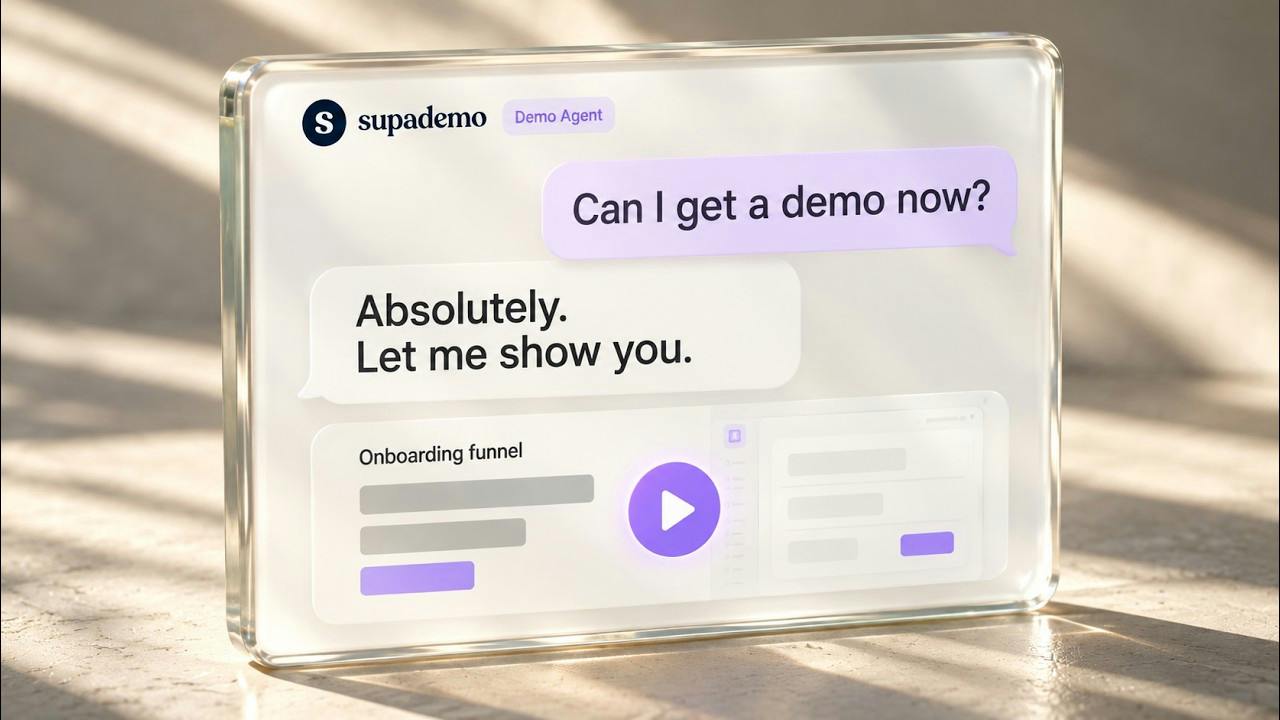
Supademo’s AI Demo Agent answers product questions, qualifies website visitors, and surfaces the relevant interactive demo or approved content. Buyers can click through a prepared demo, change paths, and ask questions by voice or text in 50+ languages. Qualified prospects can be routed to sales with a session summary. It offers more interaction than a text chatbot, but runs on supplied content rather than freely controlling a live customer product. Product Hunt launch · Product details
The feature sits on an existing interactive-demo platform. Supademo’s August 2026 update made the Agent self-serve and included 1,500 free credits per workspace. The current pricing page shows usage-based credits on paid plans, with a typical demo call estimated at about $1.25. This gives the company a subscription-plus-consumption model and lets customers test usage without a large contract. August product update · Pricing
Supademo reports 200,000+ professionals and 3,000+ paying organizations across its platform, not Agent-specific adoption. The founder says the company’s own Agent handles hundreds of conversations and books hundreds of qualified demos monthly; this is not a controlled customer study. Company overview · Founder account
The opportunity merits diligence: it can upsell the installed base and charges in proportion to use. The open questions are incremental pipeline, answer accuracy, and margins. Competitors offer similar agents, and Agent ARR, retention, gross margin, and company valuation are undisclosed. The decision is DD, pending customer and unit-economics evidence.
Product and Customer
B2B software marketing, growth, sales, and solutions teams configure approved demos and reference content, set escalation rules, and embed the Agent on their site. A prospect can explore relevant product flows, then request a person; the customer receives a transcript, interest signals, and routing context. Agent workflow
The combination of conversation, clickable demos, and a demo-authoring suite can extend into onboarding and training. Accuracy still depends on the customer keeping approved content current; grounding does not eliminate wrong answers or poor qualification.
Founders and Company
Co-founders Joseph Lee and Koushik Marka built Supademo after struggling to record and maintain product demos. The company says it serves 3,000+ organizations in 100+ countries, including Siemens, HPE, and DHL; these are self-reported platform figures. Audited financials are not public. About Supademo
Funding history, current ownership, and private-market valuation are not publicly disclosed in the sources reviewed. This limits assessment of entry price, dilution, and capital efficiency even though the business appears to have grown with a relatively lean, self-serve product motion.
Market and Bottom-Up Opportunity
The addressable market is software companies that need to explain products, qualify inbound buyers, and scale product training. The Agent’s initial beachhead is B2B SaaS and other complex products where a prospect benefits from a guided, hands-on walkthrough before talking to a salesperson. Adjacent uses include customer onboarding, self-service support, internal enablement, and multilingual education.
An illustrative scenario uses Supademo’s reported 3,000 paying organizations, not an external market estimate. If 20% adopted the Agent, each made 300 paid demo calls monthly, and the typical call generated $1.25 in credit consumption, annual usage revenue would be about $2.7 million (600 × 300 × $1.25 × 12). That excludes the underlying creator subscriptions and larger enterprise contracts, but assumes high recurring use that has not been reported. At the same call price, $100 million in annual usage revenue alone would require 80 million paid sessions a year. A large outcome therefore needs far more customers, higher session volume, larger enterprise contracts, and expansion into other platform workflows.
Traction and Distribution
Supademo reports 200,000+ professionals and 3,000+ paying organizations and lists customers including Beehiiv, Jotform, Khan Academy, and Siemens. Beehiiv says its demo experience drove several thousand signups, but this is not attributed to the Agent. Product Hunt shows 4.9 stars, 30 reviews, and 2.2K followers for the company profile. Company claims · Product Hunt
Free credits can funnel users into paid calls, while the platform already supplies demos. The missing proof is customer lift versus a static demo, paid usage conversion, and renewal among high-volume accounts.
Competition and Defensibility
Navattic and Storylane both market AI demo agents that answer questions, guide prospects, show product content, qualify intent, and route leads. Other interactive-demo vendors such as Arcade, Walnut, and Consensus compete for parts of the same sales-enablement budget. Navattic agent demos · Storylane RepX
Supademo’s potential advantage is breadth: demo creation and sharing connected to an agent across sales and customer workflows. Self-serve setup, multilingual support, and usage credits lower friction. If rivals match the interaction and integrations, the agent layer is easy to copy; defensibility must come from the authoring workflow, content library, distribution, and measured conversion gains.
Business Model and Unit Economics
The core platform is priced per creator, with the Scale plan listed at $38 per creator per month on annual billing. The Agent is a usage add-on on paid plans: workspaces start with 1,500 credits, then buy prepaid credits that do not expire. The current pricing page shows $0.06 per credit and estimates $1.25 per typical demo call. A $199 bundle corresponds to about 159 typical calls. These transparent units support trials and align revenue with usage. Supademo pricing
Gross margin is unknown. Each session can create voice, model, and content-serving costs, and longer conversations may consume more credits. Customer value depends on more than cheap calls: the agent must bring incremental qualified buyers, reduce repetitive sales work, or improve self-serve conversion. Supademo says its Agent is covered by SOC 2 Type II controls and that customer data is not used to train models; enterprise due diligence should verify subprocessors, retention, access controls, and data-processing terms. Security and product FAQ
Unicorn Path, Valuation, and Risks
Unicorn path: Conditional. Supademo has a meaningful reported customer base and a multi-product expansion path, but the Agent is a recent self-serve release and public revenue is unavailable. A $100 million annual-revenue outcome would require a much larger customer base, high enterprise contract value, or substantial recurring usage across several workflows. Current adoption and retention do not establish this scale.
Valuation attractiveness: Not assessable. The company is private and current valuation, ARR, and financing terms were not found. The product merits diligence, but no price discipline conclusion is possible without those figures.
Key risks include: (1) sessions fail to produce incremental qualified opportunities; (2) prospects avoid interacting with an AI sales agent; (3) stale or incomplete source content produces incorrect claims; (4) low usage leaves credit revenue immaterial; (5) long or voice-heavy sessions compress gross margin; (6) Navattic or Storylane bundle comparable functionality; (7) customer website traffic or sales budgets decline; (8) CRM integrations and security reviews slow enterprise rollout; and (9) company-level user counts are mistaken for AI Agent traction.
Score and Decision
| Dimension | Score |
|---|---|
| Market size and expansion | 16/20 |
| Traction and commercial proof | 16/20 |
| Team and execution capacity | 12/15 |
| Product quality and differentiation | 9/10 |
| Distribution and platform fit | 12/15 |
| Business model and unit economics | 7/10 |
| Defensibility | 6/10 |
| Total | 78/100 |
Evidence confidence: 72/100. Product workflow, pricing, founders, and platform-level customer figures are documented. Agent revenue, conversion lift, retention, and margins remain unverified.
Final Decision: DD. Advance to customer and unit-economics diligence. The Agent addresses a real bottleneck and attaches naturally to Supademo’s existing product, but the investment case depends on verified conversion lift and recurring paid usage.
Upgrade toward Invest if: customers show controlled conversion gains over standard interactive demos, paid Agent use repeats month after month, typical call costs leave healthy gross margin, and Supademo discloses sustainable ARR growth at a defensible valuation.
Downgrade toward Watch or Pass if: free credits do not convert, usage drops after initial trials, sales teams continue handling the same workload manually, or competing agents commoditize the feature before Supademo builds switching costs.
Diligence Questions
- What are Supademo’s ARR, growth, gross margin, cash runway, and customer concentration?
- How many organizations have deployed the AI Agent in production, and what percentage use it weekly?
- What is the paid-credit conversion rate after the 1,500-credit trial, and what is net retention for Agent customers?
- In a controlled test, how does the Agent change demo completion, qualified meeting rate, pipeline, and conversion versus static demos?
- What is average credit consumption and gross margin by session length and voice/text usage?
- How much sales-representative time does the Agent actually replace, and how is that measured by customers?
- What are the model and voice providers, data-retention terms, regional processing options, and escalation controls?
- How often do agents give incorrect answers or fail to surface a relevant demo, and how do customers detect and correct those failures?
- Which CRM and analytics integrations are in production, and where do customers experience setup friction?
- What are the latest financing terms and valuation, and how much capital has the company raised or returned to founders and employees?