
Table of Contents
Tadata Investment Report
Category: AI sales automation / enterprise agents
Company Stage: Seed-stage, early commercialization
Founder or Founders: Tori Seidenstein, Michael Makhlevich, Itay Shemer
Headquarters: San Francisco, California
Funding: $5 million, company-reported; round details and most investors not publicly disclosed
Business Model: Credit-based SaaS subscriptions and custom enterprise contracts
Product Hunt Launch Date: September 6, 2026
Report Date: September 9, 2026
| Investment Metric | Assessment |
|---|---|
| Venture Potential | 69/100 |
| Unicorn Path | Conditional |
| Valuation Attractiveness | Not Assessable |
| Evidence Confidence | 61/100 |
| Final Decision | DD |
Executive Summary
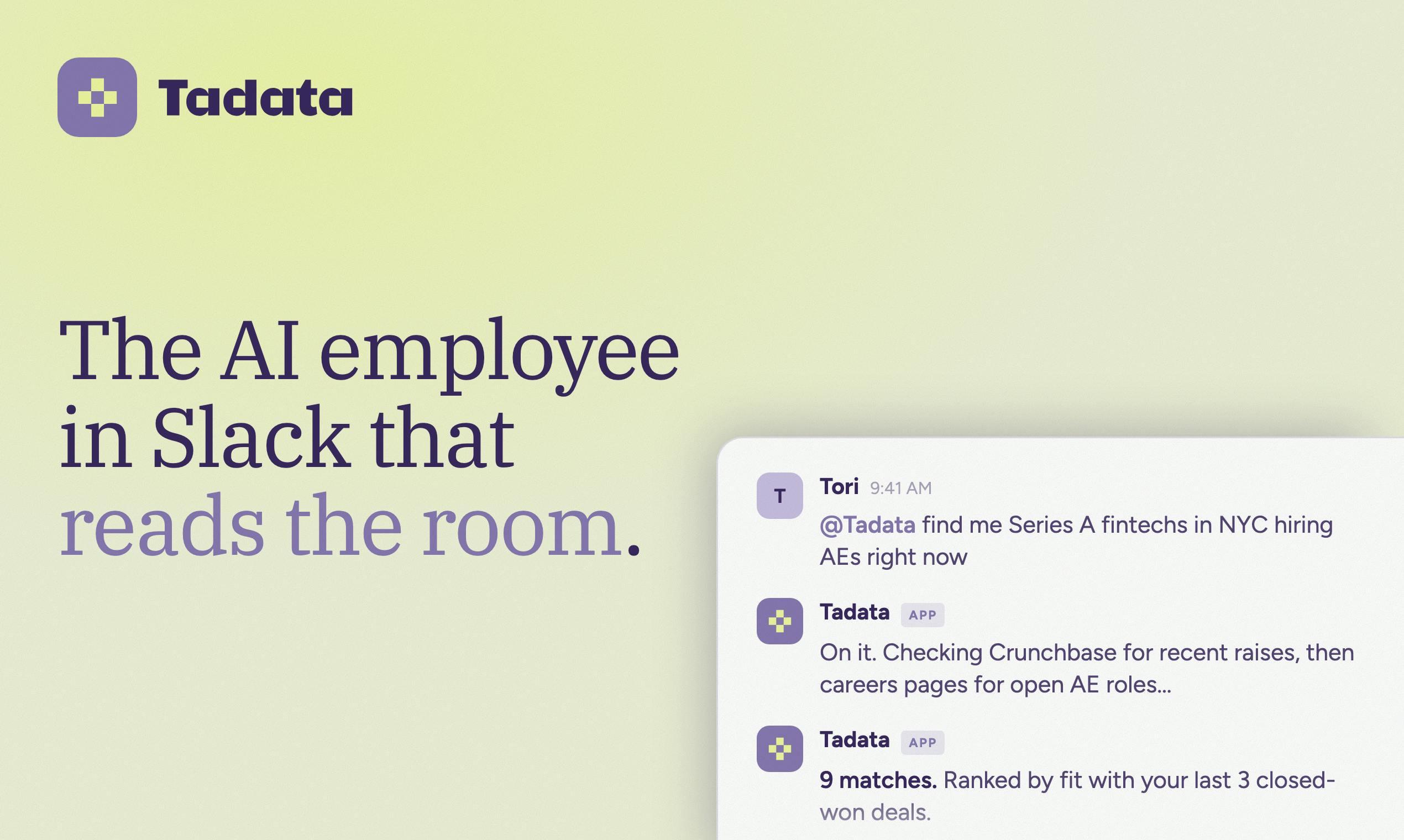
Tadata is an AI sales and go-to-market agent that operates through Slack. It connects to CRM, email, calendar, spreadsheets, and other business systems to prepare meeting briefs, research prospects, draft outreach and follow-ups, monitor account signals, and update records. Actions are presented for human approval rather than executed without review (official website; sales product page).
The product is aimed initially at founders, early sales hires, account executives, and small go-to-market teams without extensive sales-operations support. Its Slack-native delivery may reduce adoption friction compared with standalone agent builders or dashboards. The product is available through a credit-based free tier and paid plans ranging from $39 to $299 per month, with custom enterprise pricing (pricing).
The strongest investment signal is technical and founder quality. Tadata’s team created FastAPI-MCP, an open-source project with approximately 12,000 GitHub stars. PyPI recorded approximately 4.3 million package downloads in the most recent 30-day period, demonstrating substantial developer reach even though package downloads are not equivalent to customers (GitHub; PyPI statistics). The company also reports raising $5 million and has an eight-person LinkedIn footprint (company profile; job listing).
The primary concern is that Tadata recently pivoted from developer-oriented MCP infrastructure and an agent builder to a packaged Slack agent. The open-source distribution, while valuable, does not establish demand, retention, or willingness to pay for the current product. Revenue, customer count, usage, retention, gross margin, and enterprise contracts are not publicly disclosed.
Decision: DD. The combination of a technically credible team, open-source reach, funded runway, and a large enterprise workflow opportunity warrants direct diligence. Investment should remain contingent on verified commercial traction and acceptable round terms.
Product Overview
Sales teams frequently divide prospect research, meeting preparation, outreach, CRM maintenance, and internal knowledge retrieval across multiple tools. Tadata attempts to consolidate these workflows into an AI employee accessible through Slack.
Users connect Slack and selected business applications. Tadata then monitors authorized information, produces briefings or drafts, and asks for approval before actions such as sending outreach or modifying CRM records. The company specifically markets meeting preparation, prospect research, buying-signal monitoring, personalized messages, follow-ups, and CRM updates (sales product page).
Pricing consists of:
- Free: 1,000 one-time credits.
- Lite: $39 per month for 1,000 monthly credits.
- Pro: $149 per month for 4,000 credits.
- Scale: $299 per month for 10,000 credits.
- Enterprise: custom pricing with unlimited credits.
The primary benefit is workflow compression: users can delegate multi-application tasks through a familiar communication interface instead of opening separate sales, enrichment, and automation tools. Product quality appears promising, but independent reviews and structured customer case studies are limited. Published testimonials should be treated as company-reported rather than independently verified.
Founder and Team Assessment
Tori Seidenstein is co-founder and CEO. Her LinkedIn profile reports previous experience as co-founder and CTO of FairStreet, a software platform for Medicare agencies, and as a software engineer at Meta. She holds an MBA from Stanford Graduate School of Business and an undergraduate computer-science degree from Cornell (LinkedIn).
Michael Makhlevich is identified as co-founder and CPO, with prior product experience at Cyera and Microsoft. Itay Shemer is identified as co-founder and CTO, with previous algorithm-development experience at Autobrains (Michael Makhlevich; Itay Shemer). No verified prior exits were found.
LinkedIn associates eight people with Tadata. The company has also advertised a full-time founding growth role, suggesting active investment in commercialization (LinkedIn company page; job listing). Full-time commitment appears likely but has not been independently confirmed for every founder.
The team demonstrates strong technical capability through FastAPI-MCP and a credible combination of engineering, product, and go-to-market experience. The product pivot introduces execution risk, but it also suggests willingness to move closer to end-customer value.
Founder Assessment: Strong technical and product credentials, with commercial execution for the current product still unproven.
Market Opportunity
The initial customer is a Slack-centric startup or SMB go-to-market team with approximately 5–50 sellers and limited sales-operations capacity. These customers may pay to automate research, meeting preparation, personalized outreach, and CRM administration when the time saved exceeds software and inference costs.
No reliable public count of companies meeting this narrow definition was found. An analyst scenario illustrates the opportunity:
- 50,000 suitable companies globally.
- Average annual revenue of $3,600 per company, approximately the current Scale plan.
- Implied annual addressable revenue: $180 million.
An enterprise scenario of 10,000 organizations at a $25,000 ACV would represent $250 million in ARR. These are analytical scenarios, not verified market estimates.
Adjacent opportunities include customer success, recruiting, marketing operations, finance workflows, and general enterprise automation. However, broadening too early could dilute the sales wedge.
The market can support a venture-scale company, as demonstrated by significant investment in AI-native GTM products. Clay, for example, announced a $100 million financing at a $3.1 billion valuation, although its data-orchestration model, maturity, and economics are not directly comparable to Tadata (Business Wire).
Traction and Growth Signals
Tadata launched on Product Hunt on September 6, 2026, ranking second for the day. Product Hunt’s subsequent newsletter displayed 383 votes and 46 comments (Product Hunt; newsletter). This indicates launch interest, not product-market fit.
More substantive technical signals include:
- Approximately 12,000 GitHub stars and 961 forks for FastAPI-MCP (GitHub).
- Approximately 4.3 million PyPI downloads during the latest 30-day period (PyPI statistics).
- A company job listing claims more than 70 million cumulative downloads and $5 million raised; the cumulative download claim was not independently verified (job listing).
- Active hiring and product updates are visible through the company’s LinkedIn activity (LinkedIn).
The company website presents customer testimonials from a sales consultant and BraveBird, including a claimed multimillion-dollar pipeline outcome. These are company-selected claims without independently published methodology or attribution to actual closed revenue (sales page).
The most important missing metrics are current ARR, paying workspaces, net and gross retention, credit consumption, workflow completion, conversion from free to paid, and revenue attributable to the current post-pivot product.
Traction Assessment: Strong open-source awareness, but current SaaS traction remains commercially unverified.
Competitive Position
Direct competitors include Lindy, Relevance AI, Viktor, 11x, and other AI-agent platforms. Indirect competition includes Clay and conventional CRM automation. Large-platform threats include Salesforce Agentforce and Slack’s own agent infrastructure (Slack agents; Salesforce pricing).
Tadata’s differentiation is the combination of Slack-native interaction, proactive behavior, human approval, cross-application execution, and prior MCP infrastructure experience. It may feel more like delegating to a colleague than configuring an automation builder.
Switching costs are initially low. Connected workflows, accumulated preferences, organizational context, and successful task histories could increase retention, but no proprietary data advantage or network effect has been demonstrated. Dependence on Slack and third-party APIs is material.
If the largest platform in this market launched the same feature within six months, why would customers continue using this product? Customers might remain for superior cross-vendor integrations, workflow quality, implementation speed, and platform neutrality. Those advantages must be proven through measurable task success and retention.
Defensibility Assessment: Medium
Business Model and Economics
Tadata uses credit-based pricing, aligning revenue partly with usage. Current list-price ACV ranges from $468 for Lite to $3,588 for Scale, excluding enterprise contracts.
Variable costs include model inference from Anthropic and OpenAI, web research, data enrichment, cloud execution, storage, and support. Complex multi-step sales tasks may generate materially higher costs than simple text generation. Gross margin is therefore not assessable without credit-consumption and model-routing data.
Tadata reports US-based AWS hosting, AES-256 encryption, isolated ephemeral execution, credential storage through HashiCorp Vault and AWS KMS, and a Google CASA Tier 2 assessment. It does not claim SOC 2 certification on the reviewed security page (security). Its privacy policy permits processing of connected Google email, calendar, document, spreadsheet, drive, and advertising data, making security and permission management critical (privacy policy).
Unicorn Path
Assuming a 10× ARR multiple for a high-growth, enterprise-oriented AI software company:
Required ARR = $1 billion ÷ 10 = $100 million
At current pricing, this would require approximately:
- 27,900 Scale customers paying $3,588 annually; or
- 4,000 enterprise customers at a hypothetical $25,000 ACV; or
- 1,000 enterprise customers at $100,000 ACV.
The enterprise ACVs are analyst assumptions, not current Tadata pricing.
A unicorn outcome requires proven expansion within accounts, enterprise security certification, repeatable distribution, high workflow reliability, healthy inference margins, and material revenue above current self-service pricing. The current product category can support such scale, but Tadata has not yet demonstrated its share of that opportunity.
Unicorn Path: Conditional
Valuation Assessment
The company reports raising $5 million. The financing date, round type, valuation, institutional investors, ownership, and terms are not publicly disclosed. Tori Seidenstein has identified Jeff Lawson as an angel investor, but a complete investor list was not found (founder profile activity).
Valuation Attractiveness: Not Assessable
Assessment requires current ARR, growth, gross margin, retention, burn, runway, cap table, round size, SAFE caps, post-money valuation, option pool, investor ownership, and liquidation preferences.
Key Risks
- Commercial traction for the post-pivot product is unknown.
- Salesforce and Slack can bundle overlapping agent functionality.
- Agent errors could damage customer relationships or CRM data.
- Model and data-provider costs may constrain gross margin.
- The pivot may not convert open-source developers into GTM buyers.
- Broad access to email, CRM, Slack, and documents creates security risk.
- Low self-service ACV requires substantial customer volume.
- Credit pricing may be difficult for customers to predict.
- FastAPI-MCP’s last visible release activity appears older than the current product, potentially weakening the open-source funnel.
Final Assessment
Venture Potential: 69/100
| Category | Score |
|---|---|
| Market Size and Expansion Potential | 17/20 |
| Traction and Growth Evidence | 10/20 |
| Founder and Team | 13/15 |
| Product Strength | 8/10 |
| Distribution Potential | 10/15 |
| Business Model and Economics | 6/10 |
| Defensibility | 5/10 |
| Total | 69/100 |
The team, technical reputation, and enterprise workflow opportunity are the strongest elements. Commercial validation, economics, and defensibility are the weakest.
Evidence Confidence: 61/100
Pricing, product availability, founders, legal entity, GitHub activity, recent package downloads, and security policies are verifiable. Funding and cumulative downloads are company-reported. Revenue, customer count, retention, margins, burn, runway, cap table, and valuation remain unavailable.
Final Decision: DD
Tadata is sufficiently credible to justify a founder meeting and formal data request. Investment should not proceed without verifying that post-pivot adoption is generating recurring revenue and repeat usage at acceptable gross margins.
Upgrade Conditions
- Verified ARR above $1 million with strong recent growth.
- At least 70% six-month workspace retention.
- Multiple referenceable team or enterprise customers.
- Gross margin above 70% after inference and data costs.
- Demonstrated expansion revenue and repeatable acquisition.
- SOC 2 completion and documented agent-quality controls.
Downgrade Conditions
- Open-source reach fails to convert into current-product adoption.
- Low repeat usage after initial credits.
- Gross margin deteriorates as task complexity increases.
- Major platform replication eliminates the Slack-native advantage.
- Material security incident or unauthorized agent action.
- Financing terms imply an unsupported valuation.
Questions for Further Diligence
- What are current MRR, ARR, and monthly growth for the Slack agent?
- How much revenue predates the pivot versus comes from the current product?
- How many paying workspaces and active weekly users are there?
- What are free-to-paid conversion and 30-, 90-, and 180-day retention?
- What percentage of suggested actions are approved, edited, rejected, or fail?
- What are gross margin and inference/data costs per 1,000 credits?
- What are CAC and payback by open-source, outbound, referral, and Product Hunt channels?
- Which customers have expanded usage, and what is net revenue retention?
- What safeguards prevent incorrect emails, CRM changes, or data disclosure?
- What are burn, runway, team structure, and founder commitments?
- Who invested in the $5 million financing, and what are the cap table and round terms?
- How will Tadata remain differentiated if Slack or Salesforce launches an equivalent agent?