Table of Contents
- Firecrawl Developer Index Investment Report
Firecrawl Developer Index Investment Report
Category: Web data and retrieval infrastructure for AI agents — specialized search index for coding agents
Company Stage: Series A ($14.5M, August 2025); growth-stage, revenue-generating
Founder or Founders: Nicolas Silberstein Camara (CEO), Eric Ciarla (CPO), Caleb Peffer (CRO) — second company together after YC-backed Mendable
Headquarters: San Francisco, CA
Funding: $16.2M total; $14.5M Series A (August 2025) led by Nexus Venture Partners, with Y Combinator, Shopify CEO Tobias Lütke, Zapier, and Postman CEO Abhinav Asthana participating
Business Model: Usage-based API credits — pay-as-you-go with $5 auto-reload batches; free tier of 1,000 credits/month
Product Hunt Launch Date: Developer Index launched the week of August 24–31, 2026 (announced August 20, 2026); Firecrawl’s 12th Product Hunt launch
Report Date: August 31, 2026
| Investment Metric | Assessment |
|---|---|
| Venture Potential | 78/100 |
| Unicorn Path | Plausible |
| Valuation Attractiveness | Not Assessable |
| Evidence Confidence | 62/100 |
| Final Decision | DD |
Executive Summary
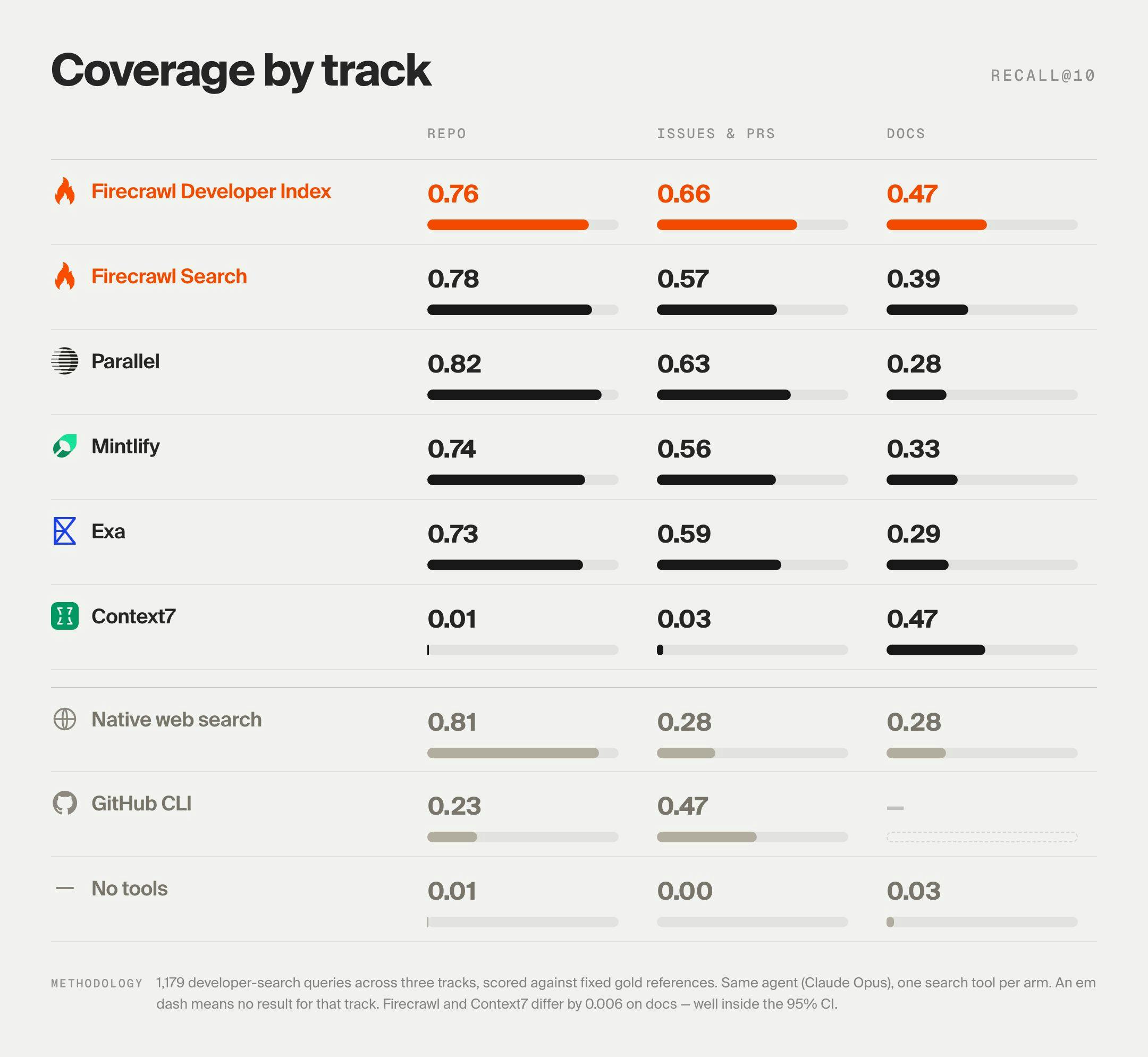
Firecrawl is the web data infrastructure layer for AI agents: one API to search, scrape, and interact with the live web, returning clean markdown or structured data. The specific product under review, the Firecrawl Developer Index, is a specialized search index for coding agents — 70 million-plus artifacts (READMEs, issues, merged pull requests, OpenAPI specs, documentation) refreshed daily, queryable via API, CLI, MCP, and SDKs, with a published recall benchmark of 63% at Recall@10 across 1,179 real developer queries. firecrawl
The company serves AI developers and agent builders — from solo developers to teams at Apple, Canva, Lovable, Sierra, Zapier, and Shopify — who need reliable, token-efficient web context inside their products and coding agents. firecrawl
The Developer Index is strategically interesting because it moves Firecrawl up the stack from scraping (commoditized) toward proprietary retrieval assets — daily-refreshed vertical indexes for research (launched June 2026) and now coding — which is where durable value accrues in agent infrastructure. firecrawl
The strongest positive signal is the traction profile: 174.2K GitHub stars (verified), company-reported figures of 1.25M+ developers, 150,000+ companies, 5 billion+ requests served, 2.5M+ weekly SDK downloads, and eight-figure ARR reached in year one and more than doubled in year two. firecrawl
The most important concern is that all commercial figures are company-reported and unaudited, with one conflicting third-party estimate, while the structural risk — OpenAI, Anthropic, and Google shipping native web search, browser use, and coding-agent retrieval — hangs over the entire category. getlatka
Final decision: DD. The market, product, traction, and team clear the diligence bar comfortably; verified financials, retention, and current round terms do not yet exist publicly.
Product Overview
The customer problem: coding agents hallucinate library behavior, API contracts, and known bugs because general web search returns stale, noisy pages; developers instead want answers drawn from the primary sources — the actual READMEs, merged PRs, and issue threads where behavior is documented. firecrawl
The Developer Index solves this with semantic retrieval over 70M+ coding artifacts, refreshed daily, with metadata filters, exposed through /v2/search/developer on the API, CLI, and MCP — plugging into Codex, Claude Code, Grok Build, Cursor, and Windsurf with no API key required to start. Alongside it, Firecrawl released DevDex, an open benchmark of 1,179 developer queries on which the index claims 63% Recall@10, roughly 10 points above the next best external provider. firecrawl
The index sits atop the broader Firecrawl platform: Search (live web plus indexed results), Scrape (markdown/JSON/screenshots with JavaScript rendering), Interact (browser automation), Agent (autonomous data gathering with in-house Spark models), Crawl, Map, and Monitor. Pricing is verified: 1,000 free credits monthly; scrape/crawl/map/monitor cost 1 credit per page, search 2 credits per 10 results, interact 2 credits per browser minute; self-serve plans (Hobby through Scale) run pay-as-you-go with $5 auto-reload batches; enterprise is custom. firecrawl
Founder and Team Assessment
The three founders — Nicolas Silberstein Camara, Eric Ciarla, and Caleb Peffer — have worked together since founding the company’s predecessor, Mendable, a YC-backed AI documentation startup that was pivoted into Firecrawl; the repository history still shows the Mendable-to-Firecrawl rename. The pivot was executed early and decisively, and the team has since shipped at an exceptional cadence: v2.5 with a Semantic Index (October 2025), /monitor (May 2026), Keyless (June 2026), Research Index (June 2026), and the Developer Index (August 2026). linkedin
Technical capability is verified through the open-source record: 6,214 commits, 171 contributors, 35 releases, and a 174.2K-star repository maintained through August 2026. Commercial capability is evidenced by the investor roster — Nexus led the Series A, with Shopify’s CEO, Zapier, and Postman’s CEO participating, a notably operator-heavy cap table. Team size is not disclosed, and no prior exits exist. Key-person risk is mitigated by having three co-founders but elevated by the undisclosed team size. github
Founder Assessment: Proven, repeat founding team with elite operator backing and rare shipping velocity; commercial execution is evidenced but financial verification is still pending.
Market Opportunity
The initial segment for the Developer Index is developers building and running coding agents — plausibly 1–3 million people worldwide given the adoption of tools like Cursor, Claude Code, and Copilot (analyst assumption). Firecrawl’s broader platform serves AI application teams needing web context: research agents, RAG pipelines, lead enrichment, price monitoring. firecrawl
Bottom-up: if 1–2 million developers and agent teams spend an average of $200–800 per year on retrieval and scraping APIs, the initial pool is roughly $200M–$1.6B, before enterprise data pipelines (the Cognism-style enrichment use case), which are larger still. The category is validated by M&A: Tavily, an agent search API competitor, was acquired by Nebius in February 2026. firecrawl
Expansion opportunities are visible in Firecrawl’s own roadmap: vertical indexes (research, developer), monitoring, autonomous agent endpoints, and enterprise contracts. Timing is strong — agent infrastructure spend is scaling with agent adoption — but the same wave is attracting the model labs themselves. firecrawl
Traction and Growth Signals
Verified: 174.2K GitHub stars (top-100 repository on GitHub), 9.6K forks, 171 contributors, 35 releases, active commits through August 29, 2026. Product Hunt: a 5.0 rating across 15 reviews, 3.2K followers, and twelve launches — the Developer Index launched in the final week of August 2026 with favorable comments. github
Company-reported but unverified: 1.25M+ developers, 150,000+ companies, 5B+ requests, 2.5M+ weekly SDK downloads, 400,000+ MCP installs, and eight-figure ARR in year one, more than doubled in year two, with 15x growth claimed in the twelve months to August 2025 [-founder-post]. A material conflict exists: GetLatka estimates 2024 revenue at $1.5M — implausibly inconsistent with the company’s own eight-figure claim, and the same tracker lists funding as $0 against a verified $16.2M, so its reliability is low; the company-reported figure is used here, flagged as unverified. firecrawl
The most important missing metrics are audited revenue, paying-customer count, retention, and net revenue retention.
Traction Assessment: Among the strongest open-source-to-commercial profiles in AI infrastructure, but financially unverified.
Competitive Position
Direct competitors in scraping and extraction: Apify, ScrapingBee, Bright Data, Zyte, Jina Reader, and Nimble. In AI-native search for agents: Exa, Perplexity’s Sonar API, Brave Search API, and You.com, with Tavily now part of Nebius. In coding-specific retrieval: Sourcegraph’s context tooling, GitHub’s own search, and — most consequentially — the coding agents’ vendors themselves. websearchapi
Differentiation: Firecrawl combines scraping, search, live interaction, and proprietary vertical indexes in one API, with an open-source core (AGPL-3.0, MIT-licensed SDKs) that deters cloud resale and a 174K-star community. The Developer Index’s daily-refreshed artifact index and published benchmark create a credible retrieval-quality lead. Switching costs are moderate (API swap is easy; accumulated workflow and monitor configurations stick). firecrawl
The six-month question — “if OpenAI or Anthropic shipped equivalent coding-agent retrieval natively, why would customers stay?” — has a partial answer: provider-neutrality (works with every harness), the extraction-plus-retrieval bundle, and price. That is a real but incomplete answer, and it caps defensibility.
Defensibility Assessment: Medium
Business Model and Economics
Revenue scales with usage: credits per page scraped, per search result, and per browser minute — a structure that naturally aligns revenue with the variable costs of proxies, rendering, browser minutes, and index maintenance. The free tier (1,000 credits monthly, keyless since June 2026) is an aggressive top-of-funnel, and agent self-onboarding — agents can mint their own API keys via a published skill file — is a novel distribution mechanic. firecrawl
Economic questions requiring verification: gross margin per endpoint (interact/browser minutes are compute-heavy; the 70M-artifact daily refresh adds fixed cost), free-to-paid conversion, and whether heavy self-serve users are profitable. Research Index paper endpoints are free — a deliberate loss-leader for the research vertical. Enterprise potential is real (Scale and Enterprise plans, credit rollover, compliance needs), but enterprise ACV is undisclosed. The AGPL license pushes serious commercial users toward the hosted product, supporting monetization. firecrawl
Unicorn Path
Assume an 8–10x ARR multiple, appropriate for high-growth, usage-based AI infrastructure with a strong open-source wedge. A $1 billion valuation therefore requires roughly $100–125M ARR.
Against a company-reported run rate of eight figures more than doubled in year two (implying at least $20M-plus if trajectory held — unverified), the remaining gap is a plausible 3–6x of continued growth, not a transformation. Required scale at current pricing: on the order of tens of thousands of active paying accounts plus a growing base of Growth/Scale and enterprise contracts at $50K–$100K-plus ACV, against a claimed 150,000+ company base already using the product. Strategic requirements: converting free/open-source usage to paid, expanding the vertical index strategy (research, developer, more), growing enterprise contracts, and surviving native retrieval from the model labs. Comparable exits (Tavily–Nebius) confirm strategic appetite for this layer. firecrawl
Unicorn Path: Plausible
Valuation Assessment
Known: $16.2M total funding; $14.5M Series A led by Nexus (August 2025), oversubscribed, with a strong angel roster. Not disclosed: post-money valuation of the Series A, any current round, SAFE caps, or secondary transactions. Revenue is company-reported, not audited, and materially conflicts with one low-quality third-party estimate. ycombinator
Valuation Attractiveness: Not Assessable. A responsible assessment requires current audited ARR, growth, gross margin, retention, and the terms of any round in progress. As an analytical observation only: if the company-reported ARR range is accurate and growth persists, a $100M+ ARR infrastructure company would typically command valuations well above $1B in comparable financings — making early-round entry attractive and any large premium round dependent on verified retention.
Key Risks
- Platform absorption — OpenAI, Anthropic, and Google shipping native web search, browser use, and coding-agent retrieval into their own harnesses
- Unverified financials — all revenue, user, and growth figures are company-reported; no audited numbers exist publicly ycombinator
- Competing third-party data — the GetLatka estimate conflicts materially with company claims, though the tracker’s own funding figure is demonstrably wrong getlatka
- Scraping commoditization — a crowded field of extraction vendors with price pressure nimbleway
- Legal and ToS exposure — scraping operates in a persistent grey zone around robots.txt, terms of service, and data ownership, with enterprise deals requiring legal review
- Self-published benchmarks — the 63% recall claim rests on the company’s own DevDex benchmark x
- Infrastructure cost intensity — browser minutes, proxies, rendering, and daily refresh of 70M+ artifacts pressure gross margin at low price points
- Index dependency — the Developer Index leans heavily on GitHub-sourced artifacts; GitHub could restrict access or ship its own retrieval layer
- Team opacity — headcount and structure are not disclosed despite a capital base suggesting meaningful scale
Final Assessment
Venture Potential: 78/100
| Category | Score |
|---|---|
| Market Size and Expansion Potential | 16/20 |
| Traction and Growth Evidence | 16/20 |
| Founder and Team | 12/15 |
| Product Strength | 8/10 |
| Distribution Potential | 13/15 |
| Business Model and Economics | 7/10 |
| Defensibility | 6/10 |
| Total | 78/100 |
The strongest elements are distribution (a top-100 open-source repository plus a verified usage-based commercial engine) and the founder team’s shipping velocity. The weakest are unverifiable financials and the structural overhang of model labs absorbing retrieval.
Evidence Confidence: 62/100
Verified: funding history and investors (press release, TechCrunch), GitHub statistics, pricing and product capabilities, launch history, founder identities. Company-reported: all revenue, user, and usage metrics. Conflicting: third-party revenue estimates of poor quality. Unavailable: audited revenue, paying-customer counts, retention, gross margin, team size, and current valuation. Confidence is capped by the absence of any verified commercial data. firecrawl
Final Decision: DD
Firecrawl clears the DD threshold on every dimension a public-information review can test: a large, validated, M&A-active market; meaningful differentiation moving up the stack into proprietary indexes; a traction profile that is exceptional even after discounting company-reported figures; and a repeat founding team with elite operator backing. It stops short of Invest because valuation and round terms are unknown, financials are unaudited, and retention and margin data do not exist publicly. Diligence should focus on financial verification and the platform-absorption risk.
Upgrade Conditions
- Audited or reference-verified ARR above $30M with sustained growth
- Verified net revenue retention above 120% and free-to-paid conversion data
- Evidence of enterprise contracts (six-figure ACVs) as a growing revenue share
- Demonstrated Developer Index adoption: usage share, retention on the endpoint, and third-party benchmark replication
- A priced round with disclosed terms at a defensible multiple of verified revenue
Downgrade Conditions
- Model labs shipping free, native coding-agent retrieval that matches the index’s recall
- Evidence that growth has stalled below the company-reported trajectory
- A material legal ruling or enforcement action affecting AI scraping generally
- GitHub restricting artifact access or launching its own agent retrieval layer
- Gross margin compression from browser-minute and index-refresh costs at scale
- Departure of any of the three co-founders
Questions for Further Diligence
- What is current ARR, monthly growth, and the split between self-serve and enterprise revenue?
- How many paying customers, and what share of revenue comes from the top ten accounts?
- What are 30/90/180-day retention and net revenue retention by cohort?
- What is free-to-paid conversion from the 1,000-credit tier, and how did Keyless change it ? firecrawl
- What is gross margin by endpoint — scrape, search, interact, agent — and where is margin thinnest?
- What does the daily refresh of 70M+ Developer Index artifacts cost in infrastructure, and how does it scale?
- How much Developer Index usage has occurred since launch, and what recall do external parties measure on DevDex?
- What is the enterprise pipeline, average ACV, and sales-cycle length?
- What were the Series A post-money valuation and terms, and is a new round currently open?
- What is team size, structure, and hiring plan relative to the $16.2M raised?
- What is the legal posture on robots.txt, ToS, and data ownership for enterprise customers?
- How is the AGPL license affecting enterprise conversion, and are commercial licenses offered?
Sources
- Product Hunt — Firecrawl Developer Index launch
- Firecrawl official website and Developer Index page
- Firecrawl blog — Developer Index announcement and Research Index announcement
- GitHub — firecrawl/firecrawl repository
- GlobeNewswire — Firecrawl $14.5M Series A press release
- TechCrunch — Firecrawl raises $14.5M
- Y Combinator — Firecrawl company page (company-reported ARR)
- Firecrawl blog — Series A announcement
- Y Combinator LinkedIn — founder and customer details
- WebSearchAPI — Tavily/Nebius acquisition and competitor landscape (secondary)
- Nimble — Tavily alternatives and competitive positioning (secondary)
- GetLatka — Firecrawl revenue estimate (secondary, flagged as unreliable)