
Table of Contents
- Nano Banana 2.1 Investment Report
- Company Snapshot
- Top Metrics
- Executive Summary
- Product Overview
- Founder and Team Assessment
- Market Opportunity
- Traction and Growth Signals
- Competitive Position
- Business Model and Economics
- Unicorn Path
- Valuation Assessment
- Key Risks
- Final Assessment
- Final Decision: Pass
- Questions for Further Diligence
- Sources
Nano Banana 2.1 Investment Report
Company Snapshot
| Field | Assessment |
|---|---|
| Category | Generative AI image creation and editing; multimodal foundation model |
| Company Stage | Launched model inside an established public company; not a standalone startup |
| Founder(s) | Product team not named. Google founders Larry Page and Sergey Brin are parent founders, not identified as model creators |
| HQ | Google is headquartered in Mountain View, California; model-team location is undisclosed |
| Funding | No separate venture funding; product-level funding not disclosed |
| Business Model | Gemini distribution, paid Gemini API usage, Google Cloud and product ecosystem |
| Product Hunt Launch Date | 2026/10/07 |
| Report Date | 2026/10/10 |
Top Metrics
| Metric | Assessment |
|---|---|
| Venture Potential | 80/100 as a strategic product |
| Unicorn Path | Not Applicable standalone; conditional on product-level revenue at scale |
| Valuation Attractiveness | Not Assessable separately from Alphabet |
| Evidence Confidence | 78/100 |
| Final Decision | Pass |
Executive Summary
Nano Banana 2.1 is Google’s image-generation and editing model, based on Gemini 3.6 Flash. It accepts text and images, supports up to a one-million-token context window, and returns image and text. Google’s model card reports gains over earlier Google image models on several internal generation and editing evaluations; these are company-run benchmarks, not independent results. Google DeepMind model card
The model card lists distribution through Gemini, AI Studio, Gemini API, Search AI Mode, Google Ads, Flow, and Stitch. API output pricing is $0.0336 per 1K image, $0.0504 at 2K, and $0.113 at 4K on Standard; Batch equivalents are about half. Gemini API pricing
Product Hunt recorded more than 120 points and an #11 daily rank for the October 7 launch. That shows launch reach, not sustained usage or revenue. Google has not disclosed Nano Banana 2.1-specific usage, retention, or financial results. Product Hunt launch Daily leaderboard
Google’s research, infrastructure, consumer reach, API, and cloud channels make this a strategically strong product. Yet venture investors cannot buy equity in Nano Banana 2.1 separately: no standalone entity, cap table, funding, revenue, or valuation is disclosed. The product-level venture decision is Pass. Alphabet stock is a separate public-equity thesis.
Product Overview
Nano Banana 2.1 supports image generation and editing, including iterative changes, localized text, diagrams, and image-grounded workflows. It is distributed through consumer, developer, advertising, and creative products. The Gemini API offers Standard and Batch generation; all generated images include SynthID watermarks. The model card says the API has no free tier, while web and image-search grounding can incur extra charges. Model card API pricing
Google discloses limitations: blurry small text, imperfect character consistency, partial instruction-following in masked edits, spatial confusion, hallucinations, and occasional latency or timeouts. These can constrain factual and production use. Model card
Founder and Team Assessment
No product founders or launch team are named. Google DeepMind published the model card. Larry Page and Sergey Brin founded Google, but are not identified as this model’s creators. Google lists Mountain View as headquarters; team location is unknown. Google history Model card
The organizational advantage is access to research, compute, engineering, and global distribution. Product-level staffing, roadmap ownership, and accountability are not public.
Market Opportunity
Use cases include consumer image editing, marketing assets, product photography, design iteration, diagrams, and API-integrated generation. The market spans established creative workflows, but Google does not disclose the product’s revenue or share; a precise standalone TAM is not supportable.
An illustrative scale scenario: at Google’s $0.0336 Standard 1K API list equivalent, $100 million in annual billings requires about 2.98 billion images, or 8.2 million daily, before discounts, grounding, and input charges. Alternatively, 1,000 enterprise API customers at $100,000 annually would equal $100 million. These are assumptions, not reported usage or customers. Distribution through Google’s products may also create value beyond direct API billings.
Traction and Growth Signals
Product Hunt recorded over 120 points and an #11 daily rank. Google’s model card, API docs, and named distribution channels confirm a formal release. They do not establish adoption. No model-specific active users, generated-image volume, paid API usage, retention, revenue, or customer counts were found.
The strongest signal is distribution access, not independently verifiable traction. Treat Product Hunt response as discovery and launch marketing.
Competitive Position
Competitors include OpenAI’s image API, Adobe Firefly, and specialist image-generation products. Adobe sells plans with generative features and partner models; OpenAI offers image generation through its API. Buyers compare quality, editing control, price, speed, rights, and workflow fit. OpenAI API pricing Adobe Firefly plans
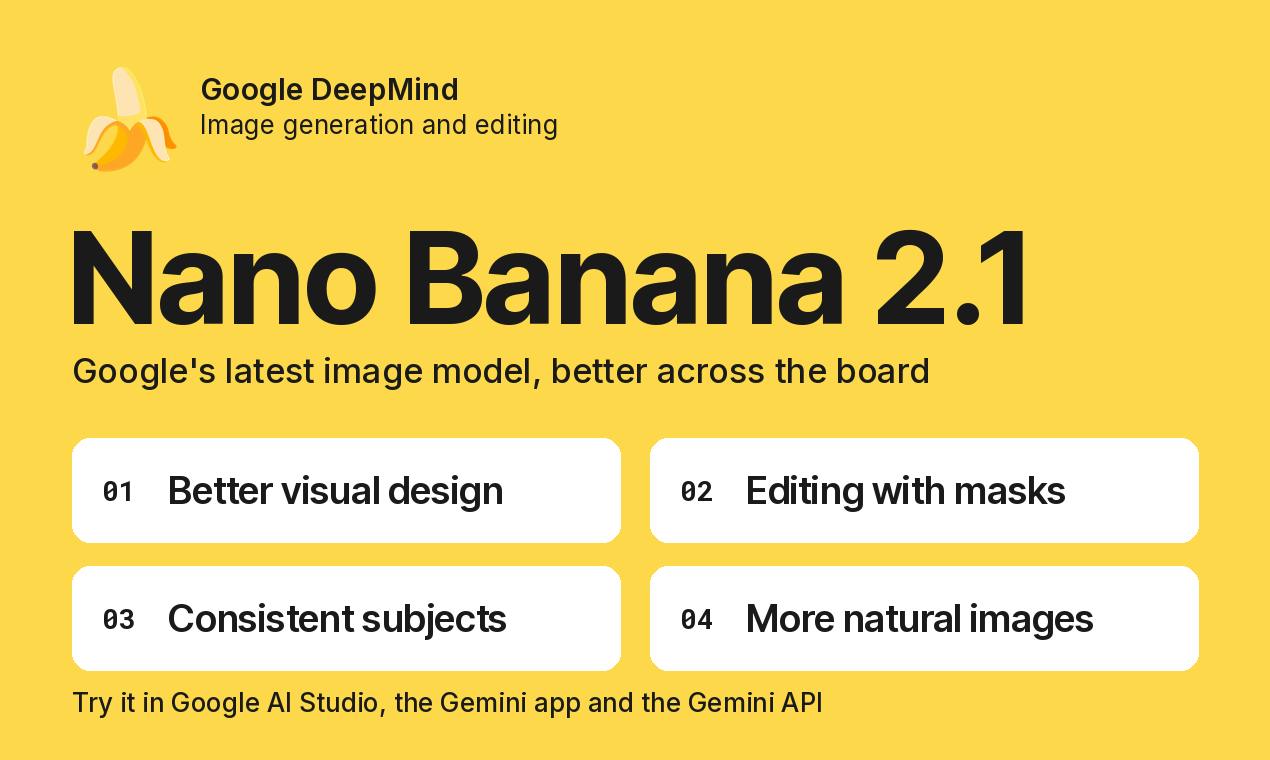
Google’s advantage is reach across Gemini, Search, Ads, Flow, and developer channels. Product Hunt promotes sharper design and mask editing; Google’s model card reports internal quality gains. Model quality alone is not a durable moat: competitors can improve quickly, and creators value workflow, licensing, and control.
Business Model and Economics
Google publishes API rates of $0.0336 per 1K Standard image, $0.0504 at 2K, and $0.113 at 4K; Batch rates are $0.0168, $0.0252, and $0.0567. Grounding is separately priced after a shared free allowance. Consumer bundles and advertising may contribute, but model-specific revenue is unknown. These are customer prices, not Google’s inference costs or margins. Gemini API pricing
Alphabet reported $402.8 billion in 2025 revenue and $58.7 billion in Google Cloud revenue. These figures show parent-company scale, not Nano Banana unit economics. Product-level costs, paid volume, gross margin, and retention impact are undisclosed. Alphabet 2025 Form 10-K
Unicorn Path
At an assumed 10× ARR multiple, a $1 billion standalone valuation implies $100 million ARR. At $0.0336 per 1K API image, that equals about 2.98 billion images yearly; at $100,000 per year, it equals 1,000 enterprise customers. This is scenario math, not a forecast or current multiple, and excludes margin, growth, retention, bundle economics, and market conditions.
Nano Banana 2.1 is already inside publicly traded Alphabet, so there is no standalone unicorn path or equity instrument to assess. Product usage could create strategic value, but its financial contribution is unknown.
Valuation Assessment
Not Assessable separately. No product-level capitalization, financing, revenue, or valuation is disclosed. Alphabet’s public valuation covers its entire business; its $402.8 billion 2025 revenue is not a proxy for Nano Banana. Alphabet Form 10-K
Key Risks
- No separate security: Product-level equity and exit rights are unavailable.
- Unreported adoption: No model-specific usage, revenue, retention, or customer data.
- Fast competition: OpenAI, Adobe, and specialist labs can close capability gaps.
- Quality limits: Text, factuality, character consistency, and precise editing remain imperfect.
- Unknown economics: Inference costs and gross margins are undisclosed.
- Platform dependence: Usage depends on Google’s API terms, quotas, and channel priorities.
- Rights and misuse: Images raise copyright, consent, impersonation, and provenance concerns.
- Cannibalization: Generative tools may change usage of other Google products.
- Obsolescence: Rapid model releases can supersede this version.
- Benchmark bias: Published comparisons are company-run; independent workflow tests are limited.
Final Assessment
| Dimension | Score |
|---|---|
| Market | 18/20 |
| Traction | 13/20 |
| Team | 12/15 |
| Product | 9/10 |
| Distribution | 15/15 |
| Business Model | 6/10 |
| Defensibility | 7/10 |
| Total | 80/100 |
Evidence Confidence is 78/100, separate from the weighted score. Specifications, API pricing, limitations, launch timing, and distribution are documented. Confidence is lower on product-level traction, revenue, unit economics, and independent quality.
Final Decision: Pass
Pass for a standalone venture investment: Nano Banana 2.1 is a Google product inside Alphabet, not an independently investable company. It appears strategically promising, but public evidence does not establish standalone economics. Alphabet requires a separate whole-company analysis.
Upgrade Conditions: A separately financed company or spinout is created with clear product rights; product-level revenue, costs, retention, and governance are disclosed; independent benchmarks and customer evidence show durable differentiation.
Downgrade Conditions: Independent evaluations show no lasting quality advantage; reliability, safety, or rights issues constrain adoption; or API economics and usage remain weak versus competitors.
Questions for Further Diligence
- What are active users, image generations, and repeat rates by channel?
- What share of usage comes from consumer, API, Cloud, Ads, Flow, and Search?
- What are model-specific revenue, inference costs, gross margin, and paid API volume?
- How much does the model improve Gemini or Cloud retention, conversion, or enterprise wins?
- What are realized prices and volume by resolution after discounts?
- How do independent tests compare quality, speed, adherence, text rendering, and editing?
- What rights and indemnities apply to commercial use, inputs, and generated likenesses?
- What controls address impersonation and harmful content?
- Who owns roadmap, compute allocation, and success metrics across teams?
- Is product-level reporting, licensing, or separate commercialization planned?