
HyperFrames Studio (Desktop)— VENTURE INVESTMENT REPORT
Research date: 2026-10-08 | Product Hunt launch: 2026-10-05
SNAPSHOT
Product: HyperFrames Studio (Desktop)
Parent: HeyGen; Product Hunt links the launch to the HeyGen profile and the product’s own site is hyperframes.dev.
Category: Agent-enabled video editing / open-source creative tooling
Product Hunt signal: #7 daily rank, approximately 163 points in the captured page; the linked HeyGen profile displayed 6,500 followers and multiple prior launches.
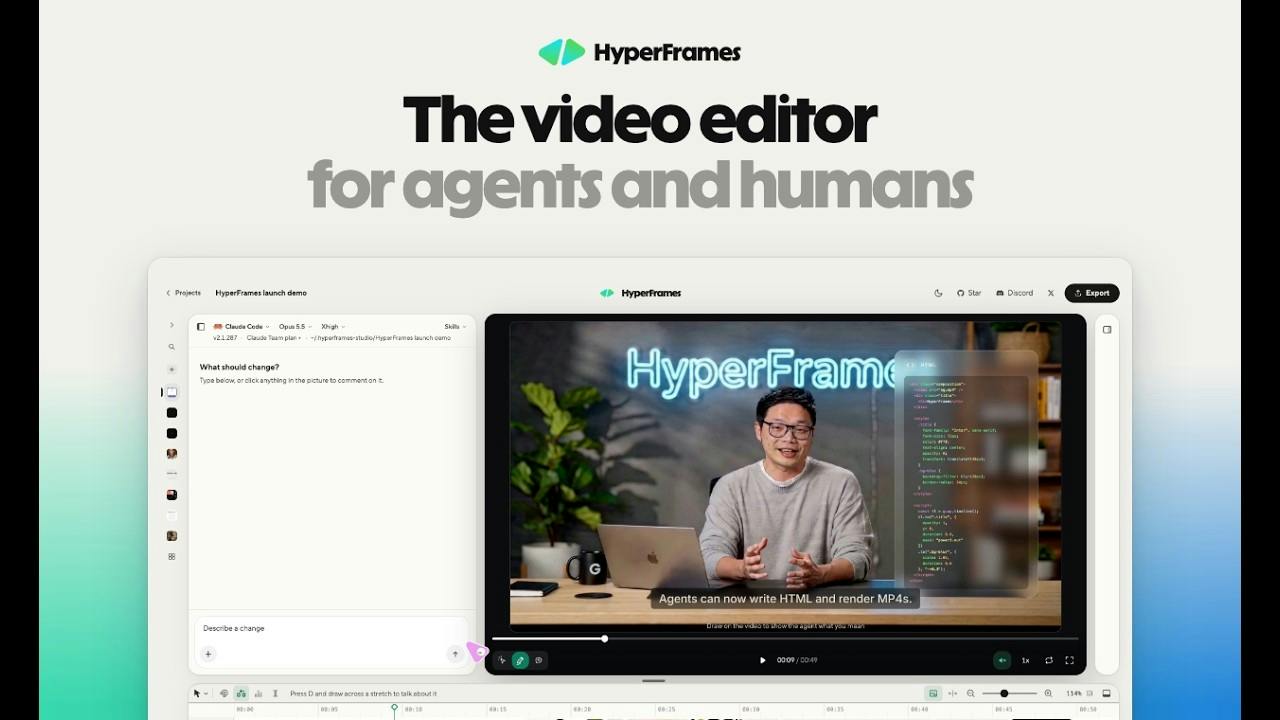
Product: Desktop environment where coding agents such as Claude Code or Codex create and revise videos through HyperFrames; users provide visual feedback and can edit manually.
Availability and pricing: Free desktop downloads for macOS and Linux; Windows listed as coming soon. HyperFrames core is Apache-2.0.
Early adoption signal: The official Studio page displayed roughly 58.8K GitHub stars, 5.2K forks, 81 contributors, and 813.1K npm downloads in the prior week for the open-source HyperFrames project. These ecosystem metrics do not measure Studio usage.
Preliminary decision: PASS for a standalone early-stage investment; monitor as a product and distribution extension inside HeyGen.
EXECUTIVE SUMMARY
HyperFrames Studio is a desktop video editor designed around a human directing an AI coding agent. The agent writes video projects as HTML through the open-source HyperFrames technology; the user can point to frames, mark elements, leave comments, and request changes in context. The editor also offers manual timeline adjustments and exports to common video formats. This workflow aims to make video iteration less ambiguous than editing by chat alone.
The product addresses a real interaction gap: coding agents can generate a first draft, but changes such as adjusting a title’s timing or visual treatment are difficult to express precisely in text. A visual feedback surface lets the creator direct revisions while keeping source projects editable. Existing HyperFrames adoption is a notable distribution asset, with a large GitHub community and npm footprint reported on the official site. HeyGen also has an established video platform and customer base.
The investment issue is corporate and economic fit. HyperFrames Studio is presented as a free desktop product from the HeyGen team; its core technology is Apache-2.0, and no separate company, paid plan, revenue stream, or capital raise was found. As a product, it could improve HeyGen’s ecosystem and attract creators into its broader platform. As a stand-alone early-stage company, the current public evidence does not identify an independent business or monetization model. Recommendation: PASS for a direct early-stage investment in this product entity; revisit only if a separate commercial organization or clear revenue model emerges.
PRODUCT AND USER
The flow combines software creation with creative direction. The user gives a coding agent a prompt to create a video. HyperFrames represents video as HTML and renders it to a final file. The Studio app provides the shared editing surface: a creator can draw or comment directly on the frame, select text or clips, send a grouped set of notes to the agent, or make manual changes using a timeline. The Product Hunt launch describes export to MP4, WebM, and MOV up to 4K, with desktop support for macOS and Linux at launch and Windows marked as coming soon.
The target user is a founder, marketer, storyteller, or creator who wants an agent to handle repetitive video assembly but still needs human control over pacing, composition, and details. The tool’s best-fit work appears to be motion graphics, product launches, talking-head recuts, and short-form video, based on maker responses on Product Hunt. Users are expected to bring their own coding agent, so the product’s utility depends on compatibility and reliable local access to files, installed agents, project dependencies, and rendering tools.
MARKET AND TIMING
Video creation is a large market with growing interest in AI-assisted editing. Existing tools focus on prompt-to-video generation, avatar videos, timeline editors, or browser-based creative suites. Agent-driven software creation is a newer interaction model: agents can manipulate a structured project, while the human gives feedback at the point of visual error. That could make high-frequency iteration faster for teams already adopting coding agents.
The market is crowded and buyer expectations are high. Users compare the product against CapCut, Adobe tools, browser-based editors, agent-native creative suites, and built-in generation inside video platforms. An editor has to deliver predictable exports, manageable assets, reproducible projects, and low-friction collaboration. AI-assisted creation alone is not enough if the resulting media requires extensive correction or if the workflow is limited to technically proficient users.
PRODUCT HUNT AND TRACTION
Product Hunt showed the launch as #7 for the day with roughly 163 points. The maker said the team had recently open-sourced HyperFrames and described strong community metrics, while the official Studio page displayed approximately 58.8K GitHub stars, 5.2K forks, 81 contributors, and 813.1K npm downloads for the prior week. These are meaningful signs of developer interest in the underlying open-source project.
They should not be treated as Studio customers. The key missing metrics are desktop installs, weekly active editors, project completion rate, repeated exports, agent integration share, and the number of users who become HeyGen customers. A high-star open-source runtime may have an audience different from nontechnical video creators. The launch does not provide an independent revenue signal.
BUSINESS MODEL AND STRATEGIC VALUE
The desktop app is free, and the HyperFrames core is Apache-2.0. No separate subscription or paid Studio tier was identified. This may be deliberate: the Studio can promote the open-source framework, increase developer engagement, and serve as a top-of-funnel product for HeyGen’s paid video platform. HeyGen could also use it to keep creators within its ecosystem as agent-native video production expands.
That strategy is plausible but not yet measurable from public data. HeyGen would need to show whether Studio users convert to paid avatar generation, video translation, hosting, or enterprise products, and whether the tool lowers acquisition cost or increases retention. If the desktop editor remains free and operates independently from HeyGen’s paid services, it may create user value without direct revenue. Open-source adoption can strengthen ecosystem reach but does not automatically produce monetization.
COMPETITIVE POSITION AND DEFENSIBILITY
HyperFrames’ code-based representation is a distinctive technical premise. Compared with opaque project formats, HTML-based video projects may be easier for coding agents to create, inspect, and revise. Visual annotations connect the agent to the rendered result. The open-source framework and existing community may make it easier to attract integrations and agent skills than a closed editor.
The moat, if any, resides in the workflow and ecosystem rather than proprietary rendering alone. Open-source competitors can adopt similar formats, and large creative platforms can add agent control surfaces. HyperFrames must sustain reliable exports, composability, templates, integrations, and human feedback that leads to accurate edits. HeyGen’s distribution, engineering resources, and adjacent AI video products are strategic advantages, but also mean product success should be evaluated at the parent-company level rather than assuming a separate startup value.
RISKS
- Monetization ambiguity: No independent Studio revenue or separate company was found.
- Product dependency: Users must operate a compatible coding agent; setup complexity may narrow adoption.
- Workflow quality: Agent edits can be nondeterministic, and visual annotations only help if the agent maps them correctly to project elements.
- Desktop coverage: Windows was not available at launch, constraining some creator and enterprise environments.
- Open-source capture: Community interest in the runtime may not translate into recurring Studio use or parent-company revenue.
- Competitive response: Incumbent editors and AI video platforms can add similar agent interfaces.
- Rendering reliability: Local dependencies, codecs, fonts, and export performance can create support burden.
- Parent-company allocation: Product priorities and business metrics are controlled within HeyGen, so an outside investor may not have direct exposure to this product’s upside.
SCORECARD (1 = weak, 5 = strong)
Problem relevance: 4/5
Product concept: 4/5
Market timing: 4/5
Technical innovation: 4/5
Distribution potential: 4/5
Standalone monetization: 1/5
Verified Studio adoption: 2/5
Defensibility: 3/5
Investability as an independent early-stage company: 1/5
Overall product signal: 3.3/5; standalone investment fit: 1.8/5.
FINAL DECISION: PASS
Pass on a direct early-stage investment in HyperFrames Studio as a separate startup because public information presents it as a free product from HeyGen, with open-source core technology and no distinct company, paid model, or financial reporting. This is not a negative product verdict: the workflow has a plausible user need, and HyperFrames’ community provides a meaningful distribution channel. For investment exposure, diligence should focus on HeyGen’s broader company and whether Studio increases paid customer acquisition, retention, or product usage.
DILIGENCE QUESTIONS
- Is HyperFrames Studio operated and funded solely within HeyGen, or is a separately investable entity planned?
- What is the team’s strategic objective for a free desktop editor?
- How many monthly active Studio users complete and export projects?
- What share of Studio users also subscribe to HeyGen, and how does that conversion compare with other acquisition channels?
- What share of the open-source HyperFrames community uses Studio or commercial HeyGen products?
- Which coding agents and model providers are officially supported and tested?
- How are project files, local assets, and user content handled, especially when agents are invoked?
- What are export reliability, render time, and failure rates across supported platforms?
- When will Windows support ship, and what enterprise deployment and update controls are planned?
- What features remain in the Apache-2.0 core versus the Studio application?
- Are there enterprise customers willing to pay for collaboration, governance, support, or deployment?
- How does HeyGen measure the effect of Studio on acquisition, retention, and paid revenue?
SOURCES
Product Hunt launch: https://www.producthunt.com/products/heygen
Official Studio page: https://www.hyperframes.dev/studio
Open-source repository: https://github.com/heygen-com/hyperframes
HyperFrames documentation: https://hyperframes.heygen.com/