
Table of Contents
Venture Investment Report: Trama
Product: Trama
Product Hunt Page: https://www.producthunt.com/products/trama-mac-automation-in-plain-language
Product Hunt Launch Date: August 24, 2026
Report Date: August 27, 2026
Final Decision: Pass
| Metric | Publicly verifiable evidence |
|---|---|
| Stage | Early access / waitlist |
| Platform | macOS 15.7 Sequoia or later; Apple Silicon and Intel |
| Pricing | Free; Pro $12/month or $96/year; Founding Member $49 one time |
| Product Hunt snapshot | Secondary tracker: 95 votes and 2 comments; observed Product Hunt surface: one review and 92 followers |
| Customers / revenue / retention | Not publicly disclosed |
| Funding | No funding attributable to this specific usetrama.com product was found |
| Team | Founder identity and team composition are not publicly disclosed |
| Evidence confidence | 42/100 |
Executive Summary
Trama is a macOS automation product that turns a plain-language instruction into a workflow the user can review and activate. Automations can react to a shortcut, schedule, clipboard change, or screenshot and use AppleScript, shell commands, OCR, screen context, and integrations. The proposition is attractive: retain native automation power while removing scripting and workflow-builder friction.
The product looks thoughtfully designed for Mac power users. A global Command-Option-X entry point, background operation, step review, and AI-assisted failure explanations address real usability problems. Bring-your-own access to Anthropic, OpenAI, Gemini, or Groq may appeal to technical buyers, while the free plan reduces trial friction.
However, Trama is early access with no public customer count, revenue, retention, workflow success rate, or growth history. Its Product Hunt page and a secondary launch snapshot show launch attention, not recurring use or willingness to pay. Product Hunt popularity is not product-market fit.
Underwriting is also constrained by missing founder information, unclear company ownership, inaccessible legal and privacy pages during research, and no disclosed financing. Trama says workflows execute locally, but the data path for its default hosted-AI option is insufficiently documented for a product able to observe screen, clipboard, and screenshot context and execute scripts.
Trama could become a good bootstrapped utility or acquisition target, but its current platform scope, pricing, traction, and defensibility do not support a venture-scale outcome. The decision is Pass. Reconsideration requires verified founder quality, strong paid retention, dependable automation telemetry, a credible security model, and expansion beyond a Mac-only prosumer niche.
Product Overview
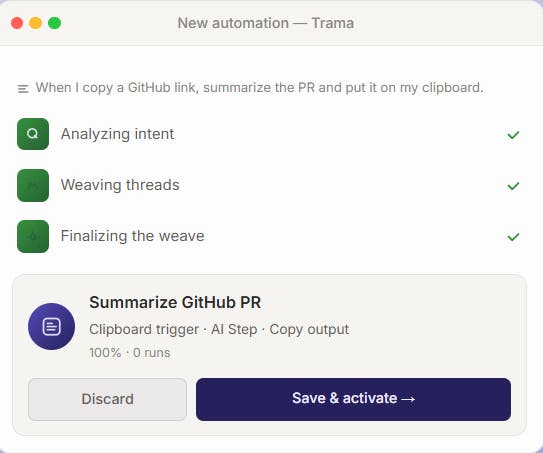
A user invokes Trama from anywhere, describes a desired outcome, reviews generated steps, and enables the workflow. Triggers include keyboard, schedule, clipboard, and screenshot events. Execution can combine native Mac capabilities with Gmail, Calendar, Google Workspace, Slack, Notion, GitHub, Linear, Jira, Airtable, messaging apps, and generic HTTP calls. Trama also claims to detect repetitive work, suggest automations, explain failures, and offer one-click repair.
The combination of conversational authoring and local execution is compelling. Apple Shortcuts still requires users to assemble actions, while scripts demand technical knowledge. Yet public materials do not disclose reliability, permission architecture, auditability, recovery guarantees, or independent security testing. Early-access and waitlist status prevent distinguishing a polished demo from a dependable platform.
Founder and Team Assessment
The site refers to direct contact with “the founder,” but no reliable source found during this review identifies that person, their record, ownership, location, or full-time commitment. No team page, attributable company profile, or relevant GitHub organization was found. Unrelated companies and repositories named Trama were excluded.
This gap is material because native automation demands macOS expertise, secure permission handling, model orchestration, integration maintenance, and support through operating-system changes.
Founder Assessment: Unverified and below the threshold for institutional investment despite promising product execution.
Market Opportunity
The broad automation market is large, but Trama’s current serviceable market is Mac users who repeat digital workflows, trust a third-party app with sensitive permissions, and pay for a utility instead of using Shortcuts, scripts, or broader SaaS automation. Likely buyers are developers, operators, creators, and small-business professionals.
At $96 annually, 100,000 paying users would produce about $9.6 million ARR before discounts, churn, fees, support, and hosted-model costs; one million would produce about $96 million. Neither reachable-user count nor conversion is validated, and one million paid Mac utility users would be exceptional. Team governance, enterprise automation, or cross-platform expansion could enlarge the market but requires security, administration, observability, and procurement capabilities not demonstrated today.
Traction and Growth Signals
A secondary tracker recorded roughly 95 votes and 2 comments for the August 24 launch; the observed Product Hunt surface showed one review and 92 followers. This is modest awareness, not evidence of activation, repeat workflow runs, paid conversion, retention, referrals, or revenue.
No verified usage metrics, customer logos, attributable testimonials, independent review base, or revenue milestones were found. The $49 lifetime offer may create early cash and feedback but can attract price-sensitive users while creating indefinite support obligations.
Traction Assessment: Too early to establish product-market fit; launch engagement does not substitute for cohort retention.
Competitive Position
Competitors include Apple Shortcuts, Automator and AppleScript, shell scripts, Keyboard Maestro, Hazel, Alfred and Raycast workflows, Zapier, Make, n8n, and AI-native browser or desktop agents.
Why will this company still win if incumbents or fast followers copy the product? There is no strong current answer. Natural-language workflow generation, model choice, local execution, and failure explanations are useful but reproducible. Apple owns macOS, permissions, and Shortcuts distribution; established vendors have integrations, communities, and mature reliability tooling.
Trama might build a moat from a corpus of successful workflows, superior repair data, a creator marketplace, trusted security, and community. None is evidenced.
Defensibility Assessment: Low today; differentiation is product experience rather than a demonstrated durable moat.
Business Model and Economics
Free permits three active automations. Pro costs $12 monthly or $96 annually and adds unlimited automations and integrations, rollback, a health dashboard, and persistent variables. The limited $49 Founding Member tier promises lifetime Pro access.
Self-serve annual pricing could work if activation and retention are strong. Bring-your-own keys may reduce inference expense but increase setup friction and variable third-party cost. Default hosted AI improves onboarding but creates an undisclosed cost and privacy dependency. Support can be expensive because failures may originate in permissions, generated scripts, models, or external APIs. Acquisition cost, conversion, churn, gross margin, and support load are not public.
Unicorn Path
At an illustrative 8x ARR multiple, a $1 billion valuation requires about $125 million ARR. At $96 annual list price, that is approximately 1.3 million paying users before discounts, churn, fees, or model costs. A viable path likely requires higher-priced team or enterprise plans, cross-platform reach, and a defensible ecosystem.
Unicorn Path: Improbable.
Valuation Assessment
Not Assessable. No financing terms, cap table, revenue, growth, retention, or current raise information attributable to this product were found. Valuation should not be inferred from launch engagement or pricing.
Key Risks
- Unverified team: Founder identity, experience, ownership, and commitment are unknown.
- No PMF evidence: Public launch activity does not reveal retention or payment behavior.
- Platform concentration: macOS dependence creates Apple policy, API, and feature risk.
- Security: The app can observe sensitive context and execute scripts or external actions.
- Data ambiguity: Boundaries among local execution, hosted AI, providers, and integrations are unclear.
- Reliability: Automations may break when interfaces, APIs, permissions, or models change.
- Copyability: Apple or established vendors can replicate conversational authoring.
- Scale economics: A $96 prosumer plan requires exceptional paid volume.
- Support burden: Lifetime access and integration maintenance create long-tail obligations.
Final Assessment
| Category | Score | Rationale |
|---|---|---|
| Market attractiveness | 13/20 | Large theme, narrower immediate paid Mac-utility segment |
| Traction and PMF | 3/20 | Early access; no verified usage, revenue, or retention |
| Founder quality | 3/15 | Identity and record not publicly verifiable |
| Product differentiation | 8/10 | Strong concept and UX, pending reliability proof |
| Distribution advantage | 7/15 | Launch visibility but no durable channel |
| Business model quality | 7/10 | Clear pricing; economics and hosted-AI costs unknown |
| Defensibility | 4/10 | Product differentiation with substantial incumbent risk |
| Venture Potential | 45/100 | Potentially useful business, not venture-underwritable today |
Evidence Confidence: 42/100. Confidence is limited by early access, absent founder disclosure, missing operating metrics, and incomplete privacy/security documentation.
Final Decision: Pass
Trama addresses a real Mac-user problem, but current evidence supports a promising utility rather than a venture-scale company. Missing founder and operating data block foundational underwriting, while platform dependence, copyability, and low annual pricing make the return math demanding.
Upgrade Conditions: Verify the founder and company; show at least 10,000 paying users or equivalent revenue velocity; disclose 6- and 12-month paid retention; publish automation success and repair rates; complete independent security review; clarify hosted-AI data flow; demonstrate efficient repeatable acquisition; and establish a team or enterprise expansion plan.
Downgrade Conditions: Persistent automation errors, weak conversion, high post-novelty churn, a security incident, a comparable Apple feature, model or integration costs damaging margins, or continued opacity about team and data handling.
Questions for Further Diligence
- Who founded and owns Trama, what are their relevant credentials, and are they full time?
- How many invited, activated, weekly active, paying, and churned users are in each cohort?
- What percentage of automations run successfully after 7, 30, and 90 days?
- Which data leave the device under hosted-AI and bring-your-own-key modes?
- How are shell, AppleScript, screen, clipboard, and integration permissions sandboxed?
- What are conversion, retention, refunds, and support time per customer?
- What are gross margins under hosted AI at median and heavy usage?
- How does one-click repair prevent unsafe changes to approved workflows?
- Which post-Product Hunt acquisition channel has shown repeatable conversion?
- What roadmap expands beyond a Mac-only prosumer utility?
- What proprietary data, community, or ecosystem could become a moat?
- What entity, IP assignments, cap table, and financing history support the product?
Sources
- Trama official website and pricing
- Product Hunt — Trama
- Product Hunt — alternatives and category context
- Launly — launch snapshot
- Apple Shortcuts User Guide
- Keyboard Maestro official website
Public information was limited as of the report date. Unrelated companies, funding announcements, and repositories named “Trama” were excluded.