
Table of Contents
Expertise AI Investment Report
Category: AI workflow automation / GTM software / AI-skills marketplace
Company Stage: Early-stage, commercially active; current marketplace product newly launched
Founder or Founders: Hao Sheng
Headquarters: Toronto, Canada; San Francisco is also listed on the Salesforce marketplace
Funding: Reported $2.5 million, but conflicting public records prevent independent verification
Business Model: Freemium, per-seat and usage-based SaaS; custom team/enterprise plans; prospective marketplace economics
Product Hunt Launch Date: August 26, 2026
Report Date: August 29, 2026
| Investment Metric | Assessment |
|---|---|
| Venture Potential | 63/100 |
| Unicorn Path | Conditional |
| Valuation Attractiveness | Not Assessable |
| Evidence Confidence | 48/100 |
| Final Decision | Watch |
Executive Summary
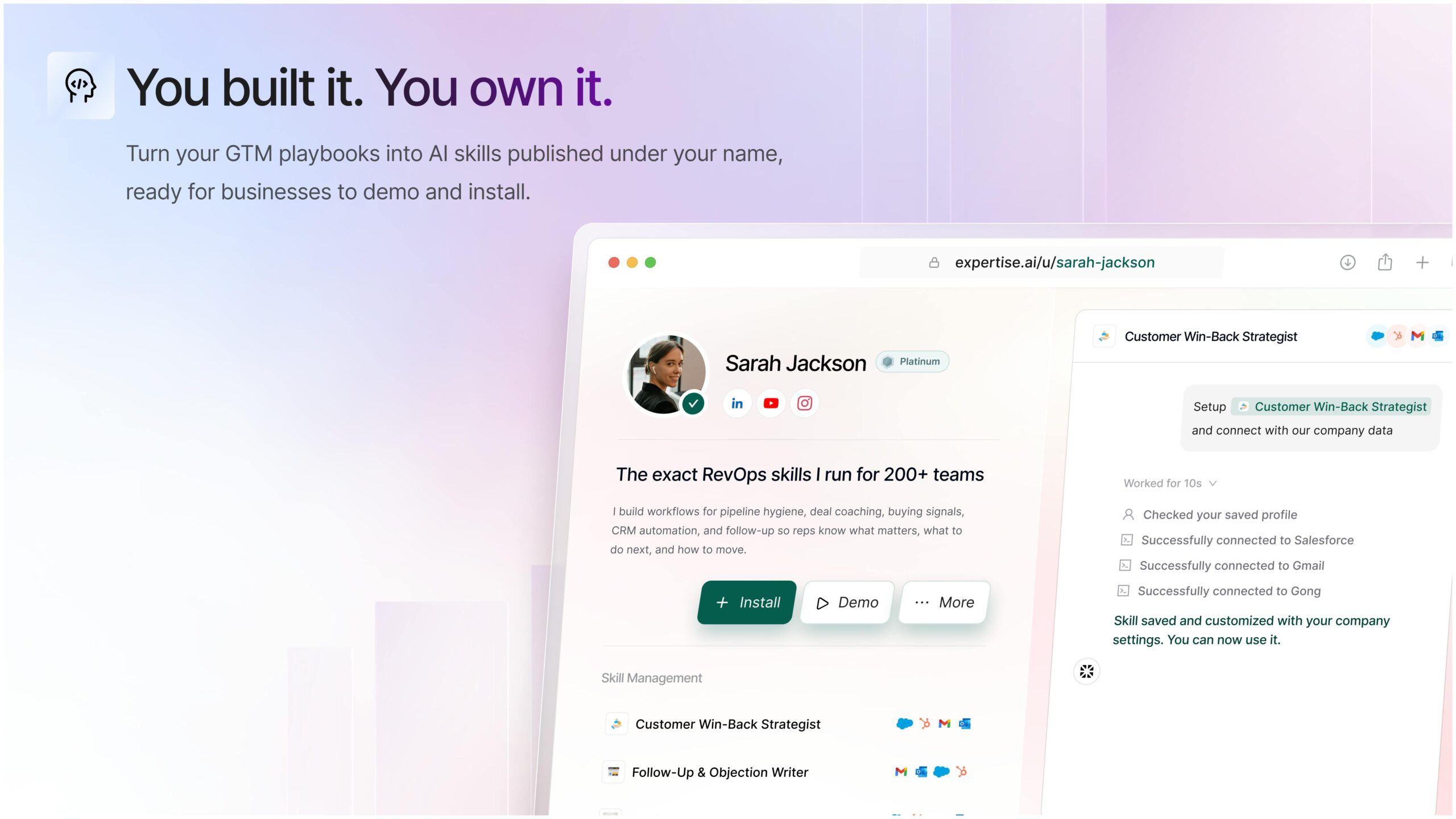
Expertise AI is evolving from Chatsimple, an AI website-sales and support agent, into a broader platform where go-to-market professionals build, distribute and potentially monetize protected AI workflows. Businesses can install these “skills” and run standardized processes for prospecting, account research, follow-up, CRM administration and pipeline management. The company continues to offer its earlier website-agent product as Expertise Live.
The product addresses a legitimate problem: revenue teams repeatedly reconstruct similar prompts and automations, while valuable operating knowledge remains trapped in individual employees or consultants. Expertise combines workflow execution, more than 30 integrations, human-approval controls and a marketplace-like distribution layer. Its current pricing includes a free plan, Pro at $50 monthly or $40 per user per month annually, and custom team plans.
The strongest investment signal is the combination of a technically relevant founder and evidence that the predecessor product reached real business deployments. Founder Hao Sheng previously worked on conversational AI at Google and real-time sales coaching at Cresta, according to his LinkedIn profile. The company publishes multiple named customer case studies, including Gutterglove, 401GO and SafeCheck, and claims that more than 100 B2B companies use its products on its website.
The main concern is that the August 2026 proposition is effectively a new product and distribution model. Historical case studies validate the website-agent product, not necessarily adoption, retention or marketplace liquidity for monetized GTM skills. Revenue, customer retention, marketplace transaction volume, gross margin and current financing terms are not publicly verified.
The product appears good and the company appears capable, but venture-scale potential depends on proving that Expertise can become a durable system of execution rather than another low-priced AI productivity tool. The appropriate decision is Watch, pending commercial evidence for the new platform.
Product Overview
Expertise AI lets users create AI workflows conversationally, connect them to business systems, share them with teams and install workflows published by outside GTM experts. Available examples include deal-risk diagnosis, meeting preparation, prospect research, MEDDICC analysis, campaign diagnostics and CRM updates, as shown in its public skills catalog.
The initial customer is a sales or revenue-operations professional who wants repeatable workflows without building custom automations. The product replaces combinations of prompts, spreadsheets, CRM manual work, Zapier-style automations and specialist point solutions.
The product is web-based. The pricing page offers 200 daily credits on the free plan, while Pro includes 5,000 monthly credits plus 200 daily credits and access to more than 30 integrations. Team pricing is customized. Credit consumption varies by task, making the effective cost of heavy usage difficult to assess publicly.
Expertise Live remains available for companies deploying an AI agent on their websites. Its Salesforce AppExchange listing describes lead qualification, meeting booking, personalized website content and native Salesforce data synchronization.
Founder and Team Assessment
Hao Sheng has strong founder-market fit on the technical side. His public profile reports prior software-engineering roles at Google’s Dialogflow organization and Cresta, where he worked on AI coaching and model-training infrastructure. He also co-founded Liscena, an insurance conversational-interface startup (LinkedIn).
Commercial execution is less independently documented. Named customers and repeated product releases suggest operating capability, but no prior exit or verified scaled sales leadership was found.
LinkedIn classifies Expertise AI as an 11–50-person company but shows only a small number of associated profiles; a secondary database estimates 17 employees. Neither figure should be treated as verified. Recent company posts have advertised engineering, growth and sales roles, indicating active hiring (LinkedIn company page).
Founder Assessment: Strong technical and product relevance, but scaled commercial capability and exact team depth remain unverified.
Market Opportunity
The narrow initial segment is B2B revenue teams with established CRM, email and meeting-data workflows but insufficient engineering resources to build and maintain agentic automations.
A reasonable bottom-up scenario—not a verified market figure—is:
- 50,000 addressable mid-market and enterprise revenue organizations globally
- $10,000 average annual platform spend across seats, credits and team administration
- Implied initial serviceable market: approximately $500 million annually
This assumption requires substantially higher account value than the current $480 annual individual plan. Expansion into enterprise workflow governance, website conversion, expert-created skills, customer support and cross-functional operations could increase the addressable market.
Willingness to pay is supported directionally by published customer outcomes. For example, Gutterglove reports reduced support volume and roughly 300 weekly conversations after implementation, although the results are company-published and relate to Expertise Live rather than the new marketplace (case study).
The market is large enough for a venture-backed business, but only if Expertise moves beyond individual subscriptions and captures meaningful team, enterprise or transaction revenue.
Traction and Growth Signals
Expertise ranked #2 for the day on Product Hunt on August 26, 2026 (daily leaderboard). Its Product Hunt profile records three launches and two reviews (Product Hunt). This demonstrates launch interest, not product-market fit.
More meaningful signals include:
- The company claims adoption by more than 100 B2B companies (official website).
- Its case-study directory names over ten deployments and reports outcomes such as 99% automated chat resolution at Gutterglove and a 50% increase in corporate leads at SafeCheck (case studies).
- The Salesforce marketplace verifies a commercially available integration.
- The company has continued releasing integrations and product features through 2025–2026 (LinkedIn).
These are credible signs of product activity, but the case studies primarily support the legacy website-agent proposition. Public sources do not establish current ARR, growth, paid-customer count, retention, skill-marketplace volume or conversion from free to paid.
A GetLatka page estimates $1.9 million of 2025 revenue, but explicitly labels the figure estimated; it is therefore not treated as verified (GetLatka).
Traction Assessment: Evidence of real deployments and sustained development, but commercial traction for the newly launched platform remains unverified.
Competitive Position
Direct and adjacent competitors include Salesforce Agentforce, HubSpot’s AI agents, Qualified, Intercom, Zapier, n8n, Lindy, Clay and numerous AI sales assistants. Free alternatives include ChatGPT or Claude combined with shared prompt documents and CRM-native automation.
Expertise differentiates through expert-authored, protected workflows that can be installed rather than copied, plus a combination of workflow execution and marketplace distribution. Existing customer integrations and case studies may help establish trust.
However, switching costs appear modest unless workflows become deeply embedded in CRM data, approvals and team governance. The underlying models are supplied by third parties, and many workflow-building capabilities can be replicated by large CRM and automation vendors. HubSpot already offers CRM-native agents and usage pricing, including $0.50 per resolved customer conversation and $1 per recommended prospecting lead (HubSpot).
If Salesforce, HubSpot or Zapier launched the same feature within six months, customers would remain only if Expertise had superior expert content, measurable workflow outcomes, cross-platform neutrality and accumulated execution data. Those advantages are plausible but not yet demonstrated.
Defensibility Assessment: Low to Medium
Business Model and Economics
The current model combines free usage, a $40–$50 monthly Pro subscription, credit-based overages and custom team plans. Expertise Live uses customized business and enterprise pricing.
At $480 per annual Pro seat, individual-user economics are unlikely to support venture scale without very large volume. Team contracts, usage expansion and marketplace take rates are therefore strategically important. The company has not publicly disclosed its commission on expert-created skills or whether experts are currently earning material revenue.
Gross-margin potential should be SaaS-like, but actual margins are unknown. Variable costs include language-model inference, web research, third-party data, integration execution, cloud infrastructure and customer onboarding. Credits can control exposure, but the public pricing page does not disclose overage rates or unit cost per workflow.
The critical economic question is whether customer revenue rises faster than inference and data costs as workflows become more complex and frequent.
Unicorn Path
An 8× ARR multiple is assumed for a durable, growing AI workflow SaaS company with strong retention and acceptable gross margins. This is an analytical assumption, not a current company valuation.
Required ARR = $1 billion ÷ 8 = approximately $125 million.
At the current $480 annual Pro price, Expertise would require approximately 260,000 paid seats. Alternatively:
- At an assumed $20,000 enterprise ACV: approximately 6,250 customers
- At a $50,000 enterprise ACV: approximately 2,500 customers
These targets are difficult under a primarily individual subscription model. A credible path requires enterprise-wide deployment, higher usage revenue, international distribution and potentially marketplace transaction fees. Expertise must also develop proprietary workflow-performance data, reliable governance and distribution that cannot be reproduced by CRM incumbents.
Unicorn Path: Conditional
Valuation Assessment
Funding data conflict materially. PitchBook reports approximately $2.5 million raised and lists investors including YSpace, Anexa Capital, Hersir Ventures, iSeed Ventures and Likeminded.vc. A 500 Global event page also identifies Chatsimple as an accelerator participant (500 Global). Conversely, GetLatka describes the business as bootstrapped. No company funding announcement or financing terms were found.
The acquisitions of Qualified by Salesforce and Drift by Salesloft confirm strategic interest in AI-driven web engagement, but transaction prices or comparable operating metrics are insufficient to value Expertise.
Valuation Attractiveness: Not Assessable
Assessment would require verified ARR, growth, gross margin, retention, burn, runway, round size, SAFE cap or post-money valuation, ownership and liquidation preferences.
Key Risks
- New-product validation: Legacy case studies do not validate retention or willingness to pay for the skills marketplace.
- Incumbent bundling: Salesforce, HubSpot and automation platforms can bundle similar agent functionality.
- Low switching costs: Workflows may be portable or reproducible through prompts and general automation tools.
- Unverified commercial metrics: Revenue, growth, retention and paid-customer count are unavailable.
- Marketplace liquidity: Expert supply does not guarantee buyer demand or recurring transactions.
- AI cost exposure: Complex workflows may consume costly inference and third-party data.
- Positioning complexity: Website agents, AE assistants and expert marketplaces represent materially different products.
- Founder and small-team dependency: Product, financing and go-to-market execution may remain concentrated around the founder.
- Data and execution risk: CRM write-backs and automated outreach require strong permissions, accuracy and auditability.
Final Assessment
Venture Potential: 63/100
| Category | Score |
|---|---|
| Market Size and Expansion Potential | 17/20 |
| Traction and Growth Evidence | 11/20 |
| Founder and Team | 12/15 |
| Product Strength | 8/10 |
| Distribution Potential | 8/15 |
| Business Model and Economics | 4/10 |
| Defensibility | 3/10 |
| Total | 63/100 |
The strongest elements are founder-market fit, a credible product and expansion into enterprise workflow execution. The weakest are commercial verification, defensibility and uncertain marketplace economics.
Evidence Confidence: 48/100
Founder history, pricing, Product Hunt ranking, integrations and named case studies are publicly verifiable. Customer-count and outcome metrics are company-reported. Revenue and employee figures are third-party estimates. Retention, margins, burn, valuation, cap table and marketplace activity remain unavailable.
Final Decision: Watch
Expertise is promising enough to monitor but not yet sufficiently validated for formal investment diligence. The current proposition launched only days before this report, while most commercial evidence relates to the predecessor website-agent product. Unknown valuation and financing terms also preclude an investment recommendation.
Upgrade Conditions
- Verified ARR above $1 million attributable to the current platform or clear retained migration from Expertise Live.
- At least 50 paying team accounts with documented six-month retention.
- Gross margin above 70% after model and data costs.
- Evidence of repeatable acquisition beyond founder-led and Product Hunt channels.
- Meaningful marketplace transaction volume and repeat purchases.
- Enterprise references demonstrating workflow standardization and measurable ROI.
Downgrade Conditions
- Weak free-to-paid conversion or rapid churn after the launch period.
- Continued repositioning without corresponding revenue growth.
- Marketplace experts failing to attract repeat usage.
- CRM platforms replicating the core workflow marketplace.
- Inference costs preventing attractive gross margins.
- Material security, privacy or misleading-claims issues.
Questions for Further Diligence
- What are current ARR, MRR and monthly revenue growth, separated between Expertise and Expertise Live?
- How many paying customers and seats are active, and how many migrated from Chatsimple?
- What are 30-, 90- and 180-day user and revenue retention?
- What percentage of free users become paid users, and how long does conversion take?
- How many skills have been installed, run repeatedly and purchased from external experts?
- What marketplace commission or revenue-sharing model is planned?
- What are gross margin and average inference, data and infrastructure costs per paid account?
- Which acquisition channels produce customers, and what are CAC and payback by channel?
- What is the team structure, and which executives own enterprise sales and marketplace growth?
- What funding has actually been raised, from whom, and what are the cap table, current valuation and proposed round terms?
- What safeguards govern CRM changes, outbound communications, customer data and expert intellectual property?
- What proprietary data or distribution advantage prevents Salesforce, HubSpot or Zapier from commoditizing the product?
Sources
- Product Hunt – Expertise AI
- Product Hunt daily leaderboard, August 26, 2026
- Official website
- Pricing
- Skills catalog
- Customer case studies
- Salesforce AppExchange listing
- Hao Sheng – LinkedIn
- Expertise AI – LinkedIn
- PitchBook company profile
- 500 Global accelerator listing
- GetLatka estimate—secondary, unverified