
Table of Contents
Voiskey Investment Report
Category: AI voice typing, productivity software, and intelligent keyboard
Company Stage: Early-stage; global product launched in July 2026
Founder or Founders: Frank Jiang
Headquarters: Singapore
Funding: Not publicly disclosed
Business Model: Freemium consumer subscription with potential team and enterprise expansion
Product Hunt Launch Date: September 15, 2026
Report Date: September 18, 2026
| Investment Metric | Assessment |
|---|---|
| Venture Potential | 55/100 |
| Unicorn Path | Conditional |
| Valuation Attractiveness | Not Assessable |
| Evidence Confidence | 43/100 |
| Final Decision | Watch |
Executive Summary
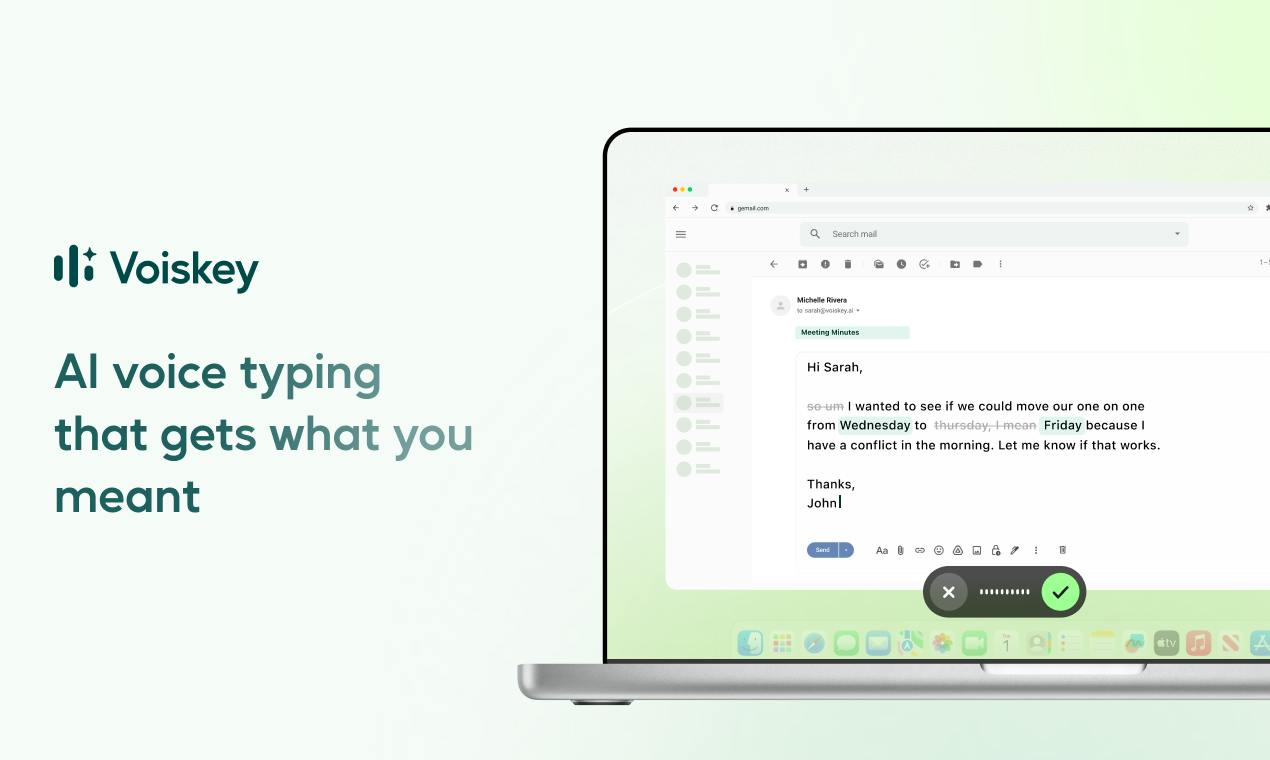
Voiskey is a cross-platform AI dictation application that converts conversational speech into polished text. It removes filler words and false starts, adjusts tone and formatting based on the active application, learns custom vocabulary, supports multilingual output, and offers a whisper mode. It is available on macOS, Windows, iOS, and Android (official website; Apple App Store).
The product targets people who write frequently—developers, founders, salespeople, customer-support staff, students, lawyers, consultants, and creators. Its customer proposition is speed and reduced keyboard effort rather than transcription alone. The company claims speech input can reach more than 220 words per minute versus approximately 45 words per minute for typing, but the practical productivity benefit will depend on correction time, environment, and user comfort with speaking aloud (official website).
The strongest positive signal is early cross-platform distribution. Google Play reports more than 10,000 downloads, 53 reviews, and a 4.2-star rating, while the US App Store reports 11 ratings and a 3.9-star average (Google Play; Apple App Store). The company also reports testing with 1,000 private-beta participants and receiving more than 480 Product Hunt votes, although neither metric establishes paid retention or revenue (launch announcement; Product Hunt update).
The main investment concern is differentiation. Voiskey enters a market where Wispr Flow, Typeless, Superwhisper, Apple Dictation, and Google voice typing already cover much of the same workflow. Wispr Flow, in particular, reports more than 60 billion words written, adoption across more than 10,000 enterprises, and $361 million of total funding. Those figures are company-reported, but they demonstrate the scale and capitalization of the incumbent challenge (Wispr funding announcement).
The final decision is Watch. The product appears functional and has early adoption, but revenue, retention, conversion, acquisition costs, founder background, funding, unit economics, and defensibility are insufficiently established.
Product Overview
Voiskey addresses the gap between unstructured spoken thoughts and text suitable for sending. Conventional dictation generally transcribes words literally; Voiskey attempts to infer intent, remove disfluencies, and produce text appropriate for email, messaging, documentation, or AI prompting.
Core capabilities include:
- Voice-to-text input in any application
- Removal of fillers, restarts, and grammar errors
- Context-sensitive tone and formatting
- Personal vocabulary and spelling preferences
- Whisper recognition
- Translation and output across more than 100 languages
- Structured prompts for AI coding tools
- Synchronization across desktop and mobile platforms
The product operates as a system-wide keyboard or input layer rather than a standalone note-taking application. This broadens usage frequency but requires users to trust it with potentially sensitive speech and application context.
The free tier provides 2,000 words per week after the introductory Pro period, according to an official use-case page. The US App Store lists Pro at $29.99 monthly or $129.99 annually (legal/consulting product page; App Store). Annual pricing is competitive with Typeless and Wispr Flow, although monthly pricing is materially higher than Wispr Flow’s $15 monthly plan and Superwhisper’s $8.49 plan (Wispr pricing; Typeless pricing; Superwhisper pricing).
Product Quality: The feature set is credible and broad, but the small review base and 3.9 iOS rating do not yet demonstrate consistent product quality across platforms.
Founder and Team Assessment
Voiskey identifies Frank Jiang as founder and CEO in company-issued announcements, and a corresponding LinkedIn profile lists him as Singapore-based (launch announcement; LinkedIn profile).
No reliable public information was found regarding Jiang’s previous employment, technical research, prior startups, exits, or fundraising history. The company describes itself as a Singapore-based AI voice research team specializing in affective computing and human-computer interaction, but individual researchers and publications are not identified.
Voiskey is provided by NEXILEAP PRIVATE LIMITED, a Singapore company incorporated on September 5, 2024. Its registered activities include software development and advertising (Voiskey terms; Singapore company record). The App Store independently identifies the same entity as the application’s seller.
LinkedIn displays inconsistent team signals: the company category indicates 51–200 employees, while another search view exposes only two associated profiles. Neither figure is sufficiently reliable to use as verified headcount. Hiring activity and founder full-time commitment are also not publicly established.
Founder Assessment: Founder identity is visible, but relevant experience, technical credentials, organizational depth, and previous outcomes remain largely unverified.
Market Opportunity
The narrow initial segment is individual knowledge workers who produce substantial written output and are comfortable dictating in private offices, homes, vehicles, or other voice-appropriate environments.
For a bottom-up scenario, assume:
- 5–20 million globally reachable, high-frequency knowledge workers
- $100–$150 in realized annual subscription revenue per paying user
- 2%–5% long-term conversion within the reachable segment
This produces a potential revenue range of approximately $10 million to $150 million annually. These are analyst assumptions, not verified market figures. The model illustrates that a consumer-only outcome requires substantial international distribution and retention.
Expansion into teams and enterprises could increase revenue per customer through centralized billing, shared vocabularies, security controls, deployment management, and industry-specific workflows. Developers, legal professionals, healthcare users, sales organizations, and support teams offer potential vertical expansion, but sensitive industries require stronger contractual and privacy safeguards.
Market timing is favorable because AI-assisted writing has made users more willing to accept semantic rewriting rather than literal transcription. Wispr Flow’s reported scale and $2 billion valuation also indicate that investors and customers may support a large voice-productivity category. However, that competitor’s lead makes market entry more difficult, not easier (Wispr announcement).
Traction and Growth Signals
Verified or attributable evidence includes:
- More than 10,000 Android downloads
- 4.2 stars from 53 Google Play reviews
- 3.9 stars from 11 US App Store ratings
- Version 1.6 active on iOS
- Availability on four major operating systems
- #2 Product of the Day on Product Hunt, with more than 480 reported votes
- 1,000 private-beta participants, according to the company
The Product Hunt launch occurred on September 15, 2026 and ranked second on that day’s leaderboard (Product Hunt leaderboard). The votes represent launch interest but provide no evidence of payment, continued use, or renewal.
The company-reported beta claim says participants achieved an average fivefold efficiency improvement. The announcement does not disclose methodology, baseline tasks, correction time, participant selection, or retention, so it should not be treated as independently validated performance (PR Newswire).
The most important missing metrics are registered users, monthly active users, weekly dictation volume, paid subscribers, free-to-paid conversion, subscription renewal, cohort retention, revenue, revenue growth, geographic mix, and customer-acquisition cost.
Traction Assessment: Early consumer adoption is visible, but commercial traction and sustained engagement remain unverified.
Competitive Position
Direct competitors include Wispr Flow, Typeless, and Superwhisper. Indirect competitors include Apple Dictation, Google Gboard, operating-system accessibility tools, Whisper-based local applications, and general AI assistants that accept voice input.
Voiskey’s stated differentiation is “Expression Intelligence”: interpreting intent and adapting output to application context rather than merely producing a transcript. Whisper mode, personal vocabulary, multilingual translation, and AI-coding prompts reinforce this positioning.
However, major competitors already advertise nearly identical capabilities. Wispr Flow supports dictation across all four major platforms, more than 100 languages, custom vocabulary, team workspaces, and enterprise controls. Typeless offers contextual tones, whisper mode, personalization, translation, and zero-cloud-retention claims. Superwhisper offers local models, context-aware AI modes, and bring-your-own-API-key functionality (Wispr pricing; Typeless pricing; Superwhisper plans).
Switching costs are presently low. Personal dictionaries and writing-style learning could create moderate data stickiness, but no proprietary dataset, patent portfolio, independently benchmarked model advantage, or network effect has been demonstrated.
If the largest platform launched the same feature within six months, why would customers continue using Voiskey? They might remain for superior accuracy in specific languages, cross-platform consistency, learned vocabulary, or a lower annual price. None of these advantages is currently proven strongly enough to constitute a durable moat.
Defensibility Assessment: Low
Business Model and Economics
Voiskey uses a freemium consumer-subscription model. Annual list revenue per subscriber is $129.99, while monthly subscribers generate up to $359.88 before discounts, taxes, refunds, and platform fees. Actual revenue mix is not disclosed.
Variable costs include:
- Speech-recognition inference
- Language-model rewriting
- Translation
- Cloud storage and synchronization
- Analytics and customer support
- Apple and Google payment commissions
- User acquisition
Heavy users may generate disproportionately high inference costs under unlimited plans. The investment case therefore requires confirmation that revenue per retained subscriber grows faster than speech and language-model costs.
Direct desktop billing could reduce App Store dependency, but the payment-channel mix is unknown. Team or enterprise plans could improve contract value and retention, although Voiskey has not publicly disclosed enterprise pricing or customers.
Unicorn Path
An 8× ARR multiple is assumed for a rapidly growing subscription software company. The multiple reflects recurring revenue potential but discounts consumer churn, weak switching costs, and competition.
Required ARR:
$1 billion ÷ 8 = $125 million
At the $129.99 annual list price, Voiskey would need approximately:
$125 million ÷ $129.99 = 962,000 annual subscribers
After discounts, free trials, refunds, and app-store commissions, the required number would likely exceed one million paying consumers unless enterprise revenue raises average revenue per account.
A more credible path would combine consumer subscriptions with team plans, enterprise deployment, developer integrations, and specialized products for regulated workflows. Voiskey would also need sustained international distribution, high renewal rates, proprietary speech or personalization data, and meaningfully better performance than bundled operating-system tools.
Unicorn Path: Conditional
Valuation Assessment
No reliable public evidence was found regarding external funding, investors, acquisition offers, a SAFE cap, or a current valuation. Nexileap’s legal incorporation is verified, but its ownership and capitalization are not publicly established.
Wispr Flow’s reported $2 billion valuation is evidence that the category can support unicorn outcomes, but it is not a valid valuation benchmark for Voiskey without comparable scale, growth, and proprietary-model evidence.
Valuation Attractiveness: Not Assessable
Required information includes ARR, growth, subscriber cohorts, gross margin, inference cost, burn, runway, cap table, financing terms, valuation, liquidation preferences, and investor ownership.
Key Risks
- Unverified retention and monetization: Downloads may not convert into durable subscriptions.
- Highly capitalized incumbent: Wispr Flow has substantially greater reported funding, usage, and enterprise reach.
- Low differentiation: Context-aware rewriting, whispering, and multilingual support are already available elsewhere.
- Privacy-policy tension: Marketing materials claim zero server retention and local storage, while the formal policy says voice recordings, transcripts, recent text, and optional application context may be collected and processed by third-party AI providers (privacy policy; company Product Hunt update).
- Sensitive keyboard permissions: A system-wide input product faces a higher trust threshold than a standalone recorder.
- High subscription price: The monthly plan is twice Wispr Flow’s published monthly price and more than three times Superwhisper’s.
- Weak current moat: No independent model benchmark or proprietary-data advantage has been shown.
- Potentially high inference costs: Unlimited dictation could pressure gross margin among power users.
- Founder and team opacity: Relevant backgrounds, headcount, and full-time commitment are not well documented.
- App-store dependency: Commissions, review policies, and keyboard-permission restrictions can affect acquisition and economics.
Final Assessment
Venture Potential: 55/100
| Category | Score |
|---|---|
| Market Size and Expansion Potential | 16/20 |
| Traction and Growth Evidence | 8/20 |
| Founder and Team | 5/15 |
| Product Strength | 7/10 |
| Distribution Potential | 9/15 |
| Business Model and Economics | 6/10 |
| Defensibility | 4/10 |
| Total | 55/100 |
The strongest elements are a real cross-platform product, early downloads, recurring pricing, and a category with demonstrated scale. The weakest are team transparency, commercial validation, privacy clarity, and differentiation from better-capitalized competitors.
Evidence Confidence: 43/100
Verified information includes the legal entity, application availability, public pricing, app-store ratings, Android download band, privacy documents, and Product Hunt launch date. Beta performance, Product Hunt vote totals, security certifications, and proprietary-model claims are company-reported. Revenue, retention, funding, team size, model benchmarks, and economics remain unavailable.
Final Decision: Watch
Voiskey is promising enough to monitor but not sufficiently validated for formal diligence. The product could become a meaningful subscription business; the available evidence does not yet show that it can overcome intense competition and reach venture-scale revenue.
Upgrade Conditions
- More than 100,000 monthly active users with verified usage data
- At least $1 million ARR or equivalent subscription run rate
- Six-month paid retention above 70%
- Gross margin above 70% after inference and platform fees
- Clear reconciliation of privacy-policy and zero-retention claims
- Independent accuracy and zero-edit-rate benchmarks
- Repeatable acquisition outside launch campaigns
- Named team or enterprise customers
- Verified founder and technical-team backgrounds
Downgrade Conditions
- App-store ratings or active usage decline materially
- Free-to-paid conversion remains weak after introductory trials
- High cancellation rates after the first paid renewal
- Inference costs prevent attractive gross margins
- A platform owner bundles comparable contextual rewriting for free
- Security, privacy, or keyboard-data incidents
- Unverified or misleading performance and certification claims
- Declining release activity or founder disengagement
Questions for Further Diligence
- What are current MRR, paid subscribers, and monthly revenue growth?
- How many registered, monthly active, and weekly active users does Voiskey have?
- What are free-to-paid conversion and 30-, 90-, and 180-day retention?
- What percentage of annual subscribers renew after the first year?
- What are average inference costs per free and paid user?
- What is gross margin after App Store fees, refunds, and AI costs?
- Which speech and language models are proprietary versus supplied by third parties?
- How is “Expression Intelligence” benchmarked against Wispr Flow and Typeless?
- How do zero-server-retention claims reconcile with third-party AI processing described in the privacy policy?
- Who are the full-time founders and senior technical employees, and what are their prior outcomes?
- What are the company’s burn, runway, ownership structure, and funding history?
- Is the company currently raising, and what valuation and investor terms are proposed?