
Table of Contents
- HarnessRouter Community Edition Investment Report
HarnessRouter Community Edition Investment Report
Category: Open-source AI-agent infrastructure / developer tools
Company Stage: Early-stage; commercial maturity not publicly disclosed
Founder or Founders: Kuanze Ma and Renchu “Richard” Song for HarnessRouter; ownership relationship with Epsilla requires verification
Headquarters: Not conclusively verified; HarnessRouter lists San Francisco, while Epsilla lists New York City
Funding: Y Combinator S23 backing is verified for Epsilla; exact funding received by HarnessRouter and current capitalization are not publicly disclosed
Business Model: Open-source Community Edition with managed, subscription-and-usage-based HarnessRouter Cloud and custom enterprise plans
Product Hunt Launch Date: August 16, 2026
Report Date: August 19, 2026
| Investment Metric | Assessment |
|---|---|
| Venture Potential | 60/100 |
| Unicorn Path | Conditional |
| Valuation Attractiveness | Not Assessable |
| Evidence Confidence | 48/100 |
| Final Decision | Watch |
Executive Summary
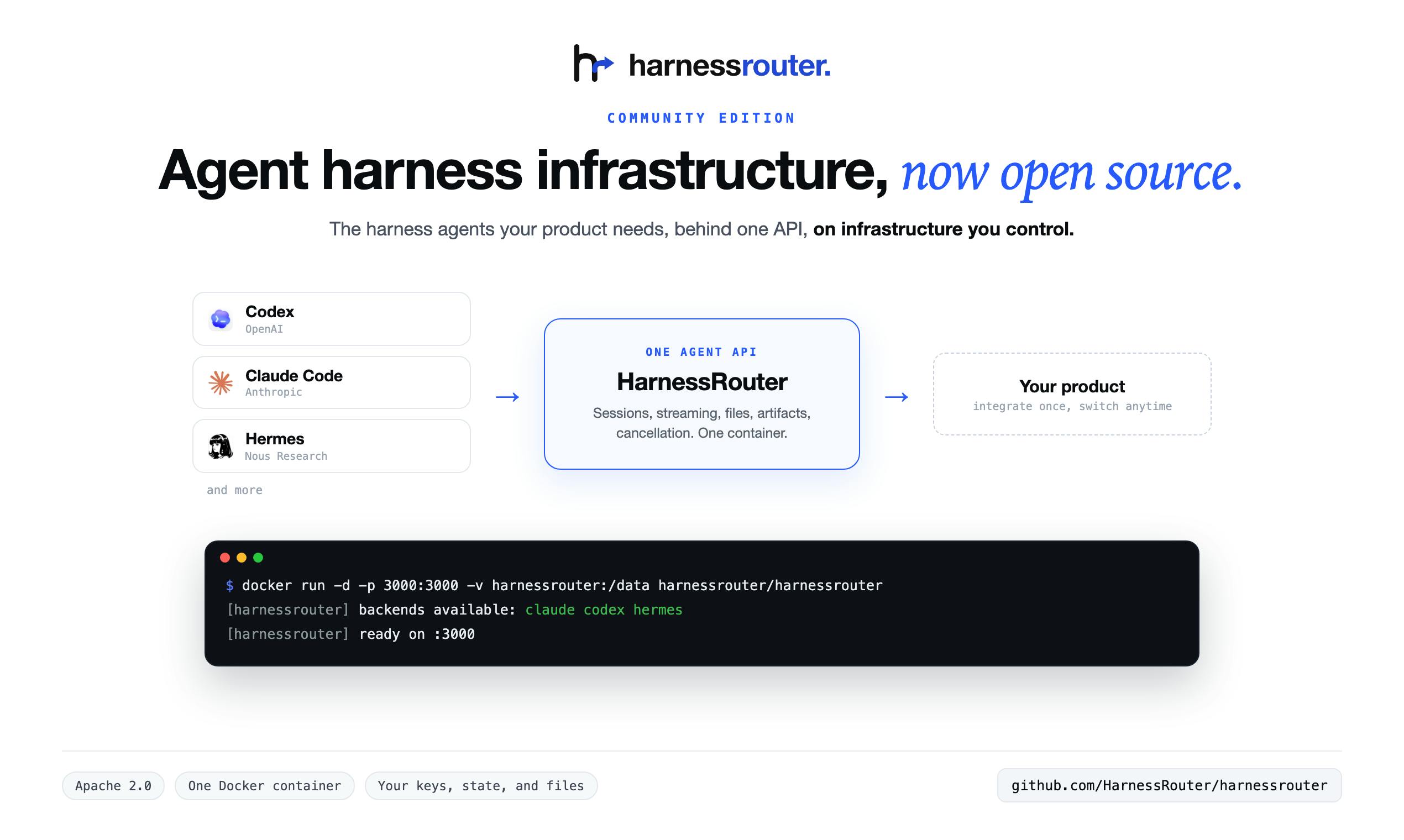
HarnessRouter Community Edition is an Apache 2.0 self-hosted runtime that lets product teams operate Codex, Claude Code, and Hermes through one API. It standardizes sessions, streaming, files, artifacts, cancellation, and failure handling—capabilities that teams otherwise implement separately for each agent harness. The commercial counterpart, HarnessRouter Cloud, operates these workloads in managed isolated sandboxes (official website; GitHub).
The product is technically credible for a very recent release. It provides a single-container installation, an OpenAI Responses-compatible interface, an explicit protocol specification, and a conformance suite. The repository had 167 stars and 11 forks as of August 19, only ten days after its creation, and was still receiving code updates (GitHub API). These are positive developer-interest signals, not evidence of product-market fit.
The strongest company signal is Richard Song’s relevant infrastructure background: his public profile reports senior engineering leadership at TigerGraph and engineering work on privacy infrastructure at Meta, followed by founding Epsilla (LinkedIn). The team also reports deployments or evaluations involving Stanford Medicine, Readily.ai, and Spira.ai, but contract value, production volume, duration, retention, and payment status are not publicly verified (YC launch).
The central concern is commercial validation. No reliable public information was found for ARR, paying customers, usage volume, retention, gross margin, cloud infrastructure costs, or customer concentration. Moreover, the corporate relationship among HarnessRouter, Epsilla, and the founders is unclear. Product Hunt attention—351 points and the #1 daily position—is useful launch validation but says little about recurring demand (Product Hunt leaderboard).
Decision: Watch. Product quality appears promising, but company quality, venture scalability, and investment price cannot yet be established from public evidence.
Product Overview
The target customer is a software team embedding long-running agents into its own application. Such teams must otherwise build sandbox provisioning, sessions, state, streaming, file handling, retries, cost controls, and separate integrations for each agent framework.
Community Edition packages a gateway, runner, console, SQLite state, and workspace storage into one Docker container. It currently supports Codex, Claude Code, and Hermes, uses customer-supplied model-provider keys, and keeps local state on customer infrastructure (open-source page). The associated Unified Harness Protocol is a draft, versioned HTTP standard with OpenAPI schemas and 52 stated conformance checks (UHP specification).
Community Edition is free under Apache 2.0. Cloud pricing is $20 per month for 500 credits, $100 for 3,000 credits, and $200 for 10,000 credits, plus top-ups; enterprise pricing is custom (pricing). The product replaces direct integration with individual agent SDKs or a custom stack of orchestration, sandbox, persistence, and observability components.
Product quality: Strong for its age, with an unusually complete open-source deployment path. However, the repository documents known configuration issues, the protocol remains a draft, and only three harnesses are currently supported.
Founder and Team Assessment
Richard Song has strong founder-market fit for infrastructure. His public career history includes TigerGraph, Meta, Google, a Cornell computer-science master’s degree, and Epsilla, a Y Combinator S23 company. These details are primarily self-reported through LinkedIn but are consistent with the official launch materials.
Kuanze Ma presents a more commercially oriented profile spanning entrepreneurship, community building, HR technology, and recent AI products (LinkedIn). His profile lists concurrent roles at Hibo and AceBeta, while Song’s profile continues to identify him as Epsilla’s CEO. Full-time allocation and ownership of HarnessRouter therefore require verification.
Epsilla’s LinkedIn page lists 2–10 employees and nine associated profiles, while the separate HarnessRouter page shows only one associated profile. LinkedIn counts are approximate and do not verify the actual operating team. No public evidence of previous founder exits was found.
Founder Assessment: Strong technical execution and relevant infrastructure experience, but organizational structure, commercial leadership, and full-time commitment remain insufficiently verified.
Market Opportunity
The initial market is narrower than “AI infrastructure”: product teams that need to expose complete, file-producing agents inside customer-facing software without operating a separate runtime for each harness.
A reasonable analyst scenario is 25,000–75,000 globally addressable software teams spending an average of $12,000 annually on managed execution, monitoring, support, and usage. That implies a preliminary serviceable market of approximately $300 million–$900 million annually. This is an analyst assumption, not a verified market measurement.
Expansion opportunities include enterprise self-hosting support, compliance controls, evaluations, model-and-harness optimization, additional runtimes, workflow templates, and higher-volume execution. International delivery is technically straightforward, although data residency and provider terms may complicate enterprise sales.
The market can support a venture-scale company, but HarnessRouter must capture a high-value infrastructure layer rather than remain a thin compatibility wrapper. Vendor-owned alternatives are advancing rapidly: OpenAI now offers agent loops, sessions, tracing, and sandbox capabilities through its Agents platform, while Anthropic offers both an Agent SDK and managed agents.
Traction and Growth Signals
The Community Edition launch ranked first on Product Hunt for August 16 and accumulated approximately 351 points. This indicates concentrated developer interest, not revenue or retention.
More useful early signals include:
- 167 GitHub stars and 11 forks within ten days of repository creation; code was pushed on August 18 (GitHub API).
- A working Docker image updated within the last day of review (Docker Hub).
- Company-reported use by Stanford Medicine, Readily.ai, and Spira.ai (YC launch).
- Public cloud pricing and enterprise sales motion.
- A prior HarnessRouter cloud launch on July 24, followed quickly by the open-source release.
Missing metrics are decisive: paying-customer count, cloud task volume, ARR, growth, six-month retention, open-source-to-cloud conversion, customer acquisition cost, gross margin, and independently confirmed customer references.
Traction Assessment: Encouraging launch activity, but commercially unverified.
Competitive Position
Direct and adjacent alternatives include LangGraph/LangSmith, E2B, Temporal, OpenAI Agents SDK, Anthropic Agent SDK and Managed Agents, and teams combining model gateways such as LiteLLM with their own sandbox infrastructure. LangSmith already combines deployment, sandboxes, tracing, evaluations, and enterprise hosting (pricing); E2B provides managed agent sandboxes with usage-based infrastructure pricing (pricing).
HarnessRouter’s differentiation is harness-level—not merely model-level—portability, combined with a self-hosted reference implementation and common lifecycle protocol. This is valuable if developers routinely switch complete harnesses and if UHP attracts independent implementations.
“If the largest platform launched the same feature within six months, why would customers continue using this product?” The current answer is only partially credible: customers might value cross-vendor portability, existing integrations, self-hosting, benchmark data, and operational history. However, switching costs are initially low, and UHP has not demonstrated independent adoption or network effects.
Defensibility Assessment: Low
Business Model and Economics
The open-core funnel is logical: Community Edition drives adoption, while Cloud monetizes managed sandboxes, concurrency, tracing, and reduced operational burden. Starter kits also carry commercial-use restrictions that may create licensing or cloud-conversion revenue (starter-kit repository).
Current self-service plans generate only $240–$2,400 of annual base subscription revenue before top-ups. Meaningful scale therefore requires heavy usage or enterprise contracts. Variable costs include sandbox compute, storage, networking, model inference, logging, and support. The company has not disclosed how credits translate into provider and infrastructure costs, making gross margin not assessable.
The economic test is whether task revenue increases faster than model, sandbox, and support costs. Long-running agents can consume substantial tokens and compute, so cost caps, routing, and harness comparison may be economically important rather than optional features.
Unicorn Path
An assumed 10× ARR multiple is appropriate only for a fast-growing, high-retention AI-infrastructure company with strong gross margins. At that multiple:
Required ARR = $1 billion ÷ 10 = $100 million.
At the current $200 monthly Scale plan, HarnessRouter would require approximately 41,700 equivalent customers before top-ups. At a $10,000 blended annual account value, it would require 10,000 customers. A more credible enterprise path—$50,000 average annual contract value—would require approximately 2,000 customers.
Reaching that level requires enterprise pricing, strong usage expansion, more harness integrations, verified reliability, global infrastructure, repeatable developer-led distribution, and proprietary workload/evaluation data. UHP would also need to become a genuine ecosystem standard rather than a company-defined interface.
Unicorn Path: Conditional
Valuation Assessment
Epsilla’s Y Combinator S23 participation is verified, but HarnessRouter’s legal entity, capital ownership, total funding, recent valuation, SAFE cap, current round, and investor rights are not publicly disclosed. The commonly cited YC investment amount should not be treated as verified company funding without transaction documents.
Valuation Attractiveness: Not Assessable
Required information includes current ARR and growth, gross margin, retention, burn, runway, cap table, ownership of HarnessRouter IP, round size, SAFE cap or post-money valuation, option pool, and liquidation preferences.
Key Risks
- No verified revenue, retention, or paying-customer evidence.
- OpenAI, Anthropic, and LangChain can bundle overlapping functionality.
- UHP may fail to gain adoption beyond HarnessRouter’s own implementations.
- Low initial switching costs and limited proprietary data.
- Unclear legal and capitalization relationship with Epsilla.
- Potentially weak cloud margins from model and sandbox costs.
- Dependence on upstream harness APIs, licenses, and product terms.
- Small apparent team and founder key-person risk.
- Security exposure from executing agents with filesystem and command access.
Final Assessment
Venture Potential: 60/100
| Category | Score |
|---|---|
| Market Size and Expansion Potential | 16/20 |
| Traction and Growth Evidence | 7/20 |
| Founder and Team | 11/15 |
| Product Strength | 8/10 |
| Distribution Potential | 8/15 |
| Business Model and Economics | 6/10 |
| Defensibility | 4/10 |
| Total | 60/100 |
The strongest elements are technical execution, founder-market fit, and a potentially important infrastructure problem. The weakest are unverified commercial traction, uncertain economics, and low present defensibility.
Evidence Confidence: 48/100
Product functionality, pricing, open-source licensing, GitHub activity, founder identities, and YC association are reasonably verifiable. Customer usage, performance benefits, and benchmark results are company-reported. Market size and unicorn customer requirements are analyst estimates. Revenue, retention, margins, funding terms, valuation, cap table, burn, and legal ownership remain unavailable.
Final Decision: Watch
HarnessRouter is promising enough to monitor, but not yet supported by the commercial evidence required for formal diligence. The product case is materially stronger than the current investment case.
Upgrade Conditions
- At least $1 million ARR or equivalent contracted recurring revenue.
- Verified production references from three or more paying customers.
- More than 80% six-month logo retention and demonstrated usage expansion.
- Cloud gross margin above 65% after model and sandbox costs.
- Repeatable open-source-to-cloud conversion.
- Independent UHP implementations or meaningful third-party integrations.
- Clear legal entity, founder commitment, cap table, and financing terms.
Downgrade Conditions
- Repository or cloud-product activity declines after launch.
- Major platforms erase the cross-harness integration advantage.
- Credits produce structurally weak gross margins.
- Customer claims cannot be independently validated.
- Upstream licensing blocks commercial harness execution.
- Material security incident involving credentials, files, or agent execution.
Questions for Further Diligence
- What are current MRR, paying-customer count, and monthly revenue growth?
- How many weekly active cloud accounts and monthly agent tasks are there?
- What are 30-, 90-, and 180-day retention by customer cohort?
- How many reported customers are paying, in production, and referenceable?
- What is gross margin by harness and model after inference and sandbox costs?
- What percentage of Community Edition users convert to Cloud, and through which channels?
- What are CAC, sales-cycle length, average contract value, and net revenue retention?
- Which entity owns HarnessRouter, UHP, the code, customer contracts, and related Epsilla IP?
- What are each founder’s time commitment, team structure, burn, and runway?
- What are the cap table, current valuation, round size, and financing terms?
- How are sandbox isolation, credential handling, incident response, and upstream license compliance audited?
- What defensible advantage remains if OpenAI or Anthropic provides a cross-harness-compatible managed runtime?