
Table of Contents
Cekura Bench Investment Report
Category: Public benchmarking and evaluation for voice AI models and agents
Company Stage: Early-stage, seed-backed Cekura product
Founder or Founders: Sidhant Kabra, Shashij Gupta, and Tarush Agarwal
Headquarters: San Francisco, California
Funding: Cekura announced $2.4 million in seed funding in 2025; valuation not disclosed
Business Model: Cekura Bench is free; it supports customer discovery for Cekura’s paid voice-agent QA and monitoring platform
Product Hunt Launch Date: 2026/10/08
Report Date: 2026/10/11
| Investment Metric | Assessment |
|---|---|
| Venture Potential | 73/100 (Cekura parent company) |
| Unicorn Path | Conditional |
| Valuation Attractiveness | Not Assessable |
| Evidence Confidence | 58/100 |
| Final Decision | DD |
Executive Summary
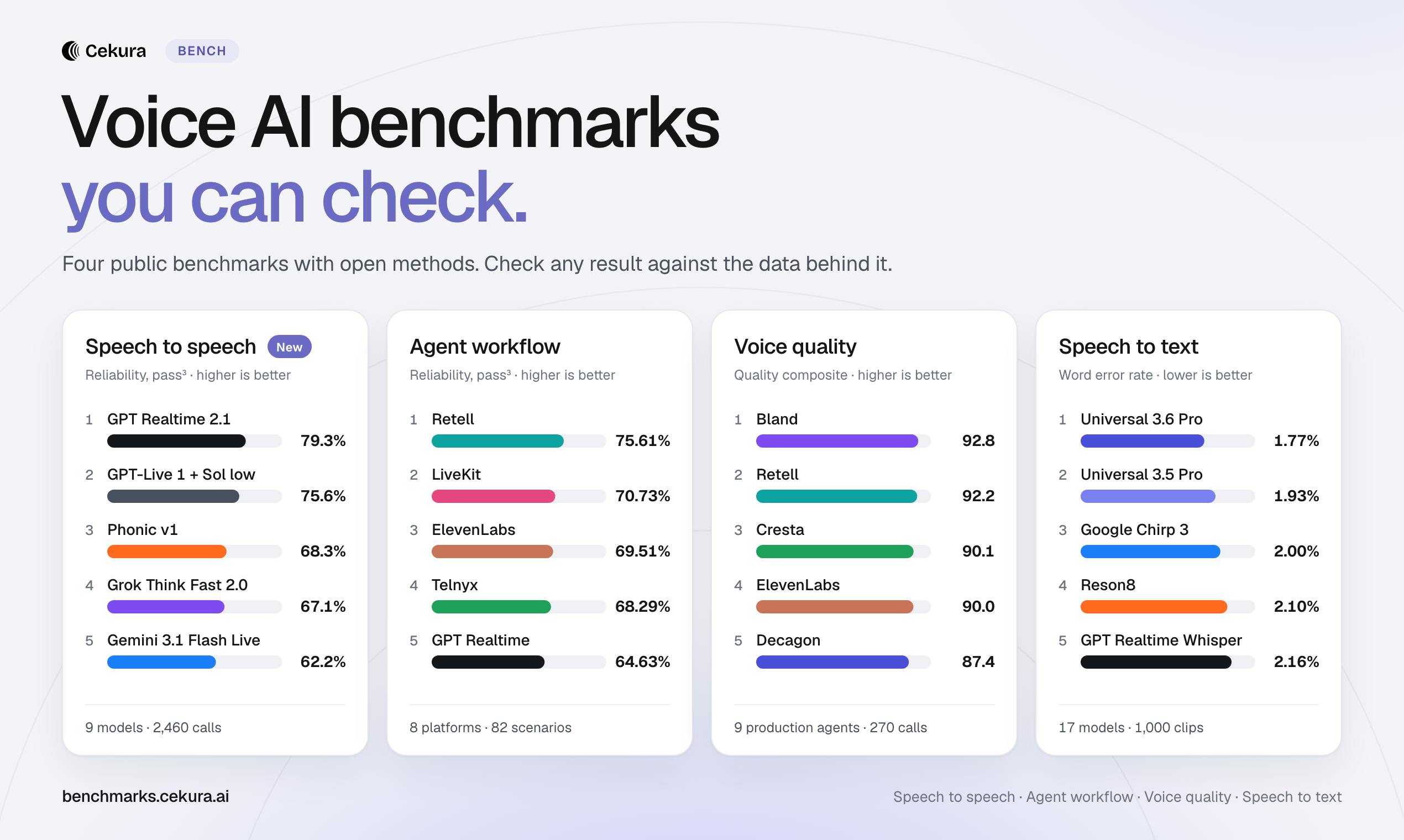
Cekura Bench compares real-time speech models, voice-agent platforms, voice quality, and speech-to-text. Its launch used common phone scenarios, a shared open-source Pipecat agent, repeated calls, and public transcripts. Test cases, code, and much call evidence are public. Cekura Bench Methodology
Cekura Bench is chiefly a free research and distribution asset for Cekura’s paid simulation, testing, and monitoring platform. It can attract developers and create leads, but has no disclosed standalone revenue. Cekura’s Startup plan is $500 per month.
Cekura reports meaningful early company traction: co-founder Sidhant Kabra says the company crossed $1 million ARR in November 2025 and had more than 150 conversational-AI customers, including 25 enterprises, by August 2026. These are founder-reported, unaudited figures. Cekura has also publicly announced $2.4 million in seed funding. Founder’s company timeline Funding announcement
Final Decision: DD. The parent company merits diligence because reported commercial traction, enterprise demand, and usage-based pricing support a real venture case. The key questions are whether the reported ARR is recurring and retained, whether gross margins hold as voice testing scales, and whether Cekura Bench generates measurable pipeline. The benchmark’s conflict of interest is disclosed by Cekura and partly mitigated by open methods, but not eliminated.
Product Overview
Cekura Bench addresses a gap in voice-agent development: demos and isolated model tests do not show whether a complete system can handle a real phone task reliably, accurately, and quickly. Its benchmark pages compare agent platforms and speech models on task completion, data accuracy, latency, reliability, voice quality, interruption handling, and transcription.
At launch, Cekura said it tested nine real-time speech models across 82 scenarios, three runs each, in two phone workflows. The public methodology now distinguishes speech-to-speech models from full agent-platform workflows; the latter uses a fixed 82-scenario suite and three repeats, with failures retained in the denominator. Cekura’s repository and pages expose test cases and code, but its documentation also says some evaluator prompts and scoring rubrics are not published, so exact reproduction is not always possible. Product Hunt Workflow methodology GitHub
Cekura Bench is free, with no paid tier disclosed. It may speed vendor selection and drive inbound demand for the parent’s paid testing platform.
Founder and Team Assessment
Y Combinator identifies Sidhant Kabra as co-founder and President, Shashij Gupta as co-founder and CTO, and Tarush Agarwal as co-founder and CEO. YC’s founder profiles describe Kabra’s customer-experience and consulting experience, Gupta’s NLP research at Google and ETH Zurich, and Agarwal’s quantitative-finance background. These profiles are useful but largely founder-supplied. The team met at IIT Bombay. Y Combinator profile
The founders combine technical research and systems experience with customer operations. The CTO also owns benchmark methodology, strengthening execution but heightening perceived conflict. Current headcount and full-time commitment are not independently verified.
Founder Assessment: Relevant technical and commercial backgrounds support execution, while independent governance of the benchmark and current team scale need diligence.
Market Opportunity
The initial customer is a team building or operating production voice agents in customer support, healthcare, financial services, sales, logistics, or recruitment. These buyers need regression tests, simulated calls, production monitoring, and evidence that an agent completes the intended task without mishandling data or compliance rules.
Cekura reports 150+ conversational-AI customers, including 25+ enterprises; neither a market count nor audited customer list is public. Scenario only: 5,000–20,000 global teams spending $6,000–$50,000 annually imply $30 million–$1 billion in potential spend. The lower figure annualizes its public Startup plan; $50,000 enterprise ACV is an assumption. Scale depends on recurring quality budgets, more monitored calls, regulated deployments, and enterprise infrastructure.
Traction and Growth Signals
Product Hunt ranked Cekura Bench #4 of the day on October 8 with 170 points; Cekura’s page showed 2.3K followers. Neither indicates durable use. Product Hunt
Founder Sidhant Kabra reports that Cekura crossed $1 million ARR in November 2025 and had 150+ customers, including 25+ enterprises, by August 2026; the company also reports evaluating about 60,000 calls daily. YC earlier listed 75+ customers. These are unaudited company claims without retention, concentration, or margin data. Bench traffic and lead conversion are unpublished. Cekura timeline YC profile
Traction Assessment: Promising parent-company traction, primarily founder-reported; the new benchmark’s conversion impact is unknown.
Competitive Position
Cekura Bench competes for trust and attention with independent voice benchmarks, open evaluation suites, academic benchmarks, and vendor-specific scorecards. In paid QA and observability, alternatives include Coval, Roark, and Voice.ai; platform providers such as Vapi, Retell, and LiveKit can also build or bundle testing. Coval Roark Voice.ai
Cekura combines simulation, vendor comparisons, and production monitoring; public code and call evidence support scrutiny. But Cekura sells in the category it benchmarks, and some rubrics are not reproducible. A moat would require trusted data, community use, integrations, and embedded release workflows.
If a major platform launched a similar benchmark, Cekura must win through credible cross-vendor neutrality, broad tests, and QA integration.
Defensibility Assessment: Medium. Workflow integration and benchmark data may compound, but neutrality and distribution are not yet proven as a moat.
Business Model and Economics
The benchmark itself is free. Cekura’s paid platform uses usage-based and subscription pricing: $0.25 per voice-testing minute, $0.05 per monitored call, and $0.025 per chat reply; the Startup plan costs $500 monthly and includes approximately 2,000 voice-testing minutes, 10,000 monitored calls, and 10 seats. Enterprise plans are custom and add volume discounts, access controls, SSO, VPC or on-premise options, and support. Pricing
Usage can expand revenue, but model, telephony, and evaluation costs scale too. Enterprise contracts may raise ACV; custom infrastructure and forward-deployed engineering add service costs. Gross margin, CAC, churn, retention, and benchmark-to-paid conversion are undisclosed.
Unicorn Path
At an illustrative 10× ARR multiple, a $1 billion valuation requires $100 million ARR. At the public Startup price of $6,000 annually, that equals about 16,700 customers. At an assumed $50,000 annual enterprise contract, it requires 2,000 customers. The latter is analyst scenario math; Cekura does not publish typical enterprise ACV.
Reported ARR and customer counts suggest willingness to pay, but $100 million requires much greater enterprise penetration and repeatable expansion. Bench is not yet a demonstrated revenue engine.
Unicorn Path: Conditional
Valuation Assessment
Valuation Attractiveness: Not Assessable. Cekura announced a $2.4 million seed round with Y Combinator, Flex Capital, Hike Ventures, and other investors in 2025. No valuation, current round terms, or later financing was disclosed. Funding announcement
The founder-reported ARR is not independently verified, and no gross margin, growth, churn, burn, or runway is available. A responsible price assessment requires current financials, cohort retention, contract-level ACV, capital needs, cap table, and financing terms.
Key Risks
- Benchmark conflict: Cekura measures a market in which it sells; transparency mitigates but does not remove bias risk.
- Reproducibility gaps: Some evaluator prompts and rubrics are not public.
- Free-product conversion: Bench traffic may not produce paid QA demand.
- Unverified metrics: ARR, customers, and call volume are founder-reported.
- Competitive bundling: Voice platforms may provide their own QA and benchmarks.
- Model churn: Rapid changes in models and telephony can make results stale.
- Usage economics: Testing and monitoring costs may rise with call volume.
- Services burden: Enterprise customization could constrain gross margin and scale.
- Customer concentration: Customer mix and renewal rates are undisclosed.
Final Assessment
Venture Potential: 73/100
| Category | Score |
|---|---|
| Market Size and Expansion Potential | 16/20 |
| Traction and Growth Evidence | 13/20 |
| Founder and Team | 13/15 |
| Product Strength | 8/10 |
| Distribution Potential | 10/15 |
| Business Model and Economics | 7/10 |
| Defensibility | 6/10 |
| Total | 73/100 |
The strongest elements are a clear production-quality problem, paid usage-based pricing, and reported early customer growth. The main gaps are independent validation of commercial metrics, unit economics, and the benchmark’s ability to convert users.
Evidence Confidence: 58/100
Primary sources verify the benchmark methodology, pricing, seed announcement, and founder identities. Customer and ARR milestones come from founder statements and have not been audited. Retention, gross margin, CAC, financing valuation, and benchmark-to-paid conversion remain unavailable.
Final Decision: DD
Cekura merits formal diligence at the parent-company level. Request financial and cohort data before considering an investment. Cekura Bench is strategically useful as a free product and trust channel, but its standalone venture value is unproven.
Upgrade Conditions: Verify ARR and growth from financial records; demonstrate strong six- and twelve-month retention; show positive gross margin after model, telephony, and evaluation costs; measure benchmark signups converting to paid customers; and establish repeatable enterprise acquisition.
Downgrade Conditions: Material divergence between reported and verified metrics, weak renewals, negative usage margins, enterprise reliance on bespoke services, credible evidence of benchmark bias, or rapid bundling by voice platforms.
Questions for Further Diligence
- Can you reconcile the reported $1 million ARR with current MRR, recognized revenue, and customer cohorts?
- What are 30/90/180-day retention, net revenue retention, churn, and expansion by segment?
- How many paying customers and enterprise contracts are active, and what is ACV and concentration?
- What are gross margin and variable cost per test minute, monitored call, and evaluation?
- What are CAC, acquisition channels, and payback for developer and enterprise customers?
- How many Cekura Bench visitors, repeat users, benchmark submissions, and paid conversions does it generate?
- How do you govern benchmark methodology and conflicts when Cekura is also a vendor?
- Which benchmark scores can be exactly reproduced, and which evaluator prompts or rubrics remain private?
- What share of deployments require forward-deployed engineering or custom infrastructure?
- What are current burn, runway, cap table, and fundraising terms or plans?