
Table of Contents
NOVA CLI v1.0 Investment Report
Category: AI coding agent / developer CLI
Company Stage: Early product; NOVA CLI v1.0 public launch
Founder or Founders: Not publicly disclosed; Product Hunt maker is Bridgeye
Headquarters: Ponda, Goa, India (registered office)
Funding: Not publicly disclosed
Business Model: Freemium software with usage credits; team and enterprise plans
Product Hunt Launch Date: 2026/10/08
Report Date: 2026-10-11
| Investment Metric | Assessment |
|---|---|
| Venture Potential | 53/100 |
| Unicorn Path | Conditional |
| Valuation Attractiveness | Not Assessable |
| Evidence Confidence | 50/100 |
| Final Decision | Watch |
Executive Summary
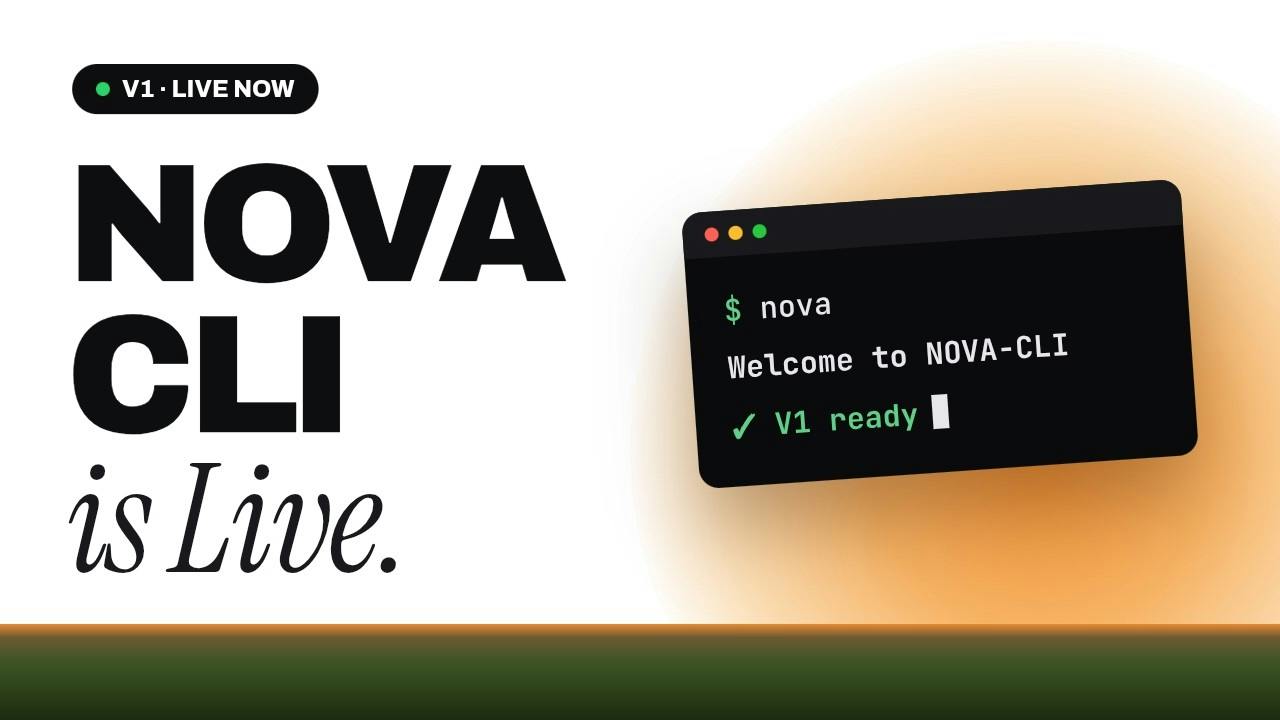
NOVA CLI v1.0 is a terminal-based coding agent from Bridgeye. A developer describes a task; NOVA reads relevant project context, edits files, runs the project’s tests and build, attempts to fix failures, and summarizes what it checked. The launch also promotes access to 160+ models on paid plans without a separate model-provider account (Product Hunt launch).
The target is terminal-first developers and small teams. The product’s strongest signal is its edit, execute, diagnose, and repair loop; its weakness is competition from better-distributed agents.
Product Hunt showed 108 points, #9 rank, 335 followers, and no reviews. Earlier launches received 95 and 4 points; these measure discovery, not retention or willingness to pay.
Current official pricing pages expose free, Starter, Pro, and Max tiers, but monthly prices render as “—”; an older February terms page lists different plan names and prices. Funding, revenue, active users, conversion, retention, and founder identity are not publicly verified. Final Decision: Watch until Bridgeye demonstrates repeat paid use and clarifies product economics.
Product Overview
The broader NOVA product also builds browser-based apps and documents. CLI workflows include project mapping, persistent context, multi-file edits, debugging, and local execution. The launch says users can run existing tests and builds; the vendor states that selected code context is sent to an AI model provider and changes are applied on the developer’s machine (NOVA home, terms, privacy policy).
Free lists two active projects and ten patches per project; paid plans add capacity, priority, and team controls. Live monthly plan prices are not displayed. The team page offers credit packs ($15 for 1,000; $65 for 5,000; $250 for 20,000), but does not establish typical per-user revenue or task cost (pricing, team pricing). The user benefit is less context switching and faster debugging; alternatives include existing terminal agents and IDE copilots.
Bridgeye says CLI requests send selected code context to model providers, are not retained by Bridgeye, and are not used for training. Providers’ own policies and processing regions still apply, a concern for proprietary code (privacy policy).
Founder and Team Assessment
Bridgeye Private Limited is registered in Ponda, Goa; Bridgeye is the Product Hunt maker (terms). Current primary sources do not identify a founder, team size, fundraising history, or commercial leadership.
Founder Assessment: Company identity is verifiable; founder capability, commitment, and team depth remain unknown.
Market Opportunity
The initial segment is terminal-first developers who want an agent to edit, run, and debug code in one workflow. As an illustrative scenario, 500,000–1,000,000 reachable users paying an assumed $10–$30 monthly would imply $60–$360 million annual revenue. These are assumptions, not measured market data; official monthly prices are not shown.
A standalone CLI is a narrow entry point. Team controls, shared credits, private deployment, and a broader build/test/ship workflow could raise contract value. Adoption is timely, but switching costs are low and models improve quickly.
Traction and Growth Signals
Product Hunt displayed 108 points, #9 daily rank, 335 followers, and no reviews for NOVA CLI v1.0. Its earlier March and September 2026 launches received 95 and 4 points respectively (Product Hunt launch history). A free tier and public installation path help evaluation, but no trustworthy user, customer, revenue, growth, conversion, retention, or referral figures were found.
The site displays testimonials, but no named case studies or attributable outcomes. Paid conversion and repeat use are unknown.
Traction Assessment: Launch activity and product claims are public; commercial traction is unverified.
Competitive Position
Direct alternatives include Claude Code, Cursor CLI, GitHub Copilot CLI, OpenCode, and Aider. GitHub Copilot offers a free CLI tier and paid individual plans starting at $10 per month, backed by GitHub’s distribution and integrated agent workflow (Copilot pricing). OpenCode is an open-source terminal and IDE agent that supports many model providers and existing subscriptions (OpenCode). These alternatives make “many models in one terminal” insufficient as a moat.
NOVA’s possible differentiation is model routing, test-and-repair, project memory, and bundled credits. App-building may broaden use but blurs positioning. No proprietary data, network effect, switching cost, benchmark advantage, or community scale is verified.
If the largest platform in this market launched the same feature within six months, customers might stay only if NOVA’s repair quality, model choice, and price were measurably better. GitHub and model providers already control major distribution channels and can bundle agent workflows.
Defensibility Assessment: Low
Business Model and Economics
Freemium subscriptions and credit packs provide a monetization mechanism, but missing plan prices and credit-to-task conversion prevent estimates of ARPA or willingness to pay. February 2026 legacy terms listed $15 Max and $30 Pro; those differ from current tiers and are historical, not current pricing (legacy terms).
Costs include inference, routing, hosting, and support. A multi-model catalog adds provider cost and quality variability. Gross margin, successful-task cost, and usage distribution are unknown; restrictive limits could also hurt retention.
Unicorn Path
At an illustrative 10× ARR, $1 billion implies $100 million ARR. At an assumed $120–$360 annual spend, that requires 278,000–833,000 paying users; these are not current prices.
A credible path requires team/enterprise plans, distribution, workflow depth, retention, and healthy inference margins. None is yet demonstrated.
Unicorn Path: Conditional
Valuation Assessment
Funding, investors, valuation, and current round terms were not disclosed. Without revenue, growth, margins, and financing data, no valuation range is supportable.
Valuation Attractiveness: Not Assessable. Investors would need current ARR, paid-user cohorts, gross margin by model and plan, burn/runway, round size, SAFE cap or post-money valuation, dilution, and investor rights.
Key Risks
- Distribution and differentiation: Free and low-cost coding agents are already widely distributed.
- Retention and paid conversion: No cohort, conversion, or paid-user metrics are public.
- Unclear pricing: Live plan prices are blank, and older terms conflict with current plan names.
- Inference economics: Credit revenue may not cover variable model costs on complex tasks.
- Code privacy: Prompts and code are sent to external model providers, whose retention and processing locations vary.
- Contractual limits: The current terms disclaim output accuracy and limit liability, which may deter business buyers (terms).
- Founder/key-person risk: Founder identity and team size are not public.
- Product focus: CLI, app builder, and document creation broaden the pitch but may dilute execution.
Final Assessment
Venture Potential: 53/100
| Category | Score |
|---|---|
| Market Size and Expansion Potential | 16/20 |
| Traction and Growth Evidence | 6/20 |
| Founder and Team | 5/15 |
| Product Strength | 8/10 |
| Distribution Potential | 8/15 |
| Business Model and Economics | 6/10 |
| Defensibility | 4/10 |
| Total | 53/100 |
An actionable workflow and large developer market are positives; commercial evidence, team visibility, pricing, and differentiation are weak.
Evidence Confidence: 50/100
Product, legal entity, terms, privacy disclosures, and launch metrics are public. Founder, funding, revenue, retention, growth, and economics remain unknown. Market scenarios are assumptions.
Final Decision: Watch
Watch until NOVA publishes pricing, demonstrates paid retention and reliable code fixes, and discloses financing terms.
Upgrade Conditions
- Publish plan pricing and per-task credit use.
- Show 500 paid users or 25 paying teams with six-month retention.
- Demonstrate repair success, regression, and acceptance rates.
- Disclose gross margins and repeatable acquisition.
- Identify founders and disclose financing terms.
Downgrade Conditions
- Weak free-to-paid conversion or repeat use.
- Failed or damaging multi-file repair.
- Provider changes undermine credit economics.
- Distribution remains launch-led.
- Material security, privacy, or legal issues.
Questions for Further Diligence
- Who founded Bridgeye, what are their relevant exits, and who works full time on NOVA?
- How many monthly active CLI users and paying subscribers are there, and how have both changed month over month?
- What are free-to-paid conversion, 30/90/180-day retention, churn, and credit-purchase frequency?
- What are plan prices, included credits, overages, and blended ARPA?
- What share of tasks complete successfully, pass project tests, and are accepted without manual repair?
- What are inference and hosting costs per task by model and plan, and gross margin by cohort?
- Which providers process code, their retention settings, and enterprise region/model controls?
- What are CAC, the best acquisition channels, and the payback period?
- How much revenue comes from CLI versus app-building, documents, and team plans?
- What are funding history, burn, runway, cap table, financing ask, valuation, and proposed investor rights?