
Table of Contents
Scholé Scenarios Investment Report
Category: Enterprise AI upskilling and adaptive scenario-based learning
Company Stage: Early-stage, externally funded
Founder or Founders: Vinitra Swamy, PhD, and Paola Mejia, PhD
Headquarters: San Francisco and Lausanne operations
Funding: $3 million disclosed
Business Model: Freemium SaaS, individual subscription, and team/enterprise plans
Product Hunt Launch Date: August 17, 2026
Report Date: August 20, 2026
| Investment Metric | Assessment |
|---|---|
| Venture Potential | 70/100 |
| Unicorn Path | Conditional |
| Valuation Attractiveness | Not Assessable |
| Evidence Confidence | 63/100 |
| Final Decision | DD |
Executive Summary
Scholé Scenarios is a scenario-based extension of Scholé AI’s workforce-learning platform. It gives employees realistic conversations or decisions to practice, provides immediate coaching, and adapts subsequent instruction to their performance. The broader product creates personalized, role-specific AI and data-science learning grounded in employer documents and work context (Scenarios; pricing).
The product targets enterprise learning-and-development teams seeking practical AI adoption rather than generic course completion. The central thesis is credible: organizations may buy AI tools without employees knowing how to apply them in their roles, while conventional learning libraries are often static and weakly connected to daily work. Scenario-based practice could improve transfer from training to execution, although Scholé has not publicly released controlled outcome data demonstrating this effect.
The company’s strongest investment signal is founder-market fit. Co-founders Vinitra Swamy and Paola Mejia recently completed PhDs at EPFL’s Machine Learning for Education laboratory, and Scholé commercializes research conducted at EPFL and UC Berkeley. Swamy also has Microsoft AI, UC Berkeley teaching, and education-infrastructure experience (ACE Ventures; Swamy profile).
Scholé raised $3 million led by ACE Ventures, with The House Fund and Fund F participating. The company reports pilots with Swisscom, Decathlon, and Coop, plus a Harvard collaboration serving learners from hundreds of companies. These are promising signals, but pilot status, contract value, revenue, retention, and employer-wide adoption are not publicly verified (funding announcement).
The company merits DD because it combines a relevant enterprise problem, research-backed founders, institutional financing, an active product, and early enterprise relationships. Investment should remain contingent on learning-outcome evidence, paid deployment expansion, retention, gross margins, and current financing terms.
Product Overview
Most corporate learning platforms deliver standardized videos, readings, or quizzes. Scholé instead creates adaptive learning paths based on a learner’s role, goals, prior performance, and employer materials. Its Olé tutor delivers lessons in text, audio, and video formats.
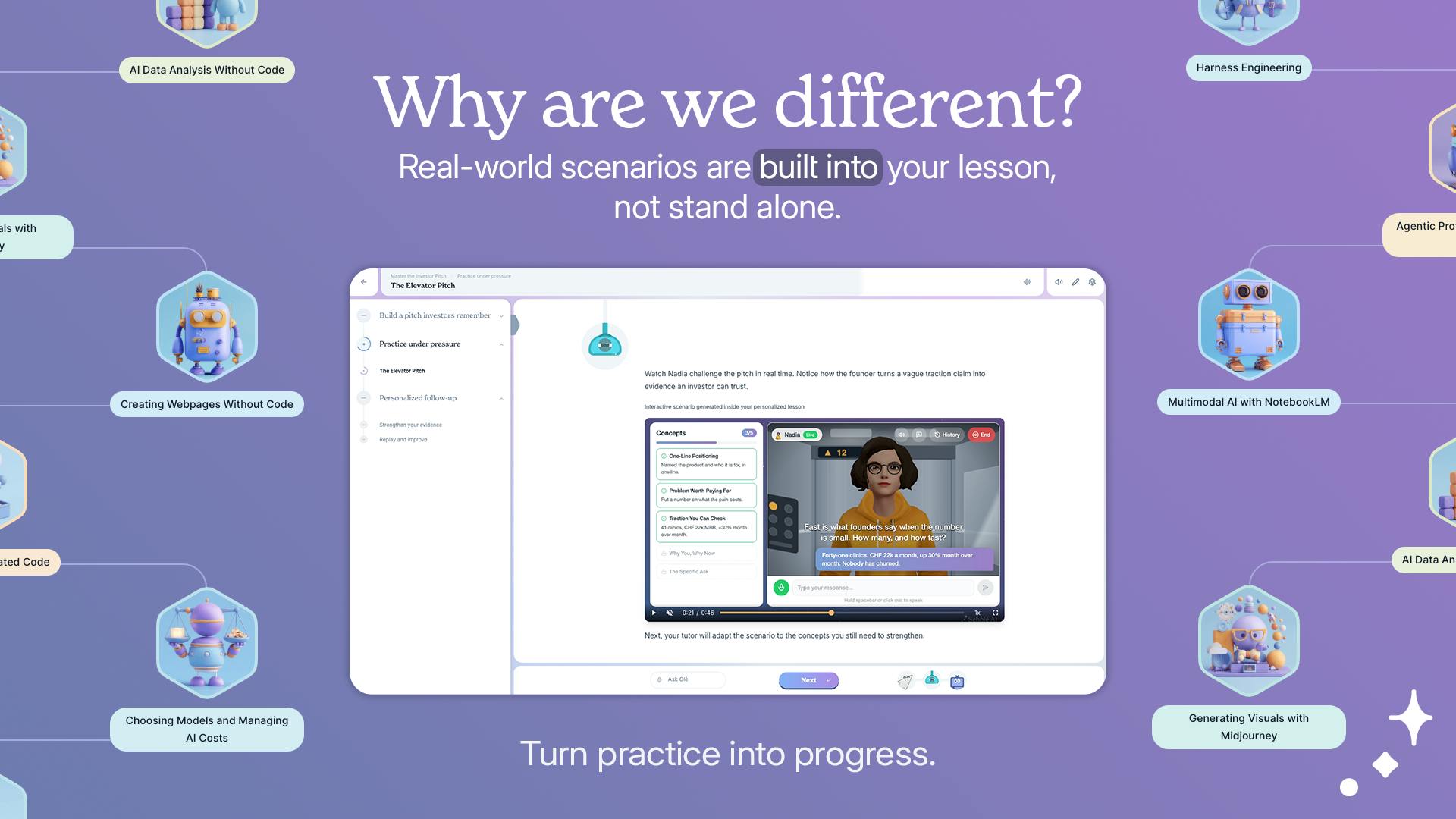
Scholé Scenarios adds active practice. A learner first receives focused instruction, then participates in a simulated workplace situation—such as explaining a concept to a colleague, handling a customer objection, or making a work decision. The system evaluates the response, gives coaching, and adapts the next lesson (official Scenarios page).
The initial use case is enterprise AI fluency, with more than 100 company-reported lessons drawn from or curated around material associated with Harvard, Berkeley, UCSD, the University of Washington, and EPFL. Team features include company-document retrieval, an administrative dashboard, progress tracking, assigned scenarios, and EU AI Act Article 4 training support (pricing).
Pricing includes:
- Free: two trial lessons;
- Pro: $99 per learner per month;
- Teams: $580 per month for up to eight seats;
- Enterprise or larger-team terms: not clearly disclosed.
The pricing page contains inconsistencies: different page sections show $5,000 and $5,800 as the annual Teams price, while the displayed $725 monthly charge for each additional learner appears economically inconsistent with the included-seat price. These terms require direct confirmation.
The primary benefit is personalized practice tied to real work. Alternatives include generic courses, live workshops, static LMS content, internal AI champions, and manual role-playing with managers or trainers.
Founder and Team Assessment
CEO Vinitra Swamy earned a PhD in computer science at EPFL, with research focused on explainable AI and personalized education. Her public profile also shows prior work as an AI software engineer at Microsoft’s ONNX initiative, teaching experience at UC Berkeley and the University of Washington, and current teaching involvement with Harvard’s Data Science Initiative (Swamy profile).
CTO Paola Mejia also completed doctoral work in EPFL’s Machine Learning for Education laboratory, focusing on self-regulated learning in online and blended environments. She has published relevant academic work and was part of the earlier Scholé project recognized by the Tools Competition (Tools Competition; EPFL profile).
This is unusually strong technical and research fit for adaptive learning. The founders also appear full-time. However, no prior founder exits were found, and large-scale enterprise sales experience is less evident.
LinkedIn lists 12 associated profiles while categorizing the company as having 2–10 employees, an internal inconsistency that prevents precise headcount verification. Public posts identify leadership across sales, learning, engineering, and design and show hiring activity in San Francisco and Lausanne (LinkedIn; careers).
Founder Assessment: Exceptional learning-science and AI fit, with enterprise commercial scaling still to be demonstrated.
Market Opportunity
The initial customer is a medium-to-large enterprise deploying generative AI across multiple functions and needing role-specific employee training, adoption measurement, and regulatory documentation. Likely buyers include Chief Learning Officers, HR/L&D leaders, AI transformation executives, and business-unit leaders.
An illustrative bottom-up opportunity is:
- 20,000–40,000 globally addressable employers;
- 100–500 deployed learners per employer;
- effective annual revenue of $300–$1,000 per learner after volume discounts.
This implies a theoretical $0.6–$20 billion opportunity. These are analyst assumptions, not company-reported figures. The wide range reflects uncertainty about whether Scholé becomes an enterprise-wide system or remains a limited cohort-training tool.
Expansion opportunities include sales coaching, customer service, compliance, leadership training, technical upskilling, onboarding, credentialing, and workforce-skills analytics. Geographic expansion is plausible because the product already operates across the United States and Switzerland and promotes multilingual learning.
Market timing is favorable because AI adoption creates a rapidly changing skills gap. However, the AI-training wedge may become less valuable as basic AI literacy improves, so Scholé must expand into persistent work-based skill development.
Traction and Growth Signals
The initial Scholé Product Hunt launch on May 2, 2026 received approximately 335 votes and ranked #1 for the day. Scholé Scenarios subsequently recorded 173 votes on August 17, with a third-party snapshot reporting a #2 daily ranking (Product Hunt; Scenarios leaderboard; Launly). This is evidence of launch interest, not product-market fit.
More relevant evidence includes:
- $3 million raised from ACE Ventures, The House Fund, and Fund F.
- Company-reported pilots with Swisscom, Decathlon, and Coop.
- A Harvard collaboration involving learners from hundreds of global companies.
- Participation in enterprise-learning and education conferences.
- Continued product releases between the May and August launches.
- Active hiring and a visible multidisciplinary team.
The company website says “hundreds of organizations” are learning on Scholé, but it does not distinguish free users, course participants, pilots, paying customers, or enterprise contracts (pricing). Likewise, employees from Bank of America, NASA, Oracle, Microsoft, and Apple reportedly used Harvard-linked courses on the platform; this does not establish those employers as Scholé customers.
The most important missing metrics are ARR, paying organizations, paid seats, weekly active learners, lesson completion, scenario frequency, free-to-paid conversion, cohort retention, contract expansion, and measured workplace impact.
Traction Assessment: Credible institutional and pilot signals, but recurring commercial traction remains unverified.
Competitive Position
Direct competitors include Sana, 360Learning, Docebo, Cornerstone, Degreed, and other AI-enabled corporate-learning platforms. Coursera for Business and LinkedIn Learning compete through content breadth and existing enterprise distribution.
Scenario-specific competitors include AI role-play and coaching products such as Second Nature, Yoodli, Mursion, and vertical sales-training tools. Free alternatives include ChatGPT or Claude role-playing, internal prompt libraries, live manager-led simulations, and employer-created LMS courses.
Scholé differentiates through its founders’ learning-science research, real-time adaptation, multi-format instruction, organizational-document grounding, and integration of instruction with scenario practice. Its academic and Harvard relationships may strengthen credibility with enterprise buyers.
Switching costs could develop through company-specific content, learner histories, skill graphs, and measured performance data. There are no clear network effects, and proprietary-data advantages are not yet demonstrated. Foundation-model providers and incumbent LMS vendors could replicate conversational simulations.
If the largest platform launched the same feature within six months, why would customers continue using Scholé? The answer would need to be measurably better learning outcomes, deeper personalization, trusted pedagogy, and accumulated learner/organization context. Public evidence does not yet prove these advantages.
Defensibility Assessment: Medium-Low
Business Model and Economics
Scholé combines individual subscriptions with team and enterprise SaaS. The Teams list price equates to approximately $725 per included learner annually at eight seats, before any ambiguity in annual pricing.
Potential enterprise ACV could range from tens of thousands to several hundred thousand dollars depending on seat count and services, but no verified contract values are available. Expansion revenue could come from additional learners, content domains, scenarios, analytics, compliance, and organization-specific knowledge bases.
Variable costs include LLM inference, retrieval and document storage, voice and video generation, scenario evaluation, cloud infrastructure, customer support, and learning-content oversight. Unlimited lessons could create unfavorable usage economics if heavy users consume significant multimodal generation.
Enterprise gross margins will also depend on onboarding and content-customization labor. The company must demonstrate that personalization and scenario generation are sufficiently automated to avoid consulting-like economics.
Unicorn Path
An 8× ARR multiple is appropriate for an enterprise learning SaaS company at scale, assuming strong growth and retention but recognizing that education software generally receives lower multiples than core infrastructure.
Required ARR = $1 billion ÷ 8 = approximately $125 million
At the Teams annual list price of approximately $5,000–$5,800, Scholé would require more than 21,000 team accounts. A more credible enterprise route would be:
- 2,500 customers at $50,000 ARR;
- 1,250 customers at $100,000 ARR; or
- 500 customers at $250,000 ARR.
Reaching this scale requires enterprise-wide deployments, strong renewal and expansion, integration with LMS/HRIS systems, multilingual delivery, measurable productivity outcomes, and expansion beyond introductory AI training.
Unicorn Path: Conditional
Valuation Assessment
Scholé disclosed $3 million in funding led by ACE Ventures, with The House Fund and Fund F participating. The round’s stage, post-money valuation, investor ownership, security type, and liquidation terms were not publicly disclosed.
Relevant comparables include private adaptive-learning companies and public enterprise-learning vendors such as Docebo and Cornerstone’s historical public-market profile. These cannot establish a responsible valuation without Scholé’s revenue and growth.
Valuation Attractiveness: Not Assessable
Required information includes ARR, growth, gross margin, retention, burn, runway, round structure, post-money valuation or SAFE cap, option pool, investor ownership, and liquidation preferences.
Key Risks
- Paid enterprise traction and renewal are not verified.
- Pilot customers may not convert into broad deployments.
- Learning outcomes and workplace productivity gains remain unquantified.
- LMS incumbents can bundle AI personalization and simulations.
- The initial AI-literacy wedge may lose urgency as baseline proficiency rises.
- Unlimited multimodal lessons could create high inference costs.
- Enterprise onboarding may require labor-intensive content customization.
- Sensitive company documents and employee-performance data create privacy risks.
- Pricing inconsistencies could indicate immature packaging or billing operations.
- Academic founder strength may not translate into enterprise sales execution.
Final Assessment
Venture Potential: 70/100
| Category | Score |
|---|---|
| Market Size and Expansion Potential | 16/20 |
| Traction and Growth Evidence | 10/20 |
| Founder and Team | 14/15 |
| Product Strength | 8/10 |
| Distribution Potential | 10/15 |
| Business Model and Economics | 6/10 |
| Defensibility | 6/10 |
| Total | 70/100 |
Founder quality and market timing are the strongest elements. Commercial proof, economics, and defensibility are the weakest.
Evidence Confidence: 63/100
Funding, investors, founders, research backgrounds, product functionality, list pricing, and pilot names are reasonably evidenced. Customer status, “hundreds of organizations,” and course participation are company-reported. Market sizing and enterprise ACV scenarios are analyst assumptions. Revenue, retention, gross margin, burn, runway, and valuation remain unavailable.
Final Decision: DD
Scholé is strong enough to justify founder meetings, customer calls, and financial diligence. The team and product are differentiated enough for venture consideration, but valuation attractiveness and recurring traction cannot be assessed publicly.
Upgrade Conditions
- Verified ARR above $1 million with strong growth.
- Ten or more referenceable, paying enterprise customers.
- Pilot-to-paid conversion and multi-department expansion.
- Six-month organization retention above 80%.
- Gross margin above 70% after multimodal inference costs.
- Controlled evidence of improved skill retention or workplace performance.
- Clear, consistent enterprise pricing and repeatable deployment.
Downgrade Conditions
- Pilots fail to convert or renew.
- Low learner engagement after mandatory onboarding.
- Weak measurable improvement versus static courses or generic chatbots.
- High customization costs produce services-heavy margins.
- Incumbent LMS vendors replicate the core functionality.
- Material privacy, assessment-bias, or AI Act compliance failures.
Questions for Further Diligence
- What are current ARR, MRR, contracted backlog, and monthly growth?
- How many organizations are paying versus piloting or using free plans?
- What are weekly active learners and lessons or scenarios per active learner?
- What are 30-, 90-, and 180-day learner and organization retention?
- What percentage of pilots convert, and what is net revenue retention?
- How are skill improvement and workplace productivity measured?
- What are gross margin and LLM, voice, video, and storage costs per learner?
- What are average enterprise ACV, sales cycle, CAC, and implementation time?
- Which Harvard, Swisscom, Decathlon, and Coop relationships generate direct revenue?
- What are current burn, runway, team structure, and founder commitment?
- What were the round valuation, security type, cap table, and investor terms?
- How does Scholé protect employer documents and employee assessment data?