
Table of Contents
Curie Investment Report
Product Hunt launch date: 2026/09/29
Product: Curie scientific literature and document analysis assistant
Product Hunt: https://www.producthunt.com/products/curie-4
Official site: https://www.curieai.tech/
Research date: 2026-10-08
Investment Snapshot
| Metric | Assessment |
|---|---|
| Category | Scientific literature search, evidence review, and research workflow |
| Stage | Newly opened web product; formal commercial entity and financing unclear |
| Customers | Researchers, students, labs, and research groups |
| Core wedge | Source-grounded answers, quoted data extraction, and human-approved systematic reviews |
| Pricing | Free tier; reported public plans at $19/month Starter and $49/month Pro, plus VAT |
| Launch signal | Product Hunt #13 of the day, 100 points, 96 followers; not PMF |
| Recommendation | Watch while ownership, commercial status, and repeat use are verified |
Executive Summary
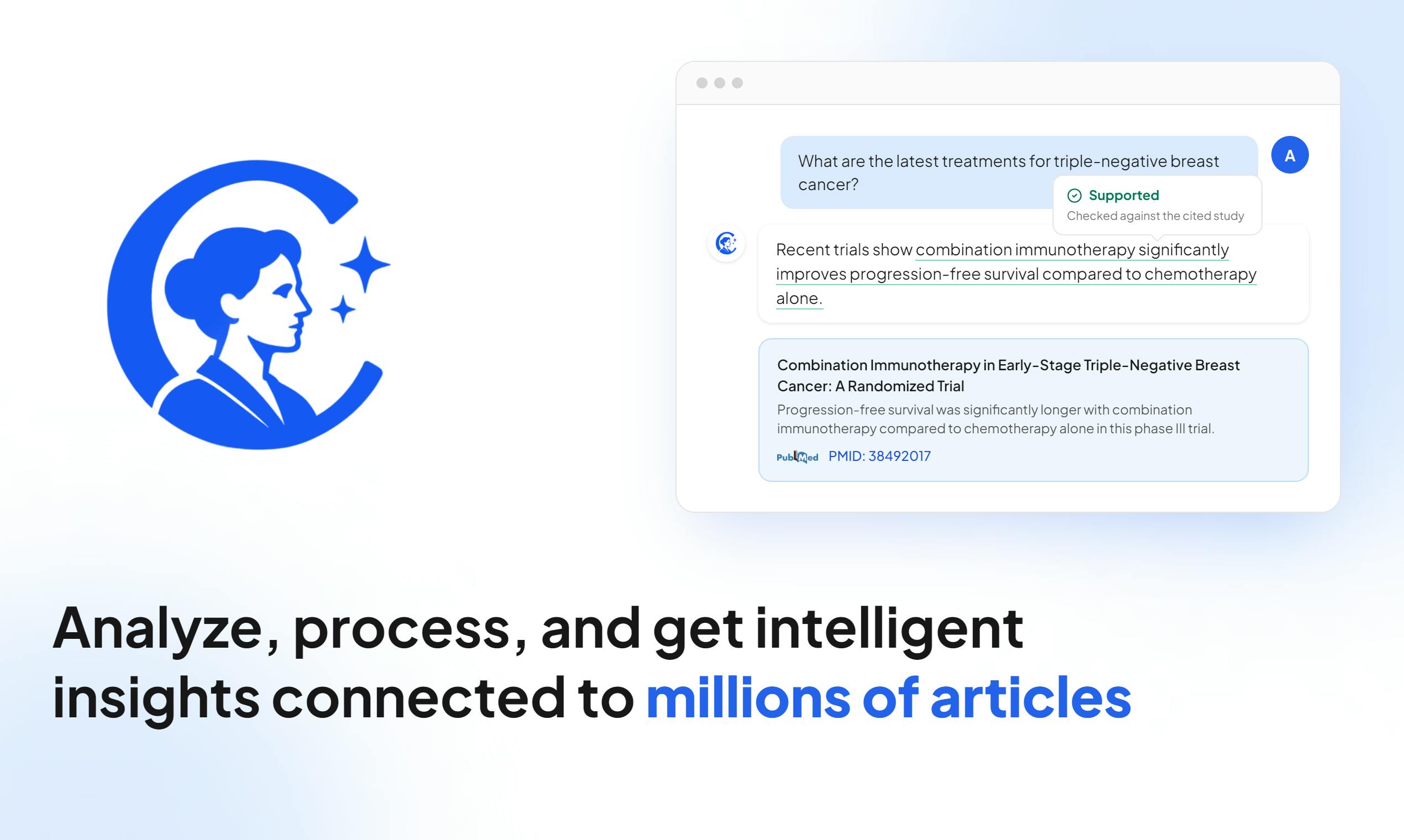
Curie is a scientific-literature assistant rather than a general chatbot. Its Product Hunt listing describes parallel search across five databases, claim checks against source text, quoted structured extraction, and researcher-approved screening/PRISMA reviews. It targets a clear pain: reviewing dense papers while maintaining traceable evidence.
Maker Víctor Madarnás calls this his first solo Product Hunt launch and one of his first major products. He says it was built over a year with the University of Barcelona’s Biost3 team and European research institutions. This suggests domain exposure, but no standalone company, cap table, financing, revenue, or institutional IP terms are public.
Early indicators are modest: #13, 100 Product Hunt points, and 96 followers. An independent desk review reports Free/$19/$49 plans but flags a conflict between paid pricing and an August legal notice reportedly calling Curie a non-commercial research prototype. I could not inspect those official pages directly, so treat this as an unresolved diligence lead. With no entity clarity or usage cohorts, the recommendation is Watch, not an investment endorsement.
Product and Customer Problem
Curie combines literature discovery, document analysis, and review workflow. It aims to show supporting passages or flag unsupported claims; users can extract structured data from uploads and run systematic reviews with human checkpoints. This evidence-first approach suits research better than untraceable fluent answers.
Likely users are graduate students, biomedical researchers, evidence-synthesis teams, and labs. The maker says the idea came from cognitive overload observed in Biost3 researchers—a founder-reported insight, not quantified discovery. No independent accuracy benchmark or time-saved study was found. Citations aid inspection but do not ensure correct interpretation.
Founder and Team Assessment
Víctor Madarnás says this is his first solo launch and one of his first products, built over a year with University of Barcelona and European research collaborators. This suggests domain access, but does not establish institutional endorsement, paying customers, or Curie’s ownership of the IP.
No separate company, named executive team, funding round, employee count, or financial data was located. The independent desk review identifies Biost3 at the University of Barcelona as the group behind the product and says its legal notice did not describe a formed commercial company. Team capability and formal ownership should be resolved before any investment process. Founder-problem fit appears positive; commercialization readiness is uncertain.
Market Opportunity
Curie addresses research search, screening, extraction, and evidence synthesis. Potential buyers are researchers and labs; institutional sales require mature data governance and team workflows. Academic budgets, procurement cycles, and disciplinary variation can slow adoption. A focused beachhead is biomedical teams already conducting systematic reviews.
Competition is direct. Elicit offers guided systematic-review workflows for search, screening, and full-text extraction. Consensus searches a large academic corpus, synthesizes evidence, and now distributes into ChatGPT and Claude. General assistants can also perform literature research, while reference managers and scholarly databases are entrenched. Curie’s differentiation is the claimed integration of claim verification, quoted extraction, and approval-based review in one workspace. No evidence yet shows a sufficiently unique corpus, workflow lock-in, or institutional distribution advantage.
For scale math, a hypothetical $1B valuation at 10× ARR requires $100M ARR. At the reported $19/month Starter list price ($228/year before VAT or any annual discount), that would require about 438,600 full-year Starter-equivalent subscribers. This is an illustrative calculation, not a forecast; the pricing figure is reported by a third-party review citing Curie’s page, and the page was not independently readable in this session. Team contracts could change the equation, but no contract values or customer counts are public. The path is ambitious and unproven.
Traction and Growth Signals
Product Hunt reports #13 day rank, 100 points, and 96 followers. The maker says Curie was in development for over a year before public availability in September. Product Hunt comments prompted a comparison with Consensus; the maker emphasized evidence reuse and systematic reviews. That is positioning feedback, not retention or willingness-to-pay evidence.
The independent review recorded Free, Starter, Pro, and custom Team pricing, with $19 and $49 monthly tiers; all prices and plan limits need direct confirmation. No active users, paying accounts, retention, revenue, contracts, or institutional deployments were found in the primary launch materials. No feature-specific GitHub repository or independent customer-review cohort was identified. There is no public evidence of PMF.
Business Model and Economics
Freemium can acquire users, with paid tiers monetizing heavier analysis and team features. Individual revenue may be limited; institutional contracts could help but require security, procurement, and collaboration capabilities. Usage caps may constrain costs, but gross margin depends on inference, document processing, database access, and support.
There is no public CAC, conversion, gross margin, LTV, churn, or expansion data. Before underwriting the business, measure paid conversion and retention by researcher type, cost per completed review, usage per tier, and institutional sales-cycle length. Clarify what the paid plan legally represents given the reported mismatch in commercial status.
Valuation Assessment
No public valuation, financing, revenue, or equity opportunity was located. The product may be a university-linked research project rather than a venture-backed company. A valuation cannot be assessed without confirming the legal entity, IP ownership, commercial rights, and paying-customer base. Product Hunt ranking and a published price page do not substitute for financial evidence.
Key Risks
- Commercial-status ambiguity: A reported non-commercial prototype notice conflicts with paid subscription listings.
- Ownership and IP: University collaboration may create unclear ownership, licensing, or commercialization rights.
- Unproven adoption: No user, paid conversion, retention, or revenue metrics are public.
- Accuracy risk: Claim matching and quotations do not ensure that evidence is interpreted correctly or that searches are comprehensive.
- Established competitors: Elicit, Consensus, general assistants, and reference databases offer overlapping capabilities and distribution.
- Academic monetization: Individual users may have limited budgets; institutional procurement may be slow.
- Coverage and licensing: Database access, full-text availability, and disciplinary coverage could constrain results.
- Privacy and compliance: Uploaded manuscripts or unpublished research are sensitive; GDPR and EU-hosting claims require verification of processors, retention, and security controls.
- Team scale: A solo maker and university research collaborators may not equal a staffed commercial product/support organization.
- Usage economics: Heavy document review may increase model and infrastructure costs faster than subscription revenue.
Scorecard
| Dimension | Score | Rationale |
|---|---|---|
| Market | 14/20 | Recurring research need; academic budgets and scope constrain |
| Traction | 5/20 | Launch interest only; no cohorts or revenue |
| Team | 8/15 | Direct academic access; commercial team and IP unclear |
| Product | 13/15 | Strong evidence-centric workflow concept |
| Distribution | 8/15 | Research collaborators and free tier; channels unproven |
| Business model | 7/10 | Freemium subscriptions plausible; economics unavailable |
| Defensibility | 6/10 | Review process and data handling may help; no moat shown |
| Total | 61/100 | Promising specialist product, unresolved investability |
Evidence Confidence
Medium-low (0.52). Product capability and founder statements are available in the Product Hunt launch. Pricing and legal-status concerns rely partly on an independent desk review citing official pages that were inaccessible for direct verification. No primary financial, usage, or customer-retention evidence was found.
Final Assessment
Final Decision: Watch. Curie has a well-defined research pain point and a differentiated evidence-traceability thesis. However, launch engagement is not PMF, no usage or revenue metrics are public, and the commercial entity/IP status is unclear. Reassess after confirming legal ownership and commercial rights, validating the paid product terms, and obtaining evidence of repeat paid use.
Upgrade to DD/Invest if: a clear investable entity owns the product, university IP and collaboration terms are settled, and research teams show repeat usage, paid retention, and measurable review-time savings.
Downgrade to Pass/Hard Pass if: commercial rights cannot be established, cited evidence proves unreliable at scale, database coverage is inadequate, or institutional buyers reject its data handling or legal status.
Due-Diligence Questions
- Which legal entity sells Curie, contracts with users, and owns the software and brand?
- What does the University of Barcelona/Biost3 collaboration cover, and who owns resulting IP?
- Why does the reported legal notice describe a non-commercial prototype while paid plans are offered?
- How many monthly active and paying users exist, by discipline and institution?
- What are paid conversion, 90-day retention, churn, and Team-pipeline metrics?
- What independent benchmark measures claim verification, extraction accuracy, and systematic-review recall?
- How are search protocols, inclusion criteria, and human approval recorded for reproducibility?
- What are the exact tier prices, usage limits, annual discounts, and VAT treatment?
- What are model, hosting, full-text access, and customer-support costs per completed review?
- What manuscripts and user data are processed, where are they stored, and which subprocessors receive them?
- What rights or technical agreements permit searching and processing each scholarly database and full-text source?
- Why would a lab choose Curie over Elicit, Consensus, or existing reference-manager workflows?
Sources
- Product Hunt listing and maker’s launch statement: https://www.producthunt.com/products/curie-4
- Official Curie site: https://www.curieai.tech/
- Official pricing page (not independently readable in this research session): https://www.curieai.tech/pricing
- Official about page: https://www.curieai.tech/about
- Official legal notice: https://www.curieai.tech/legal
- Independent desk review describing pricing and legal-status discrepancy: https://appsinsight.co/apps/curie/
- Consensus product and research workflow: https://consensus.app/home/resources/how-consensus-works/
- Consensus assistant integrations: https://consensus.app/home/blog/consensus-everywhere/
- Elicit systematic review workflow: https://elicit.com/blog/systematic-review
- PubMed, U.S. National Library of Medicine: https://pubmed.ncbi.nlm.nih.gov/