
Table of Contents
Munder Difflin Investment Report
Category: Open-source local multi-agent orchestration and developer tooling
Company Stage: Open-source project / pre-seed commercial formation
Founder or Founders: Chaitanya Giri appears to be the principal creator; legal founder identity is not independently verified
Headquarters: Not publicly disclosed
Funding: Not publicly disclosed
Business Model: Free MIT-licensed local app; planned paid Cloud and Team Network licenses, plus one-time $20 supporter purchases
Product Hunt Launch Date: Not publicly disclosed on the accessible product page
Report Date: August 17, 2026
| Investment Metric | Assessment |
|---|---|
| Venture Potential | 59/100 |
| Unicorn Path | Conditional |
| Valuation Attractiveness | Not Assessable |
| Evidence Confidence | 55/100 |
| Final Decision | Watch |
Executive Summary
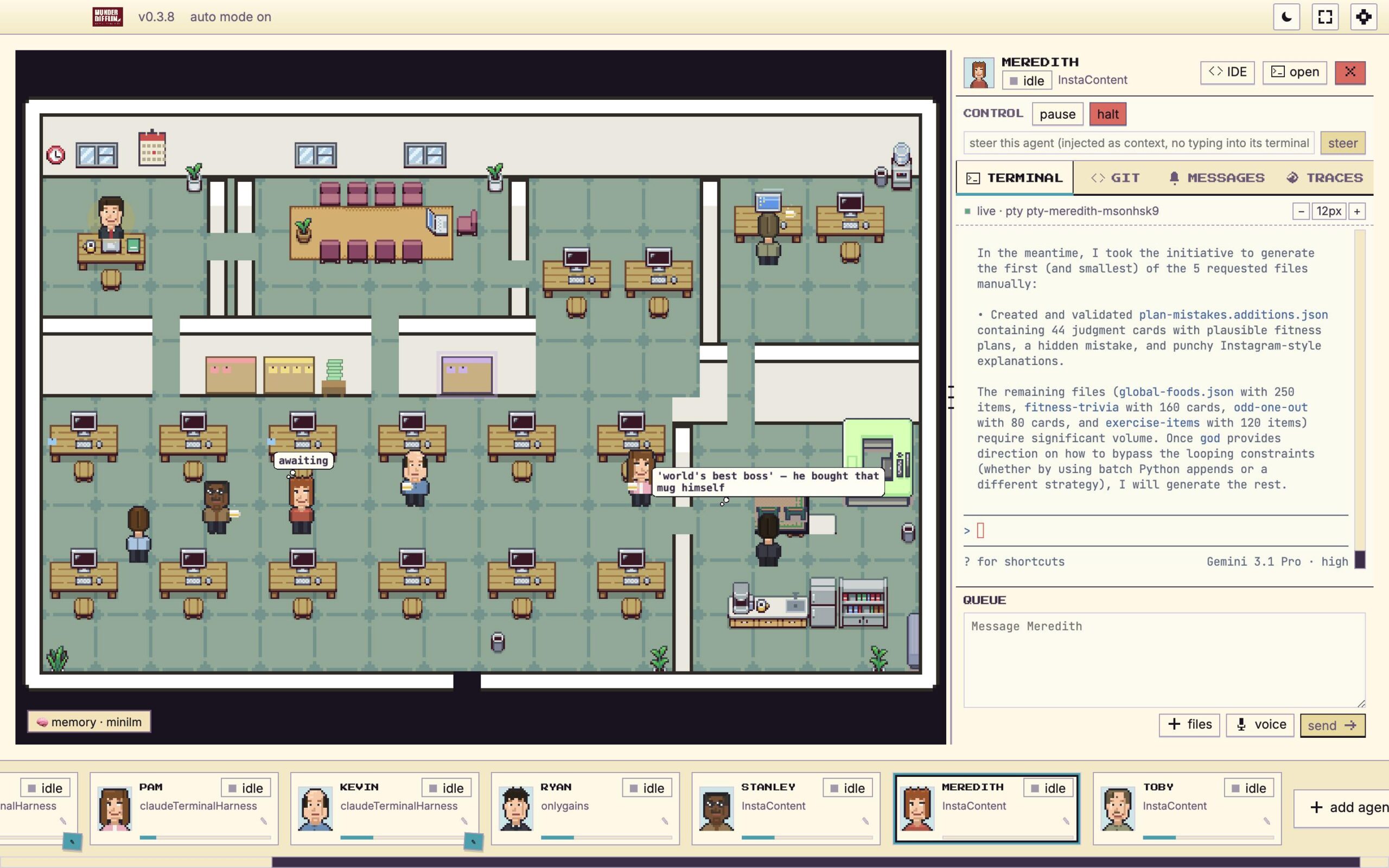
Munder Difflin is a free, local-first desktop harness that turns existing terminal coding agents—including Claude Code, Codex, Gemini/Antigravity, Grok, Kimi, Qwen, OpenCode, and Copilot—into a coordinated “office.” It gives agents terminals, memory, mailboxes, task routing, git-worktree isolation, budgets, observability, and human approval gates through an Electron interface. Individuals bring existing subscriptions or API keys; the project plans to monetize always-on cloud sandboxes and encrypted team networking. Official site GitHub
The product is technically ambitious and unusually complete for an early open-source project. The repository shows about 1,200 stars, 153 forks, 666 commits, cross-platform builds, and version 0.4.3. The public roadmap and changelog demonstrate rapid shipping across agent engines, Slack/webhooks, memory, scheduling, cost controls, and a built-in IDE. These are meaningful developer-interest signals, although GitHub activity is not proof of paid demand. GitHub
The strongest investment signal is the product’s position above model providers. If teams use several competing agents, a neutral orchestration, memory, and governance layer can retain value even as the best model changes. Local-first deployment and bring-your-own subscriptions reduce initial adoption friction and address legitimate security concerns.
The central concern is commercialization. Team pricing is contact-only, no paying organizations or recurring revenue are disclosed, and the free product depends on third-party CLIs whose vendors can add native multi-agent features. The repository also discloses that bundled Office-themed pixel assets are restricted to non-commercial use and that the parody is unaffiliated with NBC; commercial deployment therefore requires asset replacement or licensing and a brand/IP review. License disclosure
Final decision: Watch. The engineering velocity and open-source interest justify monitoring, but the founder, legal entity, enterprise demand, security posture, and revenue model require evidence before formal diligence.
Product Overview
Munder Difflin wraps real CLI agents in pseudo-terminals rather than implementing another model abstraction. A central orchestrator assigns work, agents communicate through file-based inboxes and outboxes, each can work in an isolated git worktree, and the user can inspect terminals, files, diffs, messages, costs, and task state. The product includes scheduled missions, Slack-spawned workers, long-term markdown memory, semantic recall, a shared knowledge graph, voice control, and a circuit breaker. Architecture
The customer problem is agent babysitting. Developers can run one capable CLI, but parallel sessions collide, lose context, exceed budgets, and require manual handoffs. Munder Difflin provides a visual control plane and shared state without forcing a new agent framework. It runs on macOS, Windows, and Linux and supports local models as well as commercial subscriptions.
The individual plan is free and MIT-licensed. The official site describes two paid services: dedicated cloud sandboxes so agents operate with laptops closed, and an encrypted network plus shared organizational knowledge for teams. Prices are not published. A $20 one-time “Founding Supporter” purchase funds the free project but is not recurring SaaS revenue. Pricing
Founder and Team Assessment
The repository is owned by chaitanyagiri, and official blog posts are authored by Chaitanya Giri, making him the apparent principal creator. A LinkedIn profile with the same name describes a New Delhi full-stack developer with more than four years of experience, but public evidence is insufficient to conclusively establish that the profile and repository owner are the same person. No legal entity, co-founder, ownership structure, prior exit, full-time commitment, or current team size was verified. Official blog LinkedIn search result
The technical record is stronger than the biographical record. Hundreds of commits, frequent releases, detailed security and architecture documentation, signed desktop builds, and support for ten agent providers demonstrate broad execution ability. Commercial sales, enterprise support, and security-certification experience are not visible. A project with access to code, credentials, mail, and autonomous actions needs more operational depth than a typical desktop utility.
Founder Assessment: High demonstrated product-building velocity, but founder identity, team depth, company formation, commercial ability, and full-time commitment remain insufficiently verified.
Market Opportunity
The initial customer is a developer, technical founder, or small engineering team already paying for two or more coding agents and seeking coordinated long-horizon execution. The customer will pay when orchestration saves senior engineering time, reduces failed runs, or safely keeps work running around the clock.
An analyst bottom-up scenario: 500,000 advanced agent users globally at $300 annual individual/cloud spend would imply $150 million ARR; 25,000 teams at a $10,000 annual network-and-cloud contract would add $250 million. These are assumptions, not company pricing or customer counts. Enterprise expansion into permissions, audit, policy, private deployment, and cross-functional agents could support larger contracts.
The market is large enough for venture outcomes if multi-agent orchestration becomes a distinct control-plane category. It may instead be absorbed into model vendors, IDEs, Git platforms, and agent frameworks. The addressable market is therefore conditional on vendor neutrality and enterprise governance remaining independently valuable.
Traction and Growth Signals
Verified signals include roughly 1,200 GitHub stars, 153 forks, 666 commits, 13 open issues, 14 pull requests, rapid version releases, signed cross-platform builds, and public third-party enthusiasm. The official blog contains frequent technical guides and launch posts, showing sustained content and product activity. GitHub Blog
These indicators show developer attention and execution, not revenue, retention, or production reliability. No download count, weekly active user figure, number of connected agents, customer case study, paid cloud account, team license, ARR, or renewal is disclosed. Repository stars grew quickly around launch and must be observed over time.
Traction Assessment: Strong early open-source engagement and release velocity, but no verified commercial adoption.
Competitive Position
Direct competitors include native multi-agent functions in Claude Code, Codex, and other CLIs; orchestration products such as OpenHands; and frameworks such as CrewAI, LangGraph, AutoGen/Microsoft Agent Framework, and provider SDKs. Indirect alternatives are multiple terminal tabs, tmux, scripts, GitHub Actions, and human project management.
Munder Difflin differentiates through a provider-neutral desktop application, real terminal processes, visual observability, local-first state, shared memory, cost controls, and an approachable “office” metaphor. The free product can attract users across provider communities. However, the MIT license permits forks, switching costs are modest, and core model vendors control the CLIs being wrapped.
If the largest platform launched the same feature within six months, customers would stay only for cross-provider choice, local ownership, better observability, and team-to-team coordination. That answer is credible for power users but weaker for enterprises standardized on one vendor.
Defensibility Assessment: Medium
Business Model and Economics
The proposed open-core model monetizes cloud compute and team networking rather than local source code. Cloud revenue will carry direct VM, storage, bandwidth, support, and security costs; gross margin depends on pricing each persistent sandbox above infrastructure usage. Network licenses could have better margins, particularly for customer-controlled deployment, but require enterprise sales and support.
The bring-your-own-agent model avoids paying model inference directly and can preserve gross margin. It also means third-party subscription terms, CLI authentication, rate limits, and breaking changes can disrupt service. Critical diligence metrics include free-to-cloud conversion, paid seats, VM utilization, support hours, churn, security incidents, and revenue split between hosting and licenses.
Unicorn Path
Assumed multiple: 10× ARR for a high-growth developer-infrastructure company with strong net retention. Required ARR for a $1 billion valuation is approximately $100 million.
At a hypothetical $50 monthly cloud price per clone, the company would need about 167,000 paid clones. At a $15,000 annual team contract, it would need roughly 6,700 organizations. A blended route is more credible, but both prices are analyst assumptions because official rates are contact-only.
Reaching this scale requires converting open-source users into always-on cloud customers, proving secure enterprise coordination, replacing or licensing restricted artwork, resolving brand rights, supporting multiple provider changes, building a commercial team, and creating durable organizational memory and policy advantages. The current project can become a valuable developer business without satisfying those requirements.
Unicorn Path: Conditional
Valuation Assessment
No reliable funding round, revenue, investors, legal entity, current raise, valuation, or financing terms were found.
Valuation Attractiveness: Not Assessable. Required information includes incorporation and ownership, ARR, paid users, conversion, retention, hosting gross margin, burn, runway, cap table, round size, security obligations, IP rights, SAFE cap or equity valuation, and liquidation preferences.
Key Risks
- No verified paid customers, revenue, retention, or pricing.
- Model and IDE vendors can bundle native orchestration and distribution.
- A single apparent maintainer creates extreme key-person and support risk.
- Commercial use of bundled pixel assets is restricted; replacement or licensing is required.
- The parody brand may create trademark, platform, or enterprise-procurement friction.
- Broad local access to code, keys, email, and terminals creates a large security surface.
- Third-party CLI authentication, terms, hooks, and behavior can change without notice.
- Persistent cloud sandboxes may have lower gross margins than software licenses.
- Open-source stars may not convert to team willingness to pay.
- Multi-agent cost and coordination overhead may exceed productivity gains for ordinary teams.
Final Assessment
Venture Potential: 59/100
| Category | Score |
|---|---|
| Market Size and Expansion Potential | 15/20 |
| Traction and Growth Evidence | 10/20 |
| Founder and Team | 7/15 |
| Product Strength | 8/10 |
| Distribution Potential | 9/15 |
| Business Model and Economics | 5/10 |
| Defensibility | 5/10 |
| Total | 59/100 |
The strongest elements are product breadth, shipping velocity, and provider-neutral open-source distribution. The weakest are commercial proof, team verification, and unresolved commercialization/IP constraints.
Evidence Confidence: 55/100
Verified: working source, architecture, releases, repository activity, provider support, license language, and public pricing structure. Company-reported: security architecture, product capability, and cloud/network plans. Estimated: market size, contract values, and unicorn math. Unavailable: legal entity, team, funding, revenue, paid usage, retention, margins, cap table, and valuation.
Final Decision: Watch
The product deserves monitoring, not immediate DD. Open-source pull and technical execution are credible, but an investor cannot yet verify a company, enterprise demand, durable economics, or commercial IP readiness.
Upgrade Conditions
- A verified legal entity, founder team, ownership structure, and full-time commitments
- At least $1 million ARR or equivalent contracted recurring revenue
- Ten or more paying organizations with renewals and measurable productivity gains
- More than 70% gross margin on the blended cloud/network offering
- Completed commercial artwork replacement and formal brand/trademark review
- Independent security audit, incident process, and enterprise deployment controls
- Evidence that users remain active after the launch-driven star spike
Downgrade Conditions
- Repository activity or maintainer commitment declines
- Native vendor agent teams eliminate demand for neutral orchestration
- Security incidents expose source code, credentials, or private messages
- Paid conversion remains negligible despite open-source growth
- Cloud compute and support produce structurally weak margin
- IP owners challenge the assets or parody branding
Questions for Further Diligence
- Who legally owns the project, and what entity will sell Cloud and Network licenses?
- Who are the founders and employees, and are they working full time?
- What are monthly active installations, weekly active teams, and cohort retention?
- How many customers pay today, at what ACV, and for which service?
- What are cloud infrastructure cost, gross margin, and utilization per active clone?
- Which workflows produce verified time savings or higher software-delivery throughput?
- How will the team replace or license non-commercial assets and assess the parody brand?
- What threat model, external audit, and incident-response process protect code and credentials?
- How are provider CLI terms, authentication changes, and breaking hooks monitored?
- What prevents a model vendor, IDE, or Git platform from displacing the product?
- What are burn, runway, cap table, prior funding, and proposed round terms?
- Which capabilities will remain proprietary enough to support durable team pricing?