
Table of Contents
Tabbit AI Investment Report
Category: AI-native web browser with agent automation (Chromium-based, desktop + mobile)
Company Stage: Corporate product — built by Meituan’s GN06 AI unit; public beta March 2, 2026; V1.0 June 9, 2026 kr-asia
Founder or Founders: Not an independent founder company — developed by Meituan’s GN06 team (formerly the “Guangnian Zhiwai”/LongCat unit); individual team leadership not fully verified in English-language sources kr-asia
Headquarters: Parent Meituan is Beijing-based (HKEX: 3690); the international version is published under LUMINALAB PTE. LTD., Singapore tabbit.en.softonic
Funding: No external venture funding — internally funded by Meituan; one secondary source estimates roughly three years and a multi-hundred-million-dollar corporate investment in the underlying AI team (unverified) note
Business Model: Freemium consumer product — browser free “permanently”; weekly free AI allowance; optional Pro subscription (9.9 yuan/week in China; international pricing not fully disclosed) eu.36kr
Product Hunt Launch Date: September 2026 (international positioning; 269 followers) producthunt
Report Date: September 6, 2026
| Investment Metric | Assessment |
|---|---|
| Venture Potential | 53/100 |
| Unicorn Path | Improbable (as a standalone entity; not applicable as a Meituan subsidiary) |
| Valuation Attractiveness | Not Assessable |
| Evidence Confidence | 55/100 |
| Final Decision | Pass |
Executive Summary
Tabbit is an AI-native Chromium browser built by Meituan, China’s largest food-delivery and local-services company, through its GN06 AI unit — the same organization behind Meituan’s open-source LongCat models. The browser integrates multi-model AI chat (DeepSeek, Kimi, GLM, MiniMax, Doubao, Qwen, LongCat domestically; Claude, GPT, and Gemini internationally), a GUI agent that operates websites on demand or on a schedule, reusable “Skills,” MCP compatibility, and a CLI hook that lets coding agents like Claude Code control the browser. kr-asia
The core finding of this report is structural: Tabbit is not a venture-investable startup. It is a product of a publicly listed company, internally funded, with no independent equity, round, or cap table. Any “investment case” is therefore an assessment of product quality and strategic value inside Meituan, not of investable securities. kr-asia
As a product, Tabbit is credible: it shipped from public beta to V1.0 in 100 days with weekly releases, claims agent task-completion rates improving from 53.1% to 90.8%, and published benchmark transparency (64% success on BrowserBench across 75 runs) unusual for a launch. news.aibase
The most important concern — beyond investability — is monetization and defensibility: the browser is free, the paid tier is priced near commodity levels (9.9 yuan/week in China), and the category is contested by OpenAI, Google, Perplexity, and The Browser Company’s Dia. No user counts, revenue, or retention data are independently verified. reviewstown
Final decision: Pass — not on quality grounds, but because there is no venture security to buy. The analysis below evaluates Tabbit as if assessing a hypothetical standalone entity, which is the only framing in which the requested metrics are meaningful.
Product Overview
The customer problem: knowledge workers live in browsers with context scattered across tabs, screenshots, and local files, then shuttle that context into a separate AI tool and still do the clicking, formatting, and exporting themselves. producthunt
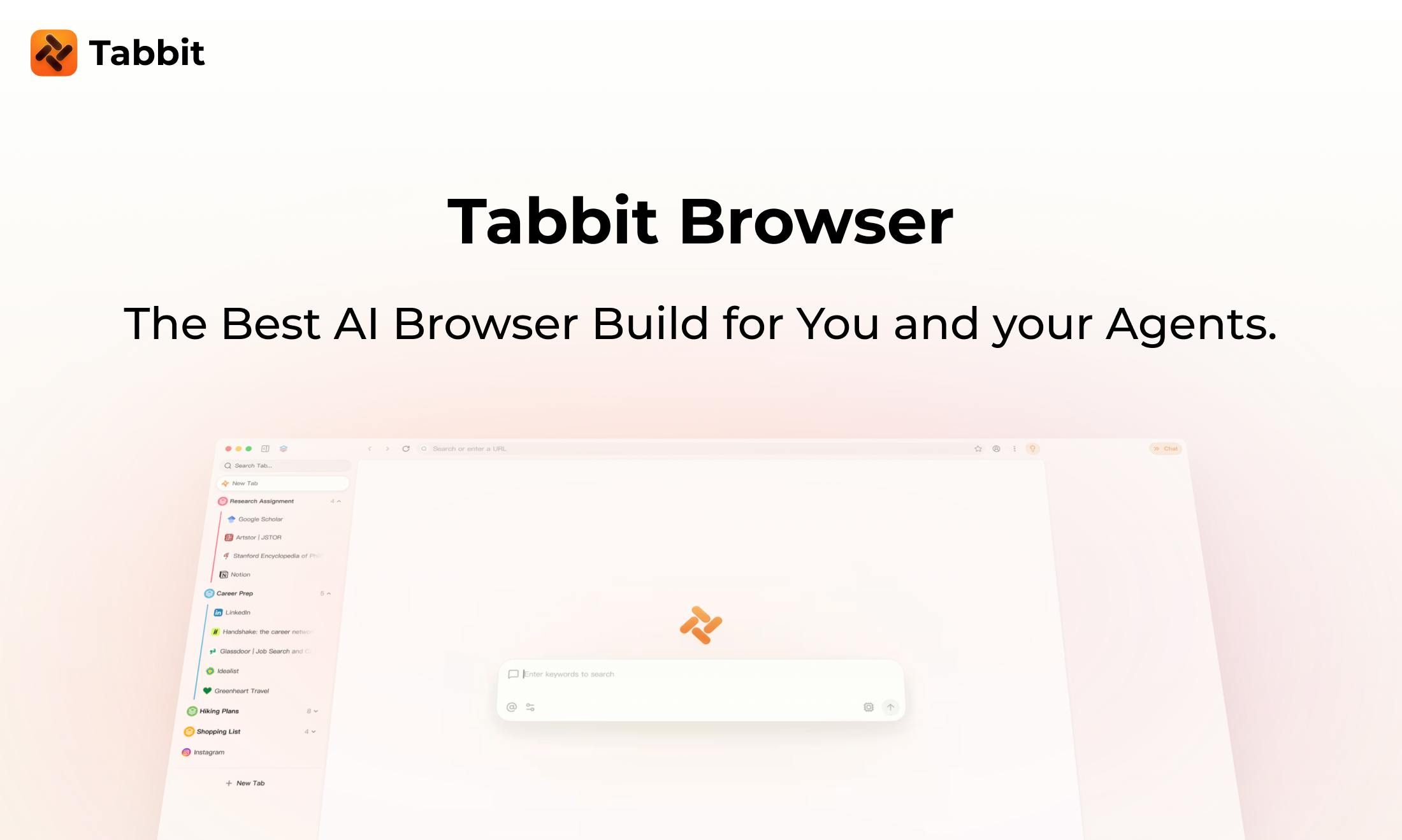
How it works: Tabbit is a standalone Chromium browser. Users point the AI at pages, tabs, selected text, screenshots, and local files, then assign jobs. Agent Mode executes browser operations — opening pages, filling forms, extracting data, cross-site workflows — immediately or on a schedule, and produces usable outputs: HTML pages, PDFs, decks, Excel, and Word documents. Workflows can be saved as Skills, shared, or published to a skills library with 300+ ready-made skills. A CLI integration lets users type /tabbit inside Codex or Claude Code to give coding agents browser control using existing login sessions without hijacking the browser. news.aibase
Target users: professionals, students, PMs, developers, and technical teams who research and produce on the web. Platforms: Windows and macOS desktops, with iOS and Android apps and a HarmonyOS version in development. news.aibase
Pricing: the browser core is free permanently, with a weekly AI allowance (~1,000 conversations, ~10 agent tasks); heavy users can upgrade to Pro (9.9 yuan/week in China; international Pro pricing not fully disclosed, with third-party estimates around $15–29/month). The replaced workflow is Chrome plus a separate chatbot plus manual formatting — free, but fragmented. eu.36kr
Founder and Team Assessment
There is no founder in the venture sense. Tabbit is developed by Meituan’s GN06 unit — formerly known as Guangnian Zhiwai (“Light Years Beyond”) — which also developed the LongCat model family that Meituan open-sourced in 2026. KrASIA’s interview with a team lead (surname Liu) indicates an experienced corporate AI team iterating weekly with real user feedback, and claims retention above what the team considers a strong industry benchmark — a company-reported claim with no disclosed figures. kr-asia
The international version is published by LUMINALAB PTE. LTD., a Singapore entity, presumably Meituan’s vehicle for overseas distribution; the precise corporate relationship is not formally disclosed in available sources. Team size is not publicly disclosed; no hiring signals specific to Tabbit were found in English-language sources. tabbit.en.softonic
Founder Assessment: A well-resourced corporate AI team with strong execution cadence, but no identifiable founder, no founder equity story, and no verifiable team-level data — by design, since this is a subsidiary product.
Market Opportunity
The initial segment is Chinese knowledge workers and students using domestic AI models, with an international expansion targeting English-speaking professionals. The problem — fragmented browsing and AI workflows — is real and high-frequency, and willingness to pay exists but is modest: Chinese Pro pricing of 9.9 yuan/week (~$70/year) anchors the low end, and international AI browsers such as Dia charge around $20/month. eu.36kr
Bottom-up: if the consumer AI-browser category reaches 20–50 million globally paying users at $50–120/year, that is $1–6B in annual category revenue — genuinely venture-scale, but split across Google (Chrome + Gemini), OpenAI, Perplexity, The Browser Company, and Chinese incumbents. Tabbit’s realistic capture depends on Meituan’s distribution and whether free-to-paid conversion works at near-free price points.
Adjacent expansion is meaningful for Meituan specifically: the browser can funnel users into local-services transactions (a mobile version already exists, though ordering takeout is not yet supported). Timing is good — agentic browsing is the 2026 frontier — but Meituan is a late-comer relative to OpenAI and Perplexity internationally, and a fast-follower domestically. eu.36kr
Traction and Growth Signals
Available evidence: public beta March 2, 2026 with no invite code; 100 days to V1.0 with 12 weekly versions shipped; agent task-completion rate reported by the company at 90.8%, up from 53.1% at beta; BrowserBench results published transparently (64% success, 75 runs, ~1.9x faster and 61% fewer tokens than a reference “Agent Browser”); positive press coverage from KrASIA, Pandaily, and 36Kr; a September 2026 Product Hunt launch with 269 followers and technically engaged comments; a Japanese user review describing strong word-of-mouth in China. kr-asia
Not available: download counts, monthly active users, paying subscribers, free-to-paid conversion, retention figures (claimed “above benchmark” but undisclosed), and any revenue. The Product Hunt launch was modest in absolute terms, and launch attention is not usage. kr-asia
The most important missing metrics are MAU and conversion to the paid tier — both unmeasurable from public sources, and both decisive for whether the free strategy is working.
Traction Assessment: Strong shipping cadence and credible company-reported technical progress, but zero independently verified commercial traction.
Competitive Position
- Direct competitors: OpenAI’s browser, Perplexity Comet, The Browser Company’s Dia (which Tabbit itself benchmarks against at ~$20/month), Arc, and — in China — AI browsers and assistants from ByteDance (Doubao), Alibaba (Qwen), and Moonshot (Kimi) go.tabbit
- Large platforms: Google can ship equivalent agent features directly into Chrome’s billions of installs; the model vendors whose models Tabbit aggregates (OpenAI, Anthropic, DeepSeek) each have incentives to own the client
- Free alternatives: Chrome + any free chatbot; Tabbit’s own free tier
Current differentiation: genuine multi-model routing (domestic-model compliance in China; international models via Singapore routing); token-efficient browser control that external coding agents can drive; a Skills ecosystem with MCP compatibility; and zero switching cost via one-click Chrome import. The deep-pocketed parent is the real advantage — Meituan can sustain free pricing indefinitely. kr-asia
The six-month replication test: if OpenAI or Google shipped an equivalent agent in their browsers (both are actively doing so), Tabbit’s answer would be model neutrality, the CLI/agent-ecosystem integration, and — in China — regulatory positioning with domestic models. Internationally, that is a weak answer. Domestically, it is stronger but shared with several giants.
Defensibility Assessment: Low.
Business Model and Economics
Revenue model: freemium consumer subscription. Free tier is permanent and generous (roughly 1,000 model conversations weekly); China Pro at 9.9 yuan/week (~$70/year); international Pro pricing undisclosed. Estimated annual contract value is roughly $70 (China) to $180–350 (international, if third-party monthly estimates hold) — a consumer price point. eu.36kr
Variable costs are significant: Tabbit pays for inference across ten-plus third-party models in addition to its own LongCat. A generous free tier on frontier-model conversations is a real expense that only a strategic parent could justify; whether Pro revenue covers inference cost per user is unknown. No app-store dependency for desktop distribution; payment processing is minor. For Meituan, the economics are strategic (consumer AI entry point, potential local-services funnel) rather than near-term profit-maximizing. eu.36kr
Unicorn Path
As a Meituan subsidiary, Tabbit’s value is embedded in Meituan’s public market capitalization and the question is moot. Hypothetically standalone, assume a 5x revenue multiple (generous for a consumer browser with uncertain monetization): $1B would require ~$200M ARR, or roughly 1–3 million paying subscribers at plausible price points — a plausible-but-unlikely outcome in a category where Google, OpenAI, and Perplexity hold distribution advantages, and where no AI browser has publicly demonstrated paid conversion at that scale.
Unicorn Path: Improbable as a standalone entity; not applicable as a subsidiary of a listed company.
Valuation Assessment
There is no standalone valuation: no rounds, no investors, no SAFE, no cap table. Tabbit is funded internally by Meituan, a public company (HKEX: 3690), and the closest economic exposure an investor can obtain is Meituan equity, whose price reflects food-delivery and local-services economics far more than any browser. One secondary source pegs the underlying team’s cumulative corporate investment in the multi-hundred-million-dollar range over three years (unverified). note
Valuation Attractiveness: Not Assessable. There is no investable security. Even in a hypothetical spin-out, assessment would require user counts, conversion, retention, inference costs, and spin-out terms.
Key Risks
- Not investable: no standalone equity; this is a corporate product of a listed company kr-asia
- Monetization unproven: permanent free core with near-free Pro pricing; no revenue disclosed eu.36kr
- Inference-cost drag: a generous free tier consuming ten-plus frontier models, sustained only by parental subsidy eu.36kr
- Platform competition: Google and OpenAI can ship equivalent agents into far larger installed bases
- Aggregator disintermediation: model vendors (OpenAI, DeepSeek, Moonshot) can and do build their own clients note
- Unverified traction claims: retention and completion-rate figures are company-reported without underlying data kr-asia
- International compliance complexity: Singapore-routed multi-model serving creates regulatory and data-flow exposure across jurisdictions tabbit
- China-market concentration: the domestic version’s viability depends on Chinese model vendors’ pricing and regulatory posture
- Corporate-strategy dependency: Tabbit’s roadmap could be deprioritized by Meituan at any time; it is one of many AI bets
Final Assessment
Venture Potential: 53/100
| Category | Score |
|---|---|
| Market Size and Expansion Potential | 14/20 |
| Traction and Growth Evidence | 7/20 |
| Founder and Team | 9/15 |
| Product Strength | 8/10 |
| Distribution Potential | 9/15 |
| Business Model and Economics | 3/10 |
| Defensibility | 3/10 |
| Total | 53/100 |
Assessed as a hypothetical standalone: the strongest elements are product strength (agent integration, multi-model routing, unusual benchmark transparency) and a well-resourced parent team; the weakest are the unproven business model and low defensibility in a category owned by larger platforms. As an actual target, the venture case is void for structural reasons.
Evidence Confidence: 55/100
Verified through multiple credible sources: Meituan/GN06 parentage, launch timeline, platform availability, feature set, and Chinese pricing. Company-reported and unverified: retention claims, agent completion rates, token-efficiency benchmarks. Unknown: users, revenue, conversion, team size, international Pro pricing, and the precise legal relationship between Meituan and LUMINALAB PTE. LTD.. The corporate-parent confusion (an App Store listing and directory sites describe Tabbit simply as a “free AI browser” without noting Meituan) slightly reduces reliability of secondary sources. kr-asia
Final Decision: Pass
Tabbit is a competently built, rapidly iterated AI browser with a credible team behind it — and it is not a venture investment, because it is a product inside Meituan, a public company. There is no founder equity, no round, and no security to purchase. A VC evaluating this Product Hunt listing as a startup opportunity should recognize it as a corporate product launch. This Pass is structural, not qualitative; the closest investable expression of this thesis is Meituan stock or positions in the AI-browser competitive set (The Browser Company, Perplexity).
Upgrade Conditions
- Meituan spinning Tabbit out as an independent entity with external financing
- A spin-out (or the parent) disclosing verified user counts and paid conversion above ~5%
- Evidence that the browser drives measurable transaction revenue for Meituan’s core business
- International Pro monetization demonstrating willingness to pay outside China
Downgrade Conditions
- Meituan deprioritizing or sunsetting the product
- Google or OpenAI shipping dominant agent browsers that freeze category conversion
- Verification that free-tier usage is unsustainable relative to inference costs
- Regulatory action against cross-border model routing in Singapore tabbit
Questions for Further Diligence
- What is the precise corporate structure connecting Meituan, GN06, and LUMINALAB PTE. LTD. ? tabbit.en.softonic
- How many monthly active users does Tabbit have across China and international versions?
- What is free-to-Pro conversion, and at what weekly allowance do users hit the paywall?
- What are inference costs per active user, and what fraction is covered by LongCat’s own serving?
- What are the verified retention figures behind the “above benchmark” claim ? kr-asia
- How is international Pro priced, and what gross margin does it carry?
- What share of agent tasks actually completes without human intervention in production (not benchmark) settings?
- What are the terms of model-provider agreements with DeepSeek, Moonshot, and international vendors?
- How does Meituan measure Tabbit’s strategic value — funnel metrics to local services, or standalone revenue?
- What is the roadmap for team/workspace features noted as missing at launch ? producthunt
- What data does Tabbit collect, and how is it handled across the Singapore routing architecture ? tabbit
- Under what conditions would Meituan consider spinning out or shutting down the browser?
Sources
- Product Hunt — Tabbit AI launch page
- Tabbit international site
- Tabbit international download/FAQ page
- Tabbit China site (membership pricing)
- KrASIA — Meituan’s GN06 unit builds Tabbit (interview)
- 36Kr English — Meituan AI Browser V1.0 launch details
- AIBase — Tabbit 1.0 launch and completion-rate claims (secondary source)
- Pandaily — GN06 public beta announcement (secondary source)
- Reuters — Meituan LongCat-2.0 model release (parent-company context)
- Note.com — independent user review with team background (secondary source)
- Softonic — Tabbit download listing, LUMINALAB PTE. LTD. developer (secondary source)
- TechShark — Tabbit tool directory listing (secondary source)
- ReviewsTown — Tabbit pricing review (secondary source)