
Table of Contents
IQ Routing Investment Report
Category: AI infrastructure — LLM gateway / model-routing and cost-optimization for agent workloads
Company Stage: Launch-stage (Product Hunt launch three days before this report; no disclosed funding)
Founder or Founders: George Avila (identified as the Product Hunt maker and launch author; background not publicly verified) producthunt
Headquarters: Not publicly disclosed
Funding: Not publicly disclosed
Business Model: SaaS subscription (bring-your-own-key gateway); Free tier, Team at $70/month, custom Enterprise contracts iq-routing
Product Hunt Launch Date: August 27, 2026 launly
Report Date: August 30, 2026
| Investment Metric | Assessment |
|---|---|
| Venture Potential | 47/100 |
| Unicorn Path | Improbable (under the current business model) |
| Valuation Attractiveness | Not Assessable |
| Evidence Confidence | 32/100 |
| Final Decision | Watch |
Executive Summary
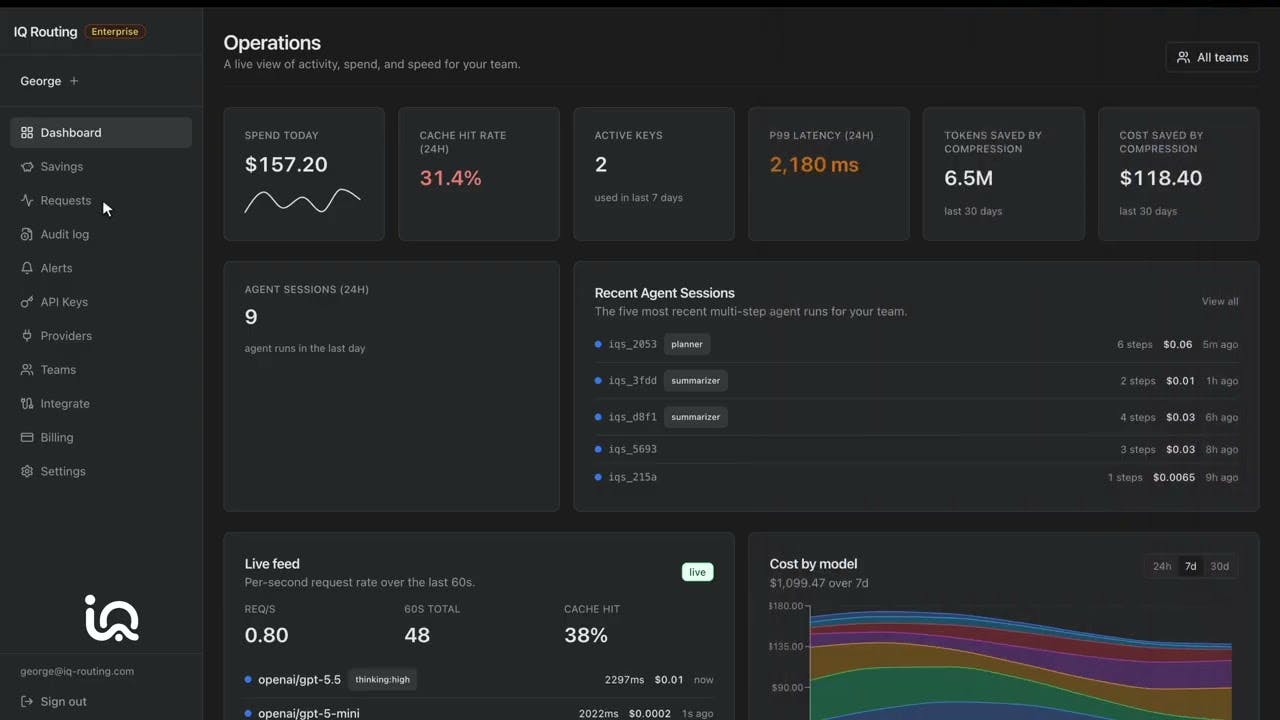
IQ Routing is a drop-in LLM gateway that sits in front of an existing OpenAI- or Anthropic-shaped SDK endpoint, classifies each request by difficulty, serves repeats from a semantic cache, and routes each step of an agent run to the cheapest model that clears a configured quality bar. Its stated differentiation is “trajectory-aware” routing: treating a multi-step agent run as one sequence and spending frontier-model budget only on the steps that need it, with per-team budgets and a four-way cost ledger aimed as much at finance teams as engineers. producthunt
The product addresses a real and growing pain. Independent commentary around the launch notes that token cost has become a production pain rather than a spreadsheet hypothesis, and that cost-routing is consolidating into a product category. The company claims 40–80% spend reductions “measured on our own traffic,” with a transparent worked example cutting a five-step LangChain loop from $1.84 to $0.77 (58%). iq-routing
The strongest positive signal is product coherence and founder engagement: the pricing page is unusually specific, the caching design (full-conversation-history cache keys, differentiated expiry for tool-use responses, a per-request cache opt-out header) held up under detailed technical questioning from a skeptical commenter on the launch page. The most important concern is that this is a three-day-old company with no verifiable revenue, customers, team, or funding, entering a category that is commoditizing quickly from both open source and large platforms. producthunt
The venture math is unfavorable as currently structured. At $70/month for Team, reaching $100M ARR would require roughly 119,000 team subscriptions, which is unrealistic; a credible unicorn path would require a strategic shift toward usage-based or inference-margin economics in a field where OpenRouter, Portkey, LiteLLM, Cloudflare, and Not Diamond already compete. api7
Given a plausible but crowded market, an unverified founder and team, self-measured savings claims, no valuation data, and launch-day attention only, the appropriate decision is Watch: the product deserves post-launch observation, not capital commitment today.
Product Overview
Problem: Teams running LLM agents pin one frontier model on every step — planning, retrieval, tool calls, cleanup — and pay reasoning-model rates for work a cheap model could do. The invoice arrives as a single unattributable line, and finance cannot allocate it. iq-routing
How it works: IQ Routing drops in behind one base URL. A purpose-built classifier scores each request’s difficulty, a semantic cache returns repeats (including paraphrased repeats) at zero marginal cost, and a resolver picks the cheapest model that clears the configured quality bar per step, with instant fallback. Sessions are tracked as accountable units with per-turn cost, latency, token, and step-class telemetry; a governor caps per-session thinking spend. Cache keys are built from the full conversation history, and tool-use responses get shorter cache lifetimes — a design detail the founder defended in the launch comments. producthunt
Target users: Engineering teams at AI startups and companies operating production agents, RAG pipelines, or chatbots with material token spend; secondarily finance/ops teams needing cost attribution. iq-routing
Pricing: Free ($0, card on file, 240 requests/min, BYOK, semantic cache); Team at $70/month (600 requests/min, per-team budgets, audit log, org access controls); Enterprise custom annual (on-prem/VPC, SOC 2 evidence pack “on request,” 6,000+ requests/min). iq-routing
Platforms: Works with OpenAI-, Anthropic-, and Google-shaped endpoints; Kimi and GLM on the roadmap. Positioned to work inside single-model tools such as Claude Code or Cursor by routing within a family. iq-routing
What it replaces: Manual model selection, provider-native prompt caching, self-hosted open-source routers, and managed gateways from Portkey, OpenRouter, or LiteLLM. launly
Founder and Team Assessment
The maker is George Avila, confirmed by the Product Hunt launch listing and a third-party launch-reporting site. He personally answered technical challenges about cache-key semantics on the launch page in credible detail. Beyond this, no reliable public information was found on his professional background, prior companies, technical or commercial history, or team size. No LinkedIn company page, GitHub organization, or funding-database entry for IQ Routing surfaced in public searches. Full-time commitment and key-person risk are therefore not assessable. producthunt
Founder Assessment: Technically articulate founder with a credible product thesis, but background, team, and commercial track record remain unverified.
Market Opportunity
The initial segment is narrow: engineering teams operating multi-step LLM agents in production with monthly inference spend in the low thousands of dollars or more. Analyst assumption: roughly 20,000–50,000 such teams exist globally today (AI-native startups, product companies shipping agent features, and enterprises with AI platforms), growing with agent adoption. Timing is favorable — token cost is now widely reported as a production pain, and cost-routing is emerging as a recognized category. aiboutique
At current pricing, bottom-up economics are constrained: 30,000 teams × ~$2,000 blended annual revenue (Team plans plus a minority of enterprise contracts at an assumed $15–30k ACV) yields roughly $60M in theoretical ceiling revenue at full penetration. That supports a good software business, not a $1B outcome, without expanding the model. Adjacent expansion paths — AI FinOps/cost governance, agent observability, on-prem enterprise gateways — are plausible but each is separately contested.
Traction and Growth Signals
Available evidence is limited to launch attention: approximately 95 upvotes on Product Hunt, #21 Product of the Day and #62 Product of the Week in a third-party tracker’s snapshot, 3 comments, and 75 followers on the Product Hunt page. One thoughtful technical comment thread suggests genuine developer scrutiny rather than pure vote inflation. Two independent newsletters and a Portuguese-language launch-analysis blog covered the product favorably as a category signal. producthunt
No evidence exists on paying customers, revenue, registered or active users, retention, GitHub activity, app-store presence, hiring, or partnerships. Product Hunt attention three days post-launch is not traction in the commercial sense.
Traction Assessment: Launch attention only; commercially unverified.
Competitive Position
| Competitor | Type | Notes |
|---|---|---|
| RouteLLM (LMSYS) | Free, open source | Up to 85% cost reduction at ~95% GPT-4-level quality on benchmarks github |
| Not Diamond | VC-backed router | $2.3M initial round; now focused on coding agents, claiming $1.2M/25% cost outcomes venturebeat |
| Martian | VC-backed router | $9M seed from NEA, Prosus, Carya, General Catalyst hpcwire |
| OpenRouter / Portkey / LiteLLM / Helicone / Cloudflare | Gateways | Established distribution; OpenRouter’s Auto Router already integrates Not Diamond api7 |
| Provider-native caching | Free substitute | Anthropic gives ~90% discounts on cached input; OpenAI auto-discounts ~50% usefloomi |
IQ Routing’s differentiation — trajectory-aware per-step routing, session envelopes, and a finance-grade cost ledger — is real but thin. The core techniques (request classification, tiered routing, semantic caching, cascades) are publicly documented and reproducible. If OpenRouter or Portkey shipped trajectory-aware routing within six months — OpenRouter already ships third-party intelligent routing — IQ Routing’s remaining answer would be the finance/audit layer and pricing, which is weak. No proprietary data moat exists yet; routing-outcome data could become one but is not yet an asset. api7
Defensibility Assessment: Low
Business Model and Economics
Revenue is pure software subscription under BYOK: the company never touches inference margin, keeping COGS low (a classifier inference per request plus cache storage). Gross margin is plausibly 70–85% (analyst estimate, not verified). Request-per-minute caps on each tier indicate infrastructure costs that scale with volume, but usage growth should raise revenue faster than cost only if customers move up tiers. The concern runs the other way: the product’s value is cost savings, so a customer saving $5,000/month pays $70 — excellent ROI, but it caps ARPU far below the value delivered and leaves headroom for a competitor to monetize better (usage-based, or a percentage of savings). Free alternatives from RouteLLM and LiteLLM compress willingness to pay. Enterprise on-prem and SOC 2 capabilities are the most credible path to higher ACVs, but SOC 2 is only offered as an “evidence pack on request,” suggesting early compliance maturity. The card-on-file requirement on the free tier filters for serious users but adds acquisition friction. iq-routing
Unicorn Path
Assume a 10x revenue multiple, reasonable for a growth-stage AI-infrastructure SaaS (comparable private dev-tool rounds range roughly 8–15x forward ARR; this is an analyst assumption). Required revenue for a $1B valuation is therefore approximately $100M ARR.
- At the $840/year Team plan: ~119,000 team customers — unrealistic.
- At an assumed $25,000 enterprise ACV: ~4,000 enterprise contracts — implausible against incumbent gateways with existing distribution.
- A credible path would require a strategic transformation: usage-based pricing, a percentage-of-savings model, or gateway/inference-margin economics like OpenRouter’s, plus a defensible data advantage in routing outcomes. Each is possible in principle but represents a major change from the current model in a commoditizing category.
Unicorn Path: Improbable
Valuation Assessment
Valuation Attractiveness: Not Assessable. No funding, round size, SAFE cap, valuation, or investor information is publicly disclosed, and no revenue exists in the public record. Assessing valuation would require: current ARR, revenue growth, gross margin, retention, burn and runway, round size and terms (SAFE cap, post-money, liquidation preferences), and the cap table. No responsible range can be constructed from a Product Hunt launch and a pricing page.
Key Risks
- Zero commercial validation — three days post-launch; no customers, revenue, or retention evidence.
- Category commoditization — free open-source routers deliver comparable savings claims (up to 85%) at zero price. github
- Platform bundling — OpenRouter, Portkey, Cloudflare, and Vercel can absorb trajectory-aware routing; OpenRouter already integrates a third-party router. api7
- Provider-native substitution — first-party prompt caching (Anthropic ~90% input discount) directly erodes the cache layer’s value. usefloomi
- ARPU ceiling — $70/month against thousands of dollars of delivered savings limits expansion revenue.
- Self-measured claims — the 40–80% savings figure is company-measured on its own traffic, not independently benchmarked. iq-routing
- Key-person and team risk — a single identified founder; no verifiable team or track record.
- Trust barrier — a gateway sees every prompt; SOC 2 is only “on request,” and card-on-file onboarding may deter security-conscious enterprises.
- Model-price volatility — sustained price cuts by model labs shrink the savings pool the product monetizes.
Final Assessment
Venture Potential: 47/100
| Category | Score |
|---|---|
| Market Size and Expansion Potential | 14/20 |
| Traction and Growth Evidence | 4/20 |
| Founder and Team | 7/15 |
| Product Strength | 7/10 |
| Distribution Potential | 7/15 |
| Business Model and Economics | 5/10 |
| Defensibility | 3/10 |
| Total | 47/100 |
The strongest elements are a genuine, timely problem and an unusually coherent product design. The weakest are defensibility (public techniques, platform bundling risk), a capped pricing model, and the total absence of commercial evidence.
Evidence Confidence: 32/100
Verified: product existence, official site and pricing, launch date and Product Hunt results, maker identity, and the competitive landscape. Company-reported: all savings claims. Analyst assumptions: market sizing, gross margin, enterprise ACV. Unavailable: founder background, team size, legal entity, funding, valuation, revenue, customers, users, retention, and security certifications.
Final Decision: Watch
IQ Routing targets a real market with a well-articulated product, but it is three days old with an unverified team, self-measured claims, low defensibility, an ARPU structure that cannot plausibly reach venture scale, and no valuation data. It is too early for DD; the market and product quality keep it above Pass.
Upgrade Conditions
- Disclosed paying customers and meaningful ARR within two quarters
- Independent or customer-published benchmarks confirming the 40–80% savings range
- Enterprise design partners or on-prem deployments with named references
- Verified team of 3+ and a credible founder background
- A pricing evolution toward usage-based or savings-share economics
- Routing-outcome data shown to compound into a measurable quality advantage
Downgrade Conditions
- No commercial adoption signal within six months
- OpenRouter, Portkey, or a model provider shipping equivalent trajectory-aware routing
- Material model-price deflation eliminating the savings pool
- Founder inactivity or product stagnation post-launch
- Any evidence of overstated savings claims
Questions for Further Diligence
- What are current MRR, paying-customer count, and card-on-file signups since August 27?
- What is the median — not best-case — measured savings distribution across real customer traffic?
- How is the per-step quality bar defined and enforced, and what is the cost/latency penalty when a cheap model fails mid-trajectory?
- Is the classifier LLM-based or embedding-based, and what does classification cost per request?
- What cache hit rates are observed on live agent traffic, and how are TTLs tuned?
- What is free-to-paid conversion and 90-day logo retention to date?
- Who is on the team, and what is each member’s verified background and commitment?
- What enterprise pipeline exists — design partners, LOIs, or on-prem references?
- How will the product respond if OpenRouter or Portkey ships trajectory-aware routing?
- How does the value proposition survive improving provider-native caching and falling model prices?
- What are funding status, runway, and cap table?
- What is the actual SOC 2 status, data-retention policy, and prompt-handling guarantee?
Sources
- Product Hunt — IQ Routing producthunt
- IQ Routing official website and pricing iq-routing
- Launly launch tracker — votes and rankings launly
- AI Toolly — launch report naming George Avila aitoolly
- The Daily Diff — launch analysis tdd
- AI Boutique — Aug 27 Product Hunt analysis aiboutique
- RouteLLM (LMSYS) — open-source router github
- Martian $9M seed — HPCwire hpcwire
- Not Diamond funding — VentureBeat venturebeat
- Not Diamond — current positioning notdiamond
- OpenRouter vs Portkey — API7 api7
- Gateway alternatives overview — llmapi.ai llmapi
- LLM routing cost benchmarks — Burnwise (secondary) burnwise
- Routing and provider caching discounts — Floomi (secondary) usefloomi