
Table of Contents
Local Investment Report
Category: On-device AI application and inference infrastructure
Company Stage: Early stage; founded in 2026
Founder or Founders: Lukas Wesemann, Prabod Rathnayaka, Fabian Waschkowski
Headquarters: Melbourne, Australia; distributed presence in Melbourne and Berlin
Funding: Not publicly disclosed
Business Model: Free consumer application today; prospective enterprise edge-AI software, runtime licensing, and optimization services
Product Hunt Launch Date: August 21, 2026
Report Date: August 26, 2026
| Investment Metric | Assessment |
|---|---|
| Venture Potential | 66/100 |
| Unicorn Path | Conditional |
| Valuation Attractiveness | Not Assessable |
| Evidence Confidence | 52/100 |
| Final Decision | Watch |
Executive Summary
Local is a free macOS application that runs open AI models on Apple Silicon rather than sending prompts and files to a hosted model. It combines chat, file analysis, coding, meeting transcription, editable memory, hardware-aware model selection, optional cloud-model access, and an “Office Mode” through which multiple laptops can use a stronger machine as a local server. The company says it collects no telemetry and requires no account (official product page).
The application is technically more interesting than a typical wrapper because it is built on BaseRT, Base Compute’s proprietary inference engine. Base Compute has published a detailed technical paper and benchmark results showing advantages over llama.cpp and MLX in several Apple Silicon workloads. However, these benchmarks were produced by the company and have not been independently replicated at meaningful scale. The paper also reports cases where competitors match or exceed BaseRT, particularly certain prefill workloads, making the evidence more credible than an entirely one-sided comparison but not independent verification (BaseRT paper).
The strongest investment signal is the underlying technical capability. The three identified co-founders are authors of the BaseRT research, the runtime has a documented API and language bindings, and the public GitHub repository had 194 stars and 15 forks as of the report date (GitHub metadata). This suggests substantive systems engineering rather than a thin user-interface product.
The central concern is commercialization. Local is free, and no reliable public information was found regarding revenue, customers, contracts, retention, downloads, gross margin, or willingness to pay. The consumer application alone has no demonstrated revenue model. A venture outcome therefore depends on converting the technology into enterprise fleet management, OEM/runtime licensing, or paid optimization infrastructure.
The appropriate decision is Watch. Product quality appears strong and company quality is promising, but commercial traction is effectively unverified. A move to formal due diligence would require enterprise design partners or paying customers, independently reproducible performance advantages, and clear financing terms.
Product Overview
Local addresses three limitations of cloud AI: sensitive data leaving the user’s environment, usage-based inference expense, and dependence on network availability. After downloading the application and a model, users can operate offline on an Apple Silicon Mac (official FAQ).
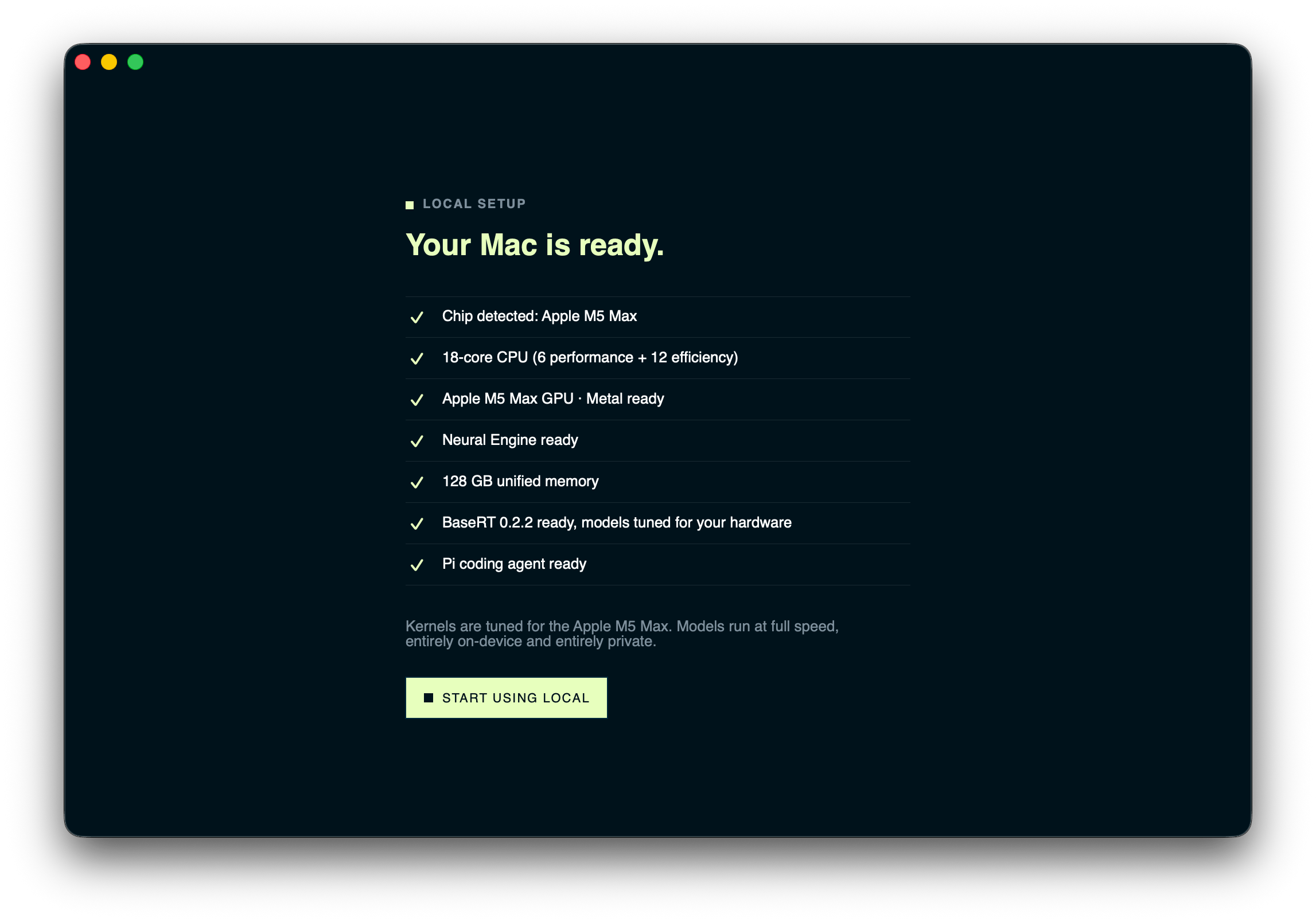
Core workflows include local chat, PDF and file analysis, editing code in a local folder, on-device meeting transcription with speaker labels, and user-controlled memory. The application recommends models based on the Mac’s chip and available unified memory. Users can optionally connect OpenAI, Anthropic, or OpenRouter using their own credentials; those requests are not local and are disabled in privacy mode.
Office Mode allows a capable Mac, workstation, or on-premises server to serve models to other computers on the same office network. This feature is strategically important because it provides a bridge from a free desktop application to enterprise deployment.
Local currently supports macOS on Apple Silicon. Windows and Linux are described as “coming,” without firm release dates. Pricing is free, with no account or per-token charge. The company has not disclosed whether future paid consumer plans are planned.
Product-quality assessment: High for an early release. The application combines several useful local workflows with hardware-aware setup, while BaseRT provides genuine technical substance. Limitations include one-platform availability, reliance on open-model quality, significant hardware requirements for larger models, and limited independent testing of privacy and performance claims.
Founder and Team Assessment
Base Compute identifies itself as a small senior team in Melbourne and Berlin. Third-party startup directory F4 lists Lukas Wesemann as CEO, Prabod Rathnayaka as CTO, and Fabian Waschkowski as a co-founder, while all three appear as authors of the BaseRT paper (F4 profile; arXiv).
Wesemann reports a University of Melbourne PhD in physics, postdoctoral nanotechnology research, work on Australian language models, and co-founding the MLAI community. These details come primarily from his own professional website and should be treated as founder-reported rather than fully independently verified (Wesemann profile).
Rathnayaka is the principal visible contributor to the BaseRT GitHub repository. His public GitHub account dates from 2014 and lists 63 public repositories, supporting an assessment of meaningful technical experience (GitHub profile). Less reliable public information was found on his or Waschkowski’s commercial track records, previous exits, or enterprise-sales experience.
The company is recruiting technical personnel and describes open roles in machine-learning research and engineering, indicating active team building (careers page). Exact headcount, employment status, founder ownership, and runway are not publicly disclosed.
Founder Assessment: Strong systems and research execution, but enterprise commercialization experience and organizational depth remain insufficiently evidenced.
Market Opportunity
The initial commercial segment should be defined narrowly: security-conscious organizations with Mac-heavy workforces that want generative-AI capabilities without routinely transferring internal documents, code, recordings, or prompts to cloud providers. Likely early adopters include software companies, professional services, regulated organizations, research groups, government contractors, and privacy-sensitive creative teams.
The consumer local-AI market is large in usage terms but difficult to monetize because capable alternatives are free. The more attractive market is enterprise edge-AI infrastructure: model distribution, access control, policy enforcement, monitoring, hybrid routing, hardware optimization, and integration across device fleets. Base Compute explicitly describes this enterprise stack as its intended direction (enterprise strategy).
No reliable public count exists for organizations that both require local LLMs and will purchase a managed platform. An illustrative analyst scenario is:
- 20,000–100,000 addressable organizations globally;
- $25,000–$100,000 annual software or support expenditure per organization;
- theoretical market of approximately $0.5–$10 billion in annual revenue.
This is a scenario, not a verified market estimate. The lower end could support a venture business; the upper end requires broad cross-platform support, regulated-industry adoption, and enterprise-grade governance. Adjacent opportunities include runtime licensing to software vendors, optimization contracts with chip manufacturers, embedded deployments, private AI appliances, and hybrid inference routing.
Traction and Growth Signals
Local ranked #5 on Product Hunt’s August 21 leaderboard with approximately 111 votes (Product Hunt leaderboard). This represents early launch interest only. It does not prove product-market fit, revenue, retention, customer satisfaction, commercial growth, or long-term demand.
More useful technical signals exist around BaseRT. Its repository was created in June 2026 and had 194 stars, 15 forks, and recent development activity by August 26 (GitHub API). The project includes a CLI, model-conversion tools, bindings, documentation, and an OpenAI-compatible API.
The underlying engine is not fully open source. The repository’s CLI, headers, bindings, format, and documentation use Apache 2.0, but the compiled engine and embedded Metal kernels are proprietary (engine licensing documentation). This may support defensibility, although it also limits external auditability.
No reliable public data was found for downloads, active installations, meeting hours processed, enterprise pilots, revenue, customer retention, conversion, or post-launch usage.
Traction Assessment: Technically promising but commercially unverified.
Competitive Position
Direct competitors include LM Studio, Ollama, Jan, GPT4All, Msty, and other local-model desktop applications. Free infrastructure alternatives include llama.cpp, Apple MLX, and self-managed model servers. Cloud AI products from OpenAI, Anthropic, Microsoft, and Google remain indirect substitutes, while Apple could bundle more local intelligence directly into macOS.
Local’s current advantages are frictionless model selection, an integrated multi-workflow interface, privacy-by-default positioning, Office Mode, and potentially faster Apple Silicon inference. BaseRT’s proprietary kernels and chip-specific optimizations are more defensible than Local’s application interface.
Nevertheless, switching costs are low for individual users, model weights are supplied by third parties, and competitors already have large developer communities. Jan claims millions of downloads, while Ollama reports more than nine million developers; these are company-reported figures but illustrate the distribution gap (Jan; Ollama).
If Apple, Ollama, or LM Studio launched comparable automatic hardware tuning and office sharing within six months, users might remain only if BaseRT delivered persistently superior performance or Base Compute had already become embedded in enterprise governance workflows. Neither advantage is yet commercially proven.
Defensibility Assessment: Medium
Business Model and Economics
Local currently produces no disclosed direct revenue. Its zero-cloud architecture should minimize recurring inference expense because compute is supplied by the customer’s hardware. Distribution, model downloads, support, software updates, and optional hosted services would still create costs.
The credible revenue routes are enterprise per-seat or per-device subscriptions, fleet-management licensing, support contracts, proprietary runtime licensing, and optimization work for model or chip vendors. Enterprise gross margins could resemble infrastructure software if support and custom integration remain controlled. Conversely, extensive deployment engineering could make the business services-heavy.
Customer acquisition is currently developer- and community-led. A regulated-enterprise strategy would require security reviews, procurement capabilities, compliance documentation, integrations, and a direct sales organization. No pricing, gross margin, sales pipeline, or customer-acquisition data is public.
Unicorn Path
For a high-growth infrastructure-software company, a 10× ARR benchmark is a reasonable analytical assumption, though actual multiples depend heavily on growth, retention, margins, and market conditions.
\[
\$1\text{ billion valuation} \div 10 = \$100\text{ million ARR}
\]
Because enterprise pricing is undisclosed, customer requirements can only be illustrated. At hypothetical annual contract values of $50,000–$250,000, Base Compute would need roughly 400–2,000 enterprise customers to reach $100 million ARR. Alternatively, a smaller number of significant OEM or chipmaker licensing agreements could contribute substantial revenue.
The free Local application cannot independently support this outcome. The company would need to establish Local as a distribution and product-validation layer, expand to Windows and Linux, sell centralized governance and deployment, produce auditable security controls, and secure OEM or enterprise channels.
Unicorn Path: Conditional
Valuation Assessment
No verified funding round, investors, SAFE cap, post-money valuation, or active fundraising terms were found. Revenue and growth are also undisclosed.
Valuation Attractiveness: Not Assessable
A responsible assessment requires current ARR, enterprise pipeline, retention, gross margin, burn, runway, round size, valuation cap or pre-money valuation, dilution, and liquidation preferences. Product quality and Product Hunt activity cannot justify a valuation range.
Key Risks
- No verified commercial traction: No revenue, contracts, retention, or usage data.
- Unproven monetization: The flagship application is free.
- Strong free competition: Ollama, LM Studio, Jan, llama.cpp, and MLX constrain pricing.
- Platform concentration: Local currently depends on Apple Silicon and Metal.
- Benchmark replication risk: Performance claims are company-produced.
- Enterprise execution risk: Security, procurement, support, and sales capabilities are unproven.
- Low consumer switching costs: Users can move between local-model interfaces easily.
- Model dependency: Product capability depends partly on third-party open models.
- Privacy assurance: “No telemetry” and local-processing claims have not been independently audited.
- Key-person risk: Core runtime development appears concentrated among a small technical team.
Final Assessment
Venture Potential: 66/100
| Category | Score |
|---|---|
| Market Size and Expansion Potential | 18/20 |
| Traction and Growth Evidence | 6/20 |
| Founder and Team | 12/15 |
| Product Strength | 9/10 |
| Distribution Potential | 8/15 |
| Business Model and Economics | 5/10 |
| Defensibility | 8/10 |
| Total | 66/100 |
The strongest elements are technical execution, enterprise relevance, and proprietary runtime optimization. The weakest are commercial traction, pricing, repeatable distribution, and verified economics.
Evidence Confidence: 52/100
Product functionality, founder identities, technical documentation, GitHub activity, launch ranking, and the runtime’s licensing structure are reasonably verifiable. Performance results and founder backgrounds are primarily company-reported. Revenue, customers, retention, funding, valuation, cap table, margins, burn, and runway remain unavailable.
Final Decision: Watch
Local is technically differentiated enough to merit continued monitoring, but the evidence does not yet justify formal due diligence. The venture case rests on a future enterprise business rather than the currently free application.
Upgrade Conditions
- Three to five verifiable enterprise design partners or paid deployments.
- Documented enterprise pricing and a repeatable sales pipeline.
- Independently reproduced BaseRT performance benchmarks.
- Evidence of sustained active usage and retention after launch.
- Windows or Linux availability.
- Enterprise security controls, deployment administration, and audit capabilities.
- A credible path to software-like gross margins.
- Clear funding terms and full-time founder commitment.
Downgrade Conditions
- Product or GitHub development materially slows.
- Users do not retain after initial model experimentation.
- Larger competitors match BaseRT performance and Office Mode.
- Enterprise deployments require excessive custom engineering.
- Privacy claims fail independent review.
- Proprietary engine restrictions inhibit adoption.
- Founder departure or loss of core runtime expertise.
Questions for Further Diligence
- How many Local installations and weekly active devices exist?
- What are 30-, 90-, and 180-day retention rates?
- How many organizations are testing Office Mode in production?
- What revenue, if any, has Base Compute generated?
- What enterprise product, pricing model, and target ACV are planned?
- Which BaseRT benchmarks have been independently reproduced?
- What functions remain proprietary, and how will runtime licensing work?
- What security audits, code-signing controls, and privacy reviews have been completed?
- What are the founders’ roles, full-time commitments, and ownership percentages?
- What are monthly burn, cash runway, and current fundraising terms?
- How will the company compete with Apple, Ollama, and LM Studio?
- Which OEM, chipmaker, or enterprise distribution partnerships are under discussion?