
Table of Contents
VoiceCap Investment Report
Category: AI meeting transcription and organizational memory
Company Stage: Newly launched / early commercial stage
Founder or Founders: Rokas Jurkėnas
Headquarters: Vilnius, Lithuania, according to VoiceCap; legal entity registered in Kaunas
Funding: No reliable public funding information found
Business Model: Freemium, per-capture-seat SaaS subscription
Product Hunt Launch Date: September 19, 2026
Report Date: September 22, 2026
| Investment Metric | Assessment |
|---|---|
| Venture Potential | 60/100 |
| Unicorn Path | Conditional |
| Valuation Attractiveness | Not Assessable |
| Evidence Confidence | 63/100 |
| Final Decision | Watch |
Executive Summary
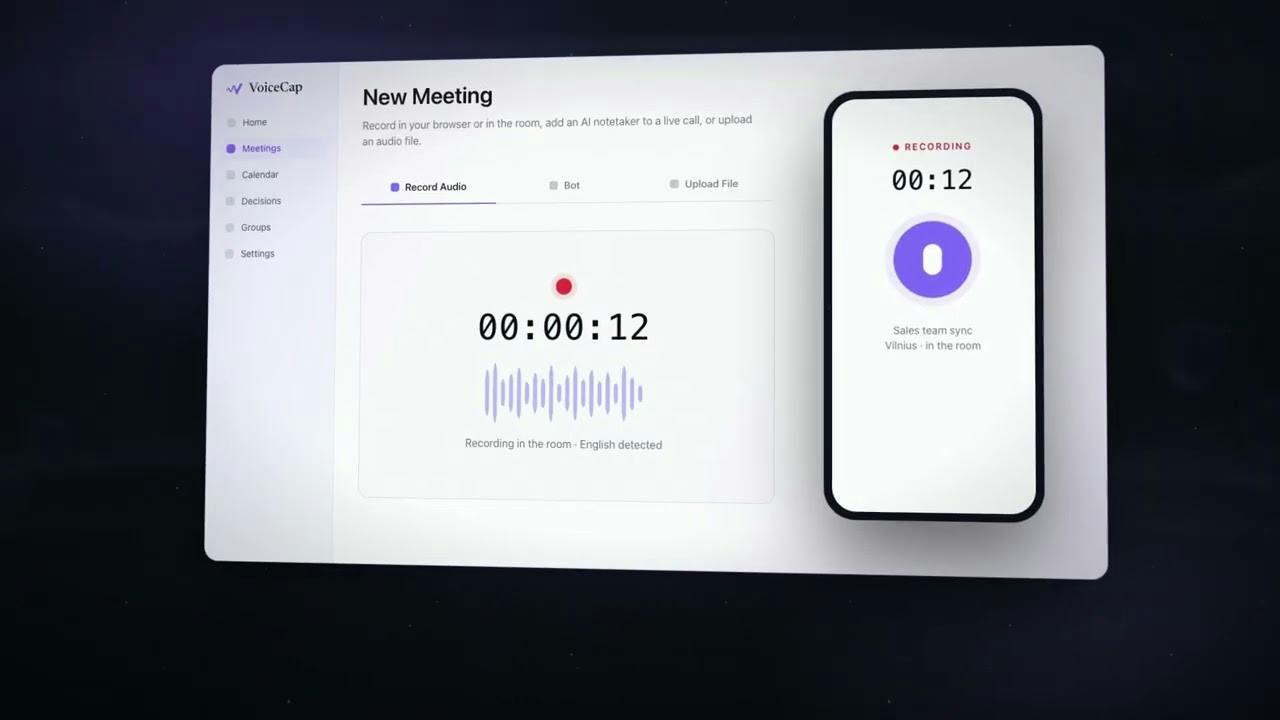
VoiceCap is an AI meeting assistant aimed primarily at European businesses whose conversations occur in languages underserved by English-first transcription products. It records in-person and online meetings, generates speaker-separated transcripts, summaries, decisions and action items, and stores the results in a searchable team workspace. Users can also query meeting records from Claude, ChatGPT and other MCP-compatible clients (official website).
The product’s strongest differentiation is its combination of European-language positioning, mobile room recording, meeting bots, decision tracking and EU-focused data governance. VoiceCap claims support for more than 100 languages and 95%+ accuracy across Baltic, Scandinavian and other European languages. These performance claims are company-reported and have not been independently benchmarked (about page, Product Hunt).
Company quality is stronger than is typical for a newly launched application. Founder Rokas Jurkėnas has operated the Idea Link software and AI-development agency since 2019. VoiceCap’s legal operator, MB “Su idėja,” reported €942,721 in 2025 turnover and €49,384 in net profit, while public employment records show approximately 13 insured employees. These figures cover the agency and cannot be attributed to VoiceCap (Lithuanian company data, Okredo).
The principal concern is the absence of product-specific commercial traction. No VoiceCap revenue, paying-customer count, active users, retention, usage volume or customer references are publicly disclosed. Its mobile applications are extremely new: the US App Store has too few reviews to display a rating, and Google Play currently displays no meaningful installation history (Apple App Store, Google Play).
VoiceCap has a potentially viable regional wedge, but it competes with well-funded meeting-intelligence platforms offering similar language coverage, mobile applications and enterprise controls. The appropriate decision is Watch until VoiceCap demonstrates independent paid adoption, retention and defensible transcription performance.
Product Overview
VoiceCap addresses the loss of decisions and commitments across in-person and online business meetings. The existing workflow usually involves manual notes, platform-generated transcripts, generic meeting bots or employees reconstructing decisions from emails and chat messages.
The product captures meetings through three channels:
- In-person recording through browser, iOS or Android;
- Automated meeting bots for Zoom, Google Meet, Microsoft Teams and Webex;
- Uploaded audio or video files.
VoiceCap then produces a transcript with speaker identification, summary, action items and proposed decisions. Confirmed decisions become separate, searchable records linked to the point in the recording where they were made. Workspace roles and sharing controls allow meetings to remain private, be shared with a group or become accessible to the full organization (features, App Store).
Its MCP integration is notable: authorized users can ask external AI assistants what was agreed in a meeting and receive answers linked to the underlying timestamp. Access is read-only and limited to meetings the user is already permitted to view, according to VoiceCap (official website).
Pricing is:
- Free: One-time allowance of 300 transcription minutes.
- Pro: €29 per capture seat per month, with 1,000 monthly minutes contributed to a workspace pool.
- Business: €49 per capture seat per month, described as unlimited but subject to a fair-use expectation of 2,500 minutes per seat per month.
- Viewers: Free and unlimited on all plans (pricing, terms).
There is a material documentation inconsistency. The website says VoiceCap supports more than 100 languages, while the iOS listing says more than 30. The website also promotes live recording and meeting bots, while the terms state that VoiceCap “does not initiate recordings itself” and only processes content submitted by users. These differences may reflect narrower mobile capabilities or outdated legal language, but they should be corrected.
Product Quality Assessment: Thoughtfully designed for multilingual meeting capture and decision memory, but accuracy, language coverage and reliability require independent testing.
Founder and Team Assessment
Rokas Jurkėnas is identified as VoiceCap’s founder and CEO and as founder and CEO of Idea Link, a Lithuanian AI and software-development agency. His public professional profile describes work in AI implementation and digital-product development, while Idea Link says it has completed more than 100 digital and AI projects (founder LinkedIn, Idea Link).
VoiceCap’s legal operator is MB “Su idėja,” incorporated in Lithuania in May 2019 and managed by Jurkėnas. The legal entity also operates Idea Link. Its public filings show revenue rising from €173,583 in 2021 to €942,721 in 2025, with €49,384 in 2025 net profit and €124,484 in equity (Rekvizitai).
Idea Link claims a team of more than 20 people, while Lithuanian social-insurance data reported approximately 13 employees as of September 2026. The discrepancy may reflect contractors, group structure or marketing language; current VoiceCap-dedicated headcount is not disclosed (Idea Link team, Okredo).
The agency background provides genuine advantages: an existing engineering team, customer relationships, cash-generating services and practical experience delivering AI systems. Conversely, VoiceCap may compete internally with client projects for talent and founder attention. No previous venture-backed startup, major exit or scaled SaaS company is publicly verified.
Founder Assessment: Relevant product-development and commercial-services experience, but dedicated SaaS leadership and ability to scale recurring revenue remain unproven.
Market Opportunity
VoiceCap’s initial segment is European consultancies, agencies, sales teams, founders and professional-services firms that conduct meetings in Baltic, Nordic or mixed European languages. These customers have a recurring need to document client commitments and may pay a premium for better language accuracy, EU storage and decision traceability.
At current list prices:
- 10,000 Pro seats at €348 annually would represent approximately €3.5 million ARR.
- 50,000 Business seats at €588 annually would represent approximately €29.4 million ARR.
- 200,000 seats at a blended €450 annual revenue would represent approximately €90 million ARR.
These are analyst scenarios, not forecasts or reported customer numbers. They exclude discounts, VAT, churn and unpaid viewers.
Adjacent opportunities include legal and consulting workflows, CRM synchronization, sales coaching, compliance archives, sector-specific vocabularies, APIs and enterprise knowledge retrieval. Geographic expansion beyond Europe is possible, but the product’s differentiation becomes weaker in English-speaking markets where established vendors have deeper integrations and larger customer bases.
The addressable market can support venture-scale revenue, but only if VoiceCap moves from a regional transcription tool to an embedded organizational-memory platform with enterprise contracts.
Traction and Growth Signals
VoiceCap’s September 2026 Product Hunt launch received approximately 97 votes and placed eighth on the daily leaderboard, according to third-party launch tracking (Product Hunt, LaunchPact). This is launch attention, not commercial validation.
The product is publicly usable through a web application and has native iOS and Android listings. The iOS listing has insufficient ratings for Apple to display a review summary, while Google Play currently shows no meaningful public download milestone. The app-store evidence is consistent with an extremely recent launch rather than established mobile adoption (App Store, Google Play).
The founder states that VoiceCap was initially built for Idea Link’s internal meetings and then offered to agency clients. No named paying customer, contract value or independent case study was found (Product Hunt maker statement).
The parent legal entity’s approximately €943,000 in 2025 turnover is evidence that the operating team has an established business, but VoiceCap launched later and its revenue cannot be inferred from those filings.
The most important missing metrics are activated workspaces, weekly active users, paid seats, conversion, minutes processed, retention, expansion revenue and customer references.
Traction Assessment: Functional product and credible operating company, but VoiceCap-specific traction is commercially unverified.
Competitive Position
Direct competitors include Fireflies.ai, Otter.ai, Granola, Fathom, tl;dv and Jamie. Indirect competitors include native meeting transcription from Microsoft Teams, Google Meet and Zoom, manual notes and general-purpose speech-to-text APIs.
VoiceCap’s €29 Pro and €49 Business monthly prices are above Fireflies’ annual-billing prices of $10 and $19 per seat per month. Fireflies also advertises transcription in more than 100 languages, mobile applications, conversation intelligence and mature enterprise controls (Fireflies pricing). Therefore, 100-language support by itself is not a defensible distinction.
Otter publicly supports a smaller language set but already offers mobile recording, meeting bots, AI chat, speaker identification, CRM integrations, SSO, SCIM and custom data retention (Otter pricing). Granola provides bot-free capture, multi-language support, mobile and desktop applications, MCP access, APIs and enterprise administration (Granola pricing).
VoiceCap’s best differentiation is the combination of smaller-language accuracy, EU positioning and decision records linked to exact transcript moments. However, the company relies on third-party providers—including Google Cloud, OpenAI, Groq, ElevenLabs, Recall.ai and AssemblyAI—rather than a disclosed proprietary speech model (privacy policy).
If a leading platform matched VoiceCap’s Baltic-language quality and decision log within six months, users would have limited reason to stay unless VoiceCap had demonstrably better accuracy, embedded workflows or accumulated organizational knowledge. Those advantages are not yet proven.
Defensibility Assessment: Low to Medium
Business Model and Economics
VoiceCap uses per-capture-seat subscriptions while allowing unlimited free viewers. This can reduce adoption friction because only users who record or upload meetings require paid seats.
At list price, annual contract value is €348 per Pro seat and €588 per Business seat. A ten-seat Business workspace would therefore produce approximately €5,880 annually before discounts and VAT.
Variable costs are potentially significant. Transcription, diarization, summaries, meeting bots, storage and AI queries use multiple third-party providers. The Business plan’s fair-use expectation of 2,500 minutes per seat suggests that usage economics require active management. VoiceCap does not disclose per-minute cost, gross margin or average utilization.
The agency could initially subsidize product development from services revenue, reducing financing pressure. However, services margins and staffing priorities differ from scalable SaaS economics. Enterprise expansion will also require SSO, SCIM, configurable retention and audit-log exports, all of which are currently described as forthcoming rather than available (security page).
Unicorn Path
An 8× ARR multiple is appropriate for scenario analysis because VoiceCap would be a recurring B2B SaaS product, but it operates in a crowded market with material inference costs.
Required ARR = $1 billion ÷ 8 = approximately $125 million.
At current prices, this would require approximately:
- 359,000 Pro seats at €348 annually; or
- 213,000 Business seats at €588 annually; or
- 12,500 enterprise customers at an illustrative €10,000 ACV.
Currency differences do not materially change the conclusion. A blended route would require hundreds of thousands of paid seats, substantial enterprise adoption and likely gross margins above 70%.
VoiceCap would need independently superior European-language performance, deeper CRM and productivity integrations, enterprise security controls, repeatable international distribution and proprietary meeting intelligence beyond commodity transcription.
Unicorn Path: Conditional
Valuation Assessment
No VoiceCap funding round, institutional investor, SAFE cap, valuation or current fundraising terms were found. The operating legal entity has positive agency revenue and profit, but VoiceCap-specific revenue is unknown.
Valuation Attractiveness: Not Assessable
Assessment requires product ARR, growth, paid seats, gross margin, retention, agency-versus-SaaS revenue allocation, burn, runway, cap table, round size and proposed post-money valuation.
Key Risks
- No verified VoiceCap revenue or retention.
- Intense competition from larger, better-distributed meeting platforms.
- Limited defensibility without proprietary speech technology.
- Potentially high transcription, bot and AI-processing costs.
- Premium pricing relative to established competitors.
- Enterprise controls remain incomplete.
- Agency work may distract the founder and technical team.
- Recording-consent and GDPR compliance risk across jurisdictions.
- Documentation conflicts concerning languages and recording behavior.
- Little public app-store adoption or customer-review evidence.
Final Assessment
Venture Potential: 60/100
| Category | Score |
|---|---|
| Market Size and Expansion Potential | 17/20 |
| Traction and Growth Evidence | 5/20 |
| Founder and Team | 11/15 |
| Product Strength | 8/10 |
| Distribution Potential | 7/15 |
| Business Model and Economics | 7/10 |
| Defensibility | 5/10 |
| Total | 60/100 |
The strongest elements are the market opportunity, relevant founder experience and functional cross-platform product. The weakest are product-specific traction, distribution and defensibility.
Evidence Confidence: 63/100
The legal entity, founder, agency finances, pricing, privacy architecture and application availability are well documented. Product performance and language accuracy are company-reported. Revenue, retention, users, customer references, unit economics, funding and valuation remain unavailable.
Final Decision: Watch
VoiceCap is too early for formal investment due diligence despite a credible team and market wedge. The decision should be upgraded only after independent evidence of recurring paid adoption and language-performance superiority.
Upgrade Conditions
- At least €1 million in verified VoiceCap ARR.
- More than 70% six-month paid-logo retention.
- At least 100 independent paying business workspaces.
- Gross margin above 70% after transcription and meeting-bot costs.
- Referenceable customers in multiple European markets.
- Independent benchmarks showing superior Baltic or Nordic accuracy.
- SSO, SCIM, retention policies and audit exports in production.
- Repeatable acquisition outside the founder’s agency client base.
Downgrade Conditions
- Weak conversion after the 300 free minutes.
- High churn after initial meeting imports.
- Gross margin deterioration at high recording volumes.
- Competitors close the European-language accuracy gap.
- VoiceCap remains primarily an internal agency product.
- Material consent, privacy or security incidents.
- Product claims remain inconsistent across legal and marketing documents.
Questions for Further Diligence
- What are VoiceCap’s current MRR, paid seats and paying workspaces?
- What percentage of free workspaces convert after using 300 minutes?
- What are 30-, 90- and 180-day workspace retention rates?
- How many customers came from Idea Link versus independent channels?
- What are transcription and summary costs per recorded hour?
- What are gross margins for Pro and Business at current utilization?
- How was the 95%+ accuracy claim measured, and against which competitors?
- How many employees work full-time on VoiceCap?
- What percentage of founder time is allocated to VoiceCap versus agency services?
- What are current burn, runway and funding requirements?
- Who owns VoiceCap’s intellectual property, and what is the cap table?
- What valuation and investor terms apply to the current or planned round?