
Table of Contents
OpenComputer Investment Report
Category: AI agent infrastructure (cloud sandboxes / managed agent compute)
Company Stage: Seed
Founder or Founders: Igor Zalutski (CEO), Mohamed Habib (CTO), Utpal Nadiger (co-founder)
Headquarters: San Francisco Bay Area (relocated from London)
Funding: $3.6M seed (June 2025, Initialized Capital); earlier backers per founder profile include Firstminute Capital and DST (amounts undisclosed)
Business Model: Usage-based infrastructure (per-second machine time + model-token passthrough) with prepaid credit plans ($20/$200 per month) and custom enterprise tier
Product Hunt Launch Date: August 27, 2026 (current positioning); an earlier version launched July 25, 2026 under the tagline “The easiest way to deploy a managed agent”
Report Date: August 29, 2026
| Investment Metric | Assessment |
|---|---|
| Venture Potential | 55/100 |
| Unicorn Path | Conditional |
| Valuation Attractiveness | Not Assessable |
| Evidence Confidence | 52/100 |
| Final Decision | Watch |
Executive Summary
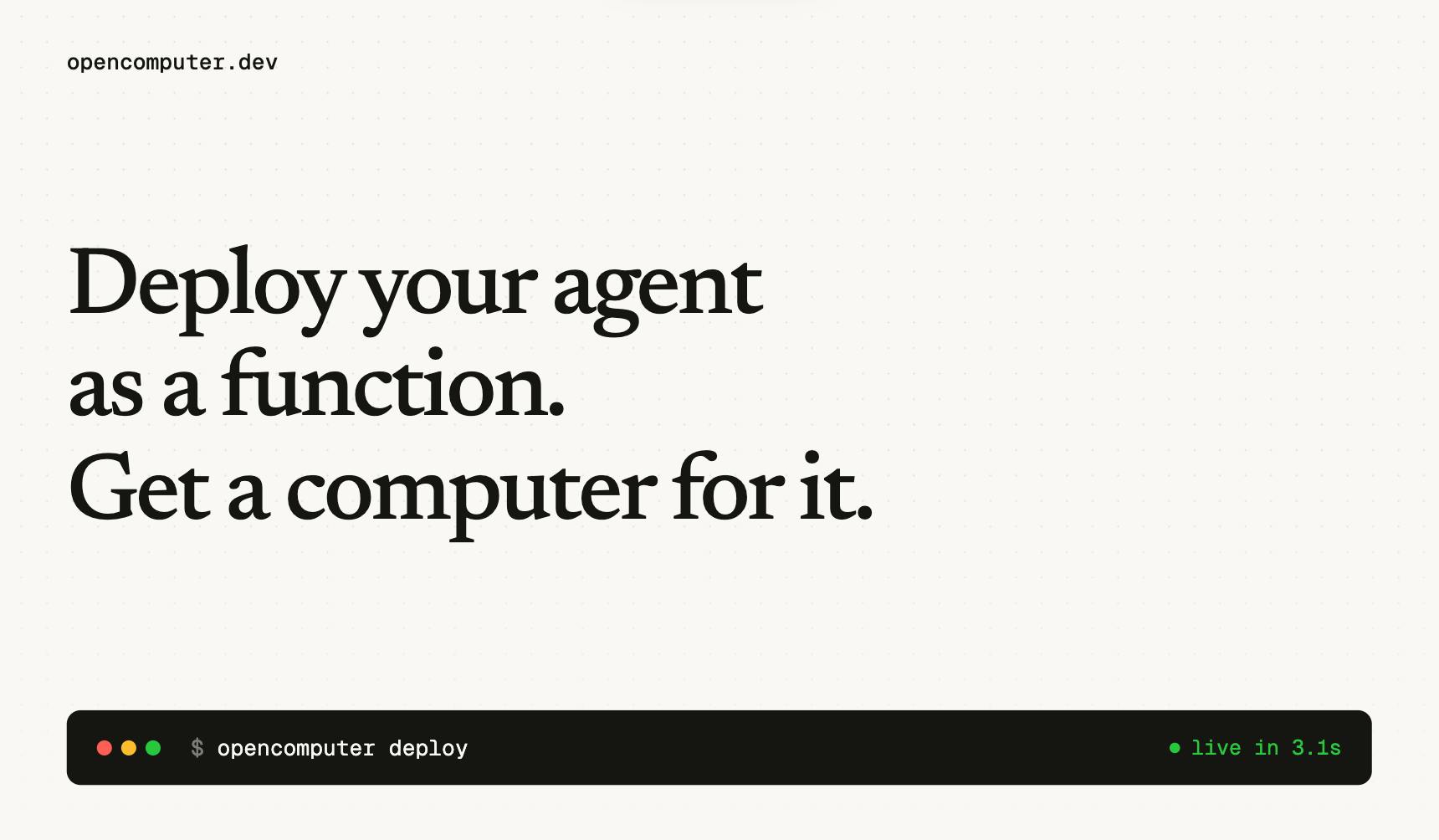
OpenComputer is a cloud platform for running AI agents, built by the team behind Digger, an open-source Terraform orchestration tool. Developers write an agent as a TypeScript function, deploy it, and each session runs on a dedicated Linux microVM that can hibernate, resume, checkpoint, and fork. The company positions itself as “Firebase/Vercel for agents”: managed sessions, streaming, scheduling, secrets injection, and a model-agnostic gateway, with bare sandboxes available one layer down. github
The strongest positive signal is the founding team. The founders built Digger to a claimed 500,000 downloads and 300+ companies, co-founded OpenTofu (the Linux Foundation-backed Terraform fork), and raised a $3.6M seed led by Initialized Capital with angels including the CEOs of Datadog and WorkOS and the co-founder of Sentry. These are credible infrastructure operators with proven open-source distribution ability and ex-Palantir/Amazon/Fitbit engineering backgrounds. blog.initialized
The central concern is that OpenComputer is the company’s second or third strategic direction in roughly a year — Terraform CI/CD, then the “Infrabase” AI DevOps agent, now agent compute — and it enters one of the most crowded, best-capitalized categories in developer infrastructure. E2B has raised roughly $32M including an Insight Partners-led $21M Series A and claims Fortune 100 customers; Daytona raised a $24M Series A in February 2026; and Vercel, Cloudflare, Fly.io, Modal, and LangChain all ship overlapping products. vestbee
There is no public evidence of revenue, paying customers, or usage for OpenComputer specifically. Product Hunt attention across two launches is modest (376 followers on the current product page; 271 on the earlier post), and the GitHub repo shows 240 stars — real but early. github
Verdict: a strong team with a plausible market and unproven commercial traction. Watch.
Product Overview
OpenComputer solves a genuine, emerging problem: agent loops need persistent, stateful compute — a real filesystem, package installation, browser automation, and the ability to pause and resume — which ephemeral containers handle poorly. Core features include TypeScript-function agent deployment, one Linux microVM per session, durable sessions with hibernate/resume, checkpoint/fork, secrets injected outside the runtime (the agent can use a token but never read it), scheduled agents, and a raw sandbox API. Pricing is pay-as-you-go with a $10 free credit; machine time runs $0.00315/min for a 2 GB/1 vCPU default instance (about $1/month for ten minutes of daily use), with Pro ($20/mo) and Max ($200/mo) plans functioning as 10× prepaid usage credit, and model tokens passed through at API rates. It replaces DIY orchestration on EC2/Fly machines or stitching together sandbox APIs plus custom session management. The product is live, documented, and verifiably functional. github
Founder and Team Assessment
Igor Zalutski (CEO, ex-Palantir/Fitbit per his LinkedIn headline), Mohamed Habib (CTO), and Utpal Nadiger have worked together since 2020, originally in London via Entrepreneur First, and relocated to San Francisco. Their OpenTofu involvement and Digger’s adoption are independently corroborated by their lead investor. Technical capability is high; commercial capability is partially demonstrated (Digger’s enterprise user base) but unproven for this product. Team size is not publicly disclosed; a July 2025 job post described three founders hiring a first engineer, and the repo shows seven contributors, suggesting a team under ten — not verified. Key-person risk is meaningful at this size, and the rapid pivots raise a focus/commitment question worth probing. github
Founder Assessment: Strong technical and open-source distribution credentials; commercial execution on this specific product remains unproven.
Market Opportunity
The initial customer is narrowly defined: developers and small teams shipping background or long-running agents (coding agents, DevOps automations, data/QA agents) who want managed stateful compute rather than assembling sandbox primitives. Adjacent expansion covers enterprise VPC/self-hosted deployments, AI app builders needing sandbox backends (the repo includes a “build a Lovable clone” guide), and scheduled agent fleets. A bottom-up sketch: if 50,000 agent-building teams worldwide would pay $1,700–$20,000 per year for managed agent compute (one always-on default machine costs roughly $1,656/year at list rates ), the near-term serviceable market is roughly $100M–$1B — real, but contested by at least eight funded or platform-backed rivals. Market timing is favorable; agent workloads are clearly growing. The market can support venture-scale revenue, but likely for one or two winners, not eight. github
Traction and Growth Signals
Verified traction is thin. Product Hunt: 376 followers on the current product page, 4.0 rating from one review, and a prior July 2026 launch with 271 followers; the launch-day comment thread was technically substantive (questions on credential scoping, drift, replayability), indicating informed interest rather than hype. GitHub: 240 stars, 23 forks, 868 commits, 138 releases, Apache-2.0. One third-party integration exists: Crabbox supports OpenComputer as a sandbox provider. The founder demoed “Serverless Agents” at an AI demo event on launch day. Digger’s legacy traction (500k downloads, 300+ companies) is investor-reported and does not transfer directly to this product. Missing: revenue, paying customers, active users, retention, and sustained post-launch usage. Note also that the fetched repo snapshot showed the latest commit dated May 29, 2026 — three months before launch — which either reflects caching or a slowdown worth verifying. github
Traction Assessment: Promising launch attention and credible engineering velocity, but commercially unverified.
Competitive Position
Direct competitors: E2B ($32M raised, enterprise traction claimed), Daytona ($31M total), Runloop, Blaxel, Northflank. Platform competitors: Vercel Sandbox, Cloudflare Sandbox, Fly.io Sprites, Modal — all listed with published per-second pricing in a May 2026 comparison — plus LangChain’s “give your agent its own computer” microVM product (June 2026), and Anthropic’s managed agents, which the makers acknowledge as a close comparator. Differentiation today: durable hibernate/resume sessions, checkpoint/fork, secrets-outside-runtime design, and an opinionated TypeScript-function deployment model. But switching costs in sandbox infrastructure are low, the core is Apache-2.0 (self-hostable), and hibernation/persistence features are already spreading — Fly.io Sprites bills nothing when idle and Vercel is beta-testing persistent sandboxes. If Vercel or Cloudflare shipped durable agent VMs in six months, the honest answer for “why stay” would be DX polish and the secrets/scheduling layer — thin. OpenComputer’s machine pricing is competitive ($0.189/hr for 2 GB vs. E2B’s ~$0.10 combined CPU+memory per the comparison, roughly comparable). opencomputer
Defensibility Assessment: Low–Medium.
Business Model and Economics
The model is usage-based compute with zero-markup token passthrough, meaning gross profit must come almost entirely from machine-time margin over raw cloud/VM costs, plus enterprise (VPC, SSO, volume pricing). The 10× credit multiplier on Pro/Max plans is a clever prepay mechanic but effectively caps implied discounts and signals heavy price sensitivity. Compute reselling in this category typically carries moderate gross margins; durable, hibernating VMs improve unit economics versus always-on machines, but no margin, CAC, or retention data is public. The model scales with usage — good if agents proliferate — but inference cost growth accrues to model providers, not OpenComputer, which only wins the machine meter. opencomputer
Unicorn Path
Assume a 10× forward revenue multiple, typical for growth-stage developer infrastructure with usage-based revenue. Required revenue for $1B ≈ $100M ARR. At current pricing: roughly 60,000 always-on default-machine equivalents (≈$1,656/yr each), or ~42,000 Max-tier customers ($2,400/yr), or ~2,000 enterprise customers at $50K ACV. The SMB tiers alone cannot plausibly get there; the path requires winning a top-two position in agent compute, landing hundreds of enterprise/VPC deals, and capturing heavy machine-time usage from agent fleets — against E2B, Daytona, and hyperscaler-adjacent platforms with 5–10× the capital. This is possible in a winner-take-most market, but only with a business-model expansion toward enterprise and much larger contract values. opencomputer
Unicorn Path: Conditional.
Valuation Assessment
Known funding: $3.6M seed, June 2025, led by Initialized Capital with devtools angels (Olivier Pomel, David Cramer, Michael Grinich, Zeno Rocha, Ben Porterfield); founder’s LinkedIn additionally lists Firstminute and DST, amounts undisclosed. No valuation, post-money figure, or current round is disclosed; comparables (E2B, Daytona Series A rounds) exist but require revenue to apply. With zero verified revenue, no responsible range can be constructed. blog.initialized
Valuation Attractiveness: Not Assessable. Required: current ARR, growth, gross margin, retention, burn/runway, round size, and post-money or SAFE cap.
Key Risks
- Competitive replication by platforms (Vercel, Cloudflare, LangChain) with native distribution. northflank
- No verified commercial traction two days post-relaunch; second PH launch suggests positioning is still being searched for. producthunt
- Pivot cadence (Terraform → Infrabase → OpenComputer) risks shallow commitment to any one market. github
- Low switching costs and an Apache-2.0 self-hostable core limit lock-in. github
- Compute-margin economics: token passthrough at cost leaves thin machine-time margin as the sole profit engine. opencomputer
- Well-capitalized rivals (E2B ~$32M, Daytona ~$31M) can outspend on GTM and price. startupintros
- Small team and founder dependency.
- Durable always-on agents raise security/blast-radius concerns flagged even by supportive PH commenters. producthunt
Final Assessment
Venture Potential: 55/100
| Category | Score |
|---|---|
| Market Size and Expansion Potential | 14/20 |
| Traction and Growth Evidence | 5/20 |
| Founder and Team | 11/15 |
| Product Strength | 7/10 |
| Distribution Potential | 8/15 |
| Business Model and Economics | 6/10 |
| Defensibility | 4/10 |
| Total | 55/100 |
Strongest: founder-market fit and product craft. Weakest: traction evidence and defensibility.
Evidence Confidence: 52/100
Verified: founders, seed round and investors, product functionality, pricing, repo activity, launch dates. Company/investor-reported: legacy Digger adoption. Unknown: all revenue, usage, retention, margin, team size, valuation, and current fundraising status.
Final Decision: Watch
The team and market clear the bar for monitoring, but there is no commercial evidence to justify DD yet, and the category’s crowding plus a recent pivot argue against assuming winner status. This is a promising product inside an unproven company in a brutally contested market.
Upgrade Conditions
- $1M+ ARR or clear paying-customer momentum within 12 months
- Evidence of sustained post-launch usage growth (SDK downloads, active sessions) rather than launch spikes
- Signed enterprise/VPC contracts at $25K+ ACV
- Demonstrated retention above 70% at six months and gross margin above 60%
- A credible, articulated moat (workflow/data lock-in) versus Vercel/Cloudflare/E2B
Downgrade Conditions
- Repo/release activity stalling (the May 2026 commit gap, if real, would qualify)
- Weak paid conversion from the free $10 credit tier
- A platform competitor shipping durable-session equivalents
- Another product pivot, or founder departure
- Misleading traction claims or security incident involving the secrets model
Questions for Further Diligence
- Current MRR/ARR and monthly growth since the July 2026 soft launch?
- How many paying customers, and what is free-to-paid conversion from the $10 credit?
- Session-level retention: 30/90/180-day cohorts and net revenue retention?
- Gross margin on machine time after underlying VM/cloud costs?
- Why the pivot from Infrabase, and what did Digger/Infrabase revenue look like?
- Burn rate, runway, and is a Series A being raised now — on what terms?
- What share of usage comes from managed agents vs. bare sandboxes?
- How do you respond if Vercel or Cloudflare ships hibernating agent VMs?
- Current team size and hiring plan?
- What does the cap table look like, including Firstminute/DST stakes?
- Why TypeScript-first when most agent workloads are Python — and what do Python SDK metrics show?
Sources
- Product Hunt — OpenComputer product page
- Product Hunt — earlier OpenComputer launch post
- OpenComputer official site and pricing
- GitHub — diggerhq/opencomputer
- Initialized Capital — Digger seed announcement
- LinkedIn — Igor Zalutski profile
- Entrepreneur First — Digger founding engineer listing
- Insight Partners — E2B Series A
- Daytona — $24M Series A announcement
- Northflank — AI sandbox pricing comparison (secondary)
- LangChain — agent compute product
- Crabbox — OpenComputer provider docs