
Table of Contents
CodeBurn Investment Report
Category: Developer Tools / AI Coding Cost Observability (open source)
Company Stage: Pre-seed / bootstrapped open-source project (no verified entity or funding)
Founder or Founders: Resham Joshi (AgentSeal founder, technical); Aditya Vikram Singh (launch co-founder, per his LinkedIn announcement)
Headquarters: Not formally disclosed; founder based in Ingolstadt, Germany (LinkedIn); GitHub org lists Germany, domain agentseal.org
Funding: None found — no reliable public information on any raise
Business Model: None currently. Free, MIT-licensed, local-first; GitHub Sponsors donations; a “sync (team telemetry)” feature in preview is the only visible monetization vector (GitHub README)
Product Hunt Launch Date: August 13, 2026 (PH page; underlying tool publicly launched ~April 13–14, 2026)
Report Date: August 15, 2026
| Investment Metric | Assessment |
|---|---|
| Venture Potential | 38/100 |
| Unicorn Path | Improbable |
| Valuation Attractiveness | Not Assessable |
| Evidence Confidence | 52/100 |
| Final Decision | Watch |
Executive Summary
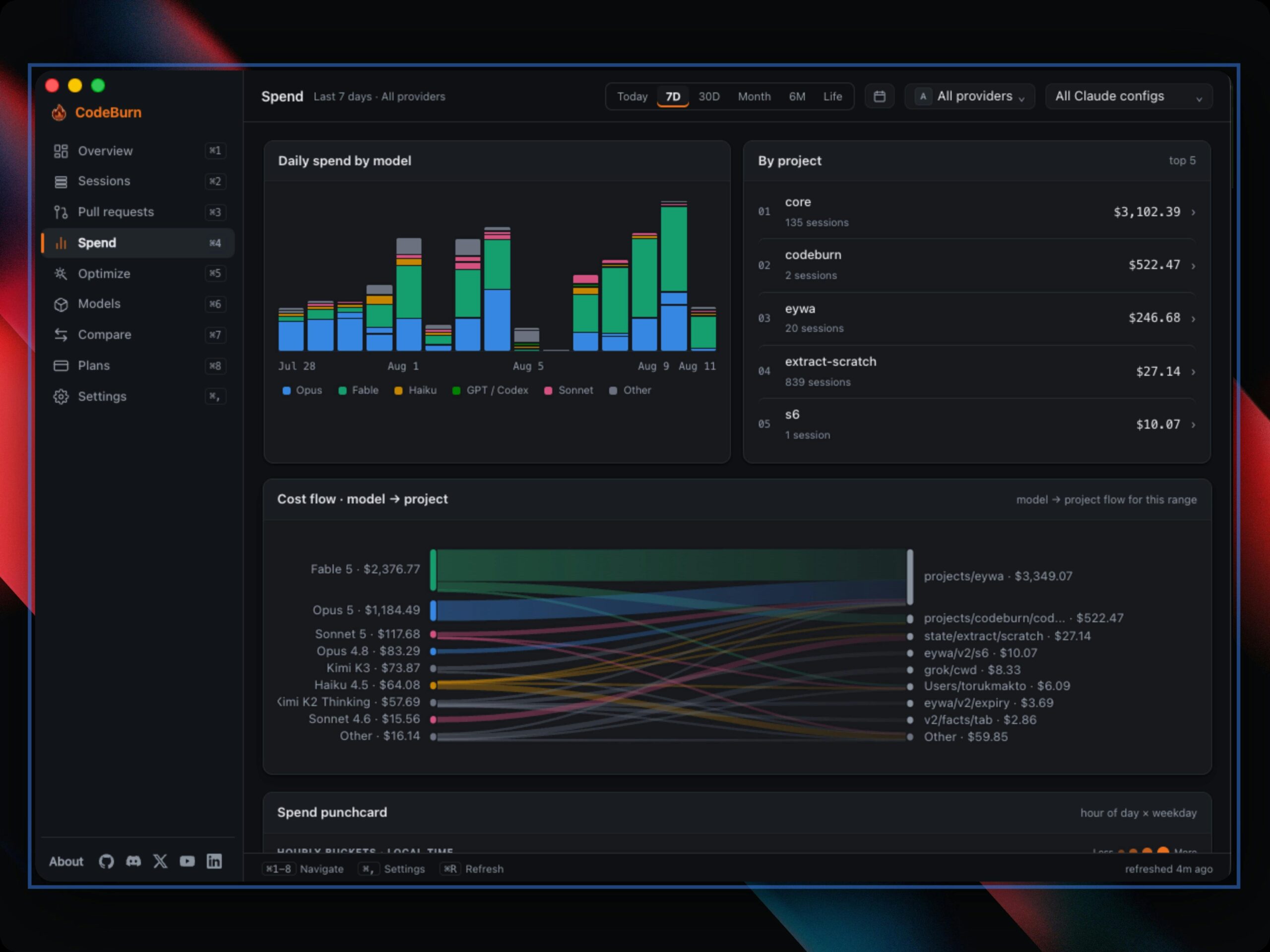
CodeBurn is a free, open-source, local-first CLI/desktop tool that reads the session files AI coding agents (Claude Code, Cursor, Codex, Copilot, ~36–40 tools) already write to disk, and breaks down token and dollar spend by task, model, project, and pull request. It adds an “Optimize” function that finds waste (cache bloat, retry tax) and applies fixes, plus budget guards and model comparison. Everything runs locally with no account and no uploads — a genuine differentiator for cost data that developers consider sensitive.
The product is unusually strong for its age. It grew from a self-described “two-hour hack” in April 2026 to roughly 9,000+ GitHub stars, 13,000+ npm downloads in its first week, GitHub Trending placement, and organic third-party coverage (VirtusLab, Trendshift, founder LinkedIn). The Product Hunt thread shows sophisticated, honest engineering engagement from the team. This is real developer adoption, not just launch attention.
The strongest positive signal is genuine bottom-up developer pull in a category — AI coding spend visibility — that is growing as agent usage explodes, with the team already shipping a desktop app, menubar, MCP server, and a preview team-sync feature that sketches a path to B2B.
The central concern is that there is no company behind the product yet in any venture sense: no revenue, no pricing, no funding, no disclosed valuation, and a permanently-free MIT core whose local-first architecture structurally limits monetization. The “used by 150k+ developers” claim on the PH page is unverified company-reported marketing. Direct free competitors (ccusage, and vendors’ own /usage commands) commoditize the core feature.
Decision: Watch. This is a promising open-source project and a credible wedge, but the venture case is unbuilt. It becomes interesting only if the preview team-sync/telemetry layer converts into paid team or enterprise revenue.
Product Overview
Problem: Developers and teams running AI coding agents cannot see where their spend goes. Provider dashboards report consumption, not what it accomplished; users report “$200/day” and “$1,400/week” surprises with no attribution (PH thread, note.com writeup).
How it works: CodeBurn parses local session logs (Claude Code JSONL, Codex rollouts, Cursor/Cline/Warp SQLite, etc.), prices each call via LiteLLM, and renders a TUI, local web dashboard, macOS menubar, and GNOME extension. Features include task classification, one-shot/retry rate, model comparison, yield (spend correlated to git commits), budget guard hooks, and an MCP server so agents can query their own usage (README).
Target users: individual developers and small teams heavily using coding agents. Pricing: free, MIT. Platforms: macOS, Linux, Windows (CLI/desktop/menubar). Primary benefit: granular, private cost attribution and waste reduction. Replaces: provider billing dashboards, manual spreadsheet estimation, and simpler trackers like ccusage. The product is active and verifiable.
Founder and Team Assessment
Resham Joshi — verified via LinkedIn and GitHub: M.Sc. Automotive Software Engineering (TU Chemnitz), former Development Engineer at Intenta Automotive; founded AgentSeal (Jan 2026, listed as self-employed, 1–10 employees, Germany). Strong technical execution is demonstrated by the product itself; commercial and go-to-market capability is unproven.
Aditya Vikram Singh — strong business pedigree: IIT Guwahati, IIM Calcutta, ex-Accenture Strategy, ex-VP Investments at Rukam Capital; per LinkedIn he is currently Head of Corporate Development at Noise (March 2026–present) while simultaneously listed as CodeBurn co-founder. This raises an unverified question about his full-time commitment and role — a material key-person/conflict question for diligence.
Team size beyond the two founders is not disclosed. The repo shows 49 contributors (open-source community, not employees). No hiring signals found. No prior exits.
Founder Assessment: Strong technical execution and credible business acumen on paper, but commercial traction, full-time commitment structure, and team depth are unproven.
Market Opportunity
Initial segment (narrow): individual developers and small engineering teams spending meaningfully on AI coding agents who need cost attribution. Adjacent: platform/engineering leads and FinOps at AI-forward companies managing team-level AI coding budgets.
Bottom-up: there are plausibly several million active AI-coding-agent users globally. The monetizable slice is those willing to pay for team cost observability — realistically hundreds of thousands of seats today, growing fast. At an assumed $10–25/seat/month for a paid team tier, the near-term serviceable market is on the order of tens to low-hundreds of millions of dollars ARR. The adjacent “LLM/agent observability” category (Langfuse, Helicone, Arize) validates willingness to pay but targets a different buyer (application LLM spend vs. developer coding spend). Timing is genuinely good — agent spend is exploding. However, the free MIT core and free competitors compress the addressable paid market, and a large user market does not by itself create a venture revenue engine.
Traction and Growth Signals
- GitHub: ~9.1–9.2k stars, 740 forks, 49 contributors, 1,144 commits, GitHub Trending (April 2026) — Trendshift, GitHub issues
- npm: 13k+ downloads in week one (founder-reported); Homebrew ~3,134 installs (formulae.brew.sh); current npm weekly downloads not retrievable
- Product Hunt: launched Aug 13, 2026; ~118 followers, ~83 upvotes per a third-party scout — modest; not evidence of PMF
- Organic coverage: VirtusLab, developersdigest, YouTube, dev.to — genuine community pull
- Missing: revenue, paying customers, retention, active users, conversion, enterprise contracts. The “150k+ developers” claim is unverified company marketing.
Traction Assessment: Strong open-source adoption and community pull, but commercially unverified — zero evidence of willingness to pay.
Competitive Position
Direct free: ccusage (the dominant, established free CLI covering ~15 agents), plus vendors’ built-in /usage commands. Indirect/commercial: Langfuse (acquired by ClickHouse, Jan 2026), Helicone (acquired by Mintlify, March 2026, in maintenance mode), Arize/Phoenix, Comet Opik, LangWatch — all LLM-observability platforms that could extend into coding-agent cost tracking. Large-platform risk: Anthropic/OpenAI/Cursor can surface native cost attribution at any time.
Differentiation: local-first privacy (no uploads), breadth (36–40 tools vs. ccusage’s ~15), and unique attribution logic (parent-child agent fan-out, per-turn cross-repo cost, “unattributed rather than guessed” honesty). These are real but replicable; there is no proprietary data moat because all data stays on the user’s machine. Low switching costs. “If the largest platform launched the same feature in six months” — there is no strong structural reason users would stay beyond breadth and neutrality, which a motivated vendor or ccusage could match.
Defensibility Assessment: Low.
Business Model and Economics
There is currently no revenue model: free, MIT, no paid tier, no hosted service; sponsorships only. Gross margin on the local tool is ~100% (near-zero COGS; minor LiteLLM/Frankfurter data dependencies). Because it is local-first, usage growth does not increase CodeBurn’s inference costs — a positive — but it also captures no usage-based revenue. The only monetization path visible is the preview codeburn sync (team telemetry push to a remote endpoint with OIDC), which could anchor an open-core hosted team dashboard (comparable to Langfuse/Helicone free→$29–$79/mo tiers). Critical unknowns to verify: willingness to pay for team cost observability, conversion of OSS users to paid seats, and whether enterprises will pay for a feature vendors may bundle free.
Unicorn Path
Assumed multiple: ~10× ARR, appropriate for a dev-tools SaaS with strong gross margins if (and only if) a durable subscription business emerges. Required revenue ≈ $1B ÷ 10 = $100M ARR. At an assumed $15/seat/month ($180/seat/year), that implies ~550,000 paying seats; at enterprise ACVs of $50k, ~2,000 enterprise customers. Given that the entire paid AI-coding-observability niche is far smaller than that today and the core product is free with low switching costs, reaching $100M ARR would require a major transformation: from a free individual utility to a paid team/enterprise FinOps platform with network/data effects the current local-first architecture does not produce. That is an unrealistic leap on current evidence.
Unicorn Path: Improbable
Valuation Assessment
No funding rounds, investors, round terms, or valuations were found. No revenue exists to anchor a multiple. Valuation Attractiveness: Not Assessable. Required to assess: current ARR/MRR (likely $0), any paid-tier conversion, growth, gross margin, founder commitment, cap table, and current round terms/valuation. No valuation range is provided, as there is no verified financial basis for one; any range derived from product quality or GitHub stars would be false precision.
Key Risks
- No monetization — free MIT core with no validated willingness to pay; the venture case is hypothetical.
- Feature commoditization — vendors (Anthropic/OpenAI/Cursor) and ccusage can replicate cost tracking natively and free.
- Low defensibility / low switching costs — local-first design precludes a data moat.
- Founder dependency / key-person risk — effectively one technical founder; co-founder’s full-time commitment unverified (concurrent Noise role).
- No verified company — no disclosed legal entity, funding, or valuation; unclear investability.
- Narrow initial wedge — cost attribution is a feature more than a platform; expansion into FinOps/enterprise is unproven.
- Platform data dependency — parsing 40 vendors’ local session formats creates ongoing breakage/maintenance burden.
- Team-sync privacy tension — monetization requires uploading telemetry, conflicting with the local-first privacy brand.
- Unverified traction claims — “150k+ developers” is company-reported and unconfirmed.
Final Assessment
Venture Potential: 38/100
| Category | Score |
|---|---|
| Market Size and Expansion Potential | 9/20 |
| Traction and Growth Evidence | 8/20 |
| Founder and Team | 7/15 |
| Product Strength | 7/10 |
| Distribution Potential | 4/15 |
| Business Model and Economics | 1/10 |
| Defensibility | 2/10 |
| Total | 38/100 |
Strongest: product strength, genuine developer pull, and market timing. Weakest: business model (none), defensibility (low), and distribution beyond free OSS virality. This score sits in the “more likely a niche/bootstrapped business” band — an excellent open-source project, not yet a venture company.
Evidence Confidence: 52/100
Verified: product exists and is active (repo, npm, brew), founder identities and backgrounds, GitHub traction, free/MIT model. Company-reported (unverified): “150k+ developers,” early download figures. Estimated: market sizing, seat counts, multiples. Unavailable: revenue, customers, retention, funding, valuation, team size, cap table, co-founder commitment. Confidence is mid-range: good product/team evidence, but all commercial and financial data is missing.
Final Decision: Watch
The product quality and organic adoption are real and impressive, and the founders are credible. But there is no revenue, no validated monetization, low defensibility, no disclosed valuation, and an improbable unicorn path under the current model. This does not yet merit formal due diligence; it merits observation.
Upgrade Conditions (Watch → DD)
- A paid team/enterprise tier (via
sync) reaching ~$500k–$1M ARR - Demonstrated free-to-paid conversion and >70% six-month retention on paid seats
- 2–3 enterprise contracts for team AI-spend observability
- Confirmed full-time commitment from both founders and a clear legal entity/cap table
- A disclosed financing at terms that can be evaluated
Downgrade Conditions (Watch → Pass/Hard Pass)
- Declining repo/npm activity or stalled releases
- Vendor-native cost attribution shipping broadly (commoditizing the core)
- Failed paid-tier launch / negligible conversion
- The “150k+ developers” claim or traction proving materially false (→ Hard Pass)
- Founder stepping back or abandoning the project
Questions for Further Diligence
- What are current npm/download and weekly-active-user trends, and how do you substantiate “150k+ developers”?
- Is there any revenue today (sponsors, contracts)? What are the plans and pricing for the
sync/team tier? - What is the legal entity, cap table, and has any capital been raised or is a round open?
- Is Aditya full-time, and how do his Noise responsibilities coexist with the co-founder role?
- Who beyond Resham is writing code, and what is the hiring plan?
- What evidence of willingness to pay exists (waitlists, inbound enterprise asks, sponsor conversion)?
- How do you defend against Anthropic/OpenAI/Cursor shipping native attribution, and against ccusage?
- Does team telemetry conflict with the local-first privacy positioning, and how is that communicated?
- What are the maintenance costs and breakage rate across 40 provider integrations?
- What is the path from a free utility to $1M+ ARR, and what gross-margin structure do you target?
- What retention/usage data exists for the desktop/menubar apps?
- Any legal, licensing, or trademark exposure (the unrelated codeburn.com services business)?
Sources
- Product Hunt — CodeBurn
- GitHub — getagentseal/codeburn
- CodeBurn website / Changelog
- npm — codeburn / libraries.io
- Homebrew — codeburn installs
- Trendshift — repo stats
- Resham Joshi — LinkedIn and GitHub
- Aditya Vikram Singh — LinkedIn and launch post
- AgentSeal — LinkedIn / GitHub org
- VirtusLab — GitHub All-Stars: CodeBurn (secondary)
- ccusage — direct competitor
- Langfuse / Helicone — LLM observability comparables