
Table of Contents
Outcome Investment Report
Category: AI-powered lead-generation and personalized funnel software
Company Stage: Pre-seed / early commercial launch; exact financing stage not publicly disclosed
Founder or Founders: Dylan Jones and Daniel Zaitzow
Headquarters: Vancouver, British Columbia, Canada
Funding: Not publicly disclosed
Business Model: Freemium B2B SaaS; Pro is $49 per month with 600 monthly premium AI credits
Product Hunt Launch Date: August 2026; the accessible Product Hunt page showed “launched this week” but did not expose a reliable exact day
Report Date: August 17, 2026
| Investment Metric | Assessment |
|---|---|
| Venture Potential | 58/100 |
| Unicorn Path | Conditional |
| Valuation Attractiveness | Not Assessable |
| Evidence Confidence | 57/100 |
| Final Decision | Watch |
Executive Summary
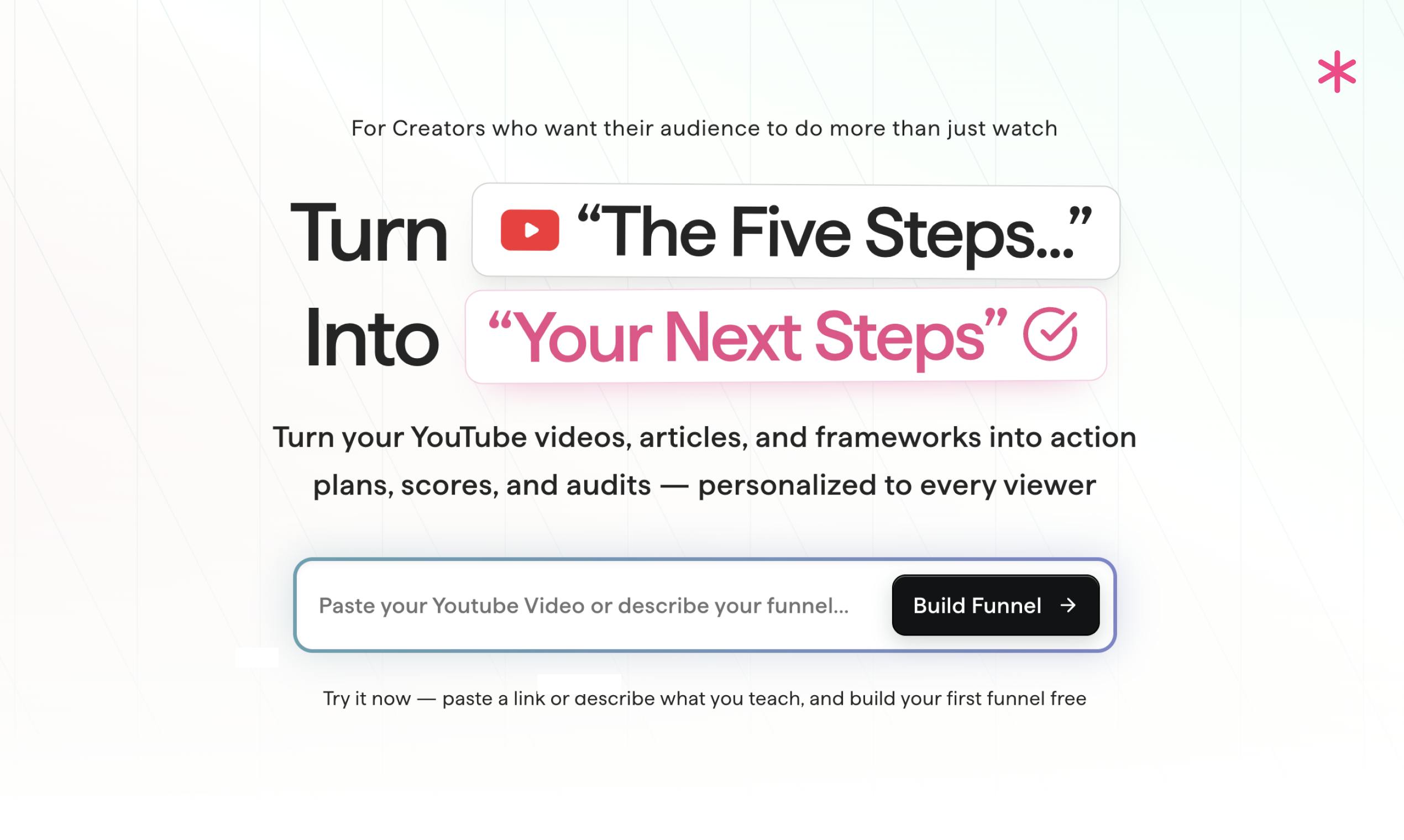
Outcome converts a creator’s video, article, or framework into an interactive lead funnel. A visitor answers a short quiz, and the product combines those answers with the creator’s source material to generate a personalized audit, score, plan, checklist, or recommendation. The customer is primarily a coach, educator, consultant, or creator who already has an audience but wants a more useful lead magnet than a static PDF or a generic quiz result. Outcome Product Hunt
The product is coherent and commercially understandable. Outcome offers unlimited static funnels and leads for free, then charges $49 per month when AI generates individualized results; the paid plan includes unlimited standard AI blocks and 600 premium credits for higher-cost functions such as research, scraping, images, audio, slides, and web design. This creates a low-friction acquisition path and aligns the paywall with actual inference cost. Pricing
The strongest investment signal is founder-market fit. Dylan Jones is presented by Outcome as a ClickFunnels co-founder, giving him direct experience in funnel software, conversion workflows, and the creator-marketing customer base. Daniel Zaitzow has operated the predecessor ContentBlocks product and is publicly associated with operations and customer experience. The team therefore starts with more category knowledge than a typical launch-week startup. Outcome founder section Daniel Zaitzow
The main concern is that public commercial evidence is almost entirely absent. Product Hunt reports a #1 daily rank and 372 points, but the makers themselves describe the launch as a visibility and feedback event rather than a revenue event. Revenue, paying customers, conversion, retention, AI cost per outcome, customer acquisition cost, and funding are not disclosed. Launch attention cannot be treated as product-market fit. Product Hunt
Final decision: Watch. Outcome is a credible product with unusually relevant founder experience, but the current evidence supports neither formal diligence nor an investment decision. Upgrade to DD requires verified paid conversion, retention, repeatable creator distribution, and healthy contribution margins after inference.
Product Overview
Outcome solves a common funnel problem: content often generates views without capturing structured intent or giving the viewer a next step tailored to their situation. A creator supplies source content, defines quiz questions and output blocks, and configures a call to action. Each respondent then receives a result grounded in the creator’s framework rather than being placed only into a prewritten score band. The builder supports text analysis, scoring, checklists, live research, visuals, custom pages, follow-up email, and a closing offer. Official product page
The free plan includes unlimited funnels, leads, responses, segmentation, integrations, and analytics. The $49 monthly Pro plan adds generated one-to-one outcomes. The product is web-based and replaces combinations of Typeform, static lead magnets, manual consulting reports, and quiz-funnel tools such as ScoreApp, Heyflow, involve.me, and Typeform. Outcome’s primary benefit is not form creation; it is applying a creator’s material to each lead before the sale.
The product is live and testable, but generated-output quality is a material execution risk. In Product Hunt comments, the founders acknowledge that models can fill gaps and describe grounding documents, skills, per-block context, and planned evaluation and observability tools. That candor is positive, but it also confirms that reliability infrastructure is still developing. Maker discussion
Founder and Team Assessment
The verified public team is small. LinkedIn lists Outcome as a privately held Vancouver company founded in 2023 with 2–10 employees and names Dylan Jones and Daniel Zaitzow. The current Product Hunt launch identifies both as makers. Outcome LinkedIn
Jones’s prior ClickFunnels involvement is directly relevant to product design and distribution. Public biographical material also associates him with OnePager and ContentBlocks, the apparent predecessor to Outcome. Zaitzow’s profile shows an operating and customer-experience role at ContentBlocks. However, the precise ownership split, current full-time status, engineering bench, and post-ClickFunnels commercial outcomes are not disclosed. No independent evidence of a broader team, institutional investors, or hiring plan was found.
Founder Assessment: Strong domain and product intuition from prior funnel-software experience, but the present team’s scale, ownership, and repeatable go-to-market execution remain unverified.
Market Opportunity
The narrow initial segment is English-speaking creators, coaches, consultants, and education businesses that already attract meaningful content traffic and sell a course, community, service, or call. These buyers will pay only if a personalized funnel lifts email capture, qualified calls, or sales enough to exceed the software and inference cost.
A bottom-up analyst scenario illustrates the opportunity, not a verified market size. If 250,000 globally reachable professional creators and advisory businesses could pay an average of $600 annually, the initial pool would be about $150 million in annual recurring revenue. Expanding into agencies, multi-brand marketing teams, sales qualification, and enterprise zero-party-data workflows at $3,000–$15,000 annual contract values could enlarge the addressable pool materially. The current $588 annual Pro price alone implies a large customer-count requirement.
Market timing is favorable because generative AI makes individualized content economically possible. It is also unfavorable because general-purpose models and no-code builders make the feature easy to reproduce. Venture scale therefore depends on distribution and conversion data, not simply on the existence of many creators.
Traction and Growth Signals
Product Hunt shows 971 followers for the product page and 372 launch points with a #1 daily rank. The launch discussion is active, and the founders provide detailed product answers. The official site is polished, pricing is live, and the predecessor ContentBlocks has been publicly discussed since at least 2024. These demonstrate shipping ability and initial interest. Product Hunt Outcome LinkedIn
They do not demonstrate commercial traction. No ARR, MRR, paid-user count, cohort retention, generated outcomes, response volume, funnel conversion lift, or customer case study with quantified results is public. The founder says email was the most effective pre-launch channel and that Product Hunt is mainly a feedback and visibility exercise. That is appropriate launch strategy, but it limits the traction score.
Traction Assessment: Encouraging launch engagement and evidence of sustained product work, but commercially unverified.
Competitive Position
Direct competitors include ScoreApp, involve.me, Outgrow, Interact, Heyflow, and AI quiz builders. Indirect alternatives include Typeform plus ChatGPT, ClickFunnels, HubSpot forms, custom no-code workflows, and a consultant manually producing a report. ScoreApp already offers established lead-generation workflows, CRM connections, dynamic result pages, and plans from roughly $39 to $149 per month, with an enterprise tier. ScoreApp pricing G2 reviews
Outcome’s differentiation is granular AI-generated output grounded in the creator’s material, delivered at a simple $49 monthly price. Its strongest potential moat is a library of tested outcome blocks, templates, conversion benchmarks, and creator distribution. Today, switching costs are likely low, proprietary data is limited, and no network effect is visible.
If the largest platform in this market launched the same feature within six months, customers would continue using Outcome only if it produced measurably better conversion, stayed faithful to creator IP, and offered a much faster authoring workflow. Those advantages are plausible but not yet evidenced.
Defensibility Assessment: Low
Business Model and Economics
The freemium structure is sensible: static segmentation costs little and can seed a wide funnel; generated outcomes drive paid conversion. At $49 per month, annual contract value is about $588 before discounts. Gross-margin potential could be SaaS-like only if standard blocks use inexpensive models and premium-credit allowances cover costly research, scraping, image, audio, and slide generation.
Critical unknowns are free-to-paid conversion, outcomes generated per account, inference and crawling cost per outcome, support load, affiliate commissions, refund rate, and renewal. A creator-facing product may experience seasonal use and high churn once a campaign ends. Expansion could come from more credits, agency workspaces, multiple brands, custom domains, analytics, and enterprise compliance. No enterprise price or verified unit economics are public.
Unicorn Path
Assumed multiple: 8× ARR, reflecting a vertical SMB SaaS business that would need strong growth and retention but faces meaningful competition. Required ARR for a $1 billion valuation would be approximately $125 million.
At the current $588 annual price, that requires roughly 213,000 continuously paying Pro accounts before discounts. At a hypothetical $3,000 blended agency ACV, it would still require about 41,700 customers. These are analyst calculations, not company forecasts. Achieving them would require a global affiliate channel, strong organic template distribution, materially higher team and agency pricing, low churn, and proof that personalized outcomes improve customer revenue.
The product can support a valuable bootstrapped company at far smaller scale. A unicorn outcome requires moving beyond individual creators into agencies and business teams, building proprietary conversion data and integrations, and sustaining acquisition beyond founder audiences and launch communities.
Unicorn Path: Conditional
Valuation Assessment
No reliable public information was found about funding, investors, revenue, a SAFE cap, current fundraising, or valuation. Product and founder quality cannot substitute for financing terms.
Valuation Attractiveness: Not Assessable. Required information includes current ARR and growth, paid cohorts, gross margin after AI costs, burn, runway, cap table, prior founder equity arrangements, round size, instrument, post-money valuation, and liquidation preferences.
Key Risks
- No verified revenue, conversion, or retention evidence.
- Low switching costs and rapid replication by quiz, funnel, and form incumbents.
- AI hallucinations could harm creators’ brands or produce unsafe recommendations.
- A $49 SMB price creates a very high customer-count requirement for venture scale.
- Inference, research, and media-generation costs may erode gross margin for heavy users.
- Creator and coaching customers can be seasonal, price-sensitive, and high-churn.
- Distribution currently appears founder-, email-, and launch-led rather than repeatable.
- The small team may be stretched across product reliability, templates, support, and compliance.
- Handling lead responses and creator source material introduces privacy and data-rights obligations.
Final Assessment
Venture Potential: 58/100
| Category | Score |
|---|---|
| Market Size and Expansion Potential | 12/20 |
| Traction and Growth Evidence | 7/20 |
| Founder and Team | 12/15 |
| Product Strength | 8/10 |
| Distribution Potential | 8/15 |
| Business Model and Economics | 6/10 |
| Defensibility | 5/10 |
| Total | 58/100 |
The strongest element is unusually relevant founder-market fit combined with a clear product proposition. The weakest elements are missing commercial evidence, low current ACV, and limited defensibility.
Evidence Confidence: 57/100
Verified: product functionality, public price, Product Hunt launch metrics, company location and size band, and named founders. Company-reported: output grounding, ClickFunnels founder history, product benefits, and launch-channel observations. Estimated: market size, ACV expansion, and unicorn math. Unavailable: revenue, retention, funding, margins, burn, valuation, customer outcomes, and cap table.
Final Decision: Watch
Outcome is interesting enough to monitor because the team understands funnels and has built a differentiated first product. It is too early for DD: public evidence does not show that users pay, stay, obtain better conversion, or generate attractive contribution margin.
Upgrade Conditions
- At least $1 million ARR with more than 50% year-over-year growth
- Twelve-month gross revenue retention above 80% for creator cohorts
- Quantified customer evidence showing material lift in qualified leads or sales
- Gross margin above 75% after all model, crawling, and media costs
- A repeatable affiliate, template, or agency channel not dependent on launch traffic
- Team/agency expansion that raises blended ACV above $1,500
Downgrade Conditions
- Free users do not convert after repeated campaigns
- Paid users churn after one funnel or one launch
- AI output errors create customer complaints or brand harm
- Competitors bundle equivalent generation into established distribution
- Premium-credit usage produces structurally weak contribution margin
- Founder commitment or product cadence declines
Questions for Further Diligence
- What are current MRR, monthly growth, and the number of paying Pro accounts?
- What percentage of activated free accounts convert within 30 and 90 days?
- What are three-, six-, and twelve-month logo retention by customer cohort?
- How many generated outcomes does a median paid account deliver each month?
- What is gross margin after model, search, scraping, image, audio, and support costs?
- What quantified conversion lift have customers measured versus static lead magnets?
- Which channels acquire customers, and what are CAC and affiliate payouts by channel?
- How are source fidelity, hallucination, and regulated-advice risks evaluated and monitored?
- What is the roadmap for agencies, teams, permissions, and higher-ACV enterprise use?
- What are founder roles, full-time commitments, team structure, and key hiring needs?
- What funding has been raised, what is the cap table, and what financing terms are being offered?
- How will Outcome build durable proprietary data or workflow switching costs?