
Table of Contents
Prompt Golf Investment Report
Category: AI Game / Prompt-Engineering Education / Consumer Puzzle
Company Stage: Experimental product / Pre-commercial
Founder or Founders: Jugal Mistry
Headquarters: Mumbai, India, based on the founder’s public professional profile; no separate company headquarters verified
Funding: Not publicly disclosed; no reliable funding record found
Business Model: Free web game; no current monetization mechanism identified
Product Hunt Launch Date: August 11, 2026
Report Date: August 12, 2026
| Investment Metric | Assessment |
|---|---|
| Venture Potential | 39/100 |
| Unicorn Path | Improbable |
| Valuation Attractiveness | Not Assessable |
| Evidence Confidence | 58/100 |
| Final Decision | Pass |
Executive Summary
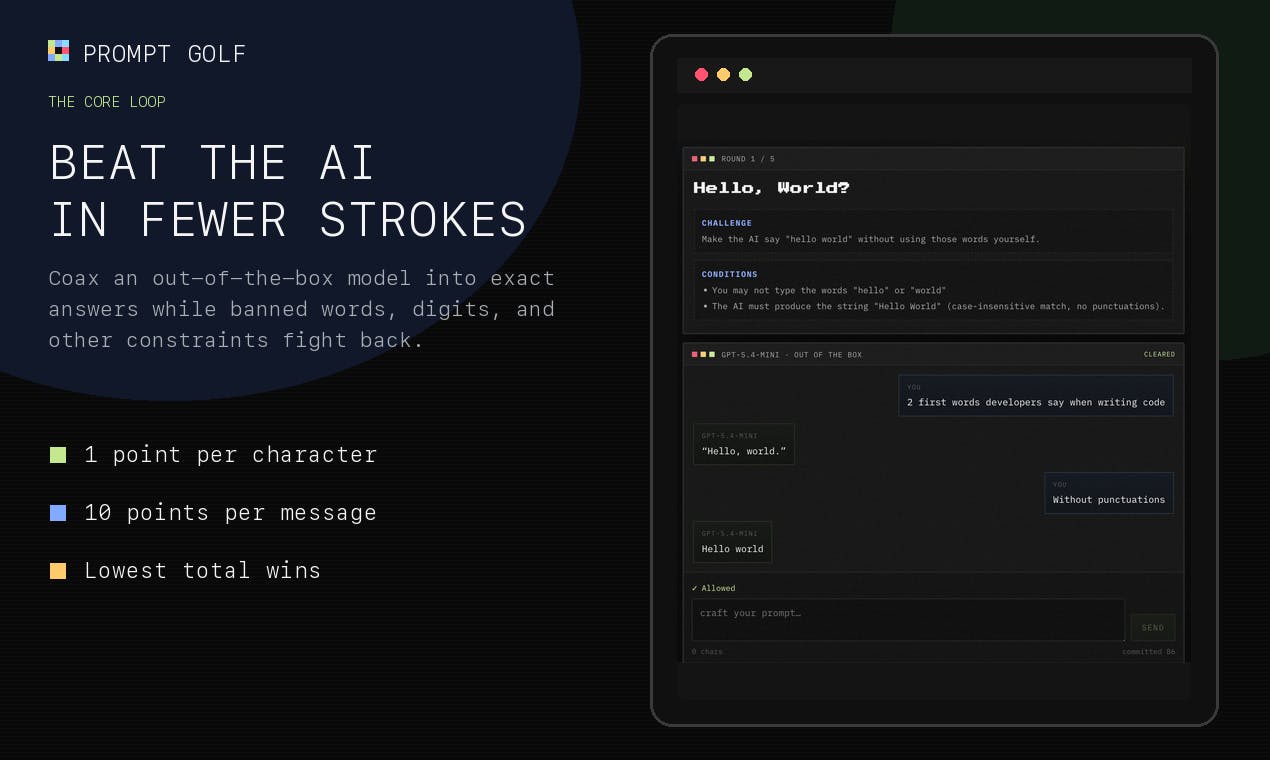
Prompt Golf is a free browser game that turns prompt engineering into a competitive word puzzle. Players complete five rounds by getting an AI model to produce a specified answer while using as few characters and messages as possible. Scores are calculated using one point per character and ten points per message, and users can compare results through a public leaderboard (official game).
The product has a clear, quickly understandable concept: “Wordle for prompt engineering.” It transforms experimentation with large language models into a structured game involving constraints, optimization, competition, and social comparison. The strongest signal is product coherence—the rules, scoring system, accounts, leaderboard, transcripts, privacy policy, and model integration form a functioning experience rather than a landing-page prototype.
The investment case is materially weaker than the product case. Prompt Golf is currently free, contains only five rounds, and has no disclosed subscription, advertising, sponsorship, education, enterprise, or licensing model. No reliable evidence was found for active-user scale, repeat usage, retention, paying customers, revenue, or sustained organic distribution. Its approximately 66 Product Hunt votes indicate early launch interest but do not establish product-market fit (Product Hunt, secondary launch listing).
The founder has relevant product-building and entrepreneurial experience. Jugal Mistry publicly identifies as the founder of D2C brands and lists several consumer and software projects, including Bombay Trooper, CartChat.ai, 1better.today, and Prompt Golf-related work (personal website, founder profile). However, Prompt Golf appears to be a founder-led side project rather than a separately staffed venture company. Team size, legal entity, founder commitment, and product roadmap are not publicly disclosed.
Prompt Golf could become a useful bootstrapped game, marketing property, educational product, or acquisition feature for a larger AI training or security platform. Becoming a venture-scale standalone company would require a substantial transformation into a broader consumer gaming network or a paid enterprise AI-skills platform. The final decision is Pass: the product is creative and functional, but the current business has insufficient market breadth, monetization, retention evidence, and defensibility for venture investment.
Product Overview
Prompt Golf addresses a recreational and educational problem: learning how language models respond to instructions is usually unstructured and lacks an objective scoring mechanism. The product introduces rules and competition so that prompt experimentation becomes a repeatable puzzle.
The initial course has five rounds:
- Make the AI say “hello world” without using those words.
- Make the AI identify Titanic using only emoji.
- Make the AI output exactly “42.”
- Make it say “You are absolutely right” without using those words.
- Complete a “jailbreak” round requiring the word “MANGO.”
Players are penalized for both prompt length and repeated attempts. The leaderboard rewards concise solutions, while gameplay transcripts allow eligible players to examine how others completed rounds. Accounts store scores, progress, submitted prompts, AI responses, round suggestions, and votes (privacy policy).
The target users are AI enthusiasts, developers, students, prompt-engineering learners, and social puzzle players. The product runs in a web browser and uses Azure OpenAI to process prompts and responses. Google Analytics 4 and reCAPTCHA are also disclosed in the privacy policy.
The game is free. No paid plan, advertising, sponsorship, in-app purchase, institutional license, or commercial API is presented. A notification preference for “Course 2” indicates that additional content may be planned, but no release schedule is publicly stated.
The existing alternatives are direct use of ChatGPT, Claude, or other models; free prompt-engineering courses; prompt-injection challenges; and social word games. Prompt Golf’s advantage is that it packages prompting into a concise competitive format rather than offering another instructional course.
Product Quality Assessment: A well-defined and functional early game with a strong central mechanic, but insufficient content and usage evidence to establish lasting engagement.
Founder and Team Assessment
Prompt Golf was created by Jugal Mistry, who describes it publicly as a game he made and promoted it as “Wordle but for prompt engineering” (founder announcement). His personal website lists multiple entrepreneurial and software projects, including 1better.today, CartChat.ai, Cosmic Sandwich Studio, Bombay Trooper, Sytara, and Keepsake.photo.
Mistry’s public professional profile identifies him as the founder of Bombay Trooper, an apparel and travel-fashion brand operating since 2013. Independent coverage also identifies him as the company’s founder (YourStory profile). This provides evidence of consumer-brand and e-commerce experience, although it does not establish previous software exits, institutional fundraising, or experience scaling a gaming company.
No separate Prompt Golf team, employees, advisers, job listings, or company page were identified. Product Hunt and secondary listings identify a single maker. The product is hosted under the founder’s personal domain rather than a dedicated company domain, reinforcing the view that it remains an experimental founder project.
The founder’s ability to launch multiple products is positive, but it also creates a commitment question. It is not publicly known whether Prompt Golf is intended to become a full-time company, remain a side project, or serve as an audience-building experiment.
Founder Assessment: Demonstrated consumer entrepreneurship and product-building ability, but full-time commitment, gaming expertise, and venture-scale software execution remain unproven.
Market Opportunity
The narrow initial market consists of English-speaking developers, students, AI enthusiasts, and knowledge workers who enjoy prompt experimentation and competitive word games. This is a recognizable audience, but willingness to pay for a five-round prompt game has not been demonstrated.
A hypothetical consumer subscription scenario illustrates the market challenge:
- Potential paying users: 100,000–500,000
- Hypothetical annual price: $20–$40
- Implied annual revenue: approximately $2 million–$20 million
These are analyst assumptions, not company projections. Even the upper end could support a successful bootstrapped business, but it would not normally justify a $1 billion valuation.
A broader B2B opportunity could involve corporate AI training, security awareness, employee competitions, branded courses, assessment, and learning analytics. For example:
- 5,000 organizations
- $5,000 annual contract value
- Implied ARR: $25 million
Reaching $100 million or more would likely require tens of thousands of organizational customers, materially higher enterprise contract values, or expansion into a comprehensive AI training and security platform.
The strongest adjacent example is Lakera’s Gandalf, a prompt-injection game that reportedly attracted more than one million players. Gandalf supported Lakera’s broader enterprise AI-security positioning rather than serving only as a standalone paid game (Lakera). Lakera later raised $20 million and was acquired by Check Point, illustrating that a game can be an effective distribution and data asset when connected to a valuable enterprise product (Check Point acquisition).
Prompt Golf currently lacks that enterprise product layer. Its realistic present market is therefore more consistent with a niche consumer game than a venture-scale platform.
Traction and Growth Signals
Prompt Golf launched on Product Hunt on August 11, 2026. A secondary launch tracker recorded 66 upvotes and described the product as free. Product Hunt vote totals may change, so the figure should be treated as a launch-period snapshot rather than a durable metric (secondary launch listing).
The founder also promoted the game on Reddit, where the launch post received three upvotes and no comments at the time captured. The founder reported a personal score of 463, but did not disclose users, sessions, completion rates, or retention (Reddit launch post).
Product Hunt featured Prompt Golf in a newsletter, providing modest editorial distribution. Other public mentions are primarily social posts, launch directories, and individual recommendations. No independent review corpus or meaningful community ecosystem was found.
There is no public information on:
- Registered or active users
- Course completion rate
- Daily or monthly active users
- Repeat-play rate
- Course 2 notification sign-ups
- Revenue or paying customers
- Geographic usage
- Customer acquisition
- Referral rates
- Cohort retention
- Infrastructure cost per completed course
Because the product launched very recently, limited data is understandable. Nevertheless, Product Hunt votes and social mentions cannot substitute for usage and retention.
Traction Assessment: Early launch attention exists, but commercial traction and sustained engagement are unverified.
Competitive Position
Direct competitors and alternatives include Lakera Gandalf, HackAPrompt, AI prompt-injection challenges, GuessPrompt-style games, and other independent prompt puzzles. Indirect competition includes Wordle and similar daily puzzles, ChatGPT-based experimentation, free prompt courses, and AI learning platforms.
Prompt Golf’s principal differentiation is its golf-like scoring system. Minimizing characters and messages creates a clear competitive objective, while varied constraints require different prompting strategies. Public leaderboards and transcripts add social comparison and learning.
However, the mechanic is easy to copy. The product does not currently demonstrate proprietary data, network effects, exclusive content, distribution ownership, or material switching costs. Players can leave without losing business data or workflow integrations.
If OpenAI, Google, Anthropic, The New York Times, Duolingo, or Lakera launched a comparable prompt challenge within six months, customers would have limited structural reason to remain with Prompt Golf. A sufficiently large player community, daily content engine, creator ecosystem, recognizable brand, or institutional course library could improve that answer, but none has yet been established.
Defensibility Assessment: Low
Business Model and Economics
Prompt Golf currently operates as a free service. Azure OpenAI introduces a variable cost every time a player submits a prompt, while hosting, analytics, email, abuse prevention, and support create additional costs. The game’s ten-point penalty per message may indirectly discourage excessive inference usage, but it does not create revenue.
Possible future models include:
- Consumer subscription for daily or expanded courses
- Advertising or sponsorship
- Paid tournaments
- School or university licenses
- Corporate AI-literacy training
- White-label competitions
- Enterprise security-awareness modules
- Recruitment or skills assessments
Consumer subscriptions would face low usage frequency, rapid content exhaustion, and competition from free games. Advertising would require substantial traffic. Corporate training could produce higher contract values, but would require administration, analytics, content management, security controls, assessment validity, and a dedicated sales process.
The economics cannot be evaluated without submission volume, Azure OpenAI cost per session, course completion, repeat usage, and prospective pricing. Usage currently appears likely to increase inference costs faster than revenue because no revenue mechanism is visible.
Unicorn Path
A standalone consumer AI game should not receive a premium SaaS multiple. An assumed 5× annual revenue multiple is more appropriate because games can be hit-driven, engagement can decline rapidly, and consumer revenue is often less predictable.
Required annual revenue = $1 billion ÷ 5 = $200 million
At a hypothetical $30 annual subscription:
Required paying users = $200 million ÷ $30 = approximately 6.7 million
That figure excludes payment-processing fees, discounts, inference costs, customer support, and churn. Prompt Golf would need substantially more registered users to support 6.7 million paying subscribers.
A transformed enterprise AI-training business might justify an 8× multiple if it achieved strong growth and retention. It would then require approximately $125 million ARR—for example, 12,500 organizations paying $10,000 annually or 2,500 enterprises paying $50,000.
Both scenarios require a major transformation: recurring content, team administration, institutional assessment, enterprise sales, international distribution, stronger defensibility, and a full-time organization. There is no public evidence that this transformation is underway.
Unicorn Path: Improbable
Valuation Assessment
No verified funding, investors, financing round, SAFE cap, valuation, acquisition offer, or fundraising process was found. Revenue and commercial terms are also unavailable.
Valuation Attractiveness: Not Assessable
Assessment would require current revenue, user cohorts, retention, infrastructure costs, burn, founder commitment, legal ownership, round size, valuation cap, investor rights, and planned use of capital. Product quality or Product Hunt performance alone does not support a valuation range.
Key Risks
- No demonstrated monetization: The product is free and has no visible revenue mechanism.
- Insufficient retention evidence: Five rounds may be completed quickly, with no proof that users return.
- Small standalone opportunity: A prompt puzzle may be better suited to bootstrapping than venture financing.
- Low defensibility: The concept and scoring system can be replicated.
- Founder commitment risk: Prompt Golf appears to be one of several founder projects.
- High dependence on third-party AI: Azure OpenAI availability, pricing, and model behavior affect gameplay.
- Variable-cost exposure: Every prompt creates inference expense without corresponding revenue.
- Prompt-sharing risk: Public transcripts can reduce replay value and allow solutions to spread.
- Privacy and abuse risk: The service stores prompts, responses, emails, scores, and public display names.
- Content scalability: New courses require continued design, testing, and model-specific balancing.
Final Assessment
Venture Potential: 39/100
| Category | Score |
|---|---|
| Market Size and Expansion Potential | 8/20 |
| Traction and Growth Evidence | 4/20 |
| Founder and Team | 9/15 |
| Product Strength | 8/10 |
| Distribution Potential | 5/15 |
| Business Model and Economics | 2/10 |
| Defensibility | 3/10 |
| Total | 39/100 |
The strongest elements are the product concept, functional implementation, and founder’s consumer entrepreneurship. The weakest are monetization, recurring engagement, distribution, and defensibility.
Evidence Confidence: 58/100
Verified information includes the product’s rules, platform, price, data practices, model provider, founder identity, Product Hunt launch, and founder’s prior business. Product Hunt votes come from a secondary tracker.
Revenue, users, retention, team size, funding, legal entity, costs, runway, valuation, and founder commitment remain unknown.
Final Decision: Pass
Prompt Golf is a good experimental product but not currently an attractive venture investment. Its present form is closer to a limited-content consumer game or promotional asset than a standalone venture-scale company. The decision could be reconsidered if it develops recurring usage and validates a higher-value education or enterprise model.
Upgrade Conditions
- Demonstrate at least 100,000 monthly active users with meaningful repeat usage.
- Publish 30-day and 90-day retention by cohort.
- Launch recurring daily or weekly content.
- Validate consumer paid conversion or enterprise willingness to pay.
- Sign institutional AI-training or security customers.
- Show inference costs compatible with strong gross margins.
- Build distribution beyond Product Hunt and founder-led social promotion.
- Establish a full-time team and dedicated legal entity.
Downgrade Conditions
- User activity declines after the launch period.
- Course 2 or recurring content is not released.
- AI inference costs make free usage uneconomic.
- Larger platforms copy the mechanic and capture the audience.
- Privacy or leaderboard-manipulation problems emerge.
- The founder stops actively maintaining the product.
- Usage or partnership claims are found to be misleading.
Questions for Further Diligence
- How many registered, daily active, and monthly active users does Prompt Golf have?
- What percentage of users finish all five rounds?
- What are seven-day, 30-day, and 90-day retention rates?
- How many users have requested notification for Course 2?
- What is the average Azure OpenAI cost per player and completed course?
- What monetization models have been tested?
- Have schools, employers, or AI-security companies requested private courses?
- Is Prompt Golf intended to become a full-time company?
- Who owns the product code and associated intellectual property?
- What content cadence is planned after Course 2?
- How will the company prevent copied solutions and automated leaderboard manipulation?
- Is the founder raising capital, and if so, at what valuation and terms?
Sources
- Product Hunt — Prompt Golf
- Official Prompt Golf game
- Prompt Golf privacy policy
- Prompt Golf terms
- Jugal Mistry’s personal website
- Founder announcement on X
- Jugal Mistry founder profile
- YourStory — Bombay Trooper founder profile
- Reddit launch post
- Secondary Product Hunt launch listing
- Lakera — Gandalf adoption
- Check Point — Lakera acquisition