
Table of Contents
DuckFightClub Investment Report
Category: Robotics competition / developer community / AI entertainment
Company Stage: Pre-revenue project or pre-company concept; legal entity not verified
Founder or Founders: Nicolas Grenié appears to be the sole maker; formal founder status not verified
Headquarters: Not publicly disclosed; the maker is based in Barcelona
Funding: Not publicly disclosed; no verified external financing found
Business Model: Currently free; prospective event sponsorship and possible future competition/platform revenue
Product Hunt Launch Date: September 9, 2026
Report Date: September 12, 2026
| Investment Metric | Assessment |
|---|---|
| Venture Potential | 37/100 |
| Unicorn Path | Improbable |
| Valuation Attractiveness | Not Assessable |
| Evidence Confidence | 44/100 |
| Final Decision | Pass |
Executive Summary
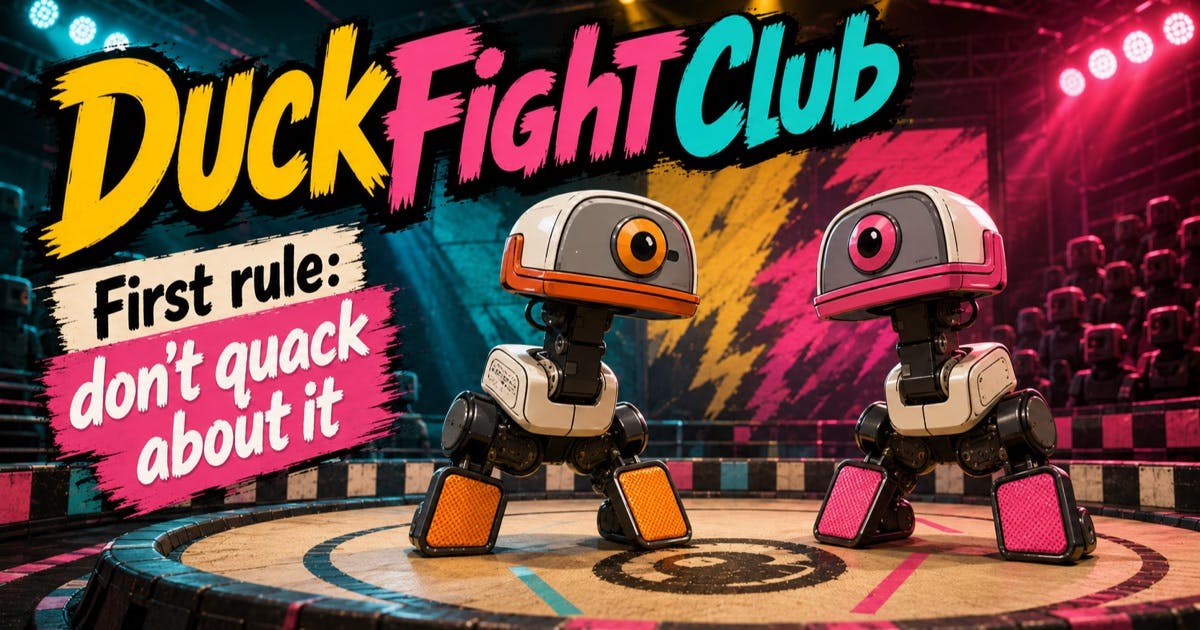
DuckFightClub is a proposed competitive robotics format in which teams train reinforcement-learning policies for Pollen Robotics’ MicroDuck and compete in simulated robot-sumo matches. Its first eight-team tournament, “QuackDown,” is scheduled for October 2, 2026 and is intended to be livestreamed on YouTube. The product currently consists principally of an event website, team-registration workflow, rules, bracket, and links to Pollen Robotics’ open-source simulator and training repositories (official site).
The concept is engaging and timely. MicroDuck is an accessible, $399 open-source biped whose software and reinforcement-learning stack can be modified and retrained. More than 10,000 units were reportedly pre-ordered within several days of launch, based on a statement from Hugging Face co-founder Thomas Wolf reported by Yahoo, creating a potentially useful seed community for competitions and user-generated robot behaviors (Pollen Robotics; Yahoo).
The strongest investment signal is founder-community fit. Maker Nicolas Grenié reports more than a decade in developer relations, including work at Typeform, Red Hat and 3scale, and experience organizing HackBarna. These capabilities are relevant to recruiting developers, sponsors and local organizers (LinkedIn). Product Hunt also generated initial attention: the September 9 leaderboard displayed DuckFightClub at No. 8 with 142 points and 14 comments (Product Hunt leaderboard).
However, the evidence supports an experimental event rather than a venture-scale company. The inaugural tournament has not yet occurred. There is no verified revenue, audience, active-team count, recurring usage, proprietary software, legal entity, full-time team, funding, pricing, or customer retention. Several teams shown in the bracket are not independently verified, while the schedule says teams will only be announced on September 16 (official site).
The project could become a distinctive community brand or sponsorship-supported event series. It does not currently demonstrate the scalable economics, proprietary platform, recurring engagement or market breadth required for venture returns. The decision is Pass, with reconsideration possible if the first events establish sustained demand and DuckFightClub evolves into a hardware-agnostic competition platform.
Product Overview
DuckFightClub addresses a real but narrow problem: developers can train MicroDuck behaviors using an open-source reinforcement-learning environment, but they lack a recurring competitive format in which to test, compare and showcase those policies.
The proposed experience is:
- Register one of eight teams.
- Develop a control policy using the MicroDuck training environment.
- Submit and freeze the policy before the competition.
- Compete in best-of-three simulated sumo matches.
- Livestream the tournament and award the “Golden Beak Belt.”
The initial competition is simulator-only. Physical events are contemplated after MicroDuck hardware becomes available; Pollen Robotics targets initial deliveries before Christmas 2026 (Pollen launch announcement). The official event schedule lists registration on September 9, team announcements on September 16, scrimmage on September 19, policy freeze on September 23 and the main event on October 2 (DuckFightClub).
The underlying technical environment is credible but is not owned by DuckFightClub. Pollen Robotics provides the robot software and a separate Apache-2.0 reinforcement-learning repository based on MuJoCo, with policy training, ONNX export and simulator-to-real deployment. As of the report date, the main repository had approximately 8,100 GitHub stars, while the RL repository had approximately 2,100; these are ecosystem signals for MicroDuck, not DuckFightClub traction (main repository; RL repository).
No ticket price, entry fee, subscription or software plan is displayed. The site offers sponsor placements around the simulated arena but does not disclose rates. No DuckFightClub app, proprietary training platform or dedicated public GitHub repository is linked from the official site.
Product Quality Assessment: A coherent and entertaining event concept built on credible open-source infrastructure, but not yet a demonstrated product. Execution quality cannot be validated until the first competition is completed.
Founder and Team Assessment
Product Hunt identifies Nicolas Grenié as the maker. His LinkedIn profile describes developer-relations and ecosystem-building experience at Typeform, Red Hat and 3scale, as well as the organization of HackBarna and several smaller technical projects (Product Hunt; LinkedIn).
This background is relevant to community recruitment, partnerships, developer marketing and event production. It is less direct evidence of operating a media business, robotics company or scalable competition platform. His profile also lists ongoing roles with OPRTRS CLUB and HackBarna; therefore, full-time commitment to DuckFightClub is not established.
No co-founders, employees, contractors or advisors are publicly identified. No legal entity, hiring page, cap table or prior financing was found. Key-person risk is consequently high.
Founder Assessment: Strong developer-community experience, but commitment, team depth and company-building plans remain unverified.
Market Opportunity
The narrow initial market is MicroDuck owners and reinforcement-learning developers interested in competitive robot programming. Pollen Robotics sells the robot for $399, and a secondary report citing Hugging Face’s co-founder said more than 10,000 units had been pre-ordered shortly after launch (Pollen Robotics; Yahoo).
A bottom-up illustration demonstrates the limitation:
- Analyst assumption: 10,000 initial hardware buyers.
- Potential competitive participants: 10%–20%, or 1,000–2,000 users.
- Annual monetization: $50–$200 per engaged participant through entry fees, memberships or digital products.
- Illustrative annual revenue: approximately $50,000–$400,000.
A sponsorship-led model could be larger but remains operationally intensive. At an assumed $10,000–$50,000 of revenue per event and 20–100 annual events, illustrative revenue would be $0.2 million–$5 million. These are analyst scenarios, not company forecasts.
The broader robotics-competition audience is real. FIRST reports more than 93,000 students competing in its 2025 robotics season, while RoboCup 2026 expected more than 3,000 participants (FIRST; RoboCup). However, those organizations also demonstrate that robotics competition is established, fragmented and often education- or sponsorship-oriented rather than a high-margin venture market.
Expansion could include other robots, educational licenses, competition-management software, branded leagues, developer recruitment, policy marketplaces or media rights. None is currently operating.
Traction and Growth Signals
Verified early signals include:
- Product Hunt launch on September 9, with a daily rank of No. 8, 142 points and 14 comments (leaderboard).
- A live registration page and published event schedule (official site).
- Access to an active underlying open-source ecosystem maintained by Pollen Robotics (GitHub).
- Reported demand for more than 10,000 MicroDuck pre-orders, although this is demand for the hardware rather than DuckFightClub (Yahoo).
No reliable public evidence was found for registered teams, completed matches, livestream audience, returning participants, sponsors, revenue, paying customers or post-event retention. The first event remains in the future as of the report date.
Traction Assessment: Initial launch attention and favorable ecosystem timing, but no commercial or recurring engagement has been verified.
Competitive Position
Direct and adjacent alternatives include:
- RoboCup, an established international robotics and AI competition ecosystem (RoboCup).
- FIRST Robotics, with large educational participation and institutional sponsorship (FIRST).
- BattleBots, an established entertainment-oriented robot-combat brand with tickets and sponsorships (BattleBots).
- Kaggle, which lets organizations and communities host machine-learning competitions for a much larger developer audience (Kaggle competitions).
- Informal competitions organized directly through the Pollen Robotics or Hugging Face communities.
DuckFightClub’s current differentiation is thematic: identical, visually distinctive robots; policies rather than hardware engineering as the main competitive variable; low-risk simulation; and a livestream-friendly sumo format. That can create an accessible spectator experience.
Switching costs and defensibility are low. The simulator and training code are controlled by Pollen Robotics and openly licensed. A MicroDuck manufacturer, Hugging Face community organizer, robotics conference or existing competition platform could reproduce the format. DuckFightClub does not yet own proprietary data, exclusive hardware access, tournament software or a demonstrated audience.
If Pollen Robotics launched the same event within six months, customers would currently have little functional reason to stay beyond affinity for DuckFightClub’s brand and organizer.
Defensibility Assessment: Low
Business Model and Economics
No operating revenue model has been disclosed. The official site advertises sponsor placements, suggesting event sponsorship as the nearest-term possibility. Potential future revenue sources include team entry fees, livestream sponsorship, local-event licensing, educational packages, subscriptions, merchandise and competition-management software.
Event sponsorship has low software-like scalability: additional tournaments require coordination, production, moderation, sponsor sales and participant support. Simulation reduces hardware damage and venue costs, but livestream production and community operations remain variable expenses.
A software-platform model could produce stronger margins, particularly if local organizers independently operated events. That would require scheduling, policy submission, standardized scoring, anti-cheating controls, leaderboards, identity, payments and analytics—capabilities not presently visible.
Unicorn Path
For the current event/media concept, a 4× revenue multiple is a more responsible assumption than a premium SaaS multiple because revenue would likely be sponsorship-, event- or advertising-based.
\[
\$1\text{ billion} \div 4 = \$250\text{ million annual revenue}
\]
At an illustrative $50,000 of revenue per event, DuckFightClub would need approximately 5,000 monetized events annually. Alternatively, a transformed software platform valued at 10× ARR would need roughly $100 million ARR, equivalent to 100,000 teams paying $1,000 annually or 10,000 institutions paying $10,000 annually.
Neither route is supported by present traction. Reaching such scale would require becoming hardware-agnostic, building proprietary competition infrastructure, developing repeatable educational or enterprise sales, operating international leagues and establishing a major media audience.
Unicorn Path: Improbable
Valuation Assessment
No funding round, investors, SAFE cap, valuation, revenue or current fundraising terms were found. The project may not yet be incorporated as an independent company.
Valuation Attractiveness: Not Assessable
Assessment would require current revenue, sponsor commitments, event economics, burn, founder commitment, legal ownership, round size, valuation cap, cap table and investor rights. Product quality and Product Hunt attention are insufficient bases for pricing an investment.
Key Risks
- No demonstrated commercial demand: No paying teams, sponsors or revenue are verified.
- Single-hardware dependency: The format currently depends on MicroDuck’s adoption, tooling and delivery.
- Event not yet completed: Operational quality and spectator appeal remain hypothetical.
- Low defensibility: Open infrastructure and reproducible rules permit rapid imitation.
- Narrow initial market: Reinforcement-learning robot competitions address a small technical audience.
- Founder commitment and team risk: Only one maker is publicly identified, with other active roles.
- Weak recurring-use evidence: A tournament may generate episodic interest without durable retention.
- Unclear IP and branding rights: The relationship with Pollen Robotics and rights to use MicroDuck commercially are not publicly documented.
- Operational scalability: Local events, judging and livestreams can become service-heavy.
- Safety and integrity risk: Physical events would require hardware-safety rules, while simulated tournaments need reproducibility and anti-cheating controls.
Final Assessment
Venture Potential: 37/100
| Category | Score |
|---|---|
| Market Size and Expansion Potential | 8/20 |
| Traction and Growth Evidence | 4/20 |
| Founder and Team | 9/15 |
| Product Strength | 5/10 |
| Distribution Potential | 6/15 |
| Business Model and Economics | 3/10 |
| Defensibility | 2/10 |
| Total | 37/100 |
The strongest elements are the maker’s community-building background, a distinctive format and the rapidly emerging MicroDuck ecosystem. The weakest are absent commercial validation, low defensibility, dependency on another company’s hardware and software, and the lack of a scalable business model.
Evidence Confidence: 44/100
Verified information includes the website, competition rules, schedule, Product Hunt launch, founder profile and underlying open-source repositories. MicroDuck demand is third-party reported from a founder statement. DuckFightClub revenue, participant count, sponsors, ownership, team, funding, retention and economics remain unavailable.
Final Decision: Pass
DuckFightClub may become a successful community event or promotional property, but it is not currently an investable venture-scale company. Its first event has not occurred, monetization is unproven, and the core technical assets belong to the MicroDuck ecosystem rather than DuckFightClub. A future reconsideration would require evidence that the format can become a recurring, hardware-agnostic platform rather than a one-off branded tournament.
Upgrade Conditions
- Successfully complete multiple events with independently verified audiences.
- Secure repeat sponsors and disclose meaningful sponsorship revenue.
- Demonstrate at least 50–100 active teams across several events.
- Show strong participant retention between competitions.
- Launch proprietary tournament, submission and scoring software.
- Expand beyond MicroDuck without losing engagement.
- Establish formal rights or a strategic partnership with the relevant hardware ecosystem.
- Confirm a full-time founding team and credible company structure.
Downgrade Conditions
- Cancellation or weak participation in the inaugural tournament.
- No repeat event following initial launch attention.
- Failure to convert sponsors or participants into revenue.
- Replication by Pollen Robotics, Hugging Face or an established competition platform.
- Loss of simulator compatibility or hardware access.
- Misrepresentation of teams, sponsors or partnerships.
- Material safety, cheating, intellectual-property or privacy issues.
Questions for Further Diligence
- How many teams have completed registration, and how many have submitted working policies?
- Are the organizations shown in the bracket confirmed participants or illustrative placeholders?
- What revenue or signed sponsorship commitments exist for the October event?
- Who legally owns the DuckFightClub brand, website, participant data and event format?
- Is Nicolas Grenié working on the project full-time, and who else is involved?
- What formal relationship exists with Pollen Robotics or Hugging Face?
- What percentage of participants are expected to return for a second event?
- What are the production cost, gross margin and organizer workload per tournament?
- Is the roadmap an event series, media property, educational product or competition SaaS platform?
- How will policies be validated, sandboxed and checked for rule violations?
- What are the cap table, burn rate, runway and proposed financing terms?
- Why would organizers and participants remain with DuckFightClub if the hardware vendor launched an equivalent league?
Sources
- DuckFightClub official website
- DuckFightClub on Product Hunt
- Product Hunt daily leaderboard — September 9, 2026
- Nicolas Grenié — LinkedIn
- Pollen Robotics — MicroDuck
- Pollen Robotics — MicroDuck launch announcement
- MicroDuck GitHub repository
- MicroDuck RL GitHub repository
- Yahoo report on MicroDuck pre-orders
- TechCrunch overview of MicroDuck