
Table of Contents
Argos Investment Report
Category: AI Browser Agent / Workflow Automation / Productivity SaaS
Company Stage: Pre-seed / Early commercial launch
Founder or Founders: Arystan Tanekov and Gleb Babichev; Aldiar Mansurov listed as CMO
Headquarters: Kazakhstan; precise corporate headquarters not publicly disclosed
Funding: No reliable public funding information found
Business Model: Freemium subscription SaaS with individual Pro and Team plans
Product Hunt Launch Date: August 9, 2026
Report Date: August 12, 2026
| Investment Metric | Assessment |
|---|---|
| Venture Potential | 56/100 |
| Unicorn Path | Conditional |
| Valuation Attractiveness | Not Assessable |
| Evidence Confidence | 58/100 |
| Final Decision | Watch |
Executive Summary
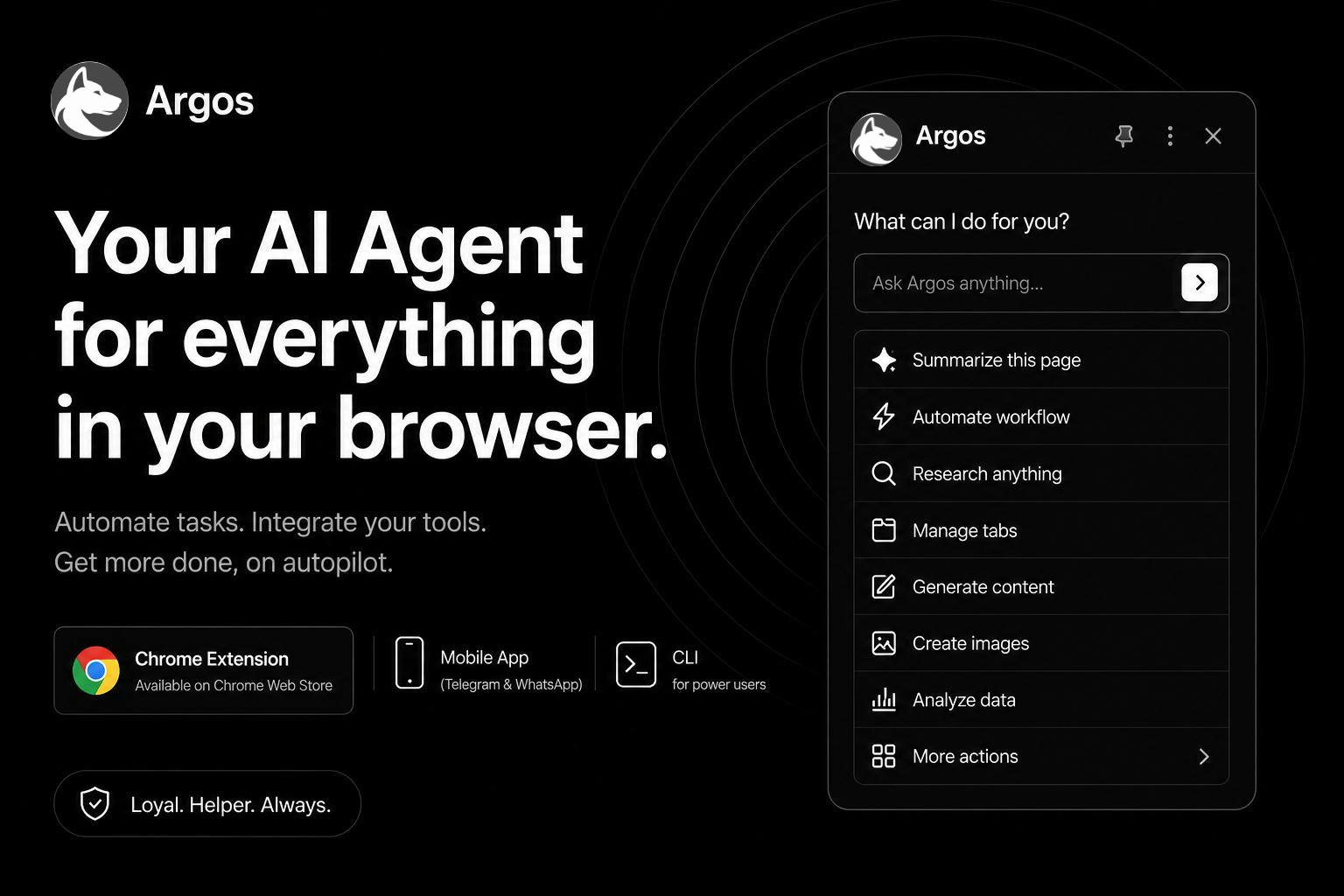
Argos is an AI browser agent that performs tasks inside a user’s existing Chrome sessions. It can click, type, fill forms, navigate websites, conduct research, generate files, and interact with services such as Gmail, Google Docs, Google Sheets, GitHub, Slack, Telegram, and WhatsApp. The product is a rebranded and modified version of Lyto AI, the founders’ earlier browser-assistant product (official website, Lyto Product Hunt profile).
The product addresses a large and credible problem: conventional AI assistants often generate an answer but leave users to execute the resulting work manually. Argos attempts to automate that “last mile” by acting within authenticated browser accounts and, for some tasks, continuing through a server-side browser after the user closes the laptop. Its combination of in-browser actions, background execution, persistent memory, scheduled tasks, messaging access, and desktop control is broader than a simple AI sidebar.
The strongest investment signal is the speed and breadth of product execution. Argos has a functioning Chrome Web Store extension, defined free and paid plans, multiple third-party integrations, a three-person public team, and previous product iterations under the Lyto name. The Chrome listing showed version 2.3.0 updated on August 11, 2026 and disclosed in-app purchases (Chrome Web Store).
The principal concern is the lack of verified commercial traction. A founder post claimed Argos reached 500 users shortly after launch, while third-party Chrome-extension trackers showed approximately 70–130 users or active installations at different snapshots. These figures may measure different things—registrations versus current extension users—but the discrepancy cannot be resolved from public data. Revenue, paying customers, conversion, retention, task volume, gross margin, and enterprise contracts are not publicly disclosed.
There is also a material trust and positioning issue. The homepage states that user data “stays local,” but the privacy policy explains that conversation history is stored on Supabase, prompts and page context can be transmitted to Google Gemini, Anthropic Claude, and Perplexity, and browser cookies may be copied to a user-specific server-side session for background execution (privacy policy). That architecture may be defensible, but the marketing language is broader than the underlying data flow.
Argos operates in a sufficiently large market to support a venture-scale company, but it faces intense competition from OpenAI, Google, Microsoft, Bardeen, Browser Use, Browserbase, and numerous Chrome extensions. The current decision is Watch. An upgrade to formal due diligence would require verified paid usage, retention, safe automation performance, and clearer privacy communication.
Product Overview
Argos targets professionals who spend time moving information between websites, filling forms, conducting research, monitoring pages, and updating productivity tools. The alternative is either manual browser work or building workflows in tools such as Zapier, Make, Bardeen, or traditional robotic process automation software.
The Chrome extension uses browser capabilities including Chrome DevTools Protocol, scripting, tab management, navigation, downloads, and clipboard access. Users issue natural-language instructions, after which Argos can navigate pages and perform actions. The company also offers scheduled tasks, page monitoring, long-term memory, deep research, document generation, and messaging access through WhatsApp and Telegram (official website).
The current pricing is:
- Free: 25 messages per day, page-level actions, integrations, memory, web search, and basic file generation.
- Pro: $15 monthly or $12 per month on annual billing, with 400 requests per week and 70 per day.
- Team: From $120 monthly or $96 per month on annual billing, beginning at five users and adding custom integrations, support, and an SLA.
The Pro plan includes background and scheduled work, WhatsApp and Telegram access, deeper research, monitoring, and desktop functionality. Payments are processed through Polar, according to the company’s terms.
The product’s primary benefit is convenience: users can automate tasks within accounts where they are already authenticated, avoiding separate API setup. That benefit also creates the main product risk. A browser agent with page-content access, OAuth tokens, and session cookies can create serious consequences if it misunderstands instructions, is compromised, or performs an unauthorized destructive action.
Product Quality Assessment: Broad and technically credible for an early product, but reliability, security, and safe-action controls need independent verification.
Founder and Team Assessment
Argos publicly identifies three team members. Arystan Tanekov is listed as co-founder and CEO, Gleb Babichev as co-founder and CTO, and Aldiar Mansurov as CMO (company page). Tanekov’s public profile states that he built Argos with Babichev and previously co-founded Lyto AI. Public profiles indicate that Tanekov and Babichev are 17, although their ages are self-reported rather than independently verified.
The founders appear to have spent approximately eight months building the previous Lyto product before repositioning or rebranding it as Argos. Lyto had three Product Hunt launches, covering the initial browser assistant, Google Workspace functionality, and a CLI. Its original launch took place on June 28, 2026, followed by the CLI on July 22 (Lyto Product Hunt profile).
This history indicates iteration speed and technical ambition. The product covers browser automation, cloud execution, integrations, memory, messaging, and desktop access—substantial scope for a small young team.
However, there is no verified evidence of previous exits, institutional fundraising, large-scale production systems, enterprise security sales, or formal compliance experience. The company must also clarify legal ownership, founder employment status, educational commitments, and whether all founders can legally execute financing and corporate documents without additional arrangements.
Founder Assessment: Strong early technical initiative and rapid iteration, but commercial experience, governance, and enterprise execution remain unproven.
Market Opportunity
The narrow initial customer is a professional or small team performing recurring browser-based research and administrative work without access to engineering resources. Examples include recruiters, sales teams, marketers, analysts, small-business operators, and administrative staff.
A bottom-up prosumer scenario could be:
- 500,000 paying individual users
- Approximately $144–$180 annual revenue per user
- Implied ARR of approximately $72 million–$90 million
This is an analyst scenario, not a company forecast. It would require large-scale consumer distribution and strong retention in a highly competitive extension market.
A team-focused scenario could be:
- 50,000 small teams
- Minimum annual contract value of approximately $1,152–$1,440
- Implied ARR of approximately $58 million–$72 million
The larger opportunity is enterprise browser automation. If Argos develops security controls, audit logs, administrative policy, deployment management, workflow analytics, and compliance, an assumed $10,000–$30,000 enterprise ACV across 5,000 customers would imply $50 million–$150 million ARR.
Market timing is favorable. Browserbase announced a $40 million Series B for browser infrastructure, Browser Use raised $17 million, and Bardeen raised $15.3 million in its Series A. These financings validate investor interest, but they also demonstrate the level of funded competition (Browserbase, Browser Use, Insight Partners on Bardeen).
The market can support venture-scale revenue. Whether Argos can capture it depends on reliability, security, distribution, and moving beyond a general-purpose consumer assistant.
Traction and Growth Signals
Argos launched on Product Hunt on August 9, 2026. Secondary trackers reported approximately 114 votes and a daily ranking around number 13. This indicates launch attention but is not evidence of recurring use or payment (Product Hunt, Launly).
Lyto’s earlier Product Hunt profile had 296 followers and reported that the initial Lyto launch ranked fifth on June 28. The profile had no Product Hunt reviews when captured. Repeated launches provide some distribution experience but may overstate independent momentum because the same underlying product was promoted several times.
A founder-reported LinkedIn post stated that Argos reached 500 users shortly after launch. Third-party Chrome tracking showed materially lower extension counts, around 70–130 depending on the snapshot, alongside 11 ratings. Because registrations, installations, and active extension users are different metrics, no single figure can be treated as verified commercial traction.
The official website displays logos for Tele2, Elevatify, and Counsel AI under “Trusted by teams at.” No case studies, contract details, named customer contacts, usage metrics, or independent confirmation were provided. These should be treated as company-reported adoption signals, not verified enterprise customers.
The most important missing metrics are paid subscribers, MRR, free-to-paid conversion, weekly active users, task success rate, 30/90-day retention, requests per user, subscription churn, refund rate, and customer acquisition cost.
Traction Assessment: Early user interest and repeated product activity are visible, but commercial traction remains unverified.
Competitive Position
Direct competitors include Bardeen, Browser Use, Browserbase-powered agents, Magical, Lindy, and other AI browser extensions. Indirect competitors include Zapier, Make, UiPath, Microsoft Power Automate, human virtual assistants, and custom scripts.
Platform competition is particularly serious. OpenAI has developed browser-operating agents, Google has Project Mariner, and Microsoft allows Copilot to click, scroll, type, and perform actions in Edge (OpenAI Operator, Google Project Mariner, Microsoft Browse with Copilot).
Argos differentiates through continuity across Chrome, messaging, cloud execution, and desktop access, combined with persistent memory. Its $15 monthly Pro price is relatively accessible, while local browser operation provides access to authenticated sessions without requiring an API integration for every website.
However, switching costs are currently low. Memory and scheduled workflows may create some retention, but there is no evidence of proprietary models, unique data, network effects, or exclusive distribution.
If Google or Microsoft launched equivalent functionality within six months, customers might remain for cross-platform flexibility, messaging access, lower pricing, or faster iteration. That is a possible but weak defense unless Argos builds specialized workflows and demonstrably superior reliability.
Defensibility Assessment: Low
Business Model and Economics
Argos has a recurring subscription model with free, Pro, and Team plans. At $15 per month and up to 400 weekly requests, the maximum headline revenue per Pro request could be low, particularly for deep research or multi-step browser tasks.
Variable costs include Gemini, Claude, and Perplexity usage; cloud browser sessions; Supabase storage; proxy or networking services; document generation; monitoring; and customer support. Team customers may also require custom integrations and SLA support.
The product could achieve software-like gross margins if routine browser tasks use inexpensive models and cloud sessions are short. Margins could deteriorate if users heavily consume deep research, parallel browser sessions, or desktop automation. The daily and weekly limits indicate that the company is already managing usage exposure.
No gross-margin, inference-cost, cloud-browser-cost, or customer-support data are public. It is therefore unknown whether revenue scales faster than variable AI and automation expenses.
Unicorn Path
An 8× ARR multiple is assumed for a high-growth AI automation SaaS company with strong retention and acceptable gross margins.
Required ARR = $1 billion ÷ 8 = approximately $125 million
At current pricing:
- Pro at $180 annually: approximately 694,000 paying users
- Pro at $144 annual billing: approximately 868,000 paying users
- Team at $1,440 minimum annual price: approximately 86,800 team accounts
- Enterprise at a hypothetical $25,000 ACV: approximately 5,000 customers
The most credible path is not exclusively through individual subscriptions. Argos would need to move toward enterprise browser automation, increase ACV, demonstrate safe and reliable execution, and add governance, audit logs, role-based controls, security certifications, centralized deployment, and specialized workflows.
It would also need repeatable distribution outside Product Hunt, international enterprise sales, gross margins likely above 70%, and strong retention. That outcome is possible in the market but is not supported by current public traction.
Unicorn Path: Conditional
Valuation Assessment
No reliable funding announcement, institutional investors, SAFE cap, post-money valuation, round size, or current fundraising terms were found.
Valuation Attractiveness: Not Assessable
Assessment requires verified ARR, growth, customer retention, gross margin, active-user cohorts, burn, runway, capitalization, proposed round size, valuation, founder ownership, and financing terms.
Key Risks
- Unverified revenue, conversion, and retention.
- Strong competition from platform owners and well-funded startups.
- Security exposure from browser cookies, OAuth tokens, and authenticated actions.
- Ambiguity between “data stays local” marketing and server/AI-provider processing.
- Low current switching costs and limited defensibility.
- Potentially high inference and cloud-browser costs at heavy usage.
- Limited founder experience in enterprise security and sales.
- Product rebranding may create customer and brand confusion.
- Dependence on Chrome, Google APIs, AI providers, and third-party websites.
- Automated-action errors could create financial, reputational, or data loss.
Final Assessment
Venture Potential: 56/100
| Category | Score |
|---|---|
| Market Size and Expansion Potential | 18/20 |
| Traction and Growth Evidence | 7/20 |
| Founder and Team | 9/15 |
| Product Strength | 8/10 |
| Distribution Potential | 7/15 |
| Business Model and Economics | 5/10 |
| Defensibility | 2/10 |
| Total | 56/100 |
The strongest elements are market timing, product breadth, pricing, and founder execution speed. The weakest are verified traction, security evidence, unit economics, platform dependence, and defensibility.
Evidence Confidence: 58/100
Product functionality, pricing, team identities, Chrome availability, privacy terms, and prior Lyto launches are publicly documented. Customer logos and the 500-user figure are company-reported. Extension-user estimates conflict across snapshots. Revenue, retention, funding, margins, burn, and valuation are unavailable.
Final Decision: Watch
Argos is too early for formal diligence but sufficiently ambitious to monitor. The market is venture-scale and the team has built a credible product, yet there is not enough evidence of durable adoption or safe enterprise readiness.
Upgrade Conditions
- Verify at least $25,000–$50,000 MRR with sustained growth.
- Demonstrate more than 1,000 paying users or 25 paying teams.
- Show strong 90-day and six-month paid retention.
- Publish task success and destructive-action prevention metrics.
- Maintain gross margin above 70%.
- Complete an independent security assessment.
- Clarify local versus cloud data processing in marketing.
- Establish repeatable acquisition outside launch platforms.
Downgrade Conditions
- Weak conversion from reported users to paid plans.
- High churn after initial experimentation.
- Security incidents involving cookies, OAuth tokens, or automated actions.
- Unsustainable model or cloud-browser costs.
- Removal or restriction from the Chrome Web Store.
- Rapid bundling by major browser or model providers.
- Misleading customer, user, or privacy claims.
- Loss of founder commitment.
Questions for Further Diligence
- What are current MRR, paying-user count, and monthly growth?
- How is the reported 500-user figure defined?
- What are 30-day, 90-day, and paid-cohort retention rates?
- What percentage of tasks complete successfully without intervention?
- How many of the displayed customer logos represent paying customers?
- What is gross margin by Free, Pro, and Team plan?
- What are average AI and cloud-browser costs per active user?
- How are destructive actions identified and approved?
- Has the browser extension undergone an independent security audit?
- What legal entity owns Argos and Lyto’s intellectual property?
- What are the founders’ full-time commitments and current ownership?
- What are the proposed round size, valuation, and financing terms?
Sources
- Product Hunt — Argos
- Official Argos website and pricing
- Argos Chrome Web Store listing
- Argos privacy policy
- Argos terms of service
- Argos team page
- Lyto Product Hunt profile
- Browserbase Series B
- Browser Use funding announcement
- Bardeen financing announcement
- OpenAI Operator
- Microsoft Browse with Copilot