
Table of Contents
Readr Investment Report
Category: AI-assisted ebook reader (consumer reading app, open source)
Company Stage: Just-launched, pre-revenue side project
Founder or Founders: “Anusree” (Product Hunt user @anusree_j; solo maker; full legal name and background not independently verified) producthunt
Headquarters: Not publicly disclosed
Funding: Not publicly disclosed; no evidence of external funding found
Business Model: None currently — free, open-source app; no pricing page found producthunt
Product Hunt Launch Date: September 3, 2026 (ranked #10 on the daily leaderboard, as a promoted launch) producthunt
Report Date: September 6, 2026
> Disambiguation: This report covers the Readr launched on Product Hunt in September 2026 — an open-source, AI-enabled ebook reader for iPhone, iPad, and Mac. It is unrelated to (a) the App Store app “Readr: Read it Later, Offline,” which sells a “Readr+” subscription, and (b) an earlier, different open-source “Readr” Mac PDF viewer with LLM chat posted to Reddit in September 2025 by a different developer. producthunt
| Investment Metric | Assessment |
|---|---|
| Venture Potential | 31/100 |
| Unicorn Path | Improbable |
| Valuation Attractiveness | Not Assessable |
| Evidence Confidence | 25/100 |
| Final Decision | Pass |
Executive Summary
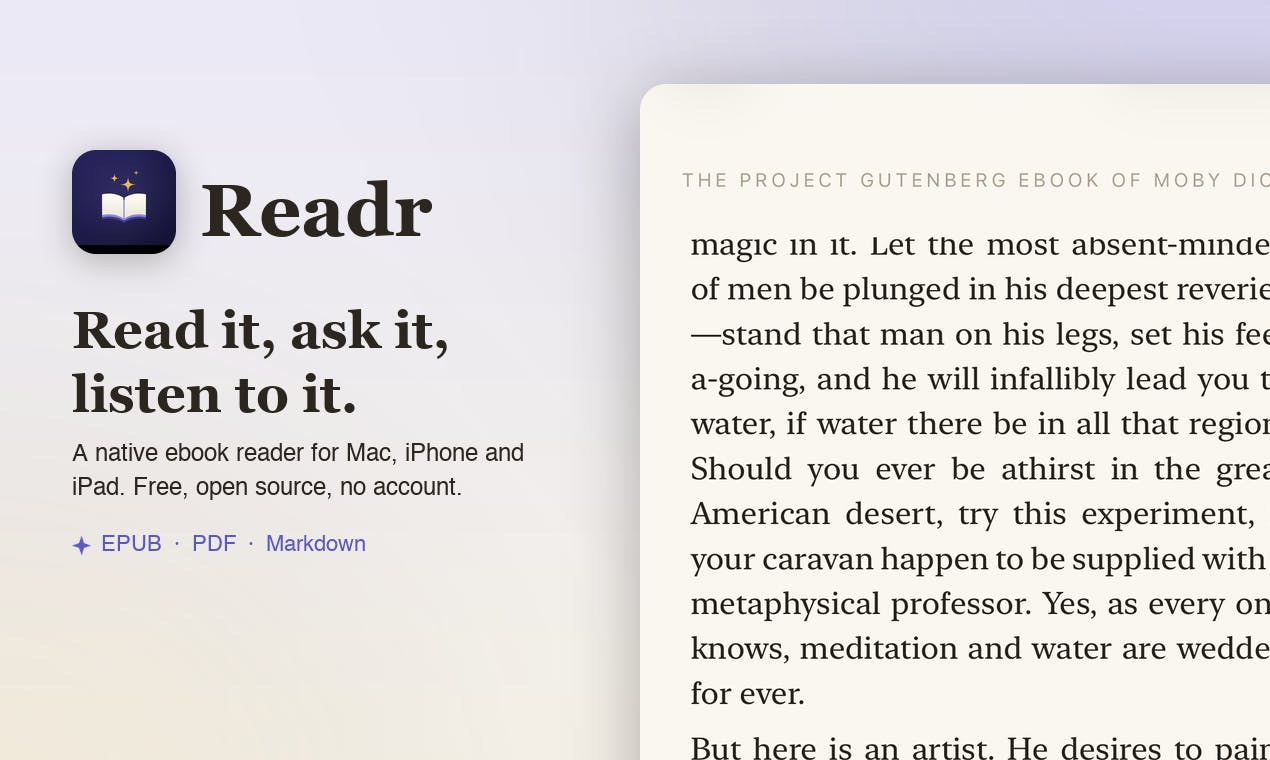
Readr is a free, open-source ebook reader for Apple platforms in which the book itself is conversational: readers select a passage, ask a question, and receive an answer in the margin that is grounded in the whole book and explicitly labeled when it draws on real-world knowledge rather than the text. It also generates spoiler-free recaps of what the reader has covered so far, and includes on-device text-to-speech with no usage cap. producthunt
The target user is the DRM-free ebook reader — people who own EPUB and PDF files — and the product deliberately trades ecosystem convenience for privacy: no account, no server, open-source code. The differentiation is thoughtful product craft (margin-anchored answers, source citation, spoiler-aware recaps) rather than proprietary technology. producthunt
The strongest positive signal is the coherence of the privacy-first, local-first design and the founder’s stated focus on data ownership, plus a competent launch that reached the top ten on Product Hunt’s daily leaderboard. producthunt
The most important investment concern is that there is no business: the app is free, open source, has no disclosed pricing, and its AI features appear to depend on the user’s own model access, making revenue under the current model structurally zero. The category is also being commoditized rapidly — Apple’s Accessibility Reader provides system-wide read-aloud functionality, and AI Q&A over documents is now a standard feature pattern across reading apps. producthunt
The venture case is therefore weak on both economics and defensibility. This is a promising hobbyist/open-source project, not currently a venture-scale company. Final decision: Pass, with reconsideration possible if the founder builds a monetized product with demonstrated retention.
Product Overview
The customer problem: readers of long-form books lose thread, forget earlier plot points or arguments, and cannot ask questions of the text (“could this science be real?”, “what did this character do earlier?”) without breaking immersion or encountering spoilers via web search.
How it works: the user opens their own DRM-free EPUB or PDF files in Readr. Selecting a line and asking a question produces an answer in the margin, drawn from the whole book, with the app indicating when it is pulling from real science rather than the book’s fiction. A recap feature summarizes what the reader has read so far without spoilers. A “Listen” mode reads the page aloud with a natural on-device voice and no cap on usage. The app requires no account and runs without a server. producthunt
Core features: margin Q&A grounded in the book’s full text; real-world-vs-book distinction; spoiler-free recaps; unlimited on-device TTS; EPUB/PDF import. Platforms: iPhone, iPad, and Mac, distributed via the linked website and an open-source GitHub repository (launch tags include Open Source and GitHub). producthunt
Pricing: none — the product is free and open source. A Product Hunt commenter’s reference to supplying “your own API key” suggests the AI Q&A may operate on a bring-your-own-key basis, which the maker has not contradicted; this is unverified. producthunt
The replaced workflow is reading in Apple Books or a third-party reader, then breaking out to Google or ChatGPT with spoilage risk, and separately using TTS apps like Speech Central or @Voice. The DRM-free constraint is a real limitation: it excludes Kindle and most commercial ebook purchases, confining the product to public-domain, indie, and self-owned files. speechcentral
Founder and Team Assessment
The Product Hunt maker profile identifies a solo maker under the name “anusree,” whose account was created in July 2026, making Readr their first launch. The profile self-describes work on “open infrastructure for digital identity and trust — verifiable credentials, decentralized directories, protocol design,” with Readr as a current app and “people owning their own data” as the connecting theme. producthunt
This is founder-reported information only. No LinkedIn profile, GitHub account, prior companies, exits, or employment history could be independently matched with confidence. Team size appears to be one; there are no job listings or hiring signals. Full-time commitment is unknown; the profile describes multiple parallel interests (identity infrastructure and apps), which suggests a part-time or portfolio approach.
Founder Assessment: A self-described solo builder with an ideologically consistent privacy/local-first orientation, but with no verifiable track record, no team, and no demonstrated commercial capability.
Market Opportunity
The initial segment is narrow: iPhone/iPad/Mac users who read DRM-free ebooks (public-domain works, purchased EPUBs, PDFs) and want AI assistance while reading. This is a subset of the already-limited non-Kindle, non-DRM reader population. Apple Books and Kindle dominate commercial ebook reading; the DRM-free audience skews technical and price-sensitive, and is well-served by free tools.
Willingness to pay is structurally weak in this segment: the audience chooses DRM-free partly to avoid paying platform tolls, and comparable products compete on price aggressively — Speech Central sells a one-time purchase with no subscription, and LoudReader offers a free tier with on-device AI narration. loudreader
A bottom-up estimate: assume 1–3 million globally addressable DRM-free, Apple-platform readers who might use an AI reading companion, at a hypothetical future $40–60/year subscription. Even 3% conversion would yield roughly $1.2–5.4M ARR — a viable indie business, well below venture scale. Expansion opportunities (cross-platform Android/Windows, student/research document Q&A, licensing the engine) exist but each moves toward markets with stronger incumbents (Readwise, Matter, and Trellis are already listed as adjacent alternatives on Product Hunt). producthunt
Timing is favorable in one sense — on-device AI and natural TTS crossed the quality threshold only recently — but that same timing means every major platform can now bundle these features natively.
Traction and Growth Signals
Available evidence: a September 3, 2026 Product Hunt launch that placed #10 on the daily leaderboard (as a promoted launch, i.e., paid placement); 115 followers and a 4.0 rating from a single review at the time of research; a small number of engaged, technically substantive comments, including questions about context-window economics and upload functionality; inclusion in Product Hunt’s September 4 newsletter. producthunt
Not available: downloads, App Store ratings (no verified App Store listing was located), registered or active users, paying customers, revenue, retention, website traffic, GitHub star history (the repository is referenced but was not independently verified), and any post-launch momentum data — the launch occurred three days before this report.
The most important missing metrics are downloads/active users and any evidence of retained usage. A single-review 4.0 rating and a promoted leaderboard placement carry almost no evidentiary weight for product-market fit.
Traction Assessment: Launch-week attention only; no commercial or usage evidence exists.
Competitive Position
- Direct competitors: AI-enabled reading apps — Reader AliveTranslate (translate, listen, and question ebooks), Readwise Reader, Matter, and Trellis, which Product Hunt itself lists as alternatives producthunt
- Large platforms: Apple (Accessibility Reader provides system-wide read-aloud, and Apple Intelligence can summarize any content); Amazon Kindle; Google Play Books support.apple
- Free/open-source alternatives: Karpathy’s reader3-style self-hosted EPUB readers, the earlier open-source Readr PDF+LLM viewer, and generic use of ChatGPT/Claude alongside any reader reddit
- TTS specialists: Speech Central (one-time purchase), @Voice, LoudReader (free with on-device AI narration) loudreader
Current differentiation is genuine product craft: margin-anchored, book-grounded answers with an explicit fiction-vs-reality distinction, spoiler-aware recaps, and a strict no-account/no-server posture. That posture is a real differentiator for a privacy-sensitive niche — but it is also the direct reason the product cannot easily monetize. Being open source makes every differentiator trivially copyable by competitors. producthunt
The six-month replication test: if Apple shipped “ask about this page” in Apple Books — which its existing Accessibility Reader and AI infrastructure make straightforward — Readr’s remaining advantages would be DRM-free file support and the no-account stance. That answer protects a niche, not a company. Switching costs are near zero: books are user-owned files that open in any reader. support.apple
Defensibility Assessment: Low.
Business Model and Economics
There is currently no revenue model. The app is free and open source with no disclosed pricing, subscription, or paid tier. Because the product explicitly runs without accounts or servers, marginal costs per user appear near zero for the maker — the AI inference cost appears to be shifted to users via their own API keys (unverified), and TTS runs on-device. This is economically clean but generates no revenue. producthunt
If a future paid tier were introduced, the economics would face several pressures: App Store fees of 15–30% on iOS subscriptions; consumer churn in reading apps; a price-sensitive audience accustomed to free/open-source alternatives; and the cost of running hosted AI if the maker moved away from BYO-key (which would also contradict the no-server positioning). Whether usage growth could outpace inference costs is not assessable because there is no monetized usage to measure. loudreader
Unicorn Path
Assume a future consumer subscription model at ~$50/year and a generous 10x ARR multiple for a high-growth consumer app. Required revenue: $1B ÷ 10 = ~$100M ARR, implying roughly 2 million paying subscribers.
The addressable population of DRM-free, Apple-platform readers willing to pay for an AI companion (estimated above at 1–3 million) would need near-total paid penetration — not credible against free alternatives and native platform features. Reaching venture scale would require a strategic transformation: cross-platform expansion, hosted AI with a paid subscription that contradicts the current privacy positioning, and a shift into student/research document workflows where Readwise, Notion, and the model providers themselves compete. support.apple
Unicorn Path: Improbable. Under the current free, open-source model there is no revenue path at all; even a competent subscription pivot targets a niche unlikely to exceed low-single-digit millions in ARR.
Valuation Assessment
No funding rounds, investors, valuations, or fundraising activity are publicly disclosed. No incorporation or legal entity information was found. Current fundraising status is unknown; the profile reads as an independent project rather than a fundraising company. producthunt
Valuation Attractiveness: Not Assessable. Assessment would require at minimum: a legal entity, ARR and growth, retention cohorts, pricing, unit costs (inference, if any hosted AI), round size or SAFE cap, post-money valuation, and investor ownership. None of these exist publicly, and a pre-revenue open-source project cannot be responsibly valued from Product Hunt performance.
Key Risks
- No revenue model: free and open source by design; monetization would contradict the product’s core no-account/no-server identity. producthunt
- Platform commoditization: Apple already provides system-wide read-aloud via Accessibility Reader and can bundle book Q&A natively. support.apple
- Niche addressable market: DRM-free-only support excludes Kindle and most commercial ebooks. producthunt
- Open-source zero defensibility: all differentiators are publicly copyable code.
- Solo, unverified founder: no verifiable track record, no team, possible part-time commitment. producthunt
- Promoted launch: the #10 ranking reflected paid placement rather than organic demand. producthunt
- Price-anchored competition: rivals compete at free or one-time-purchase price points. loudreader
- Brand collision: at least two other products named “Readr” exist in the market, including a subscription read-it-later app on the App Store. apps.apple
Final Assessment
Venture Potential: 31/100
| Category | Score |
|---|---|
| Market Size and Expansion Potential | 10/20 |
| Traction and Growth Evidence | 3/20 |
| Founder and Team | 5/15 |
| Product Strength | 6/10 |
| Distribution Potential | 5/15 |
| Business Model and Economics | 1/10 |
| Defensibility | 1/10 |
| Total | 31/100 |
The strongest element is product design: book-grounded, spoiler-aware AI answers with a privacy-first architecture are a genuinely better reading experience than alt-tabbing to a chatbot. The weakest elements are the absent business model (1/10), low defensibility (1/10), and a three-day-old traction record. This score places Readr in the weak-venture-case band (0–34).
Evidence Confidence: 25/100
Verified: the product exists, its features, platforms, launch date, and leaderboard placement. Founder-reported: the maker’s self-description and data-ownership focus. Unverified: founder identity and background, GitHub repository details, download counts, any usage or retention data, API-key mechanics. Unknown: entity, team, funding, revenue, costs, runway. Almost no commercial evidence exists, which caps confidence in the 20–39 band. producthunt
Final Decision: Pass
Readr is a well-crafted, genuinely useful free tool with a coherent privacy-first philosophy — and it is not a venture investment. It has no revenue model, a niche DRM-free audience, near-zero defensibility against Apple and existing reading platforms, a single unverified founder, and an improbable path to venture-scale revenue. None of these constitute integrity or structural-failure concerns, so Hard Pass is unwarranted; the project is simply better suited to open-source community support or bootstrap economics than to venture capital. It could be reconsidered if the founder deliberately converts it into a commercial product with demonstrated traction.
Upgrade Conditions
- Introduction of a paid tier with evidence of free-to-paid conversion and positive 90-day retention
- Demonstrated download and active-user growth beyond launch week, across platforms
- Verifiable founder identity, background, and full-time commitment
- A credible expansion thesis (e.g., research/student document Q&A) with early evidence
- Any funding or team formation indicating company-building intent
Downgrade Conditions
- Product abandonment or stalled update cadence
- Apple shipping equivalent native book-Q&A features support.apple
- Evidence of negligible usage beyond launch week
- No move toward monetization within 6–12 months, confirming hobby-project status
Questions for Further Diligence
- Is Readr a company, a project, or a portfolio piece alongside your identity-infrastructure work ? producthunt
- What are current downloads, weekly active users, and 30-day retention?
- How does the AI Q&A work mechanically — BYO API key, on-device model, or something else ? producthunt
- If BYO key, how do you plan to serve non-technical users who won’t obtain one?
- Do you intend to monetize at all, and how would that square with the no-account/no-server positioning?
- What is the GitHub repository’s activity level and contributor count?
- Have you measured how many users actually ask questions versus only using TTS?
- What is your plan for Android, Windows, and browser-based reading?
- How would you survive Apple or Amazon shipping native book Q&A ? support.apple
- Do you have any trademark concern given existing “Readr” apps on the App Store ? apps.apple
- Is there any funding, incorporation, or planned raise?
- What is the roadmap for the fiction-vs-science grounding feature, and is it defensible?
Sources
- Product Hunt — Readr launch page
- Product Hunt — maker profile (@anusree_j)
- Product Hunt — Best of September 3, 2026 leaderboard
- Product Hunt — Readr alternatives page
- Product Hunt newsletter — September 4, 2026
- Apple Support — Accessibility Reader (platform competitive context)
- Speech Central — one-time-purchase TTS reader (competitive context)
- LoudReader FAQ — free AI narration reader (competitive context)
- App Store — “Readr: Read it Later, Offline” (different product, disambiguation)
- Reddit r/macapps — earlier, unrelated “Readr” PDF+LLM viewer (disambiguation)