
Table of Contents
Sai Investment Report
Category: AI agents / desktop and enterprise workflow automation
Company Stage: Series A
Founder or Founders: Ang Li and Jiachen Yang
Headquarters: Palo Alto, California; an earlier funding announcement described the company as San Francisco-based
Funding: Approximately $27 million total, including a $5 million seed and $21.5 million Series A
Business Model: Subscription and enterprise software with usage credits and cloud-computer infrastructure
Product Hunt Launch Date: September 21, 2026
Report Date: September 25, 2026
| Investment Metric | Assessment |
|---|---|
| Venture Potential | 76/100 |
| Unicorn Path | Conditional |
| Valuation Attractiveness | Not Assessable |
| Evidence Confidence | 66/100 |
| Final Decision | DD |
Executive Summary
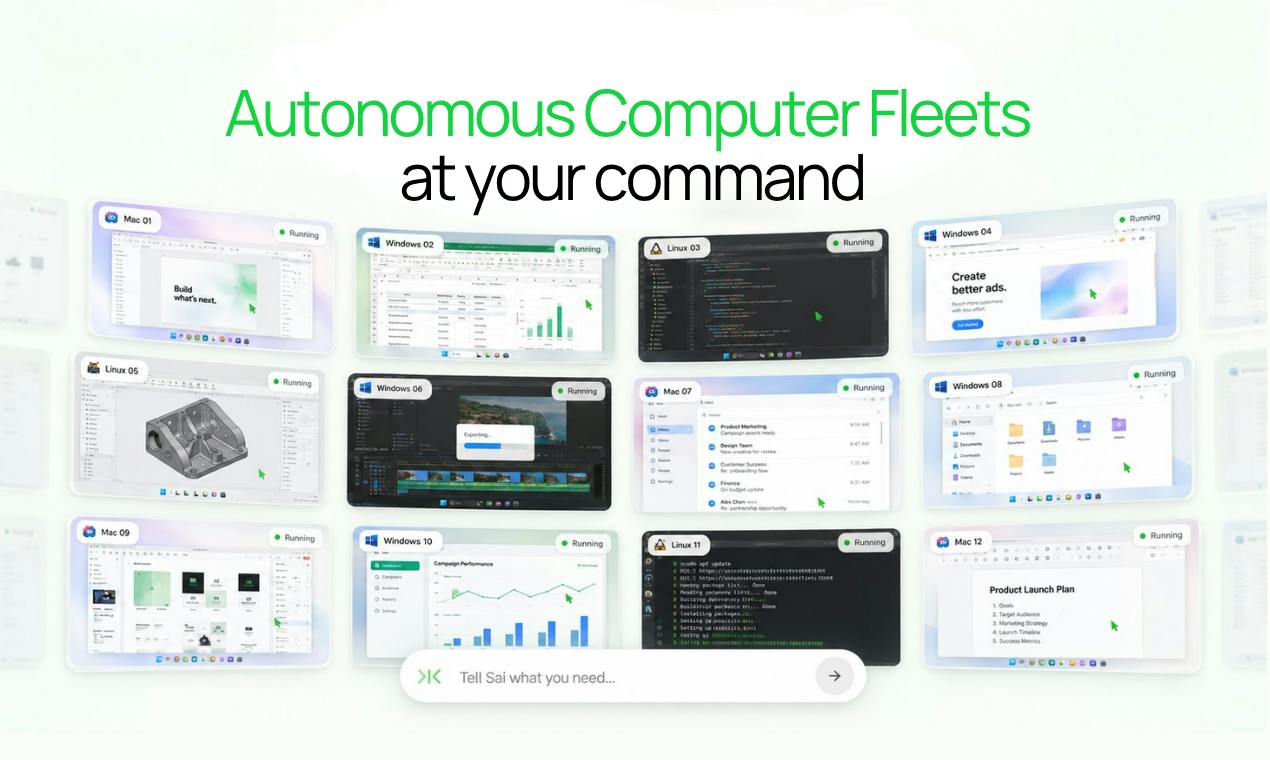
Sai is Simular’s general-purpose computer-use agent. It controls browsers, native applications, files, terminals, and cloud virtual machines through graphical interfaces rather than depending exclusively on application APIs. Users describe a task in natural language, watch Sai perform it, intervene when necessary, and convert successful recurring tasks into more deterministic workflows (Sai; Simular).
The product targets individuals and businesses with repetitive screen-based work, including research, data entry, invoicing, lead sourcing, document processing, reporting, and workflows spanning applications that lack compatible APIs. Its central differentiation is a neuro-symbolic approach: frontier models explore and reason, while successful procedures can be represented as executable code for cheaper, more repeatable subsequent runs.
The strongest positive investment signal is Simular’s technical position. Its open-source Agent S framework has generated peer-reviewed research, won a best-paper award at an ICLR workshop, and reported leading results on established computer-use benchmarks. Sai reported a 73% partial score on OSWorld 2.0 at $15.70 per task, though its binary success rate was only 28.25%, emphasizing the continuing gap between partial benchmark completion and dependable commercial automation (Agent S GitHub; OSWorld 2.0 results).
Company quality appears high. The founders are former Google DeepMind researchers, the current website names a multidisciplinary team of approximately 16 people, and Simular has raised about $27 million from Felicis, Basis Set Ventures, NVentures, Flying Fish Partners, South Park Commons, Samsung NEXT, Xoogler Ventures, and individual investors (funding announcement; Basis Set Ventures).
The main investment concern is the gap between technical benchmark leadership and repeatable commercial economics. Revenue, paying-customer count, retention, production-task success, inference cost, and gross margin are not publicly disclosed. Computer-use agents also receive broad access to sensitive business systems, creating substantial security, privacy, and error-liability barriers.
The decision is DD. Simular has credible technology, experienced founders, financing, and a large potential enterprise market. Investment requires verification that benchmark performance translates into reliable production usage and that subscription revenue exceeds model, virtual-machine, support, and exception-handling costs.
Product Overview
Sai addresses workflows that remain difficult to automate through APIs or conventional robotic process automation. It observes graphical interfaces, uses the mouse and keyboard, manipulates files, runs terminal commands, and works across desktop and browser applications. Tasks may run on the customer’s computer or on a persistent private cloud machine.
Core capabilities include scheduled workflows, shared team skills, cloud execution, local-device operation, human approval for consequential actions, remote steering through messaging services, persistent environments, and API access. Windows, macOS, Linux, and virtual-machine environments are supported, although exact feature parity across platforms is not publicly documented (pricing page).
Current monthly pricing is:
- Starter: Promotional price of $50, apparently reduced from $200; includes cloud Windows access and usage credits.
- Premium: $200, with an always-on Windows or Mac computer and higher credits.
- Pro: $500, with fair-use unlimited usage, team workflows, API access, and priority capacity.
- Enterprise: Custom pricing, with managed scaling, SSO, role-based access, audit/security features, integrations, and service-level guarantees.
The Starter pricing presentation is ambiguous because the page displays both $200 and $50. The report treats $50 as the current promotional price, not a durable list price.
Sai replaces manual screen work, custom scripts, traditional RPA configuration, browser automation, and point-to-point API integrations. Its value proposition is strongest where workflows recur, span several applications, and contain stable portions that can be converted into deterministic procedures.
Founder and Team Assessment
CEO Ang Li previously worked at Google DeepMind and has experience spanning continual learning, autonomous driving, computer vision, and large-scale AI infrastructure. South Park Commons reports that he also worked at Baidu Apollo, Facebook AI Research, Carnegie Mellon Robotics, Apple, Google Street View, and Comcast Labs, and earned a computer-science PhD from the University of Maryland (South Park Commons).
CTO Jiachen Yang is described by Simular as a former DeepMind researcher with a Georgia Tech PhD specializing in reinforcement learning and multi-agent systems. TechCrunch independently confirms that Li and Yang met at DeepMind and worked on research intended to improve production systems, including Google products (team page; TechCrunch).
The current team page names approximately 16 people across research, engineering, communications, recruiting, and go-to-market roles. The group includes researchers and engineers formerly associated with DeepMind, Google, Baidu Apollo, TikTok, Atlassian, Shopee, and academic institutions. This is company-reported background rather than independently verified employment history.
Technical capability is unusually strong for the stage. Commercial capability is less proven: public evidence is concentrated in research, financing, launches, and one detailed customer case study rather than a broad set of referenceable enterprise deployments.
Founder Assessment: Excellent technical founder-market fit, but enterprise sales and operating discipline require verification.
Market Opportunity
The initial customer segment should be defined as operations-intensive SMBs and enterprise departments that repeatedly transfer information between legacy desktop, browser, email, document, and accounting systems. These customers may pay materially more than individual consumers if Sai replaces measurable administrative labor without requiring system migration.
An illustrative bottom-up scenario is:
- 10,000 Pro accounts × $6,000 annual subscription = $60 million ARR
- 800 enterprise customers × $50,000 assumed ACV = $40 million ARR
- Combined opportunity = $100 million ARR
The enterprise ACV is an analyst assumption, not published pricing. Achieving it would require secure deployment, service guarantees, implementation support, high task volume, and demonstrable labor savings.
Simular’s company-published case study reports that Trevino’s Auto Mart reduced monthly human involvement in QuickBooks invoicing from approximately 11 hours to under one hour. This suggests customer willingness to pay where avoided labor clearly exceeds subscription and supervision costs, but one vendor-authored case study is insufficient to establish repeatability (case study).
Adjacent markets include claims processing, finance operations, recruiting, healthcare administration, customer support, travel operations, and managed automation services. Geographic expansion is possible, but privacy rules, language support, labor economics, and cloud-data residency could complicate deployment.
Traction and Growth Signals
Sai ranked #3 on Product Hunt’s September 21 daily leaderboard. Product Hunt’s awards page separately labels Sai a “Launch of the Day,” creating an internal presentation inconsistency; the numbered leaderboard is the clearer source for ranking (daily leaderboard; awards page). Product Hunt attention is not treated as commercial traction.
More meaningful evidence includes:
- Five product launches since March 2025, indicating continuous product development;
- Approximately $27 million in institutional financing;
- A public open-source framework supporting macOS, Windows, and Linux;
- Company-reported execution of millions of agent steps;
- A detailed automotive-dealership workflow;
- Participation as an early adopter of Windows 365 for Agents;
- A 16-person named team and active recruiting across engineering, research, product, and go-to-market functions (launch history; Microsoft pilot announcement; careers).
The most important missing metrics are ARR, paid-account count, active usage, task completion in production, cohort retention, credit consumption, enterprise pipeline, customer concentration, and renewal rates.
Traction Assessment: Technically credible with early customer evidence, but commercial growth remains unverified.
Competitive Position
Direct competitors include general computer-use agents, browser agents, and enterprise automation platforms. Relevant alternatives include OpenAI’s browser-oriented Operator capabilities, Anthropic’s computer-use models, Microsoft Copilot Studio, UiPath, and open-source frameworks such as Browser Use. Manual labor, virtual assistants, macros, scripts, and API-based automation are also substitutes (OpenAI Operator; Anthropic computer use; Microsoft computer use; UiPath pricing).
Simular’s strongest differentiation is the combination of GUI control, model orchestration, symbolic replay, cloud computers, and open research. Its Agent S work provides technical credibility and a potential recruiting and developer-distribution advantage.
Switching costs could develop from stored workflows, learned procedures, enterprise integrations, approval policies, and historical execution data. However, no network effect is apparent, and customers may avoid lock-in by maintaining scripts or standard RPA assets.
If the largest platform launched the same feature within six months, customers would continue using Sai only if it delivered demonstrably higher completion reliability, lower total cost, broader cross-application support, and faster workflow creation. Current benchmark leadership supports this argument but does not prove durability.
Defensibility Assessment: Medium
Business Model and Economics
Sai combines recurring subscriptions, usage credits, cloud-computer hosting, API access, and enterprise contracts. Potential ACV ranges from $600 annually for promotional Starter pricing to $6,000 for Pro, before enterprise contracts.
Gross margin is uncertain. Variable costs include frontier-model calls, specialist models, persistent virtual machines, storage, networking, observability, customer support, and failed-task retries. Sai’s reported OSWorld 2.0 cost of $15.70 per long task would be problematic under a $500 monthly “unlimited” plan if customers repeatedly run expensive workloads. Real commercial tasks may cost materially less, especially after conversion to deterministic code, but this requires verification.
The company’s neuro-symbolic approach could improve economics if repeated workflows genuinely use fewer model calls over time. Conversely, long-tail GUI failures could require expensive human support and implementation services, reducing software margins.
Unicorn Path
Using an illustrative 10× ARR multiple for a rapidly growing AI automation company implies:
Required ARR = $1 billion ÷ 10 = approximately $100 million.
At current pricing, that equals approximately:
- 166,700 Starter subscribers at $600 annually;
- 41,700 Premium subscribers at $2,400 annually;
- 16,700 Pro subscribers at $6,000 annually; or
- 2,000 enterprise customers at an assumed $50,000 ACV.
The most credible route is enterprise automation rather than a purely consumer “robosecretary.” It requires high production reliability, gross margins above roughly 70%, repeatable vertical workflows, security certifications, low exception rates, and strong expansion within customer accounts.
Unicorn Path: Conditional
Valuation Assessment
Simular raised a $5 million seed led by Basis Set Ventures and a $21.5 million Series A led by Felicis, bringing total disclosed financing to approximately $27 million. Series A participants included NVentures, Basis Set Ventures, Flying Fish Partners, South Park Commons, and Lenny Rachitsky; earlier investors included Samsung NEXT and Xoogler Ventures (Simular announcement; Basis Set).
No reliable post-money valuation or current financing terms were found. Revenue is also undisclosed.
Valuation Attractiveness: Not Assessable
Required information includes ARR, revenue growth, gross margin, retention, task-level contribution margin, burn, runway, round valuation, dilution, liquidation preferences, and current financing plans.
Key Risks
- Production reliability may remain below the threshold required for unattended enterprise work.
- Revenue, customer count, and retention are not publicly disclosed.
- Frontier-model and cloud-computer costs may undermine gross margin.
- Major AI and automation platforms can bundle computer-use capabilities.
- Sai handles credentials, screenshots, communications, and sensitive business data.
- The privacy policy permits model training on user inputs and outputs unless users opt out, except for protected Google API data (privacy policy).
- Broad horizontal positioning may lead to expensive implementation and support.
- GUI changes can break workflows despite symbolic replay.
- Benchmark scores may not predict repeatable real-world completion.
- The promotional Starter price creates uncertainty around willingness to pay.
Final Assessment
Venture Potential: 76/100
| Category | Score |
|---|---|
| Market Size and Expansion Potential | 19/20 |
| Traction and Growth Evidence | 12/20 |
| Founder and Team | 14/15 |
| Product Strength | 9/10 |
| Distribution Potential | 9/15 |
| Business Model and Economics | 6/10 |
| Defensibility | 7/10 |
| Total | 76/100 |
Technical depth, founder quality, market breadth, and research differentiation are the strongest elements. Commercial traction, distribution efficiency, and task-level economics are the weakest.
Evidence Confidence: 66/100
Funding, investors, founders, team composition, pricing, research activity, and benchmark methodology are publicly documented. Customer outcomes, millions of executed steps, and cost-reduction claims are company-reported. Revenue, retention, margins, valuation, burn, and production reliability remain unavailable.
Final Decision: DD
Simular warrants formal diligence because it has a credible technical advantage, experienced founders, substantial financing, and an enterprise-relevant product. The conditional unicorn path depends on proving reliable, economically attractive automation outside controlled benchmarks.
Upgrade Conditions
- Verified ARR above $5 million with strong enterprise growth;
- At least 70% six-month customer retention;
- Gross margin above 70% after model and virtual-machine costs;
- Multiple independently referenceable enterprise deployments;
- Production task success above 90% for defined recurring workflows;
- Evidence of account expansion and repeatable customer acquisition.
Downgrade Conditions
- Persistent production success materially below benchmark results;
- High customer-support or human-intervention requirements;
- Gross margins constrained by inference and virtual-machine costs;
- Security incidents or inappropriate handling of customer data;
- Competitors reaching equivalent reliability at materially lower prices;
- Weak renewal after promotional pricing expires.
Questions for Further Diligence
- What are current ARR, MRR, and monthly revenue growth?
- How many Starter, Premium, Pro, and Enterprise customers are paying?
- What are 30-, 90-, and 180-day retention by plan?
- What percentage of tasks complete without human intervention?
- What are model, VM, support, and retry costs per task and customer?
- What is gross margin by subscription tier?
- How often are successful tasks converted into deterministic workflows?
- What are customer acquisition cost, sales cycle, and enterprise pipeline?
- How many referenceable enterprise customers are in production?
- What data is retained or used for training under enterprise contracts?
- What are burn, runway, cap table, and current financing terms?
- Which intellectual property remains proprietary versus open source?