
Table of Contents
Epho Investment Report
Category: Developer Tools / AI Agent Infrastructure
Company Stage: Early commercial launch
Founder or Founders: Burak Karakan (maker); operated by Bruin Data Limited
Headquarters: Bruin Data Limited is registered in England and Wales; Epho operating headquarters is not publicly disclosed
Funding: Epho-specific funding is not publicly disclosed
Business Model: Usage-based cloud infrastructure; customers bring model-provider API keys
Product Hunt Launch Date: August 21, 2026
Report Date: August 26, 2026
| Investment Metric | Assessment |
|---|---|
| Venture Potential | 63/100 |
| Unicorn Path | Conditional |
| Valuation Attractiveness | Not Assessable |
| Evidence Confidence | 54/100 |
| Final Decision | Watch |
Executive Summary
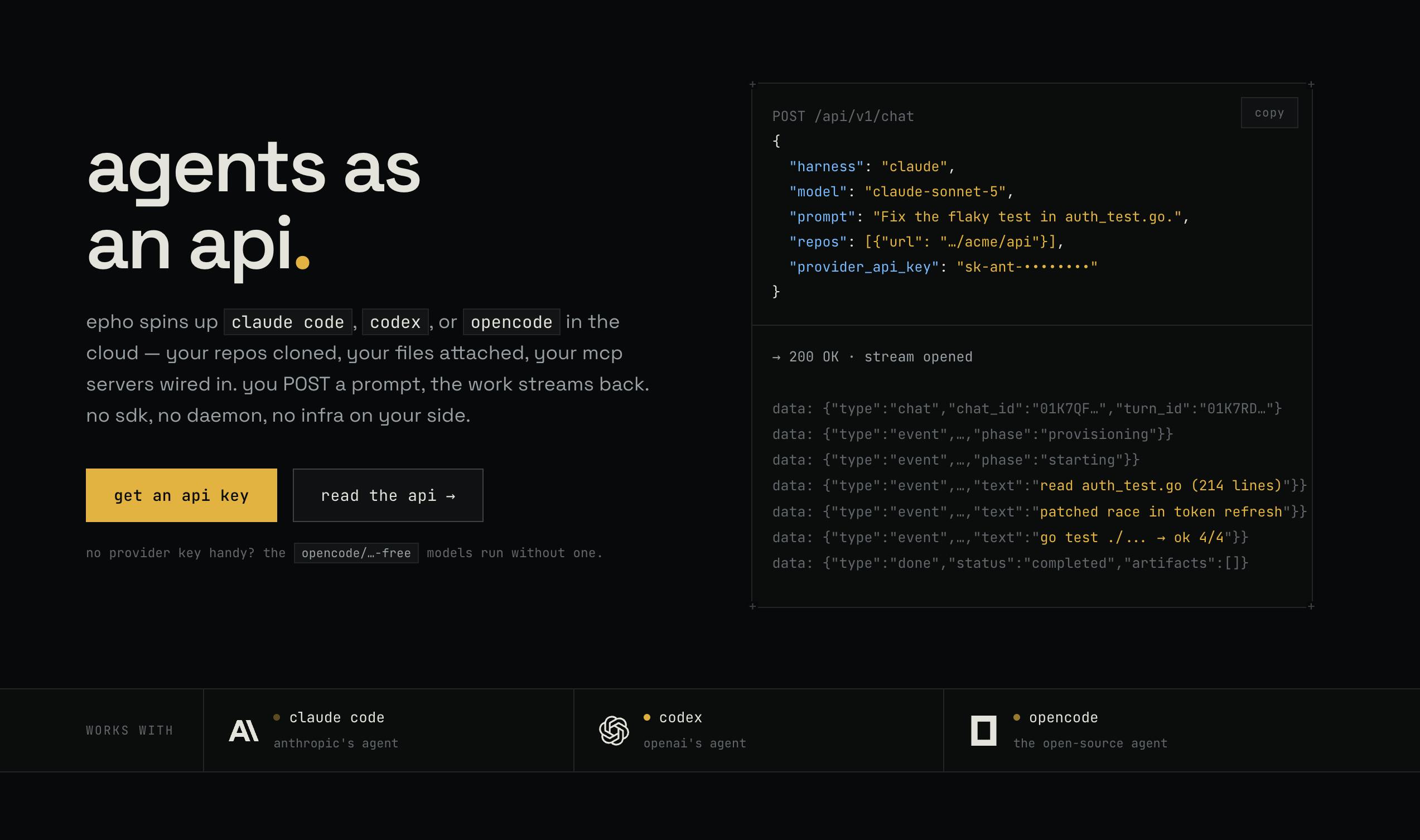
Epho exposes Claude Code, Codex, and OpenCode through one cloud API. A developer sends a prompt plus repository context; Epho provisions an isolated sandbox, configures the coding-agent harness, streams events, preserves multi-turn state, and returns artifacts. It replaces orchestration work that teams otherwise build around raw sandboxes.
Timing is attractive as software teams move agents from local terminals into asynchronous product, CI, support, and internal workflows. Epho’s opinionated “agents as an API” layer could become valuable if it proves reliable across providers.
The strongest signal is founder-market fit. Product Hunt names Burak Karakan as maker, while Epho identifies Bruin Data Limited as operator. Karakan is Bruin’s co-founder and CEO, and Bruin’s public GitHub project demonstrates relevant infrastructure execution. Epho reportedly originated from Bruin’s own AI-analyst work.
The main concern is unverified Epho-specific traction. Launch attention does not establish recurring usage, revenue, retention, or willingness to entrust private code and credentials. Competition from E2B, Daytona, Modal, cloud platforms, and self-built systems is strong. Security assurance and margins matter because requests may carry provider keys, repository tokens, environment variables, and MCP credentials.
Final decision: Watch. Upgrade to DD requires verified paid usage, repeatable acquisition, enterprise security evidence, acceptable margins, and proof that the managed-agent layer retains value beyond raw sandbox compute.
Product Overview
The initial customer is a developer or platform team embedding coding agents into CI, issue-to-PR automation, review, data operations, or internal tools. The alternative is to provision compute, install each harness, clone repositories, inject credentials, stream events, recover failed jobs, persist sessions, and manage queues.
Epho’s official site presents one POST endpoint for Claude Code, Codex, or OpenCode. It supports SSE streaming and asynchronous jobs, durable chat IDs, up to 32 repositories, input files, environment variables, MCP servers, sandbox-provider fallback, and artifact retrieval. Customers supply model-provider keys, so Epho bills infrastructure rather than tokens.
Pricing is $0.0000164 per vCPU-second, $0.0000053 per GiB-second of memory, and $0.000000036 per GiB-second of disk. The default 2-vCPU, 2-GiB, 10-GiB instance is quoted at about $0.0026 per minute; signup includes $10 credit. Enterprise tiers, support commitments, uptime guarantees, and discounts are not published. Independent reliability tests and external production references were not found.
Founder and Team Assessment
Product Hunt identifies Karakan as maker. Epho’s footer names Bruin Data Limited as operator; Bruin’s legal page verifies UK company number 14960347. Karakan’s GitHub profile identifies him as Bruin’s co-founder and CEO, and the active Bruin repository provides evidence of technical capability.
Karakan says Epho emerged from Bruin’s AI-analyst project, giving him direct exposure to the problem. A secondary interview reports approximately 15 Bruin staff, mostly engineers, and an undisclosed seed round, but these figures are not Epho-specific and require verification. Epho headcount, team allocation, hiring, and ownership are unknown.
Founder Assessment: Strong technical execution and relevant infrastructure experience, but Epho’s staffing, commercial leadership, and priority within Bruin remain unverified.
Market Opportunity
The beachhead is software and AI-product teams needing many coding-agent jobs programmatically. Buyers will pay when Epho saves more engineering cost and failures than its markup over raw compute. Adjacent uses include secure execution for data analysis, QA, support, and enterprise workflow agents.
A bottom-up scenario is illustrative because customer data is absent. At the default rate, 1,000 agent-hours monthly cost roughly $158, or $1,900 annually, before model charges. Ten thousand such accounts imply only about $19 million annual revenue. Reaching $100 million would require about 52,600 accounts at that spend, or higher-value enterprise plans—roughly 4,200 customers at $24,000 annual contract value.
Traction and Growth Signals
At review, Product Hunt showed 199 followers, 158 points, and a #6 daily rank. Comments liked repository context and per-second billing; one user asked about missing .NET support, which the maker offered to address with a custom environment. Epho says Bruin uses the product in production for its AI analyst. No verified Epho ARR, external paying-customer count, run volume, retention, revenue growth, case study, uptime history, or public Epho repository was found. Traction Assessment: Encouraging launch interest and an internal use case, but commercially unverified.
Competitive Position
Direct competitors include E2B, Daytona, Modal, Vercel Sandbox, Cloudflare Sandboxes, and Runloop. Indirect alternatives include major clouds, container platforms, self-hosted runners, and hosted tools from coding-agent vendors.
Epho differentiates through a small HTTP surface, multiple harnesses, durable sessions, backend fallback, and BYOK pricing. These reduce integration time. Initial switching costs are low; durable state, operational history, security policy, and workflow integrations could raise them. No proprietary data or network effect is evident.
If the largest platform launched the same feature within six months, customers would stay only if Epho delivered superior cross-harness reliability, observability, enterprise controls, or support. That advantage is plausible but unproven.
Defensibility Assessment: Low to Medium.
Business Model and Economics
Revenue is usage-based infrastructure. BYOK avoids model-inference exposure, but Epho still bears sandbox, storage, orchestration, egress, support, and failed-run costs. Published retail prices do not reveal gross margin or compute markup.
Enterprise value likely requires audit logs, SLAs, private networking, certifications, and support. CAC, expansion revenue, concentration, and margins are unknown.
The key test is whether agent-hours and higher-margin control-plane features grow faster than costs. Required evidence includes gross margin by workload, fallback and failure costs, session-storage cost, support load, and net revenue after cloud spend.
Unicorn Path
Assume an 8x revenue multiple for a fast-growing, high-retention developer-infrastructure company with strong margins. This is an analytical scenario, not Epho’s current multiple. A $1 billion valuation then requires about $125 million annual revenue.
At $1,900 annual revenue per small customer, Epho needs roughly 65,800 customers. At $24,000 enterprise ACV, it needs about 5,200. A blended path requires global distribution, enterprise control-plane pricing, and software-like gross margin.
Scale requires external production adoption, enterprise security, multi-cloud reliability, repeatable distribution, and valuable policy layers. Epho must remain relevant if model vendors launch hosted APIs.
Unicorn Path: Conditional.
Valuation Assessment
No Epho financing, valuation, SAFE cap, or fundraising terms were found. Epho appears to be a Bruin Data Limited product, not a separately disclosed company. Secondary sources conflict on Bruin funding, while a recent interview reports an undisclosed seed; neither establishes Epho’s ownership or price.
Valuation Attractiveness: Not Assessable.
Assessment requires Epho/Bruin ARR, growth, gross margin, retention, burn, runway, cap table, IP ownership, round size, post-money valuation, and liquidation preferences. Product quality and Product Hunt points cannot support a valuation range.
Key Risks
- Commercial validation: no verified external revenue, customers, retention, or usage cohorts.
- Security: sensitive code and multiple credentials traverse Epho-managed infrastructure.
- Commoditization: sandbox and model vendors can bundle orchestration.
- Margins: low per-second pricing may leave limited contribution after compute, retries, storage, and support.
- Parent focus: Epho’s resources and ownership inside Bruin are unclear.
- Platform dependency: harness or provider changes can break integrations or economics.
- Reliability burden: multi-provider fallback creates operational complexity and outage liability.
- Low switching costs: the API is easy to adopt but may be easy to replace.
Final Assessment
Venture Potential: 63/100
| Category | Score |
|---|---|
| Market Size and Expansion Potential | 16/20 |
| Traction and Growth Evidence | 5/20 |
| Founder and Team | 12/15 |
| Product Strength | 8/10 |
| Distribution Potential | 9/15 |
| Business Model and Economics | 7/10 |
| Defensibility | 6/10 |
| Total | 63/100 |
The strongest elements are timing, simplicity, and an experienced technical operator. The weakest are absent commercial evidence, unclear margins, and competition.
Evidence Confidence: 54/100
Product functionality, pricing, legal operator, maker identity, and launch activity are verified through official pages. The internal use case is company-reported. Customer economics and unicorn calculations are analyst scenarios. Revenue, customers, retention, team allocation, margin, financing terms, and valuation remain unavailable.
Final Decision: Watch
Epho is promising but too early for formal diligence. The conditional unicorn path depends on enterprise expansion and durable orchestration value; valuation is not assessable. Founder quality helps, but traction, security, economics, and defensibility need proof.
Upgrade Conditions
- Verify at least 20 external paying teams and multiple production references.
- Show sustained run-volume growth and strong 90-day account retention.
- Demonstrate over 60% gross margin after compute, retries, storage, and support, with a path above 70%.
- Publish independent security testing, credential controls, incident procedures, and a compliance roadmap.
- Establish repeatable acquisition outside Product Hunt and Bruin’s network.
- Clarify Epho ownership, dedicated staffing, and financing terms.
Downgrade Conditions
- Security incidents or misleading isolation and credential-handling claims.
- Weak paid conversion, low repeat usage, or usage concentrated in Bruin.
- Structurally poor gross margin.
- Major-platform bundling without a differentiated response.
- Epho becomes non-core or product development slows materially.
Questions for Further Diligence
- What are Epho’s current MRR, paying-customer count, and monthly run-volume growth, excluding Bruin usage?
- What shares of accounts run a first job, return after 30/90 days, and convert from credit to paid?
- What are revenue and gross margin per agent-hour after compute, retries, storage, egress, and support?
- How are provider keys, repo tokens, environment variables, MCP credentials, snapshots, logs, and artifacts encrypted, retained, and deleted?
- Which sandbox providers are used, how is tenant isolation tested, and what audits cover Epho?
- What uptime, completion, fallback, and p95 startup-latency metrics have production workloads achieved?
- Which external customers use Epho in production, and can three provide references?
- Why will customers choose Epho over E2B, Daytona, Vercel, or self-built runners after initial integration?
- What enterprise features and ACVs are planned, and how will they improve margin and retention?
- How are Epho’s IP, revenue, employees, and liabilities allocated within Bruin Data Limited?
- What are Bruin’s cap table, current terms, valuation, burn, runway, and Epho-specific budget?
- How will Epho respond if Anthropic, OpenAI, or OpenCode offers an equivalent hosted API?