
Table of Contents
MakersClaw 2.0 Investment Report
Category: AI-agent orchestration and startup operations software
Company Stage: Early commercial / post-launch; commercial validation not publicly established
Founders: Sachin Sharma and Shreyans Bhansali
Headquarters: Kolkata, India, according to the company’s LinkedIn profile; registered office in Howrah, West Bengal
Funding: No reliable public funding announcement found
Business Model: Freemium, credit-based SaaS; enterprise pricing available by quotation
Product Hunt Launch Date: September 18, 2026 for MakersClaw 2.0; the original MakersClaw launched June 16, 2026
Report Date: September 22, 2026
| Investment Metric | Assessment |
|---|---|
| Venture Potential | 59/100 |
| Unicorn Path | Conditional |
| Valuation Attractiveness | Not Assessable |
| Evidence Confidence | 48/100 |
| Final Decision | Watch |
Executive Summary
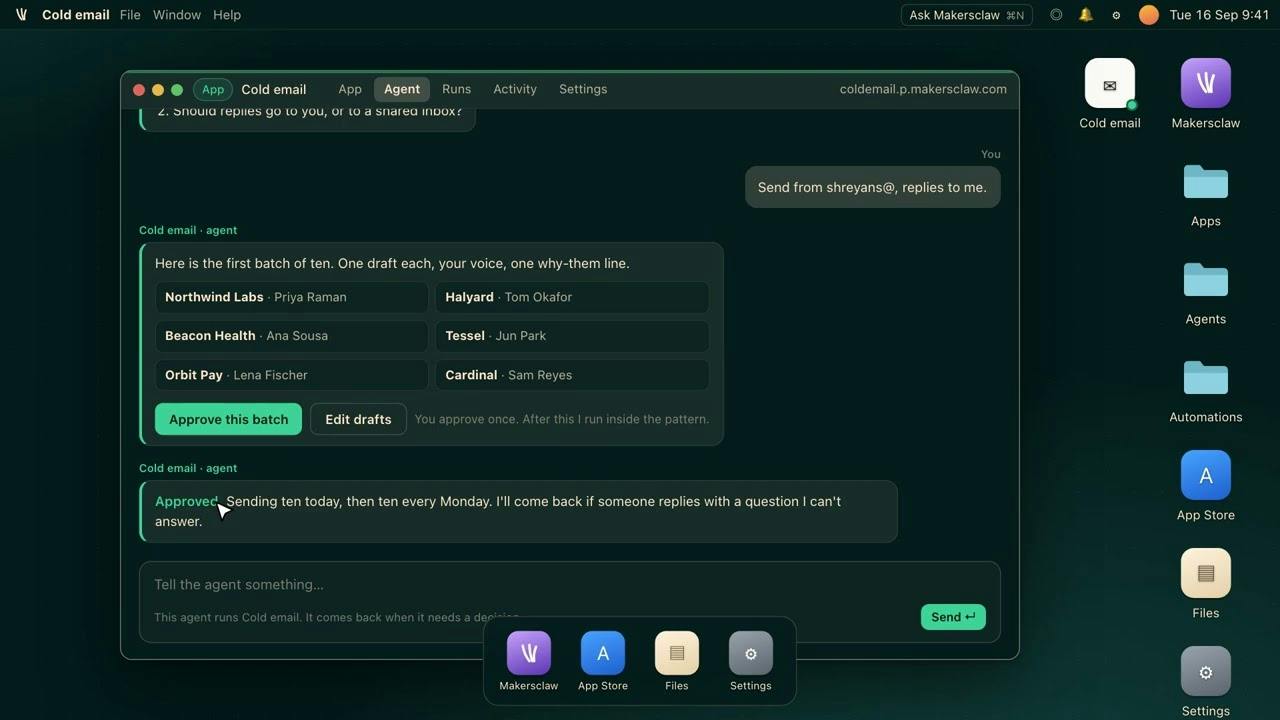
MakersClaw 2.0 is positioned as an operating system for startups in which users state a business objective and AI agents create and maintain the necessary workflows, applications, research and automations. The official site emphasizes persistent work around company goals rather than isolated chatbot requests, including go-to-market planning, customer research, content and operations workflows (MakersClaw).
The product addresses a genuine problem: founders frequently coordinate fragmented AI tools, workflow automations, documents and communication channels manually. MakersClaw attempts to replace that fragmented stack with agents that retain company context and continue executing after the initial instruction. This is more ambitious than a generic chatbot, but the reliability of long-running autonomous work is not independently demonstrated.
The strongest investment signal is founder-product fit. Sachin Sharma and Shreyans Bhansali have AI education and several years of operating experience through AskCodi. Sharma’s profile shows software-engineering experience and a master’s degree in Intelligent Adaptive Systems; Bhansali’s profile shows a master’s degree in AI and prior research experience (Sharma, Bhansali). Their history suggests the technical capacity to build agent infrastructure.
The central concern is the absence of verified commercial traction. No reliable public data establishes MakersClaw-specific revenue, paying customers, active workspaces, retention, agent task-completion rates, gross margin or customer-acquisition economics. Product Hunt attention indicates early interest, not product-market fit. The legal entity’s reported revenue cannot safely be attributed to MakersClaw because it also operates or is associated with other products.
The product may support a venture-scale business if it evolves from an inexpensive founder tool into a reliable multi-user operating platform with larger contracts, strong security controls and proprietary workflow data. At present, that outcome is insufficiently validated. The appropriate decision is Watch, with an upgrade to DD contingent on commercial, retention and reliability evidence.
Product Overview
MakersClaw’s initial customer appears to be a solo founder or small startup team that needs to execute recurring go-to-market and operational work without hiring specialists for every function. The user provides an outcome—such as reaching initial customers—and the system generates agents, workflows, mini-apps and automations to pursue it (Product Hunt, official site).
The official site presents integrations or intended connections with tools including Slack, Notion, GitHub, Google Drive, Gmail, Google Calendar, HubSpot, Linear and Airtable. The company also describes shared company memory and ongoing execution rather than one-off responses (MakersClaw). The authenticated workspace requires JavaScript and an account, limiting independent testing from public pages (login page).
Public pricing consists of:
- Free: 3,000 one-time credits, capped at 1,500 credits per day; a work-email signup is advertised with 10,000 credits.
- Pro+: starts at $29 per month for 29,000 monthly credits and up to three users. Higher credit packages are shown on the public site.
- Enterprise: negotiated volume credits, invoicing, security review, DPA support and more than three seats (pricing section, enterprise page).
The principal benefit is consolidation: replacing separate prompt sessions, automation builders, spreadsheets and contractors with one goal-oriented workspace. Product quality cannot yet be rated as proven, however, because public benchmarks for task accuracy, failure recovery, latency and unattended execution are unavailable.
Founder and Team Assessment
Sachin Sharma identifies himself as a MakersClaw co-founder and previously co-founded AskCodi. His public profile lists earlier software-engineering experience at Nucleus Software, a master’s degree in Intelligent Adaptive Systems from the University of Hamburg and a B.Tech. from NIT Hamirpur (LinkedIn).
Shreyans Bhansali identifies himself as MakersClaw co-founder and AskCodi CEO. His profile lists a master’s degree in AI from the University of Hamburg, a computer-science bachelor’s degree from the University of Sheffield and prior research work at the University of Hamburg (LinkedIn).
The official imprint identifies Cogaid Solutions Private Limited as the operator, names both founders as directors and supplies CIN U72900WB2022PTC255121 (imprint). This substantially improves confidence in the legal entity and founder identities.
LinkedIn classifies the company as having 2–10 employees but shows only two associated profiles; this is a platform estimate, not verified payroll headcount (company profile). Both founders also list AskCodi and Assistiv.ai roles, creating product-focus and key-person risks. No previous exit is publicly verified.
Founder Assessment: Strong technical and relevant product experience, but team depth, exclusive commitment and enterprise commercial capability remain unverified.
Market Opportunity
The narrow initial market is solo founders and small technology startups willing to pay for recurring AI-assisted operations. At $348 annually for the entry Pro+ plan, even 100,000 paying workspaces would produce only approximately $34.8 million in annualized subscription revenue, before discounts, churn and usage overages. This is an analyst scenario, not a company forecast.
The more attractive expansion is into startup teams and SMB departments requiring persistent sales, support, research and operational agents. If enterprise accounts paid an illustrative $10,000–$30,000 annually, 5,000 accounts would represent $50–$150 million in ARR. Actual enterprise pricing and willingness to pay are not publicly disclosed.
Market timing is favorable in the sense that infrastructure for agent orchestration is becoming easier to build. However, that also lowers entry barriers. OpenAI supplies agent APIs, computer-use tools, orchestration, guardrails and tracing directly to developers (OpenAI). The opportunity is therefore large, but value may accrue to model providers, horizontal agent platforms or vertical applications rather than an undifferentiated “company OS.”
Traction and Growth Signals
MakersClaw 2.0 appeared on Product Hunt’s September 18, 2026 leaderboard at approximately tenth place (leaderboard). Public search indexes report materially inconsistent totals of roughly 155–180 votes. Because the live count was not reliably retrievable, no single vote figure should be treated as authoritative.
The original MakersClaw launched June 16, 2026 as AI employees operating through team communication tools (Product Hunt leaderboard). The September release indicates product iteration, but two launch events do not establish sustained usage.
Other observable signals include an operating login environment, published pricing, an enterprise-contact flow and active founder communication. No app-store listing is expected for this browser-based SaaS product. No meaningful public GitHub repository, independent customer case study, marketplace review base or verifiable enterprise customer was found.
Reported FY2025 revenue of approximately ₹1.28 million for Cogaid Solutions appears in a secondary company-data source, but this predates MakersClaw’s 2026 launch and may include AskCodi or consulting revenue; it is therefore not treated as MakersClaw traction (Tracxn).
Traction Assessment: Launch activity and product availability are verified, but commercial traction is unverified.
Competitive Position
Direct competitors include AI-workforce and automation platforms such as Relevance AI and Lindy. Relevance AI offers configurable AI workforces, more than 2,000 integrations, evaluations, analytics and enterprise controls (Relevance AI). Lindy offers persistent workspace context, scheduled routines, integrations, approvals and plans from $29.99 to $199.99 per user per month (Lindy).
Indirect alternatives include conventional automation platforms, contractors, virtual assistants and founder-built workflows using model APIs. OpenAI’s agent tooling makes custom development increasingly accessible and represents bundling risk (OpenAI).
MakersClaw’s differentiation is its startup-centric abstraction: the user specifies an outcome rather than assembling agents manually. At $29 per month, entry pricing is accessible. However, low pricing can become a disadvantage if long-running agents consume substantial model, browsing and execution resources.
If a major platform launched the same feature within six months, users would remain only if MakersClaw had materially better startup workflows, accumulated company context, reliable autonomous execution or a strong founder community. None is yet proven as a durable moat.
Defensibility Assessment: Low to Medium.
Business Model and Economics
The model is credit-based SaaS with free acquisition, paid monthly plans and negotiated enterprise contracts. This aligns revenue with usage better than an unlimited plan, but “credits” obscure the relationship among customer value, model tokens, browser-compute time and infrastructure cost.
Variable costs likely include model inference, isolated agent runtimes, web or data services, storage and third-party integrations. These costs could increase faster than revenue if agents perform long, unsuccessful loops. Founder Sachin Sharma has publicly discussed high API spending in experimentation, reinforcing that cost control is a real operating issue, although it does not disclose MakersClaw’s unit economics (LinkedIn).
Gross margin, average credit consumption, overage revenue, refunds, customer-support burden and payment-processing costs are not publicly disclosed. Enterprise expansion could improve contract value but will require access controls, auditability, security review and service reliability.
Unicorn Path
For an early AI SaaS company with unproven margins, an illustrative 8× ARR multiple is more prudent than a premium infrastructure multiple. Under this assumption:
Required ARR = $1 billion ÷ 8 = approximately $125 million.
At the $29 monthly entry price, annual revenue is $348 per account. Reaching $125 million would require approximately 359,000 continuously paying accounts, ignoring discounts and churn. That is improbable for a founder-focused product.
A more credible blended route might require:
- 100,000 smaller accounts at $500 annual revenue: $50 million;
- 5,000 enterprise accounts at $15,000 ACV: $75 million;
- Total illustrative ARR: $125 million.
This remains highly demanding and requires strong international distribution, enterprise-grade security, repeatable sales, high retention and acceptable inference economics. The company would also need demonstrably superior agents, proprietary workflow knowledge and substantially greater organizational capacity.
Unicorn Path: Conditional
Valuation Assessment
No reliable financing announcement, institutional investor, SAFE cap, round size, post-money valuation or current fundraising terms were found. No external funding should be inferred from the product’s launch or legal registration.
Valuation Attractiveness: Not Assessable
Responsible assessment requires current ARR, growth, gross margin, retention, cash balance, burn, runway, cap table, round size, valuation, liquidation preferences and investor rights.
Key Risks
- Commercial traction: No verified MakersClaw revenue, customers or retention.
- Agent reliability: Long-running autonomous workflows may fail silently or require extensive supervision.
- Commoditization: Model providers and larger agent platforms can bundle similar orchestration.
- Unit economics: Low entry pricing may not cover inference and isolated-runtime costs.
- Founder focus: Both founders publicly retain roles across MakersClaw, AskCodi and Assistiv.ai.
- Weak switching costs: Workflows may be portable unless company memory and integrations become deeply embedded.
- Security and permissions: Agents accessing email, documents and operational systems create material data and authorization risk.
- Enterprise readiness: Public evidence of certifications, uptime commitments, RBAC and audit controls is limited.
- Distribution: Product Hunt and founder-led content are not yet demonstrated as repeatable acquisition channels.
Final Assessment
Venture Potential: 59/100
| Category | Score |
|---|---|
| Market Size and Expansion Potential | 15/20 |
| Traction and Growth Evidence | 7/20 |
| Founder and Team | 11/15 |
| Product Strength | 7/10 |
| Distribution Potential | 8/15 |
| Business Model and Economics | 6/10 |
| Defensibility | 5/10 |
| Total | 59/100 |
The strongest elements are relevant founders, a functioning commercial product and a potentially large workflow-automation opportunity. The weakest are commercially unverified traction, uncertain agent reliability, unclear economics and limited defensibility.
Evidence Confidence: 48/100
Founder identities, education, legal operator, pricing, product positioning and launch activity are reasonably verifiable. Product capabilities and integrations are primarily company-reported. Customer numbers, revenue, retention, margins, acquisition costs, funding, valuation and security posture remain unavailable.
Final Decision: Watch
MakersClaw is promising enough to monitor but not yet strong enough for formal investment due diligence. Its venture path depends on moving beyond launch attention to retained, paying usage and proving that persistent agents deliver reliable outcomes at attractive gross margins.
Upgrade Conditions
- At least $1 million in verified ARR or equivalent contracted recurring revenue.
- More than 70% six-month paid-logo retention.
- Evidence of at least 100 materially active paying teams.
- Gross margin above 70% after inference and runtime costs.
- Published task-completion and human-intervention metrics.
- Several referenceable enterprise or high-growth startup customers.
- Repeatable acquisition beyond Product Hunt and founder audiences.
- Clear founder commitment and organizational ownership.
Downgrade Conditions
- Weak conversion after free credits are exhausted.
- High three- or six-month churn.
- Agent costs scaling faster than paid revenue.
- Persistent reliability or unauthorized-action incidents.
- A major platform replicating the workflow without meaningful differentiation.
- Reduced product activity or divided founder attention.
- Misleading claims concerning customers, revenue or autonomy.
Questions for Further Diligence
- What are current MakersClaw MRR, paying workspaces and monthly growth?
- What percentage of activated workspaces remain active after 30, 90 and 180 days?
- How many customers exhaust free credits and subsequently purchase a plan?
- Which workflows generate the highest repeat usage and retention?
- What percentage of agent runs finish successfully without human correction?
- What are inference and runtime costs per 1,000 customer credits?
- What are gross margin and contribution margin by pricing tier?
- Which channels generate paying customers, and what is CAC by channel?
- How many enterprise pilots or contracts exist, and what is their average ACV?
- How are permissions, prompt injection, data isolation and unintended actions controlled?
- How do the founders allocate time among MakersClaw, AskCodi and Assistiv.ai?
- What are the cap table, burn, runway, financing target, valuation and proposed round terms?
Sources
- MakersClaw official website and pricing
- MakersClaw Product Hunt page
- MakersClaw enterprise offering
- MakersClaw legal imprint
- MakersClaw LinkedIn company profile
- Sachin Sharma — LinkedIn
- Shreyans Bhansali — LinkedIn
- Product Hunt September 18, 2026 leaderboard
- OpenAI agent-building tools
- Lindy pricing
- Relevance AI pricing