
Table of Contents
Articos Investment Report
Category: AI-powered synthetic user research and message testing
Company Stage: Early commercial / venture-studio-backed
Founder or Founders: Shaheer Gadit; additional co-founder identity not publicly verified
Headquarters: Dubai, United Arab Emirates
Funding: No separately disclosed external funding round; built within Disrupt.com
Business Model: SaaS subscriptions, on-demand research packs, and custom enterprise plans
Product Hunt Launch Date: September 2, 2026
Report Date: September 5, 2026
| Investment Metric | Assessment |
|---|---|
| Venture Potential | 58/100 |
| Unicorn Path | Conditional |
| Valuation Attractiveness | Not Assessable |
| Evidence Confidence | 51/100 |
| Final Decision | Watch |
Executive Summary
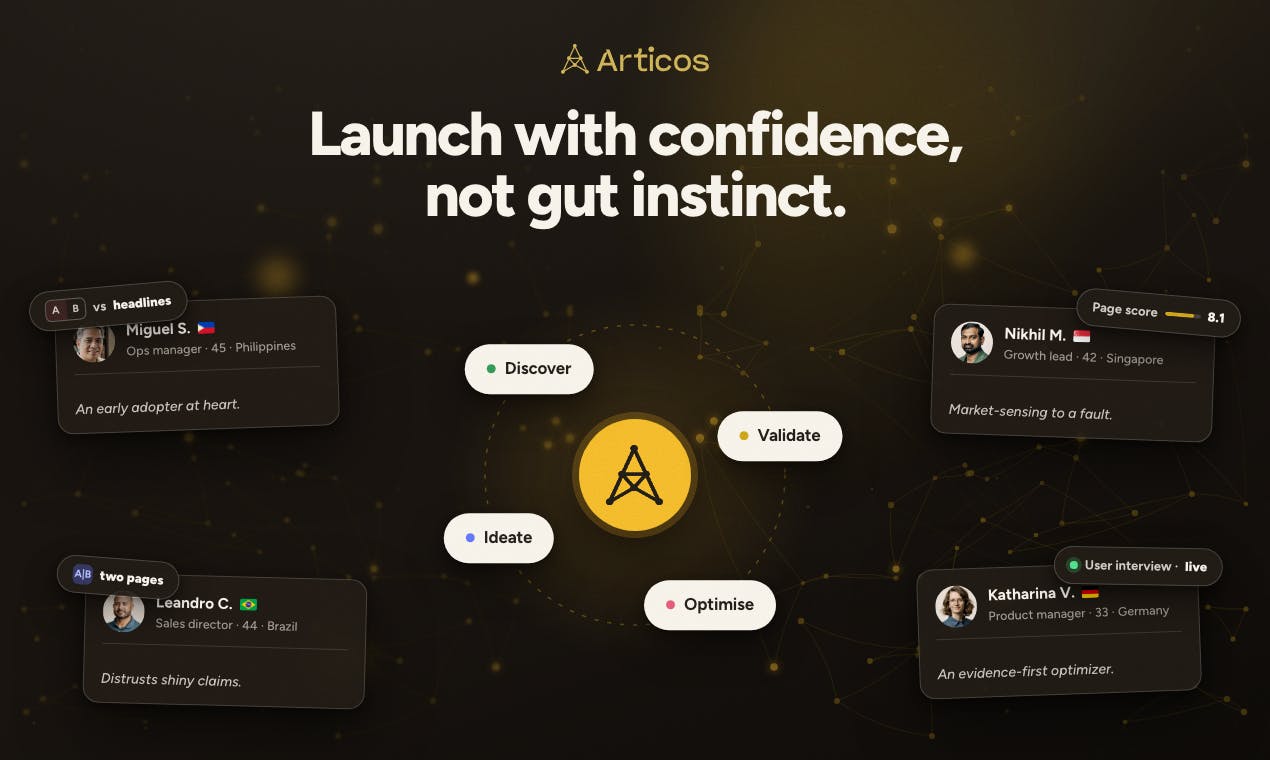
Articos is a browser-based AI user-research platform that conducts structured interviews with synthetic personas. Customers define an audience and research question, and the platform generates personas, interviews them, synthesizes findings, and produces a report. Primary use cases include message testing, concept validation, landing-page evaluation, A/B testing, ICP discovery, and early-stage product research (official website).
The product targets SaaS teams, agencies, consultants, founders, product marketers, and growth teams that cannot justify the time or expense of recruiting human participants for every decision. Its strongest product attribute is speed: Articos says it can produce a structured report in less than 30 minutes, with subscription pricing materially below conventional research engagements (pricing).
The strongest company-level signal is founder-market fit combined with venture-studio support. Founder and CEO Shaheer Gadit reports prior product experience at Cloudways and DigitalOcean, while Articos was developed within Disrupt.com, whose model provides operating resources and capital as ventures pass validation milestones (Product Hunt, Disrupt). The team also appears capable of content-led distribution: Articos maintains a large and frequently updated research and marketing library (blog).
The principal investment concern is whether synthetic research creates reliable incremental evidence or merely plausible AI-generated feedback. Articos markets “86% human accuracy,” but its methodology page more precisely describes 86% theme recall, alongside 49.2% precision and an F1 score of 0.619. The supporting paper is labeled a preprint, so the company’s repeated “peer-reviewed” characterization has not been independently confirmed through a named academic venue (methodology).
Commercial evidence is limited. Revenue, paid accounts, retention, usage cohorts, gross margin, and enterprise contracts are not publicly disclosed. Product Hunt activity and testimonials indicate interest, not product-market fit. The decision is therefore Watch: the product is promising, but the venture case requires verified recurring revenue, retention, and independent methodological validation.
Product Overview
Traditional qualitative research involves recruiting appropriate participants, scheduling interviews, conducting sessions, and manually synthesizing results. These costs and delays cause smaller teams to rely on intuition, internal debate, surveys, or generic AI prompts.
Articos substitutes simulated participants for recruited humans. Users select a research type, describe what they are testing and define the intended audience. The platform constructs a panel with different personality traits and adoption stances, conducts isolated interviews, and returns findings, supporting quotations, confidence indicators, and recommendations. Reports can be exported, while higher plans support white labeling for agencies (official website).
The current pricing page lists:
- Starter: promotional price of $47 per month, normally $79, including ten studies monthly.
- Pro: promotional price of $119 per month, normally $199, including unlimited studies and white-label reports.
- On-demand: referenced at $29 for two studies or $69 for five.
- Enterprise: custom pricing.
- Trial: two free studies without a credit card, subject to the stated trial period (pricing).
There is a minor inconsistency: the pricing page describes a seven-day trial, while LinkedIn company information describes a three-day trial. The current pricing page is used as the more authoritative product source.
Articos is delivered through the web; no relevant App Store or Google Play product was identified. It is positioned as directional research that complements rather than fully replaces human interviews—a prudent limitation acknowledged on the company’s own website.
Product Quality Assessment: Well-defined workflow and accessible pricing, but output validity remains the critical unresolved product question.
Founder and Team Assessment
Shaheer Gadit is publicly identified as CEO and co-founder. Product Hunt states that he spent several years in product roles at Cloudways and DigitalOcean. This background is relevant because Articos serves product and growth teams, and Cloudways was acquired by DigitalOcean in a $350 million transaction. However, Gadit was not identified as a founder of Cloudways, and no prior personal exit was verified.
Disrupt identifies Gadit as an Articos CEO/co-founder and a Disrupt partner. It describes Articos as a venture built inside its operating system, under which ventures receive technical, go-to-market, hiring, and capital support as they pass defined development stages (Disrupt team, venture-building model).
Owais Khan is a Product Hunt launch-team member and is publicly described elsewhere as Articos’s head of growth, not clearly as a co-founder. His profile reports more than 14 years in B2B SaaS marketing and experience at Cloudways and DigitalOcean. Exact employment terms and full-time commitment are not independently verified (Owais Khan).
LinkedIn lists six associated employees and a company-size band of 2–10, but the boundary between dedicated Articos staff and shared Disrupt resources is unclear (company profile). No independently verified research-science leadership, previous founder exit, or dedicated security function was found.
Founder Assessment: Relevant product and go-to-market experience with strong venture-studio support, but technical ownership, research-science credentials, and independent team depth require verification.
Market Opportunity
The narrow initial market is agencies, consultants, SaaS product marketers, and startup product teams that need frequent directional feedback but cannot routinely commission human research.
Articos’s normal self-serve pricing implies annual recurring revenue per account of approximately:
- Starter: $79 × 12 = $948
- Pro: $199 × 12 = $2,388
A bottom-up scenario—not a verified market estimate—illustrates the opportunity:
- 25,000 self-serve customers at an average $1,500 annual contract value: $37.5 million ARR
- 2,500 agency or enterprise customers at $10,000 annually: $25 million ARR
- Combined illustrative opportunity: $62.5 million ARR
Reaching this scale would require adoption well beyond founders experimenting with synthetic personas. Expansion opportunities include enterprise research governance, customer-data integration, human/synthetic hybrid panels, longitudinal brand tracking, APIs, localization, and agency workflow management.
Market timing is favorable because AI lowers the cost of producing qualitative simulations. It is also risky: the same trend makes basic persona generation and interview synthesis readily replicable.
Traction and Growth Signals
Articos received 155 Product Hunt points and ranked third for September 2, 2026 (Product Hunt awards). Comments include several positive user anecdotes, including claimed use at Cloudways and by early-stage companies. One commenter, however, questioned how the scores should be interpreted and why a higher-scoring message was not adopted—highlighting the difficulty of connecting synthetic feedback to real conversion outcomes (Product Hunt discussion).
The company claims use by people at Instacart, HiJiffy, DealHub, Cloudways, and “hundreds of teams.” These are company-reported claims and do not establish corporate contracts, paid adoption, or customer retention. No public case study ties Articos recommendations to statistically measured conversion improvements.
Product activity is visible: Articos announced concept testing, deeper follow-up studies, live persona calls, and a move out of beta during 2026. Its website lists 249 articles, with frequent recent publication, suggesting a deliberate SEO acquisition strategy (blog, LinkedIn).
Revenue, registered users, monthly active users, paying accounts, conversion, churn, research volume, and revenue growth remain undisclosed.
Traction Assessment: Active product and content development with positive anecdotes, but commercially unverified.
Competitive Position
Direct competitors include Synthetic Users, which starts at $12,500 annually, and other AI-persona or synthetic-research tools. Adjacent competitors include Userology, which charges per AI-moderated session with real participants, and Outset, which provides AI-moderated qualitative research. Traditional alternatives include UserTesting, User Interviews, Qualtrics, research agencies, and direct customer interviews.
Free alternatives include ChatGPT or Claude persona prompts, surveys, community feedback, founder interviews, and internally constructed research workflows. Research repositories such as Dovetail can also expand into adjacent AI analysis and synthesis.
Articos differentiates through structured persona diversity, hypothesis isolation, behavioral frameworks, adversarial review, transparent evidence chains, and low pricing. Agency white labeling provides a practical distribution angle.
Defensibility is currently limited. Much of the workflow can be recreated with frontier models, orchestration, and templates. Durable advantage would require proprietary outcome data showing that Articos predictions correlate with real customer behavior, plus integrations and accumulated research benchmarks.
“If the largest platform in this market launched the same feature within six months, why would customers continue using Articos?” The credible answer would be superior validated predictions, specialized workflows, historical benchmarks, or agency integration. Public evidence does not yet establish those advantages.
Defensibility Assessment: Low
Business Model and Economics
Articos combines subscriptions, research packs, and custom enterprise pricing. Normalized self-serve ACV is approximately $950–$2,400 before discounts. This is affordable and may support product-led acquisition, but it creates a high customer-count requirement for venture-scale revenue.
Variable costs include language-model inference, web validation, report generation, storage, analytics, live-call processing, and customer support. The “unlimited research” Pro plan introduces adverse-selection risk: heavy users could consume substantial inference capacity without corresponding revenue growth. Gross margin must therefore be measured by cohort and usage tier.
The current promotional discount lowers Starter and Pro pricing by 40%, which may improve conversion but reduces near-term revenue and complicates willingness-to-pay analysis. Enterprise features and pricing are insufficiently disclosed.
Unicorn Path
Assume an 8× ARR multiple, appropriate only for a high-growth SaaS company with strong retention, expanding enterprise revenue, and healthy gross margins.
Required ARR = $1 billion ÷ 8 = approximately $125 million.
At current normalized pricing:
- At $948 Starter ACV: approximately 132,000 paying accounts
- At $2,388 Pro ACV: approximately 52,000 paying accounts
- At a blended $1,500 self-serve ACV: approximately 83,000 accounts
- At a future $20,000 enterprise ACV: approximately 6,250 enterprise customers
- At a blended $10,000 ACV: approximately 12,500 customers
These thresholds are demanding for a specialized user-research product. A credible path would require Articos to evolve into a broader continuous customer-intelligence platform, sell to enterprise product and marketing organizations, integrate proprietary customer data, and prove that predictions improve commercial outcomes.
Unicorn Path: Conditional
Valuation Assessment
No reliable public information was found regarding a priced financing, SAFE cap, post-money valuation, ownership structure, or separately allocated investment from Disrupt. Disrupt has announced a broader commitment to build and support AI ventures, but that does not establish Articos’s funding amount or valuation.
Valuation Attractiveness: Not Assessable
Required information includes ARR, growth, gross margin, retention, inference costs, burn, runway, capitalization, Disrupt’s ownership and shared-services arrangements, round size, valuation cap, liquidation preferences, and current fundraising terms.
Key Risks
- Research-validity risk: Synthetic participants may reproduce model priors rather than actual buyer behavior.
- Unverified commercialization: Revenue, paid accounts, retention, and growth are undisclosed.
- Methodology-claim ambiguity: “86% accuracy” primarily refers to theme recall, not full predictive accuracy; reported precision is lower.
- Replication risk: Frontier-model providers and research platforms can reproduce core features.
- Low ACV: Current pricing requires a large customer base unless enterprise revenue grows materially.
- Unlimited-plan economics: Heavy usage may pressure gross margin.
- Low switching costs: Reports and research prompts can be moved to competing tools.
- Compliance maturity: The privacy policy still describes a private beta with no paid services, conflicting with the current commercial product and terms (privacy policy).
- Methodology inconsistencies: Public pages variously reference 9 versus 32 domains and 69 versus 93 countries.
- Venture-studio dependency: Team resources, IP ownership, capitalization, and operational independence from Disrupt are unclear.
Final Assessment
Venture Potential: 58/100
| Category | Score |
|---|---|
| Market Size and Expansion Potential | 13/20 |
| Traction and Growth Evidence | 8/20 |
| Founder and Team | 11/15 |
| Product Strength | 8/10 |
| Distribution Potential | 10/15 |
| Business Model and Economics | 5/10 |
| Defensibility | 3/10 |
| Total | 58/100 |
The strongest elements are product clarity, affordable pricing, relevant founder experience, agency positioning, and venture-studio support. The weakest are uncertain research validity, absent commercial metrics, low switching costs, and an unproven route from low-price self-service subscriptions to enterprise scale.
Evidence Confidence: 51/100
Pricing, features, launch activity, founder identity, headquarters, team-range indicators, and the Disrupt relationship are reasonably evidenced. Customer adoption and methodology performance are company-reported. The methodology is available as a preprint but lacks clearly identified independent publication or replication. Revenue, retention, funding allocation, valuation, gross margin, burn, and cap-table information are unavailable.
Final Decision: Watch
Articos addresses a real workflow problem and may become a meaningful SaaS business. It is not yet possible to conclude that its insights reliably predict human behavior, that users retain after initial experimentation, or that its economics support venture returns. The company is worth monitoring but does not yet present enough verified commercial evidence for formal diligence.
Upgrade Conditions
- At least $1 million ARR with sustained monthly growth.
- More than 70% six-month logo retention and evidence of usage retention.
- Independent replication of the methodology against prospective—not only published—human research.
- Multiple enterprise contracts with ACVs above $15,000.
- Gross margin above 75%, including heavy users of the unlimited plan.
- Case studies linking recommendations to measurable conversion or product outcomes.
- Clear IP ownership, capitalization, and operating arrangements with Disrupt.
- Repeatable acquisition beyond Product Hunt and founder-led outreach.
Downgrade Conditions
- Low conversion after free studies or launch discounts.
- Customers treating Articos as a one-time novelty rather than a recurring workflow.
- High inference costs or Pro-plan abuse materially reducing gross margin.
- Independent testing showing poor prediction of real participant behavior.
- Major competitors bundling equivalent synthetic research at little incremental cost.
- Continued inconsistencies in scientific, privacy, or customer claims.
- Material data-security, confidentiality, or intellectual-property incidents.
Questions for Further Diligence
- What are current MRR, paid-account count, and monthly revenue growth?
- What are free-to-paid conversion and 30-, 90-, and 180-day retention?
- How many studies does the median customer run after months one, three, and six?
- What percentage of revenue comes from Starter, Pro, packs, and enterprise contracts?
- What is gross margin by plan after model, web-research, and live-call costs?
- How does the 86% recall benchmark translate into prediction of prospective human behavior and commercial outcomes?
- Was the methodology externally peer-reviewed, and by which journal, conference, or independent researchers?
- What customer data is sent to third-party model providers, and is it used for model training?
- Who owns Articos’s intellectual property, and what equity or control rights does Disrupt hold?
- What are current burn, runway, financing structure, and fundraising terms?
- Which acquisition channels produce retained paying customers at an acceptable CAC?
- What proprietary data or integrations will prevent model vendors and research platforms from replicating the product?