Table of Contents
WebBrain Investment Report
Category: Open-source AI browser agent (browser extension; productivity / developer tools)
Company Stage: Bootstrapped open-source project; no legal entity or institutional funding identified
Founder or Founders: Emre Sokullu (solo)
Headquarters: Not publicly disclosed (founder based in Istanbul, Türkiye)
Funding: None found; no funding announcements or investor disclosures
Business Model: Free MIT-licensed extension (BYO LLM key or local models) plus an optional managed “WebBrain Cloud” subscription at $5/month per device profile
Product Hunt Launch Date: August 13, 2026
Report Date: August 16, 2026
| Investment Metric | Assessment |
|---|---|
| Venture Potential | 41/100 |
| Unicorn Path | Improbable |
| Valuation Attractiveness | Not Assessable |
| Evidence Confidence | 45/100 |
| Final Decision | Pass |
Executive Summary
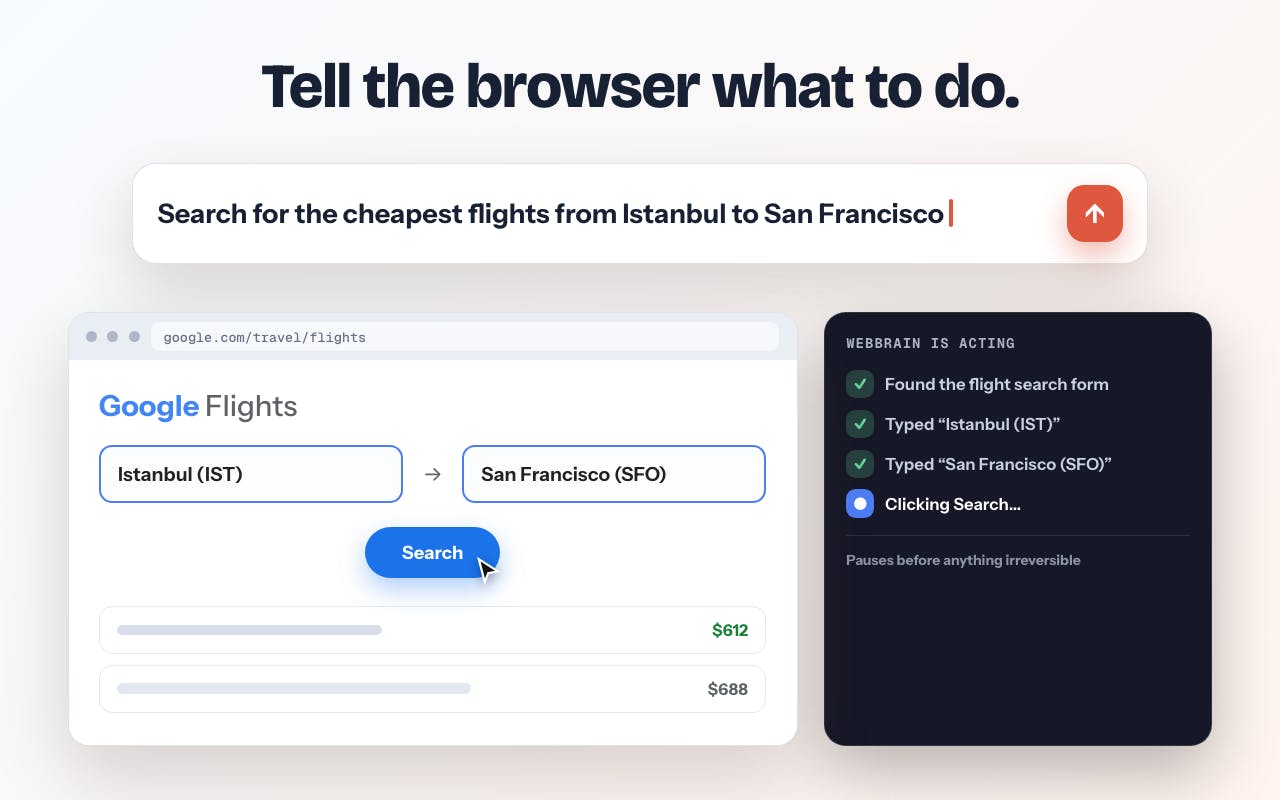
WebBrain is a free, open-source (MIT) browser extension for Chrome, Firefox, and Edge that places an AI agent in the browser sidebar. It reads pages, extracts structured data, and executes multi-step tasks (clicking, typing, navigating) using the user’s choice of LLM — local models via llama.cpp/Ollama or cloud APIs such as OpenAI, Anthropic, and OpenRouter — with a managed default, WebBrain Cloud, priced at $5/month per device profile (webbrain.one). webbrain
The product serves privacy-conscious power users and developers who want a model-agnostic, self-hostable alternative to proprietary browser AI. It is genuinely well-built: roughly 3,340 commits and 163 releases since April 2026, a documented security model, and an MCP server that lets coding agents drive a signed-in browser (GitHub). github
The strongest positive signal is founder-caliber execution velocity combined with a real prior venture: Emre Sokullu previously founded GROU.PS, a VC-backed SaaS that raised approximately $5M and, by his account, reached 8M monthly uniques and 15,000+ paying customers before its IP was sold (Startup Grind, LinkedIn). startupgrind
The most important concern is structural, not executional: WebBrain is a free, MIT-licensed tool competing against browser agents shipped by Anthropic (Claude in Chrome, now on all paid Claude plans), OpenAI (ChatGPT Atlas), and Perplexity (Comet, free across platforms) — companies with effectively unlimited distribution and the ability to bundle equivalent functionality at zero marginal price (TechCrunch, UD comparison). techcrunch
Commercial traction is unverified: 991 Chrome users, a 3.5-star rating across 8 reviews, 610 GitHub stars, and a modest Product Hunt launch of ~120 upvotes (Chrome Web Store, NODUS PH data). No revenue, subscriber count, or retention data is disclosed. chromewebstore.google
Final decision: Pass. This is a credible open-source project and a potentially good bootstrapped business, but it does not currently present a venture-scale investment case. Reconsideration conditions are specified below.
Product Overview
The customer problem is real: knowledge workers want AI assistance inside the pages they already use, without per-vendor lock-in or sending browsing data to a cloud provider. WebBrain’s answer is a sidebar agent with three permission modes — Ask (read-only), Act (full browser control via the Chrome DevTools Protocol), and Dev — plus data extraction, saved workflows, scheduled tasks, page watches, and multi-provider support across 100+ preconfigured LLM endpoints. webbrain
Differentiation rests on four pillars: open-source auditability, local-first privacy (fully offline operation with local models), model agnosticism, and price (free self-hosted; $5/month managed). Target users are developers and technical prosumers; non-technical users are better served by bundled incumbents. The product replaces a patchwork of copy-paste into ChatGPT/Claude, single-vendor browser plugins, and manual scraping. It is active and verifiable — version 26.2.0 was updated August 7, 2026. chromewebstore.google
Founder and Team Assessment
Emre Sokullu (Istanbul) is publicly identified as the builder on GitHub, the Chrome Web Store, and his personal site. Verified history: founder/CEO of GROU.PS (2006–2019), which raised ~$5M across three rounds and was profitable at 1M+ monthly uniques as of 2013; earlier roles at hakia and ReadWriteWeb are corroborated. His LinkedIn claims GROU.PS created “$30M in enterprise value” with IP sold to a “confidential public telecom corporation” — this exit claim is founder-reported and not independently verified. startupgrind
Technical capability is strongly evidenced by the codebase itself; the commit cadence suggests heavy AI-assisted solo development. Commercial capability is plausible but dated. Team size appears to be one: 23 GitHub contributors exist, but pull requests are overwhelmingly authored and merged by Sokullu, and the Chrome listing uses a personal Gmail with “non-trader” status. Full-time commitment is not disclosed; he maintains several side projects. Key-person risk is absolute. github
Founder Assessment: Proven technical execution and a real prior SaaS journey, but this is a solo open-source project with unverified commercial intent and no organizational depth.
Market Opportunity
The initial segment is narrow: technically sophisticated, privacy-sensitive users who want a model-agnostic browser agent and will either self-host LLMs or pay a small fee for a managed default. Adjacent segments include SMB workflow automation and, speculatively, enterprise browser automation.
Bottom-up estimate (analyst assumptions, not verified data): if the realistic initial pool is ~3–5M global power users reachable via browser stores and open-source channels, and 1–3% convert at $60/year, the initial niche supports roughly $2–9M ARR. That is a meaningful bootstrapped business, not a venture-scale one. Reaching venture scale requires expansion into team/enterprise automation or usage-based API revenue — a different product, sales motion, and company. Market timing is favorable (agentic browsing is a contested 2026 theme), but the same timing is why the largest AI labs are bundling the category for free. techcrunch
Traction and Growth Signals
Verified signals: 991 Chrome users and 3.5 stars across 8 ratings; 610 GitHub stars, 77 forks, 163 releases, active commits through August 4, 2026; a Product Hunt launch on August 13, 2026 with ~120 upvotes and 9 comments, ranking outside the day’s top 10; one MarkTechPost feature that is explicitly sponsor-supported content and therefore not independent press validation. github
Launch attention is modest and there is no evidence of sustained commercial traction: no disclosed revenue, paying subscribers, retention, or enterprise customers. The most important missing metrics are WebBrain Cloud subscriber count, MRR, free-to-paid conversion, and 90-day retention. Product update frequency is the one genuinely strong signal.
Traction Assessment: Real engineering momentum, but commercially unverified and early even by launch-attention standards.
Competitive Position
Direct competitors: Claude in Chrome (Anthropic; beta on all paid plans, 1.5K Chrome ratings); ChatGPT Atlas (OpenAI) and Perplexity Comet (free, cross-platform, enterprise push since March 2026); Gemini-in-Chrome and Edge Copilot as platform-native options. Indirect competitors: developer frameworks (Browser Use, OpenClaw) and Dia-style AI browsers. Free alternatives abound — including WebBrain’s own free tier. ud.com
Differentiation is genuine but fragile: open-source, local-first, model-agnostic, and cheap. There are no switching costs, no proprietary data, and no network effects; the MIT license permits forking by any competitor. The product depends entirely on browser vendors’ extension platforms (Manifest V3 constraints; Firefox support is self-admittedly weaker ). github
If the largest platform launched the same feature in six months: they already have. Anthropic, OpenAI, and Perplexity ship equivalent or superior agents bundled into subscriptions users already pay for. WebBrain’s residual answer — “open, local, model-agnostic” — matters deeply to a small technical audience and little to the mainstream.
Defensibility Assessment: Low
Business Model and Economics
Revenue model: freemium. Free tier (BYO key or local models) carries near-zero serving cost — a genuine economic advantage, since users bear inference costs. The paid tier, WebBrain Cloud at $5/month per device profile with “unlimited” fair use, creates a margin question: heavy agentic usage can consume substantial tokens, so gross margin depends on fair-use enforcement and routing to cheaper models. At $60/year ARPU, even 10,000 paying subscribers yields only ~$600K ARR. There is no team, enterprise, or usage-based tier today; expansion revenue is absent. Payment-processing fees materially erode a $5 price point. All unit economics are unverified; subscriber count, churn, and inference cost per subscriber would need diligence. webbrain
Unicorn Path
Assumed multiple: 8x ARR — generous for a low-ARPU consumer subscription facing free bundled competition (high-growth SaaS earns 8–12x; consumer subscriptions often earn less). Required ARR = $1B ÷ 8 = ~$125M. At $60/year per subscriber, that implies ~2.1 million paying subscribers — against a current base of ~991 total free users and free competition from Anthropic, OpenAI, Google, and Perplexity. Required strategic changes: a move from individuals to teams/enterprise, a 10–50x higher ACV, usage-based API revenue, repeatable distribution, and a real organization — none of which exist or are signaled today.
Unicorn Path: Improbable
Valuation Assessment
No funding history, investors, rounds, or valuations were found; the project appears to have no corporate entity. Valuation Attractiveness: Not Assessable. It cannot be responsibly assessed without current MRR from WebBrain Cloud, subscriber count and growth, gross margin after inference costs, retention, and — if a round exists — round size, SAFE cap or post-money terms, and founder ownership. No valuation range is offered, because none of the required inputs (verified revenue, growth, or financing terms) are public.
Key Risks
- Platform commoditization: Anthropic, OpenAI, Google, and Perplexity bundle equivalent agents free or in existing subscriptions. ud.com
- No verified revenue or paying-customer evidence; $5/month ARPU caps economic potential.
- MIT open-source license eliminates IP moat; forking is trivial.
- Solo-founder key-person risk; no entity, team, or succession structure identified.
- Browser-platform dependency: Chrome Web Store policy and Manifest V3 constraints can break or delist the product.
- Security surface: browser agents are prompt-injection targets; WebBrain’s own docs acknowledge residual gaps. github
- Managed-cloud margin risk: “unlimited” fair-use at $5/month invites adverse selection by heavy users.
- Low switching costs and weak lock-in.
- Weak distribution: ~991 users after ~4 months and a mid-table Product Hunt launch. chromewebstore.google
- Privacy/regulatory scrutiny of agentic browsing and credential handling.
Final Assessment
Venture Potential: 41/100
| Category | Score |
|---|---|
| Market Size and Expansion Potential | 11/20 |
| Traction and Growth Evidence | 4/20 |
| Founder and Team | 8/15 |
| Product Strength | 7/10 |
| Distribution Potential | 6/15 |
| Business Model and Economics | 3/10 |
| Defensibility | 2/10 |
| Total | 41/100 |
Strongest element: a technically credible, rapidly shipped product from a founder with a real prior SaaS journey. Weakest: structural defensibility and business model — a free, forkable tool at $5/month competing with free bundles from the largest AI labs, with no verified commercial traction. This profile fits “promising bootstrapped/open-source business,” not a venture case.
Evidence Confidence: 45/100
Verified: product existence and activity, store statistics, GitHub metrics, pricing, founder identity, and prior-company history. Company-reported and unverified: the GROU.PS exit value. Estimated: market sizing and unicorn math (assumptions stated). Unavailable: revenue, subscribers, retention, conversion, margins, team size, legal entity, funding, and valuation. The single press feature is sponsored, which limits its evidentiary weight. marktechpost
Final Decision: Pass
Pass — not Hard Pass — because the product is real, functional, and honestly represented; there are no integrity red flags. But venture-scale growth is unlikely under the current model, defensibility is low, distribution is weak relative to bundled incumbents, no commercial traction is verified, and no valuation exists to underwrite. This is a product an investor can admire and still decline.
Upgrade Conditions
- Verified $500K+ ARR from WebBrain Cloud with >70% six-month subscriber retention
- 50K+ active installs with organic, non-Product-Hunt acquisition
- A team or enterprise tier with signed pilots and materially higher ACV
- Formation of a legal entity, a small team, and disclosed financing terms
- Evidence of a durable advantage (proprietary workflows, distribution, or data) that survives platform bundling
Downgrade Conditions
- Development cadence stalls or the founder deprioritizes the project
- Chrome Web Store policy action or Manifest V3 changes breaking core functionality
- A publicized prompt-injection or credential-security incident
- Weak paid conversion confirming users will not pay when incumbents are free
- Any misleading traction or funding claims
Questions for Further Diligence
- What are current WebBrain Cloud MRR, subscriber count, and month-over-month growth?
- What are free-to-paid conversion and 30/90/180-day subscriber retention?
- What is the average inference cost per Cloud subscriber, and gross margin after payment fees?
- What share of the ~991 Chrome users are weekly active, and how is retention trending by cohort?
- Is WebBrain your full-time commitment, and is there a legal entity and cap table?
- Are you raising, and on what terms (round size, SAFE cap/post-money)?
- Why will users pay $5/month when Claude in Chrome, Comet, and Gemini are bundled free?
- What is the roadmap for team/enterprise tiers or usage-based API revenue?
- How does the MCP server strategy position WebBrain as infrastructure for coding agents, and what usage has it seen?
- What is the plan if Chrome extension policies restrict CDP-based automation?
- What did the GROU.PS exit actually return, and what did you learn about distribution that applies here?
- What single metric would convince you this can be more than a bootstrapped business?
Sources
- Product Hunt — WebBrain producthunt
- Official site — webbrain.one webbrain
- GitHub — webbrain-one/webbrain github
- Chrome Web Store — WebBrain chromewebstore.google
- LinkedIn — Emre Sokullu linkedin
- Startup Grind — GROU.PS background startupgrind
- emresokullu.com — personal site emresokullu
- NODUS — Product Hunt daily rankings (secondary launch data) nodus-ai
- TechCrunch — Anthropic launches Claude for Chrome techcrunch
- UD — AI browsers 2026: Comet vs Atlas vs Claude in Chrome ud.com
- MarkTechPost — WebBrain feature (sponsor-supported; treated as company-influenced) marktechpost