
Table of Contents
Execlave Investment Report
Category: AI agent security and governance (runtime policy enforcement / compliance infrastructure)
Company Stage: Bootstrapped pre-seed; founded approximately March 2026; publicly launched August 13, 2026
Founder or Founders: Bhaumik Lathiya (Co-Founder & CEO) and Rishit Mavani (Co-Founder, engineering)
Headquarters: Not publicly disclosed; founders based in Ravensburg and Weingarten, Baden-Württemberg, Germany
Funding: None found; no funding announcements or investor disclosures
Business Model: B2B SaaS, freemium — Free tier (non-commercial), Starter $199/month, Professional $599/month, Enterprise custom; cloud-managed or self-hosted
Product Hunt Launch Date: August 13, 2026
Report Date: August 16, 2026
| Investment Metric | Assessment |
|---|---|
| Venture Potential | 43/100 |
| Unicorn Path | Conditional |
| Valuation Attractiveness | Not Assessable |
| Evidence Confidence | 45/100 |
| Final Decision | Watch |
Executive Summary
Execlave is a runtime governance and enforcement layer for AI agents: an SDK and control plane that evaluates every agent action against customer-defined policies before execution, rather than logging failures after the fact. It offers policy enforcement (19–20 policy types; block, warn, monitor, and require-approval modes), a kill switch, cryptographically signed audit trails, and compliance evidence mapped to SOC 2, the EU AI Act, ISO 27001, GDPR, HIPAA, PCI DSS, and NIST AI RMF (execlave.com). execlave
The product targets platform engineering, security, and compliance teams at organizations deploying autonomous agents into production — with particular relevance to EU-regulated industries given the founders’ Germany base and the EU AI Act emphasis.
The strongest positive signal is category validation arriving almost in real time: Zenity, the closest funded comparable, raised a $125M Series C led by Norwest on August 3, 2026 (total funding ~$185M), and Palo Alto Networks has acquired Protect AI (reportedly $650–700M) and announced intent to acquire AI-gateway startup Portkey (Calcalist, Palo Alto Networks). Strategic acquirers and growth investors clearly believe agent governance is a real budget line. calcalistech
The most important concern is the gap between that validated market and this specific company: Execlave is three days post-launch with no disclosed customers, revenue, or funding, built by two early-career founders whose prior roles — a working-student position and a vocational IT qualification — do not include enterprise security or go-to-market leadership (LinkedIn: Lathiya, LinkedIn: Mavani). linkedin
Final decision: Watch. The market thesis is credible and the product architecture is thoughtful, but there is no commercial evidence to underwrite, and the team must demonstrate it can sell into a category dominated by heavily funded incumbents.
Product Overview
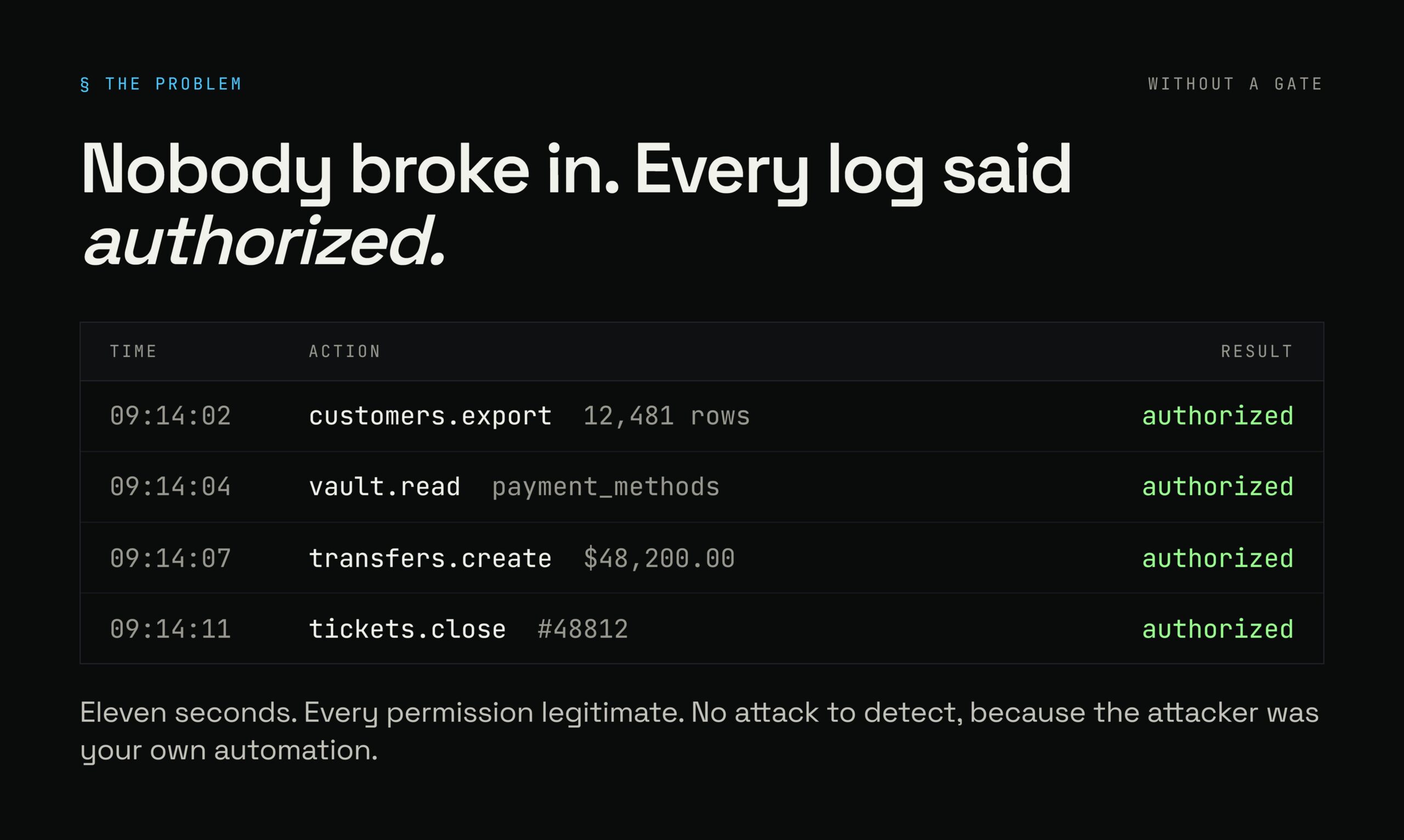
The customer problem is concrete: organizations give AI agents access to production systems, but their governance exists only as written policy — nothing enforces it at runtime. Execlave sits synchronously in the execution path: the agent’s intended action is evaluated against policies (cost limits, model restrictions, PII guards, prompt-injection defenses) in a claimed p50 under 20ms, then allowed, blocked, or held for human approval; every decision is hash-chained and signed for audit. execlave
Core capabilities include tiered autonomy levels, real-time cost circuit breakers, an agent registry with shadow-agent detection, permission-drift detection, eval-to-policy suggestions, and data-access lineage. Integration is via JavaScript/TypeScript and Python SDKs (npm install @execlave/sdk), with managed cloud or self-hosted (Docker/Kubernetes, air-gap) deployment (docs). execlave
Pricing: Free (1 agent, 500 traces/month, non-commercial), Starter $199/month (3 agents, 5,000 traces), Professional $599/month (10 agents, 25,000 traces), Enterprise custom; trace overages at $25–40 per 1,000 (pricing). The product is live and verifiable; the founders’ Product Hunt responses show unusual technical candor about latency budgets and false-positive tuning. producthunt
Founder and Team Assessment
Bhaumik Lathiya (Co-Founder & CEO, Ravensburg) lists Execlave from March 2026; his prior visible role is a Werkstudent (working-student) position at Solmotion Project GmbH. Rishit Mavani (Co-Founder, Weingarten) holds a Fachinformatiker application-development qualification and leads engineering and product architecture. Both appear to be first-time, early-career founders; no prior exits, enterprise security tenure, or senior engineering leadership could be independently verified. linkedin
Team size appears to be two; no hiring signals, advisors, or investors were found. Full-time commitment is implied by the launch but not documented. Key-person risk is total — the product, sales motion, and compliance narrative depend entirely on two individuals.
Founder Assessment: Technically engaged and communicative founders with evident product craft, but no verified enterprise, security-industry, or commercial track record — a material gap when selling trust infrastructure to regulated buyers.
Market Opportunity
The initial customer is narrow and real: a platform or security engineering team at a mid-market or enterprise company — ideally in EU-regulated sectors (finance under DORA, healthcare, insurance) — that is moving LLM agents from pilot to production and cannot evidence control to auditors.
Bottom-up estimate (analyst assumptions, not verified data): if 10,000–20,000 organizations globally will run production agents in regulated environments within several years, and Execlave’s realistic ACV is $7,000–$25,000 (Professional tier to light enterprise), the initial serviceable market is roughly $70M–$500M ARR. That is meaningful but not obviously venture-scale on its own; the venture case relies on the broader agent-governance category expanding to multi-billion-dollar spend, which investor behavior — Zenity’s $185M total, Palo Alto’s acquisitions — supports but does not guarantee. Geographic expansion follows regulatory pressure: EU first, then US frameworks. Market timing is genuinely favorable; the EU AI Act’s enforcement phases create forcing events. calcalistech
Traction and Growth Signals
Launch attention: 116 upvotes and a #14 daily ranking on Product Hunt (August 13, 2026), 90 product-page followers, hunted by an established hunter (@fmerian), with substantive comment threads. A LinkedIn launch post from Mavani confirms the date. producthunt
Sustained traction: none verifiable. No revenue, paying customers, pilot logos, SDK download counts, retention, or usage metrics are disclosed. The website is polished, docs are detailed, and comparison content (e.g., vs. Zenity) indicates an SEO-led acquisition strategy. The company is roughly five months old. The most important missing metrics: paying customer count, MRR, pilot-to-paid conversion, and SDK adoption. execlave
Traction Assessment: A competently executed launch with no commercial validation yet — attention, not evidence.
Competitive Position
Direct competitors: Zenity ($185M raised, enterprise agent security); Palo Alto Networks’ Prisma AIRS (Protect AI, ~$650–700M acquisition; Portkey pending); Microsoft (agent identity/governance in its cloud stack); Credo AI, Holistic AI, NeuralTrust, and Unbound in AI governance. Startup-level runtime-enforcement rivals include Kastra Labs and Agent Trust OS — and Phinq, an open-source runtime-governance layer that launched on Product Hunt the same day as Execlave . Indirect competition: observability platforms (LangSmith, Arize, Fiddler) that could add enforcement. calcalistech
Execlave’s differentiation: enforcement in the request path (not retrospective monitoring), framework-agnostic SDK, self-hosted/air-gap deployment, and compliance-evidence-as-byproduct. Its pricing advantage versus enterprise suites is real for mid-market buyers. However, there are no switching costs yet, no proprietary data, and no network effects; policy engines are replicable, and agent frameworks (OpenAI, LangChain, Microsoft) could embed native governance.
If the largest platform launched the same feature in six months: Palo Alto and Microsoft effectively already are. Execlave’s credible residual answer is neutrality — vendor-agnostic governance for multi-model, multi-framework estates — plus self-hosting for air-gapped buyers. That answer serves a segment, but it is a positioning moat, not a technical one.
Defensibility Assessment: Low
Business Model and Economics
The model is standard B2B SaaS with a non-commercial free tier as PLG wedge, $199–$599/month self-serve tiers, trace-based overages, and a custom enterprise tier — a sensible ladder from developer evaluation to procurement. Implied ACVs of ~$2,400–$7,200 (self-serve) are too low to build a venture business without either volume or enterprise expansion; the Enterprise tier is where the model must land.
Gross-margin potential is typical SaaS (the enforcement path is lightweight compute), though synchronous enforcement creates an infrastructure availability obligation — if Execlave’s gate goes down, customer agents stop. Unverified assumptions: willingness to pay at listed prices, free-to-paid conversion, overage attachment, support burden for compliance buyers, and the cost of obtaining the company’s own certifications. Note: the site lists “SOC 2 Type II” as a managed-cloud attribute — company-reported and unverified for a five-month-old startup. execlave
Unicorn Path
Assumed multiple: 10x ARR, appropriate for high-growth security SaaS with strong retention (category leaders can command more; sub-scale vendors less). Required ARR = $1B ÷ 10 = $100M. At the Professional tier (~$7,200/year), that implies ~14,000 customers — implausible. At a realistic enterprise ACV of $50,000–$100,000, it implies roughly 1,000–2,000 enterprise customers — achievable only for a category leader with a global sales organization, channel partnerships, and certifications.
Required strategic changes: move from self-serve to enterprise sales; obtain SOC 2 Type II and ISO 27001 for Execlave itself; build compliance credibility the founders currently lack; expand from enforcement point product to platform; and raise substantial capital to compete with Zenity’s $185M war chest. The category demonstrably produces large outcomes (Zenity’s raise; Palo Alto’s M&A), so the path exists — but it is contingent on near-total organizational transformation.
Unicorn Path: Conditional
Valuation Assessment
No funding history, investors, rounds, or valuations were found; no Crunchbase-profiled financing exists. Valuation Attractiveness: Not Assessable. Assessment would require: current MRR and growth, paying customer count, pilot pipeline, gross margin, founder equity split and cap table, any SAFE or round terms under discussion, and burn/runway. No valuation range is offered because none of the required inputs — verified revenue, growth, or financing terms — are public. Comparable context exists only at category level (Zenity’s Series C; Protect AI’s ~$650–700M exit), which frames the prize but prices nothing about Execlave.
Key Risks
- No verified commercial traction — three days post-launch with zero disclosed customers or revenue.
- Founder-market credibility gap: early-career team selling trust infrastructure to regulated enterprises.
- Funded-competitor squeeze: Zenity ($185M), Palo Alto/Prisma AIRS, and Microsoft can outspend and out-certify Execlave. calcalistech
- Platform absorption: agent frameworks and model providers could embed native policy enforcement, commoditizing the layer.
- Unverified performance claims: if real-world enforcement latency exceeds the claimed sub-20ms, adoption stalls — the founders themselves call latency the hardest problem. producthunt
- Compliance-credibility paradox: selling SOC 2/EU AI Act evidence tooling while the company’s own certifications are unverified.
- Open-source undercutting: Phinq and similar projects offer free runtime governance .
- Enterprise sales-cycle mismatch: self-serve pricing attracts evaluators, but security procurement is slow and relationship-driven.
- Absolute key-person risk across a two-person team.
- Availability liability: a synchronous gate is on the customer’s critical path.
Final Assessment
Venture Potential: 43/100
| Category | Score |
|---|---|
| Market Size and Expansion Potential | 14/20 |
| Traction and Growth Evidence | 3/20 |
| Founder and Team | 5/15 |
| Product Strength | 7/10 |
| Distribution Potential | 6/15 |
| Business Model and Economics | 5/10 |
| Defensibility | 3/10 |
| Total | 43/100 |
Strongest element: a genuinely validated, well-timed market with regulatory tailwinds and proven acquirer appetite. Weakest: the absence of any commercial traction combined with an unproven team in a category where buyer trust is the product.
Evidence Confidence: 45/100
Verified: product existence, documentation, pricing, SDK availability, launch metrics, founder identities, and competitor financings. Company-reported and unverified: sub-20ms enforcement, kill-switch latency, SOC 2 Type II status, and the policy-type count (the site says 19, the launch says 20 — immaterial but indicative of marketing drift). Unavailable: revenue, customers, retention, entity details, funding, and team size beyond the founders. execlave
Final Decision: Watch
Watch, because the market thesis is strong enough to monitor actively but the company is too young and unvalidated for due diligence: no revenue, no customers, no certifications, and no demonstrated ability to sell against funded incumbents. Pass would underweight genuine category momentum; DD would overweight a three-day-old launch.
Upgrade Conditions
- 10+ paying customers or $100K+ ARR within 6–9 months, with named pilots in regulated industries
- SOC 2 Type II certification of Execlave’s own platform
- Evidence of enterprise pipeline (design partners, $50K+ ACV contracts)
- SDK adoption metrics showing organic developer pull beyond Product Hunt
- Team expansion with at least one hire carrying enterprise security or compliance credibility
- Independent validation of latency and enforcement claims
Downgrade Conditions
- No paying customers six months post-launch
- Zenity, Palo Alto, or Microsoft ships a comparable mid-market/self-serve enforcement tier
- Open-source alternatives (e.g., Phinq) achieve meaningfully greater adoption
- Founder commitment wavers or the team dissolves
- Any security failure of the gate itself, or discovery that compliance claims were overstated
Questions for Further Diligence
- What are current MRR, paying customer count, and the pilot pipeline since launch?
- How many teams have installed the SDK, and what is the free-to-paid conversion so far?
- What are 30/90-day retention and weekly active usage for evaluators?
- Is Execlave’s own SOC 2 Type II claim a completed audit, in-progress, or aspirational?
- How does p50/p99 enforcement latency hold under production load, and who has verified it independently?
- Which design partners, if any, in regulated industries are running agents through Execlave today?
- Why does a buyer choose Execlave over Zenity or Palo Alto’s Prisma AIRS — and over open-source Phinq?
- What is the legal entity, its jurisdiction, and the founders’ equity split?
- Are both founders full-time, and what is the runway without external capital?
- Are you raising, and on what terms (round size, instrument, valuation cap)?
- What is the enterprise roadmap — SSO/SAML is listed, but what about audit partnerships and channel strategy?
- Which EU AI Act provisions do you expect to generate enforceable demand, and on what timeline?
Sources
- Product Hunt — Execlave producthunt
- Execlave — official site execlave
- Execlave — pricing execlave
- Execlave — docs / SDK execlave
- LinkedIn — Bhaumik Lathiya linkedin
- LinkedIn — Rishit Mavani linkedin
- LinkedIn — launch announcement linkedin
- Product Hunt daily rankings, Aug 13 2026 (secondary launch data)
- Calcalist — Zenity $125M Series C calcalistech
- Palo Alto Networks — Portkey acquisition intent paloaltonetworks
- BankInfoSecurity — Protect AI deal valuation bankinfosecurity
- NeuralTrust — AI governance tools landscape (secondary market context) neuraltrust