
Table of Contents
TrackMCP Investment Report
Category: Developer analytics / MCP server observability (“Google Analytics for MCP servers”)
Company Stage: Pre-traction launch-stage product; no verified company, team, or funding
Founder or Founders: Attributed by secondary launch trackers to Krishna Goyal; not named on the official website and not independently verified mindpattern
Headquarters: Not publicly disclosed
Funding: Not publicly disclosed; no reliable public information was found on funding or investors
Business Model: Freemium SaaS — a free tier is offered; no published pricing page producthunt
Product Hunt Launch Date: September 4, 2026 (per two secondary launch trackers; the Product Hunt page shows “launched this week” without an explicit date) mindpattern
Report Date: September 7, 2026
| Investment Metric | Assessment |
|---|---|
| Venture Potential | 33/100 |
| Unicorn Path | Improbable |
| Valuation Attractiveness | Not Assessable |
| Evidence Confidence | 30/100 |
| Final Decision | Pass |
Executive Summary
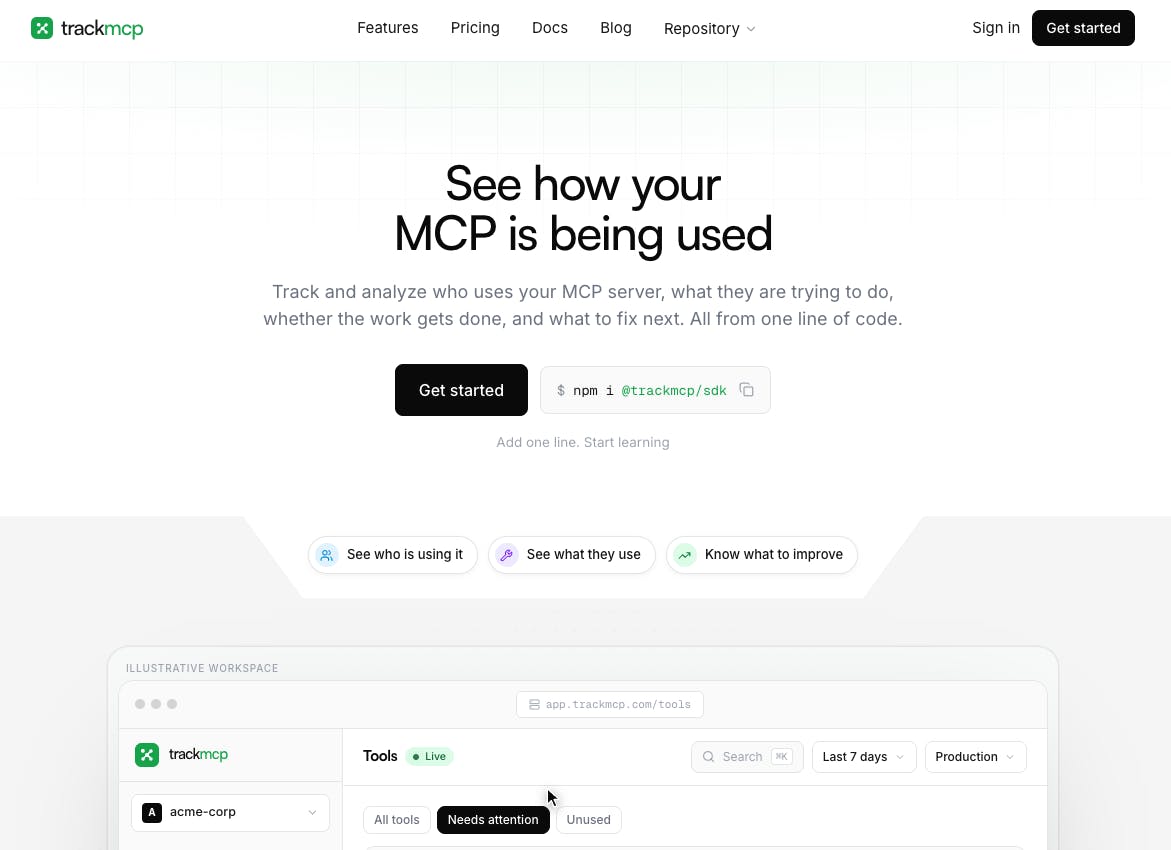
TrackMCP is a usage-analytics layer for MCP (Model Context Protocol) servers. One line of code — wrapping an existing MCP server with an SDK — captures which AI clients connect, which tools they call, in what sequence, where workflows stall or fail silently, and whether tasks complete, then summarizes the findings in plain English. It positions itself explicitly as “Google Analytics for MCP Servers,” serving the operators of MCP servers: API companies and SaaS vendors exposing their products to AI agents via Claude, Cursor, ChatGPT, and custom clients. producthunt
The product is interesting because the MCP ecosystem is expanding quickly, and server operators genuinely lack product-level answers — who is connecting, what agents are trying to accomplish, and whether their tools actually work — that traditional APM does not provide. The one-line integration and free tier are sensible wedge mechanics. trackmcp
The strongest positive signal is launch reception: roughly 103 upvotes and a #9 daily ranking, with unusually substantive comment-thread engagement from experienced agent developers, including one commenter who helps companies build official MCP servers endorsing the problem as real. mindpattern
The most important concern is a combination of three facts. First, the founder was asking a Reddit community how to find initial users two days before launch, indicating effectively zero confirmed adoption. Second, the comment thread contains a credible technical critique that the server boundary cannot observe what the agent does next — the very “outcome” signal the product claims to deliver. Third, Datadog, IBM Instana, Langfuse, and other observability platforms already ship MCP monitoring, with far greater distribution. producthunt
No team, funding, users, or revenue data is publicly available, and the founder’s background could not be verified. Venture Potential scores 33/100, the unicorn path is Improbable, and the valuation is not assessable. The final decision is Pass, with defined conditions for reconsideration.
Product Overview
The customer problem: MCP server operators ship tools to AI agents but cannot see how those tools are used. Server logs record that a call happened; APM shows latency; neither explains whether an agent’s task succeeded, which tools are ignored, or where workflows break. This matters commercially — an MCP server is now a product surface, and product surfaces need product analytics. producthunt
TrackMCP wraps an existing MCP server via withTrackMCP(server, ...) from an npm (or Python) SDK, capturing tool calls, sessions, client connections, errors, latency, retries, and workflow outcomes, with the server owner controlling redaction, filtering, and retention. The dashboard shows active clients, new versus returning usage, workflow paths, completion rates, and “silent failures” — cases where a 200 OK masks a schema mismatch that causes the agent to retry and give up — plus plain-English weekly insights with suggested fixes. producthunt
Target users are engineering and product teams at companies operating MCP servers. Pricing is a free tier with no published paid plans; the platform is the web dashboard plus SDK. The product replaces manual logging and dashboard-building on top of server logs, or accepting blindness about agent usage. producthunt
Verification caveats: the website displays demo data, not verifiable customer output; the SDK exists on npm; and a Product Hunt commenter publicly challenged whether outcome measurement is actually possible from the server boundary, since the agent’s next turn happens in a client the server cannot see. The founder’s answer describes planned visibility rather than confirmed capability — which half of the outcome story is measurable today remains unclear. producthunt
Founder and Team Assessment
The official website names no one. Two secondary launch trackers credit the developer as Krishna Goyal and both note the absence of public team or funding information. No verifiable LinkedIn profile, GitHub organization, prior company, or track record for the builder could be found in the course of this research. A Reddit post by an account consistent with the builder (September 2, 2026) states “I developed a platform… I would appreciate any suggestions on effective strategies to identify the initial users,” which — if attributable — is a candid and useful signal: the product pre-dates its first users, and the builder is actively seeking go-to-market guidance rather than exhibiting an existing distribution capability. mindpattern
Technical capability appears real: the one-line wrapper design, TypeScript/Python SDK support, and privacy-aware framing of tool-argument capture are competent choices. Commercial capability, team size, full-time commitment, and legal entity are all unknown or unverifiable. Key-person risk is total. producthunt
Founder Assessment: Apparently capable solo builder with a well-scoped product, but identity, background, and commitment are unverifiable, and no commercial track record exists.
Market Opportunity
The initial segment is narrow and specific: companies and teams that operate MCP servers exposed to third-party agents — API-first businesses, developer platforms, and SaaS vendors adding MCP endpoints. The problem is genuine and recently articulated by practitioners: product managers want to compare MCP-channel usage against traditional UI usage. producthunt
No pricing is published, so willingness to pay is untested. Comparable product-analytics tools (Moesif-style API analytics, or LLM-observability SaaS) typically monetize at roughly $50–$500 per month for small teams and higher for scale usage — an assumed $2,000–$10,000 annual contract value for a paying operator.
Bottom-up estimate (analyst assumption): if roughly 5,000–20,000 organizations worldwide meaningfully operate public MCP servers by 2027 — a plausible range given the ecosystem’s growth trajectory — and 5–10% adopt a dedicated analytics tool at ~$3,000–$8,000 per year, the near-term serviceable revenue pool is roughly $1M–$15M ARR. That can support a small bootstrapped business; it does not obviously support venture scale unless the category consolidates into broader agent-observability spend. Timing, however, is favorable: MCP became a de facto standard in 2025–2026 and observability demand is being pulled forward by enterprise deployments. microsoft
Traction and Growth Signals
- Product Hunt: approximately 103 upvotes, #9 daily ranking on September 4, 2026; 121 followers; one review at 5.0. mindpattern
- Comment quality was high: informed questions about argument logging, proxy architecture, and outcome measurement, plus an endorsement from a developer who builds official MCP servers for companies. producthunt
- The product is live and installable via npm (
@trackmcp/sdk) with a functioning marketing site. trackmcp - A Reddit founder post two days before launch explicitly sought help finding initial users — strong evidence that adoption was effectively zero at launch. reddit
- Not available: user count, server count, SDK downloads, revenue, retention, growth, GitHub statistics, team, or funding. No press coverage, customer case studies, or partnerships were found.
The gap between launch attention and commercial validation is wide here: 103 upvotes and thoughtful comments demonstrate that the problem resonates with practitioners, but nothing demonstrates that any MCP server operator has adopted the product.
Traction Assessment: Problem resonance confirmed by community response; adoption and revenue effectively zero and unverified.
Competitive Position
Direct competition is already substantial. Datadog’s Agent Observability provides MCP client monitoring with per-tool latency, error rates, and retries (announced December 2025). IBM Instana ships MCP monitoring with distributed tracing and Gen-AI observability dashboards. Langfuse, a widely adopted open-source LLM-observability platform, supports MCP tracing with client-server context propagation. Monte Carlo’s 2026 agent-observability guide describes an MCP Gateway in the same space. SigNoz documents MCP observability via OpenTelemetry, and Microsoft describes end-to-end MCP tool-call observability as an operating principle for its internal deployments. Indirect competitors include the broader LLM-observability field (Arize, LangSmith, Helicone, OpenObserve) and free alternatives: hand-rolled OTel instrumentation and log analysis, as recommended in practitioner guides. speakeasy
TrackMCP’s differentiation is framing, not architecture: it sells product analytics (who, what, whether it worked, what to fix) rather than infrastructure observability (traces, metrics, APM), with plain-English insight generation as the distinctive feature. That framing has genuine appeal, but it is trivially copyable — the underlying telemetry (tool calls, latency, retries, errors) is exactly what Datadog already collects. There are no network effects, no proprietary data at current scale, and low switching costs. trackmcp
The decisive question — “if Datadog or Langfuse shipped a product-analytics view for MCP servers within six months, why would customers stay?” — has no strong answer. Datadog’s distribution and Langfuse’s open-source base both exceed anything TrackMCP can access.
Defensibility Assessment: Low.
Business Model and Economics
The revenue model is not publicly disclosed beyond a free tier. The plausible model is usage-based or tiered SaaS on event volume (tool calls captured), analogous to product-analytics and LLM-observability pricing. Gross margin potential is high — telemetry ingestion and dashboarding are cheap per event, and there are no meaningful AI inference costs unless the plain-English insight feature uses LLM calls at scale, which would add a real variable cost the pricing must cover. Customer acquisition would presumably be product-led (free SDK, upgrade for volume), which suits a one-line integration well.
What is missing: any published pricing, any paying customer, and any evidence that MCP server operators will pay for analytics separate from their existing observability stack. The key economic question — whether “product analytics for MCP” is a distinct budget line or a feature of Datadog/Langfuse spend — is unanswered, and the incumbent pricing bundles already point toward the latter.
Unicorn Path
Assume TrackMCP becomes a usage-based SaaS for agent-facing infrastructure. A 10x ARR multiple is appropriate for a high-growth developer-analytics subscription business at scale.
Required Revenue for a $1 billion valuation ≈ $1B ÷ 10 = $100M ARR.
At an assumed $5,000 average annual contract value, this requires roughly 20,000 paying MCP server operators — a very large share of the plausible global population of serious MCP server operators (see market estimate above), in a segment where Datadog and IBM already sell the surrounding observability budget. Reaching that scale would require: verified funding and a real team; a defensible technical answer to the client-side outcome-visibility problem; enterprise features (SSO, compliance, data residency); international expansion; and winning share against platforms that already own the customer relationship.
Unicorn Path: Improbable.
Valuation Assessment
No funding history, investors, round terms, SAFE caps, or valuations are publicly known. There is no revenue to which a multiple could be applied, and no comparable private financing for this specific product exists in public view.
Valuation Attractiveness: Not Assessable. Assessment would require: round size and terms (SAFE cap or post-money), ARR and growth if monetized, retention and event-volume economics, gross margin, burn and runway, and investor ownership. Deriving a valuation from a 103-upvote launch would be meaningless.
Key Risks
Ranked from most to least material:
- Zero verified adoption: the founder was seeking first users days before launch. reddit
- Incumbent commoditization: Datadog, IBM Instana, and Langfuse already ship MCP observability with dominant distribution. datadoghq
- Product-claim gap: the outcome-measurement story is publicly challenged as potentially not achievable from the server boundary; the actual current capability is unclear. producthunt
- Founder opacity: no verifiable identity, background, team, or legal entity. chatgate
- Category ambiguity: product analytics for MCP may be a feature of existing observability budgets rather than a standalone spend category.
- Privacy and security exposure: ingesting tool arguments — which contain user data — creates compliance and trust obligations the product only partially addresses with redaction controls. producthunt
- No pricing: monetization is entirely hypothetical.
- Open-source substitution: OTel-based and OSS alternatives can replicate core telemetry at zero license cost. signoz
Final Assessment
Venture Potential: 33/100
| Category | Score |
|---|---|
| Market Size and Expansion Potential | 11/20 |
| Traction and Growth Evidence | 2/20 |
| Founder and Team | 4/15 |
| Product Strength | 5/10 |
| Distribution Potential | 6/15 |
| Business Model and Economics | 3/10 |
| Defensibility | 2/10 |
| Total | 33/100 |
The strongest elements are the wedge design (one-line SDK, free tier), favorable timing in a fast-growing MCP ecosystem, and validated problem resonance. The weakest are zero adoption, an unverifiable founder, and near-zero defensibility against observability incumbents already shipping the capability.
Evidence Confidence: 30/100
Verified: product existence, website, SDK, free tier, and launch metrics. Attributed via secondary sources only: founder name and solo development. Estimated: market sizing and ACV assumptions above. Unknown: founder background, team, legal entity, funding, users, downloads, revenue, retention, and current capability boundaries of the outcome-measurement claims. This is a very thin evidence base, and the attribution chain for the founder should be treated as unverified.
Final Decision: Pass
TrackMCP addresses a real, well-timed problem, but it does not currently fit a venture strategy: there is no verified company behind it, no users, no pricing, no funding, a publicly challenged core claim, and incumbents with superior distribution already shipping the same telemetry. Pass reflects venture fit, not product worthlessness — as an open-source project or seedling for a bootstrapped analytics tool, the concept is sound.
Upgrade Conditions
- Verified adoption: at least dozens of active MCP servers instrumented, with retention beyond the first month
- A published pricing model with evidence of converting free users to paid
- A technically credible solution to client-side outcome visibility, or honest scoping of what the server boundary can measure
- A verifiable founder identity, team, and legal entity, with full-time commitment
- Institutional funding or credible revenue (e.g., $250K+ ARR) demonstrating the category is a distinct budget line
- Evidence of differentiation survival after Datadog/Langfuse feature expansion
Downgrade Conditions
- No measurable adoption within six months of launch
- Datadog or Langfuse shipping a product-analytics view for MCP servers
- Evidence that outcome-measurement claims misrepresent current capability
- The product going unmaintained (a material risk for a solo project)
- A security or privacy incident involving captured tool arguments
Questions for Further Diligence
- Who is building TrackMCP, full-time or part-time, and is a legal entity in place?
- How many MCP servers are currently instrumented, and what is 30-day retention on instrumented servers?
- What exactly can the server boundary measure today regarding agent outcomes, and what requires client-side instrumentation?
- What is the intended pricing model, and have any operators indicated willingness to pay?
- How is captured tool-argument data stored, redacted, and retained, and is the processing compliant with GDPR/CCPA?
- What share of sessions involves sensitive arguments, and how do operators configure filtering?
- How does TrackMCP respond to Datadog’s and Langfuse’s existing MCP monitoring?
- Is there a public GitHub repository, and what is the SDK’s install and download volume?
- What LLM inference costs does the plain-English insight feature incur, and how are they priced in?
- Which MCP server operators, if any, are in active pilots?
- Is the company raising capital, and on what terms?
- What is the roadmap for hosted-enterprise-server support, where the operator does not control the server code?
Sources
- Product Hunt — TrackMCP producthunt
- TrackMCP — official website trackmcp
- Reddit r/mcp — founder post seeking initial users reddit
- Mindpattern — launch metrics and founder attribution (secondary) mindpattern
- ChatGate — launch analysis (secondary) chatgate
- Datadog — MCP client monitoring announcement (competitive context) datadoghq
- IBM Instana — MCP monitoring documentation (competitive context) ibm
- Langfuse — MCP tracing documentation (competitive context) langfuse
- SigNoz — MCP observability with OpenTelemetry (competitive context) signoz
- Monte Carlo — 2026 agent observability guide (market context) montecarlo
- Speakeasy — monitoring MCP servers (market context) speakeasy
- Microsoft — MCP security and governance (market context) microsoft