
Table of Contents
AgentConnect Investment Report
Category: AI Agent Infrastructure / Developer Tools / Team Collaboration
Company Stage: Pre-seed / Public open-source launch
Founder or Founders: Not publicly disclosed
Headquarters: Not verified; the GitHub organization lists the United States
Funding: No reliable public funding information found
Business Model: Open-source software, planned hosted cloud service, and enterprise deployments
Product Hunt Launch Date: August 9, 2026
Report Date: August 12, 2026
| Investment Metric | Assessment |
|---|---|
| Venture Potential | 60/100 |
| Unicorn Path | Conditional |
| Valuation Attractiveness | Not Assessable |
| Evidence Confidence | 54/100 |
| Final Decision | Watch |
Executive Summary
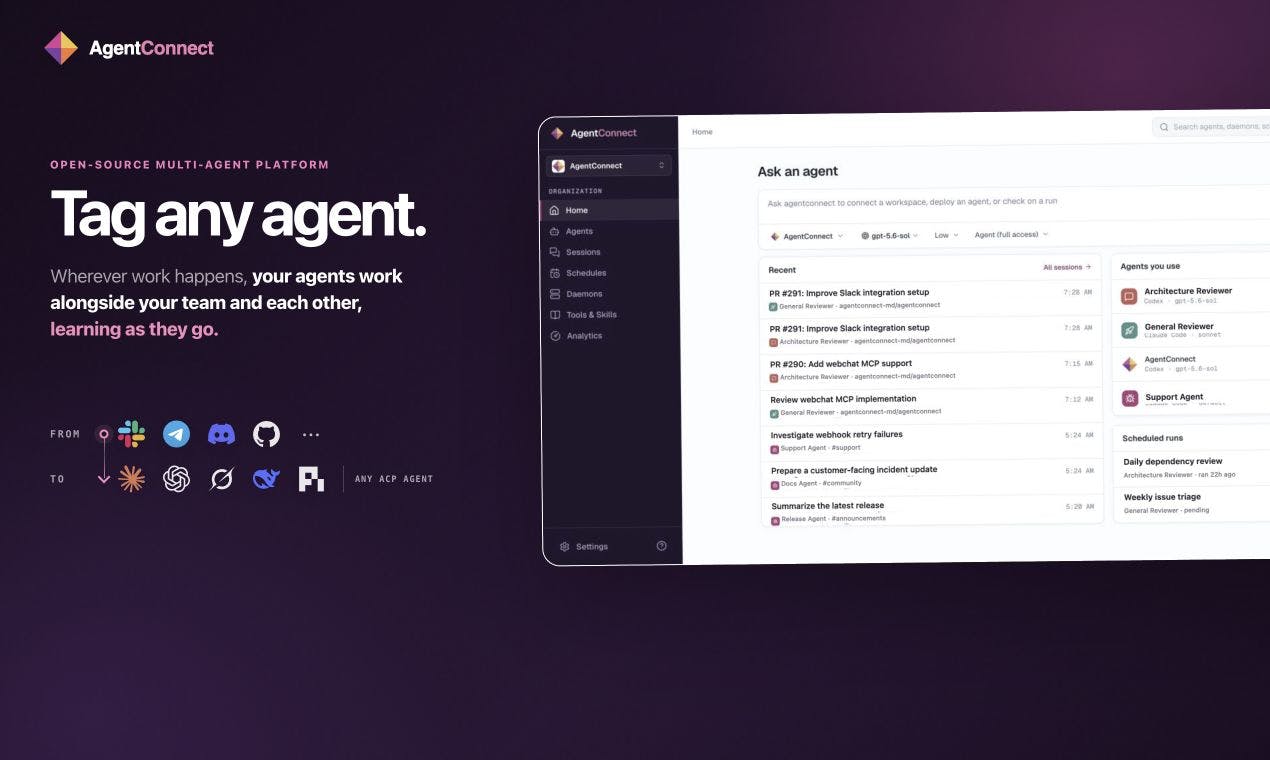
AgentConnect is an open-source platform for operating AI agents across team communication and development environments. It connects ACP-compatible runtimes—including Claude Code, Codex, Gemini CLI, and other agents—to Slack, Telegram, Discord, Lark/Feishu, GitHub, webhooks, and scheduled workflows. Teams configure each agent’s role, model, workspace, memory, tools, permissions, and execution machine through a shared control plane (official documentation).
The product addresses a credible emerging problem: coding agents increasingly perform shared operational work, but many still run inside an individual developer’s terminal. AgentConnect attempts to turn these personal agents into controlled organizational resources with shared visibility, permissions, persistent context, and cross-agent handoffs. Its self-hosted architecture may appeal to security-conscious engineering teams that do not want code, credentials, and agent sessions routed through another vendor’s hosted runtime.
The strongest investment signal is product execution. The public repository contains a substantial TypeScript monorepo covering a web console, control plane, relay, agent daemon, permissions, memory, messaging, and deployment tooling. The repository had 55 stars, seven forks, four principal human contributors, and active development as of the report date (GitHub repository data). This is significantly stronger evidence of product depth than a landing page or prototype.
The principal concern is the absence of commercial validation. AgentConnect Cloud remains invitation-only, public pricing is unavailable, and no verified revenue, paying-customer, retention, usage, pipeline, or customer-reference data were found. Product Hunt attention and GitHub stars indicate developer interest, not product-market fit. Founder identities, corporate ownership, financing history, and full-time commitment are also unclear.
AgentConnect could become a meaningful enterprise agent-management platform, but that outcome depends on converting an Apache-2.0 project into a recurring-revenue control plane with enterprise-grade security, compliance, integrations, and support. The appropriate decision is Watch, with an upgrade to DD if the company demonstrates repeatable commercial adoption and verifies its team and financing structure.
Product Overview
AgentConnect addresses the fragmentation that occurs when team members independently run coding and operational agents in local terminals. In that environment, other employees may not be able to inspect an agent’s work, continue its sessions, govern its permissions, or reuse its context.
The platform introduces a shared operating layer. Teams can:
- Assign named roles to agents.
- Connect different ACP-compatible runtimes.
- Trigger agents from chat messages, GitHub events, webhooks, or schedules.
- Control workspace, model, memory, tools, and machine placement.
- Define agent and session visibility.
- Permit selected agents to call other agents.
- Inspect sessions and tool calls through a central console.
Agent processes and workspaces run on infrastructure controlled by the customer. The optional relay forwards inbound events, while the control plane manages configuration, permissions, metadata, and observability. The company states that the control plane does not store message bodies, code, attachment data, or live ACP session streams, except for explicitly approved organizational knowledge and managed skills (architecture documentation).
The open-source stack is available under the Apache 2.0 license and can be deployed with Docker Compose. The hosted AgentConnect Cloud console is available only by invitation, while private deployment, SSO, and dedicated support are presented as enterprise offerings (official website). No public cloud or enterprise pricing was found.
The primary users are engineering and operations teams already experimenting with multiple coding agents. The product replaces internally built Slack bots, scripts, schedulers, permission layers, and agent-routing infrastructure.
Product Quality Assessment: Technically ambitious and publicly functional, with unusually detailed architecture for such an early launch. Production reliability, security audits, deployment complexity, and actual customer usability remain unverified.
Founder and Team Assessment
AgentConnect does not identify its founders or executive team on its website. Its blog uses the collective attribution “The AgentConnect team,” but does not disclose individual leadership, ownership, or employment status (company blog).
The public repository shows four primary human contributors. At the report date, the leading contributor had 546 contributions, followed by contributors with 120, 67, and 47 contributions (GitHub contributor data). This supports the existence of an active technical team, although contribution counts do not establish founder status, employment arrangements, or intellectual-property ownership.
The repository was made public on July 24, 2026 and was still receiving updates on August 12, 2026. It had progressed to release v1.40.0 by August 7, suggesting either extensive pre-public development or a rapid imported release history (GitHub release history). That is a positive execution signal but should not be interpreted as evidence of commercial traction.
No reliable information was found concerning prior startups, exits, fundraising experience, sales leadership, or full-time commitment.
Founder Assessment: Strong evidence of multi-contributor technical execution, but leadership identity, commercial capability, ownership, and commitment remain unverified.
Market Opportunity
The initial customer should be defined narrowly as a software company with multiple developers already using coding agents across production support, code review, issue triage, and engineering automation. These customers face a real governance problem once agents access repositories, credentials, messaging systems, and production tools.
A bottom-up market illustration can be constructed using analyst assumptions:
- Addressable agent-using engineering organizations: 25,000–100,000
- Potential annual software spend per organization: $10,000–$30,000
- Implied initial addressable revenue: $250 million–$3 billion annually
These figures are not verified market statistics. They illustrate the scale required and depend on AgentConnect establishing paid cloud or enterprise contracts. The lower end could support a valuable software company but not necessarily a unicorn. The upper end requires AI agents to become standard organizational infrastructure and AgentConnect to capture a meaningful international share.
Expansion opportunities include security policy, agent observability, audit logs, compliance, managed connectors, usage analytics, agent cost controls, enterprise identity management, and a marketplace for tools or skills. Market timing is favorable because major platforms are moving agents into collaborative work environments; Anthropic’s Claude Tag, for example, brings Claude into Slack as a shared organizational identity (Anthropic announcement).
Traction and Growth Signals
AgentConnect launched on Product Hunt on August 9, 2026. Public trackers showed approximately 107–159 votes, while one secondary tracker placed it sixth for the day. The difference likely reflects snapshot timing or Product Hunt presentation changes. These figures represent launch attention, not sustained usage or commercial adoption (Product Hunt page, daily leaderboard).
More meaningful technical signals include:
- 55 GitHub stars and seven forks.
- Four main human contributors.
- Recent repository updates.
- Public documentation and deployment instructions.
- A working package structure covering multiple infrastructure components.
- Active releases and issue tracking.
A self-hosted community post received five upvotes and no substantive adoption evidence. No independently verified production deployments, customer case studies, marketplace reviews, or enterprise references were found (Reddit launch post).
The most important missing metrics are active installations, weekly active organizations, cloud waitlist size, paid design partners, conversion, retention, revenue, deployment success rate, and workload volume.
Traction Assessment: Strong early product activity, but commercially unverified.
Competitive Position
Direct and adjacent competitors include Anthropic’s Claude Tag, Microsoft Copilot Studio, OpenClaw, OpenACP, CrewAI, LangGraph/LangSmith, and internal agent-integration systems. AgentConnect also competes with developers building their own Slack or GitHub bots.
Its differentiation is the combination of:
- Provider-neutral ACP runtime support.
- Team-oriented permissions and session visibility.
- Multi-machine agent placement.
- Existing-workflow integrations.
- Self-hosted execution.
- An open-source Apache 2.0 codebase.
The architecture reduces model-vendor lock-in and may satisfy customers that require code and agent processes to remain in their own environment. However, the open-source license also lowers barriers to copying, forking, or embedding the software.
If the largest platform launched the same functionality within six months, customers might retain AgentConnect for provider neutrality, self-hosting, and cross-platform operation. That answer is credible but not yet sufficient. Microsoft, Anthropic, GitHub, Slack, and major agent frameworks possess stronger distribution and could bundle overlapping capabilities.
Long-term defensibility would need to come from enterprise integrations, governance data, operational reliability, community adoption, workflow depth, and a standard position within the ACP ecosystem—not the current feature set alone.
Defensibility Assessment: Medium-Low
Business Model and Economics
The current open-source product is free to self-host. The apparent commercial model is an open-core or managed-control-plane strategy:
- Hosted AgentConnect Cloud subscriptions.
- Enterprise private deployments.
- SSO, governance, compliance, and administrative features.
- Dedicated support and implementation services.
Because customers supply their own model subscriptions or API keys and model traffic flows directly to the provider, AgentConnect states that it does not mark up inference usage (official FAQ). This should limit direct inference-cost exposure and permit attractive software gross margins.
Variable costs would include cloud control-plane infrastructure, relay traffic, logging, support, integration maintenance, security work, and enterprise onboarding. Self-hosted deployment could reduce hosting costs but increase support complexity.
No public pricing, revenue, gross margin, customer acquisition cost, or renewal data are available. The company must show that organizations will pay for centralized management rather than self-hosting the open-source edition or relying on bundled vendor products.
Unicorn Path
For a high-growth enterprise infrastructure company, an 8× revenue multiple is an optimistic but defensible long-term assumption. Broader public SaaS multiples have recently been lower, so this requires strong growth, retention, and strategic positioning (SaaS Capital Index).
Required ARR = $1 billion ÷ 8 = approximately $125 million
Because pricing is unavailable, customer requirements are scenario-based:
- At $15,000 annual contract value: approximately 8,300 customers
- At $50,000 annual contract value: approximately 2,500 customers
- At $100,000 annual contract value: approximately 1,250 customers
The most credible route is not low-priced developer subscriptions. It is an enterprise control plane covering governance, permissions, security, auditability, integrations, and agent fleet management.
Required strategic developments include paid cloud availability, enterprise identity and compliance, repeatable sales, strong net retention, international distribution, ecosystem leadership, security certifications, and reliable management of thousands of agent workloads.
Unicorn Path: Conditional
Valuation Assessment
No reliable public evidence was found concerning funding, investors, a SAFE cap, round size, post-money valuation, revenue, or current fundraising terms. Name-matched database entries could not be reliably connected to this product and therefore were excluded.
Valuation Attractiveness: Not Assessable
A responsible valuation assessment requires current ARR, growth, gross margin, retention, paid-customer count, burn, runway, cap table, round size, valuation cap, dilution, and liquidation preferences. Product quality, repository activity, and Product Hunt performance are not sufficient bases for a valuation range.
Key Risks
- No verified commercial traction: Revenue, paying customers, retention, and production usage are unknown.
- Founder and ownership opacity: Leadership, legal entity, IP ownership, and full-time commitment are not disclosed.
- Incumbent bundling: Anthropic, Microsoft, GitHub, Slack, or agent-platform vendors could bundle similar controls.
- Open-source monetization risk: Teams may self-host without purchasing Cloud or enterprise services.
- Security burden: The platform coordinates agents with access to repositories, credentials, tools, and communication channels.
- Deployment complexity: Multi-component self-hosting may create onboarding and support friction.
- Standards dependency: Its runtime-neutral advantage depends partly on ACP adoption and compatibility.
- Weak current switching costs: Customers may migrate if configurations, skills, and workflows remain portable.
- Unproven enterprise readiness: Security audits, certifications, SLAs, and compliance capabilities are not publicly verified.
Final Assessment
Venture Potential: 60/100
| Category | Score |
|---|---|
| Market Size and Expansion Potential | 16/20 |
| Traction and Growth Evidence | 6/20 |
| Founder and Team | 8/15 |
| Product Strength | 9/10 |
| Distribution Potential | 9/15 |
| Business Model and Economics | 6/10 |
| Defensibility | 6/10 |
| Total | 60/100 |
The strongest elements are product depth, market timing, provider neutrality, and the self-hosted architecture. The weakest are commercial traction, leadership verification, pricing, monetization evidence, and defensibility against well-distributed platforms.
Evidence Confidence: 54/100
The product architecture, repository activity, license, integrations, contributors, and cloud waitlist are publicly verifiable. Product positioning and architectural privacy claims are company-reported rather than independently audited.
Revenue, customers, retention, founders, legal entity, funding, valuation, unit economics, burn, and runway remain unavailable. Evidence is therefore sufficient to evaluate the product but not the investment terms or commercial company.
Final Decision: Watch
AgentConnect is more substantial than a typical early Product Hunt launch and could address an important infrastructure layer as AI agents move from individual terminals into shared organizational workflows. However, the company is not ready for formal investment diligence based solely on public evidence. The Cloud product is still invitation-only, and there is no verified commercial adoption.
Upgrade Conditions
- Verify founders, legal entity, IP ownership, and full-time commitment.
- Launch paid Cloud pricing and report initial conversion.
- Demonstrate at least 25–50 paying organizations or credible enterprise design partners.
- Provide 90-day and six-month organizational retention.
- Show repeatable acquisition outside Product Hunt.
- Publish security audits and a credible enterprise compliance roadmap.
- Establish software gross margins above 70%.
- Demonstrate sustained open-source growth and third-party contributions.
Downgrade Conditions
- Minimal repository or release activity after launch.
- Failure to convert the cloud waitlist into active organizations.
- Major security incidents involving credentials or agent permissions.
- ACP adoption stalls or critical runtimes discontinue compatibility.
- Incumbents replicate provider-neutral, self-hosted team controls.
- The core team is not working on AgentConnect full-time.
- Company claims concerning users, customers, or security prove misleading.
Questions for Further Diligence
- Who are the founders, and what percentage of their time is committed to AgentConnect?
- Which legal entity owns the code, trademarks, domains, and commercial rights?
- How many organizations have completed a successful deployment?
- How many organizations remain active after 30 and 90 days?
- How many Cloud waitlist members have become design partners or paying customers?
- What pricing and annual contract values are planned for Cloud and enterprise deployments?
- What are current MRR, monthly growth, gross margin, burn, and runway?
- Which workflows generate the highest recurring agent usage?
- What security audits, penetration tests, and compliance certifications are planned?
- How will the paid product remain compelling against the Apache-2.0 edition?
- What proprietary advantage can survive direct competition from Anthropic, Microsoft, or GitHub?
- What are the current round size, valuation, cap table, and financing terms?