
Table of Contents
Portfolio Lab Investment Report
Category: AI investing, systematic strategy construction, and agentic trading
Company Stage: Early commercial product within an operating registered investment adviser
Founder or Founders: Richard “Rich” Sun
Headquarters: San Francisco, California
Funding: Not publicly disclosed
Business Model: Freemium consumer SaaS plus investment-management fees through affiliate alphaAI Capital
Product Hunt Launch Date: August 10, 2026
Report Date: August 13, 2026
| Investment Metric | Assessment |
|---|---|
| Venture Potential | 63/100 |
| Unicorn Path | Conditional |
| Valuation Attractiveness | Not Assessable |
| Evidence Confidence | 64/100 |
| Final Decision | Watch |
Executive Summary
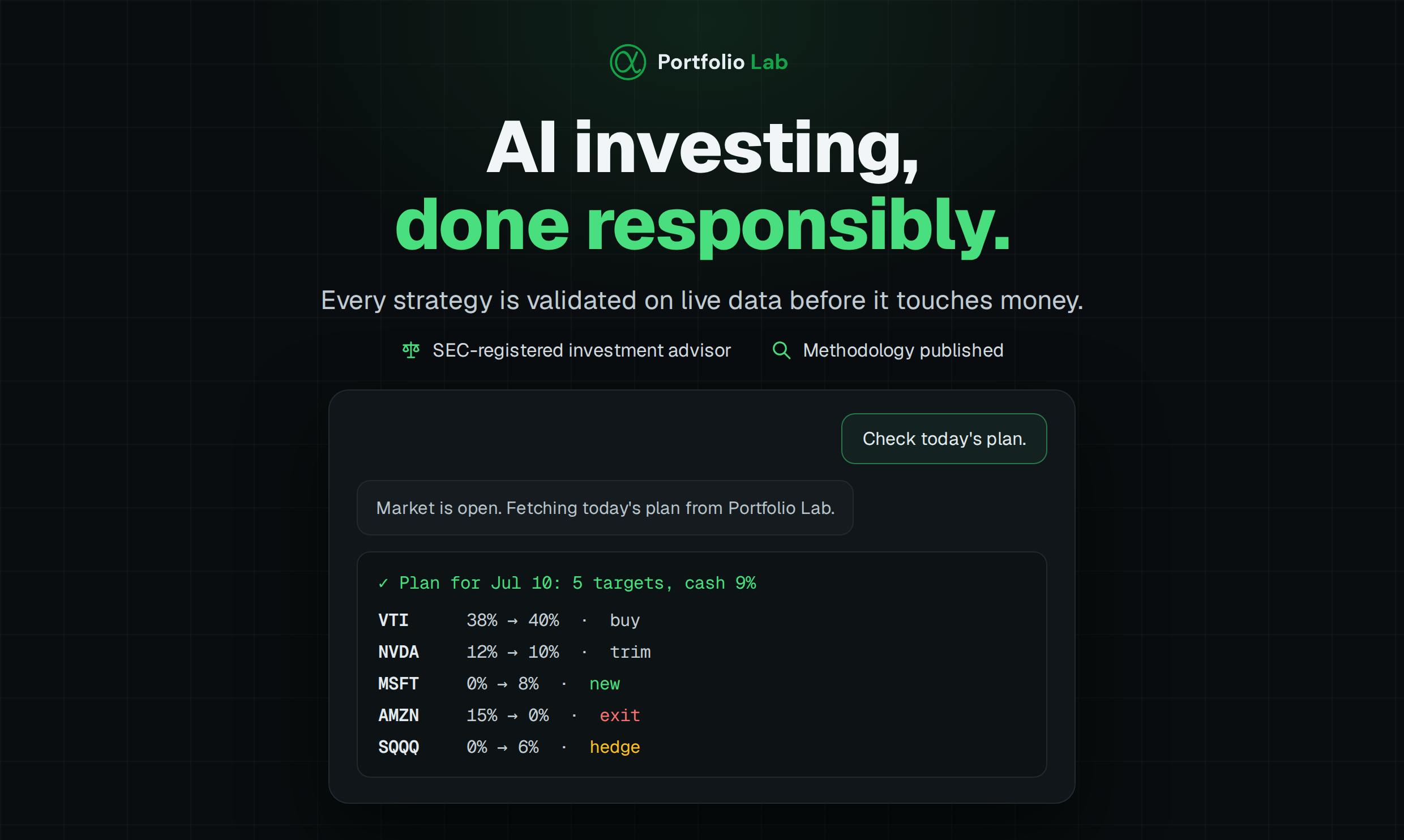
Portfolio Lab lets self-directed investors use specialized quantitative models to construct, backtest, paper-trade, and eventually deploy systematic investment strategies. Strategies can be transmitted to Claude, ChatGPT, or another MCP-compatible agent for execution in the user’s brokerage account, or managed through alphaAI Capital, an SEC-registered investment adviser (Portfolio Lab; SEC relationship summary).
The product is interesting because it addresses a real weakness in generative-AI investing tools: attractive backtests can result from data leakage, overfitting, unrealistic transaction assumptions, or repeated parameter tuning. Portfolio Lab says it separates construction from validation and uses out-of-sample, walk-forward, point-in-time, and live-paper testing before deployment (methodology overview).
The strongest investment signal is that Portfolio Lab is not being launched by an anonymous AI-app team. Founder Richard Sun has relevant investment-banking, hedge-fund, quantitative-research and registered-adviser experience, while the underlying alphaAI business had $5.218 million of discretionary regulatory assets under management as of December 31, 2025 (Form ADV brochure; founder profile).
The largest concern is the gap between an appealing product concept and verified adoption. Portfolio Lab’s revenue, paid subscribers, connected brokerage accounts, retention, trading volume and assets influenced by its strategies are not publicly disclosed. The managed alphaAI business demonstrates operational credibility but remains small relative to the scale required for a venture outcome.
Decision: Watch. Portfolio Lab has a credible founder, a functional product and a potentially large market, but formal diligence should wait for evidence that retail investors retain subscriptions, deploy strategies with real capital and trust agentic trading through multiple market cycles.
Product Overview
Portfolio Lab targets self-directed investors who want systematic strategies but lack the programming, data and statistical expertise required to build reliable quantitative systems.
A user selects an objective, after which Portfolio Lab produces multiple strategies optimized for metrics such as return, Sharpe ratio or drawdown. Users can inspect allocations and behavior, validate strategies on unseen data, and paper-trade them using live prices and simulated fills. Paid users can access stocks, advanced assets, deeper analytics and agent-driven execution (official website).
The web product has three plans:
- Explorer: Free, with standard ETFs, limited builds and paper trading.
- Analyst: $20 per month annually or $25 monthly; adds stocks, unlimited builds, deeper analytics and agentic investing.
- Quant: $40 per month annually or $50 monthly; adds leveraged and crypto ETFs, all strategy types and the full metrics suite (Portfolio Lab pricing section).
The managed alternative is alphaAI Capital, which charges $4 per month below $10,000 and 0.50% annually above that threshold. The SEC relationship summary states a general $100 account minimum, while the current alphaAI marketing site states $1,000; this appears to reflect either a commercial-policy change or strategy-specific minimums and should be clarified (SEC filing; alphaAI pricing).
Product quality: Promising. The build–validate–paper-trade workflow is coherent and more responsible than unrestricted AI-generated trading code, but model quality and live performance cannot be independently evaluated from public materials.
Founder and Team Assessment
Richard Sun’s public history includes technology investment banking at Barclays, work at a San Francisco long/short hedge fund associated with Crosslink Capital, equities trading and machine-learning research. These details appear on his professional profile and are consistent with his official founder account, although employment specifics have not all been independently confirmed through former employers (LinkedIn; founder letter).
The regulatory record is stronger evidence. Sun controls alphaAI Capital Management LLC, founded in 2021 and wholly owned by alphaAI Capital Management Inc. The firm reported no disciplinary events in its February 2026 Form ADV brochure (Form ADV).
LinkedIn advertises an 11–50 employee company range but exposes only three associated profiles; neither figure verifies the actual full-time team. Engineering depth beyond the founder and founder dependency therefore remain material questions (alphaAI LinkedIn).
Founder Assessment: Strong founder-market fit and regulatory operating experience, but team depth and institution-building capability require verification.
Market Opportunity
The initial segment is U.S. self-directed stock and ETF investors interested in systematic strategies but not sufficiently technical to use coding-first quantitative platforms.
Approximately 62% of Americans report owning stocks, including through retirement accounts, according to Gallup. Only a small subset will actively design strategies, accept quantitative-model risk and pay for agentic execution (Gallup).
An analyst scenario—not a verified market estimate—is:
- Approximately 160 million U.S. adult stock owners;
- 1%–5% plausible long-term target segment for active AI/systematic tools;
- 1.6–8 million potential users;
- $240–$480 annual subscription revenue per paying user.
That implies a theoretical U.S. subscription opportunity of approximately $384 million–$3.8 billion. Actual willingness to pay could be substantially lower, particularly during periods when simple index strategies outperform active systems.
Adjacent expansion includes adviser tooling, strategy marketplaces, institutional licensing, APIs, international brokerage integrations and managed assets. Regulatory complexity makes international expansion slower than ordinary SaaS.
Traction and Growth Signals
Portfolio Lab ranked #2 for August 10, 2026 on Product Hunt, behind Oqoqo, and a third-party tracker reported approximately 233 upvotes (Product Hunt leaderboard; secondary launch tracker). Its page showed one review and roughly 660–670 followers shortly after launch (Product Hunt). These establish launch interest, not product-market fit.
The more meaningful signal is the existing alphaAI operation. Its regulatory brochure reported $5.218 million in discretionary AUM at year-end 2025, establishing that the firm managed real client assets (Form ADV). The company claims to serve “thousands” of investors, but no audited or regulatory client count was found; the claim should not be treated as verified (founder letter).
Portfolio Lab-specific revenue, subscribers, active users, real-money deployments and retention remain undisclosed.
Traction Assessment: Real operating history through alphaAI, but Portfolio Lab’s commercial traction is not yet verified.
Competitive Position
Direct competitors include Composer by SoFi, QuantConnect and no-code strategy platforms. Composer allows natural-language strategy creation, backtesting and automated brokerage execution and charges approximately $32 monthly on an annual plan (Composer pricing). QuantConnect provides a more technical, code-first research and live-trading environment with plans starting below its $84-per-month Select tier (QuantConnect).
Indirect competitors include Betterment, Wealthfront, traditional robo-advisers, brokerage-native tools, TradingView, ChatGPT-generated code and passive ETF portfolios. Betterment reports more than $70 billion of AUM, demonstrating the scale of automated investing but also the strength of incumbent distribution (Betterment).
Portfolio Lab differentiates through validation discipline, proprietary signals, agent connectivity and the option to move from self-directed software into regulated management. The company reports seven models, more than 200 predictors and over one billion data points, but these are company claims without independent model-performance verification (Portfolio Lab).
If a leading brokerage launched the same feature within six months, customers would remain only for demonstrably superior risk-adjusted performance, trusted live records, unique data or strategy portability. SoFi’s acquisition and relaunch of Composer illustrates that large financial platforms can combine similar technology with stronger distribution (SoFi announcement).
Defensibility Assessment: Medium-Low
Business Model and Economics
The SaaS plans produce annual contract values of $240–$600 before discounts. Gross margins could be software-like, but market-data licensing, model computation, brokerage integrations, customer support and regulatory compliance are meaningful variable and semi-fixed costs.
The managed service adds AUM revenue at 0.50%. At the disclosed $5.218 million AUM, a simple application of that rate would produce approximately $26,000 in annual advisory fees; actual revenue may differ because smaller accounts pay flat fees and legacy arrangements exist. This is an analyst calculation, not reported revenue.
The agentic model avoids direct custody: Portfolio Lab says users authorize transactions in their own brokerage accounts. The RIA’s Form ADV identifies Alpaca Securities as its primary custodian and executing broker, with some legacy accounts at Interactive Brokers (Form ADV).
The website’s “SIPC member” wording requires clarification: the regulatory brochure says alphaAI is not a broker-dealer and identifies Alpaca and Interactive Brokers as SIPC-member custodians. Protection therefore relates to eligible assets at the custodian, not investment losses or necessarily Portfolio Lab itself.
Unicorn Path
Assume a 6× revenue multiple for a fast-growing but regulated consumer fintech combining subscription software and asset-management revenue.
Required annual revenue = $1 billion ÷ 6 = approximately $167 million.
At annual plan pricing:
- Analyst at $240: approximately 696,000 subscribers;
- Quant at $480: approximately 348,000 subscribers;
- Managed service at 0.50%: approximately $33.4 billion AUM.
The latter would require increasing AUM more than 6,000-fold from the disclosed $5.218 million, although subscription revenue could reduce the AUM requirement.
Reaching this scale requires repeatable consumer distribution, multi-broker integrations, long-term validated performance, materially larger compliance and engineering teams, low churn, international expansion and a defensible strategy-data ecosystem.
Unicorn Path: Conditional
Valuation Assessment
No reliable public information was found on external funding, investors, SAFE caps, financing rounds, current fundraising status or valuation. The SEC filing verifies the operating adviser but does not provide startup financing terms.
Valuation Attractiveness: Not Assessable
Assessment requires ARR by product, advisory revenue, AUM growth, subscriber retention, gross margin, customer-acquisition cost, burn, runway, cap table, round size, post-money valuation and liquidation preferences.
Key Risks
- Portfolio Lab-specific revenue and retention are undisclosed.
- Investment performance may degrade outside historical regimes.
- Strong distribution advantage held by brokerages and SoFi-owned Composer.
- High customer churn following drawdowns or extended underperformance.
- Regulatory exposure around agent-generated or agent-executed trades.
- Small disclosed managed AUM relative to claimed user reach.
- Model, market-data and execution failures could cause financial loss.
- Low SaaS ACV requires hundreds of thousands of subscribers.
- Founder and key-person concentration.
- Potential consumer confusion regarding SIPC protection and adviser status.
Final Assessment
Venture Potential: 63/100
| Category | Score |
|---|---|
| Market Size and Expansion Potential | 17/20 |
| Traction and Growth Evidence | 10/20 |
| Founder and Team | 13/15 |
| Product Strength | 8/10 |
| Distribution Potential | 7/15 |
| Business Model and Economics | 5/10 |
| Defensibility | 3/10 |
| Total | 63/100 |
Founder-market fit, regulatory infrastructure and the dual SaaS/AUM model are the strongest elements. Distribution, defensibility and Portfolio Lab-specific commercial validation are weakest.
Evidence Confidence: 64/100
The legal entity, regulatory status, founder identity, AUM, advisory pricing and product pricing are verified through official sources or SEC filings. Model scale, investor count and technological superiority are company-reported. Revenue, retention, funding, team size, gross margin and valuation remain unavailable.
Final Decision: Watch
The company is more credible than a typical Product Hunt fintech launch, but current evidence does not yet support formal diligence. A move to DD requires proof that Portfolio Lab converts launch interest into retained paid subscribers and real-money deployments without excessive compliance or acquisition costs.
Upgrade Conditions
- $1 million or more in verified annualized Portfolio Lab subscription revenue.
- At least 5,000 paying subscribers with over 70% six-month retention.
- Documented real-money deployment through multiple brokerages.
- Gross margin above 70% on subscription revenue.
- Independently reviewed live strategy records across adverse markets.
- Sustainable acquisition outside Product Hunt and founder-led promotion.
- Clear regulatory treatment of agent-directed trading.
Downgrade Conditions
- High churn following strategy drawdowns.
- Significant divergence between backtests, paper results and live execution.
- Regulatory action, inadequate disclosures or misleading performance claims.
- Major brokerage or data-provider integration loss.
- Composer or another incumbent reaching feature parity with lower friction.
- Security failure involving brokerage credentials or trading authority.
Questions for Further Diligence
- What are Portfolio Lab’s current MRR, paid subscribers and monthly growth?
- What are 30-, 90- and 180-day retention by plan?
- How many users have connected a brokerage or deployed real capital?
- What portion of alphaAI’s claimed investors are funded advisory clients?
- What are current AUM and net monthly asset flows?
- How are live results compared with backtested and paper-trading results?
- What are customer-acquisition cost and payback by channel?
- What are gross margins after data, compute, brokerage and compliance costs?
- How is agent trading authorized, limited, monitored and reversed?
- What are team composition, burn rate and runway?
- What funding has been raised, and what are the cap table and current round terms?
- Which proprietary datasets or models cannot be reproduced by a major brokerage?