
Table of Contents
bb Investment Report
Category: Open-source agentic IDE / AI developer tools
Company Stage: Pre-monetization, early adoption
Founder or Founders: Michael Yong originated the project; Sawyer Hood is a core creator/contributor. Formal corporate founder titles are not publicly disclosed.
Headquarters: Not publicly disclosed; both identified creators are associated with the San Francisco Bay Area (Michael Yong, Sawyer Hood).
Funding: No reliable public funding announcement found
Business Model: Currently free, MIT-licensed and local-first; future commercial model not publicly disclosed
Product Hunt Launch Date: August 11, 2026 (Product Hunt)
Report Date: August 14, 2026
| Investment Metric | Assessment |
|---|---|
| Venture Potential | 63/100 |
| Unicorn Path | Conditional |
| Valuation Attractiveness | Not Assessable |
| Evidence Confidence | 58/100 |
| Final Decision | Watch |
Executive Summary
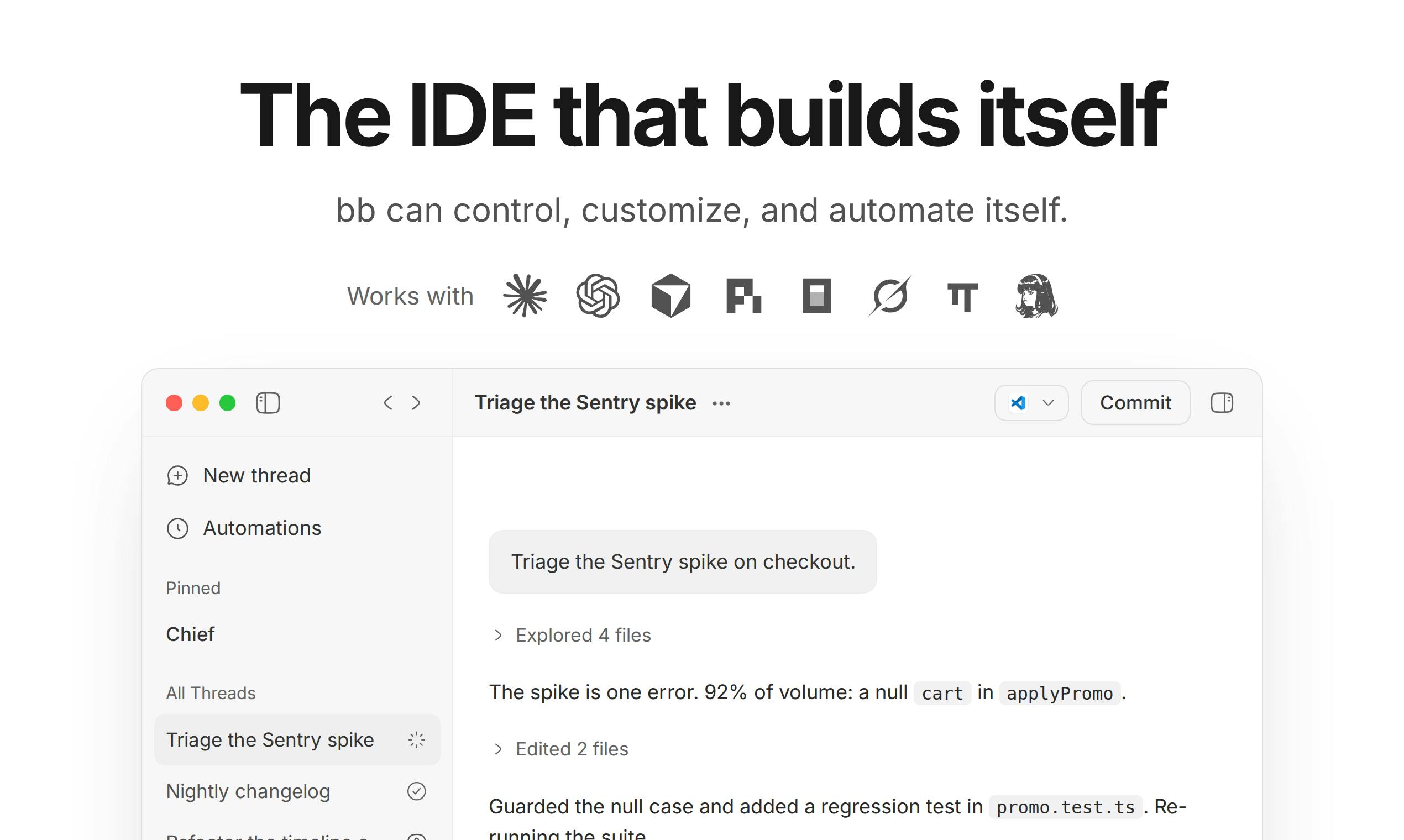
bb is an open-source development environment for coordinating multiple coding agents—including Claude Code, Codex, Cursor, Pi and OpenCode—through threads, worktrees, a desktop interface, CLI and HTTP API. Its central differentiation is self-extensibility: agents can create plugins, commands and interface panels that modify bb itself. It runs locally and uses subscriptions or credentials that customers maintain with the underlying model providers (official website, GitHub repository).
Product quality appears strong for such an early project. The product combines a polished visual interface with provider neutrality, agent orchestration, automation, remote access and an extension system. The repository is actively maintained, the changelog is substantial, and external contributors are already shipping fixes. The MIT licence and local-first architecture appeal to developers who value control, privacy and freedom from a single model provider.
The strongest investment signal is developer adoption velocity. As of August 14, 2026, the repository had approximately 1,862 stars and 206 forks, while the bb-app package recorded 4,447 npm downloads between July 11 and August 9 (GitHub API, npm downloads API). These are meaningful early open-source signals, but they do not establish active usage, retention, revenue or willingness to pay.
The central concern is that bb is currently a free, permissively licensed product without a disclosed commercial strategy. Its strongest features can be forked, while competitors such as OpenAI, Anthropic, Cursor, Google and Microsoft control agent models, existing developer distribution and enterprise relationships. Provider neutrality may create user value but does not yet create defensibility.
The appropriate decision is Watch. bb merits close observation because of its technical quality, founders’ relevant experience and large underlying market. It should move to formal due diligence only after demonstrating sustained active usage and a credible monetization path that preserves open-source adoption.
Product Overview
Developers increasingly use several coding agents, but agent sessions, worktrees, approvals and outputs remain fragmented across terminals and provider-specific applications. bb provides a common environment in which users can assign tasks to different agents, observe work in separate threads, hand tasks between agents and allow agents to initiate other threads (official website).
Its primary features include:
- Multi-agent orchestration across major coding-agent providers.
- Isolated threads and worktrees for parallel work.
- Desktop, browser, CLI and HTTP interfaces.
- Plugins that can add panels, commands, schedules and integrations.
- Automation initiated by scripts, cron jobs or messaging bots.
- Local-first operation using the user’s existing provider subscriptions.
- Remote and mobile access to sessions running on the user’s machine.
The extensibility architecture is the main product-strength signal. Sawyer Hood describes examples including task management, automated code review, a Markdown workspace and customized thread layouts, all built through the same plugin system available to users (founder article). These examples are creator-reported rather than independent customer case studies.
The product is free and MIT-licensed. No paid team, cloud or enterprise plan is publicly listed. The recommended desktop build supports macOS, while Linux users can use the npm version and Windows users must currently run it through WSL2; native Windows support is unavailable (GitHub README).
Product Quality Assessment: Technically differentiated and unusually polished for its stage, but still explicitly described as being in active development.
Founder and Team Assessment
Michael Yong appears to be the project’s originator: Sawyer Hood states that bb began as Yong’s passion project and that Hood moved from early user to contributor (Sawyer Hood’s article). Yong is a software engineer with prior roles at Quora and Figma, providing relevant experience in large-scale consumer software and collaborative developer-facing products (LinkedIn, GitHub).
Sawyer Hood is a major contributor and public spokesperson. His public GitHub profile identifies previous experience at Figma and Facebook, while repository activity shows him authoring and reviewing substantial product changes (GitHub profile, repository commits). Public contributor data also shows meaningful contributions from Yong, Hood and other developers, although some automated-agent contribution counts should not be interpreted as human team size (contributors API).
The team’s technical capability is credible. However, the legal entity, employment status, equity ownership, full-time commitment, sales capability and formal team size are not publicly disclosed. No previous founder exits were verified.
Founder Assessment: Strong technical founder-market fit and execution, but corporate commitment and commercial capability remain unverified.
Market Opportunity
The initial customer is a professional developer or small engineering team using multiple AI coding agents and managing parallel tasks. The immediate value proposition is reduced coordination overhead, provider flexibility and a more inspectable workflow than terminal-only agents.
GitHub reported more than 180 million developers in 2025 and stated that nearly 80% of new developers used Copilot during their first week, demonstrating broad adoption of AI-assisted development (GitHub Octoverse). This is a broad population, not bb’s serviceable market.
An illustrative bottom-up market can be constructed as follows:
- 5–15 million professional developers who could become frequent multi-agent users.
- Potential monetization of $15–$40 per seat monthly for a future hosted collaboration, governance or enterprise product.
- Implied annual seat opportunity of approximately $0.9–$7.2 billion.
This is an analyst scenario, not a company forecast. It excludes inference fees, which users currently pay to model providers, and assumes bb develops commercially valuable team features.
Adjacent opportunities include enterprise policy controls, shared workflows, managed remote execution, audit logs, plugin distribution and organization-wide agent governance. The market is large enough for venture outcomes, but bb has not yet shown that it can capture economic value from it.
Traction and Growth Signals
The public repository was created in February 2026 and had approximately 1,862 stars, 206 forks and 108 open issues by August 14, 2026 (GitHub API). The npm package recorded 4,447 downloads over the latest available monthly period (npm API). Downloads may include updates, automated systems and repeat installations, so they are not equivalent to users.
The August 12 desktop release recorded hundreds of downloads per macOS artifact shortly after publication, although auto-updates and multiple formats make unique-install calculations inappropriate (release API). The current changelog documents mobile-performance work, message editing, context compaction, plugin improvements and numerous community-supplied fixes (changelog).
Product Hunt and Hacker News provide additional launch attention, not proof of product-market fit (Product Hunt, Hacker News). No reliable public figures were found for daily active users, retained installations, organizations, paying customers or revenue.
Traction Assessment: Strong early open-source interest and product velocity, but commercially unverified.
Competitive Position
Direct competitors include agentic IDEs and orchestration tools such as Cursor, Windsurf, Cline, Continue and Google Antigravity. Provider applications—including OpenAI’s Codex app and Anthropic’s Claude Code—also increasingly support parallel or delegated agent work. Indirect alternatives include VS Code extensions, terminal multiplexers, Git worktrees and internally built orchestration scripts.
bb’s advantages are provider neutrality, local operation, permissive licensing and a unified extension system that agents themselves can use. Its disadvantages are limited platform support, small distribution, an early plugin ecosystem and dependency on third-party agent interfaces and subscriptions.
If a major platform launched equivalent orchestration within six months, users might retain bb for open-source control, cross-provider support and custom plugins. However, those advantages are unlikely to be sufficient for most mainstream users unless bb establishes a substantially better ecosystem, workflow history or enterprise governance layer.
Switching costs are currently low, proprietary data is limited, and the MIT licence allows competitors to reuse the software subject to licence terms.
Defensibility Assessment: Low
Business Model and Economics
There is currently no disclosed revenue model. Users pay underlying providers directly, so bb avoids model-inference costs but also captures none of that spending (official website). Local-first execution should permit attractive software gross margins if bb later charges for collaboration, management or enterprise functionality.
Potential commercial models include:
- Hosted synchronization and remote execution.
- Team administration, permissions and auditability.
- Enterprise support and deployment.
- A paid plugin marketplace.
- Managed agent compute or usage-based orchestration.
A future $20-per-seat monthly plan would equal $240 annual recurring revenue per seat before discounts and payment-processing costs. Enterprise contracts could raise ACV through security, governance and deployment features. However, conversion, support burden, cloud expense, gross margin and customers’ willingness to pay are all unknown.
The core economic challenge is open-source monetization: the paid layer must offer enough value to monetize organizations without weakening the free product’s community distribution.
Unicorn Path
For a high-growth developer-tools SaaS business, an illustrative 10× ARR multiple is reasonable for scenario analysis, though actual multiples depend heavily on growth and retention. Cursor’s exceptional financing—$2.3 billion raised at a $29.3 billion post-money valuation after reporting more than $1 billion in annualized revenue—shows the category’s upside but should not be treated as a normal comparable (Cursor announcement).
At 10× ARR:
Required ARR = $1 billion ÷ 10 = approximately $100 million.
Possible routes include:
- Roughly 417,000 paid seats at $240 per year; or
- 5,000 organizations at $20,000 ACV; or
- 2,000 enterprise customers at $50,000 ACV.
These figures assume gross software revenue and do not account for churn, discounts or partner fees. Since bb currently charges nothing, achieving this scale requires launching a paid team or enterprise layer, building sales and support capabilities, establishing security controls and converting open-source adoption into organizational deployments.
Unicorn Path: Conditional
Valuation Assessment
No reliable public information was found regarding funding, investors, a SAFE cap, current fundraising, equity ownership or company valuation. Revenue is also not publicly disclosed and may currently be zero.
Valuation Attractiveness: Not Assessable
Assessment would require current ARR or MRR, retained active installations, commercial launch plans, gross margin, burn, runway, cap table, round size, post-money valuation, liquidation preferences and founder commitment.
Key Risks
- No demonstrated monetization: The current product is free with no disclosed paid roadmap.
- Commercial traction unknown: Revenue, active users and retention are unavailable.
- Competitive bundling: Model providers and major IDEs can add similar orchestration.
- Weak current defensibility: MIT licensing, low switching costs and limited proprietary data.
- Provider dependency: Changes to agent CLIs, authentication or interoperability could disrupt integrations.
- Enterprise-security gap: Agent access to repositories and local systems creates permission, audit and code-exfiltration concerns.
- Founder and entity uncertainty: Full-time commitment, ownership and corporate structure are undisclosed.
- Platform limitations: Native Windows support is absent, potentially restricting mainstream adoption.
- Open-source support burden: Rapid community growth could create maintenance costs before revenue.
Final Assessment
Venture Potential: 63/100
| Category | Score |
|---|---|
| Market Size and Expansion Potential | 18/20 |
| Traction and Growth Evidence | 10/20 |
| Founder and Team | 12/15 |
| Product Strength | 9/10 |
| Distribution Potential | 9/15 |
| Business Model and Economics | 2/10 |
| Defensibility | 3/10 |
| Total | 63/100 |
The strongest elements are technical execution, market timing and early open-source momentum. The weakest are the absence of monetization and limited defensibility against well-funded platforms.
Evidence Confidence: 58/100
Product functionality, licensing, repository activity, downloads and creator backgrounds are reasonably verifiable. Funding, legal entity, team structure, users, revenue, retention, economics and valuation remain unavailable. Market and unicorn calculations are explicitly analyst scenarios.
Final Decision: Watch
bb is a promising product, but the venture case is insufficiently validated. Product strength alone cannot resolve the lack of a business model, commercial traction and financing information.
Upgrade Conditions
- Evidence of at least 10,000 retained monthly active developers or substantial organizational deployment.
- Launch of a paid team or enterprise product with credible conversion.
- Verified annualized revenue approaching $1 million.
- Six-month customer or workspace retention above 70%.
- Gross margin above 70% on paid cloud services.
- Repeatable distribution beyond launch communities.
- Enterprise references and credible security controls.
- Confirmation of full-time founders and a coherent corporate structure.
Downgrade Conditions
- Repository or release activity materially declines.
- Active installations fail to retain after initial experimentation.
- Major IDEs commoditize provider-neutral orchestration.
- Provider changes repeatedly break integrations.
- Paid features fail to convert open-source users.
- A material security incident occurs.
- Core creators discontinue full-time involvement or disagree over commercialization.
Questions for Further Diligence
- How many unique installations, weekly active users and active organizations does telemetry show?
- What are 30-, 90- and 180-day retention rates by installation cohort?
- Are Michael Yong and Sawyer Hood working full-time on bb, and what are their formal roles?
- What legal entity owns the trademarks, domains and commercial rights?
- What monetization model is planned, and which features will remain open source?
- Have organizations offered to pay for collaboration, governance or support?
- What are current MRR, expenses, burn and runway?
- How will bb maintain integrations as provider CLIs and protocols change?
- What enterprise security, permissions, audit and data-residency controls are planned?
- What is the current cap table and fundraising valuation?
- How will bb defend against Cursor, Microsoft, Google, OpenAI or Anthropic bundling similar workflows?
- What proportion of npm and desktop downloads represent retained human users rather than updates or automation?