
Table of Contents
- Product Analytics for Agents and Users Investment Report
Product Analytics for Agents and Users Investment Report
Category: Agent analytics, product analytics, and LLM observability
Company Stage: Series A / commercial enterprise SaaS; expanding into self-service agent analytics
Founder or Founders: Alex Li
Headquarters: Los Altos, California, United States
Funding: $24 million total disclosed: $6 million seed and $18 million Series A
Business Model: Freemium and usage-based B2B SaaS, priced by monthly tracked users; custom enterprise contracts
Product Hunt Launch Date: August 11, 2026; Kubit originally launched on Product Hunt in April 2020
Report Date: August 14, 2026
| Investment Metric | Assessment |
|---|---|
| Venture Potential | 78/100 |
| Unicorn Path | Plausible |
| Valuation Attractiveness | Not Assessable |
| Evidence Confidence | 70/100 |
| Final Decision | DD |
Executive Summary
Product Analytics for Agents and Users is Kubit’s expansion from warehouse-native product analytics into AI-agent analytics. It joins LLM traces—prompts, model outputs, tool calls, latency, and token usage—with user behavior such as re-prompts, abandonment, conversion, retention, and sentiment. The intended customer is a product or engineering team operating a production AI application and struggling to connect technical agent failures with business outcomes (Kubit, Product Hunt).
The product addresses a credible gap between two existing categories. LLM-observability tools explain model and system behavior, while product-analytics platforms measure user behavior. Kubit seeks to combine both data sets inside the customer’s warehouse and make the resulting context available to coding agents through MCP. Its warehouse-native architecture, support for OpenTelemetry and CDP data, and existing enterprise analytics engine make the positioning more substantive than a superficial AI feature.
Kubit is also an established venture-backed company rather than a new Product Hunt project. It was founded in 2018 and raised an $18 million Series A led by Insight Partners after a $6 million seed round, bringing disclosed funding to $24 million. The company previously named Paramount/ViacomCBS, Wish, and Quizlet as customers and currently presents references from Miro, Vix, GameChanger, and Serko (Insight Partners, Kubit website).
The strongest investment signals are founder-market fit, credible enterprise references, and an architectural position spanning product analytics, data warehouses, and agent observability. The most important concern is missing current commercial performance. Revenue, ARR growth, retention, customer count, gross margin, burn, and runway are not publicly disclosed. The absence of a publicly announced financing round after 2022 is not inherently negative, but it makes current capital efficiency and growth trajectory important diligence questions.
The final decision is DD. Kubit has a strong enough team, product, customer base, and market position to justify formal due diligence. Investment attractiveness cannot be determined without current financial metrics and financing terms.
Product Overview
Production AI teams typically monitor agent traces separately from customer behavior. Engineers might inspect prompts, tool calls, latency, and hallucinations in LangSmith or Langfuse, while product managers use Mixpanel, Amplitude, or PostHog to study funnels and retention. Determining whether a specific agent failure caused a user to re-prompt, abandon, or fail to convert can require manually joining data across several systems.
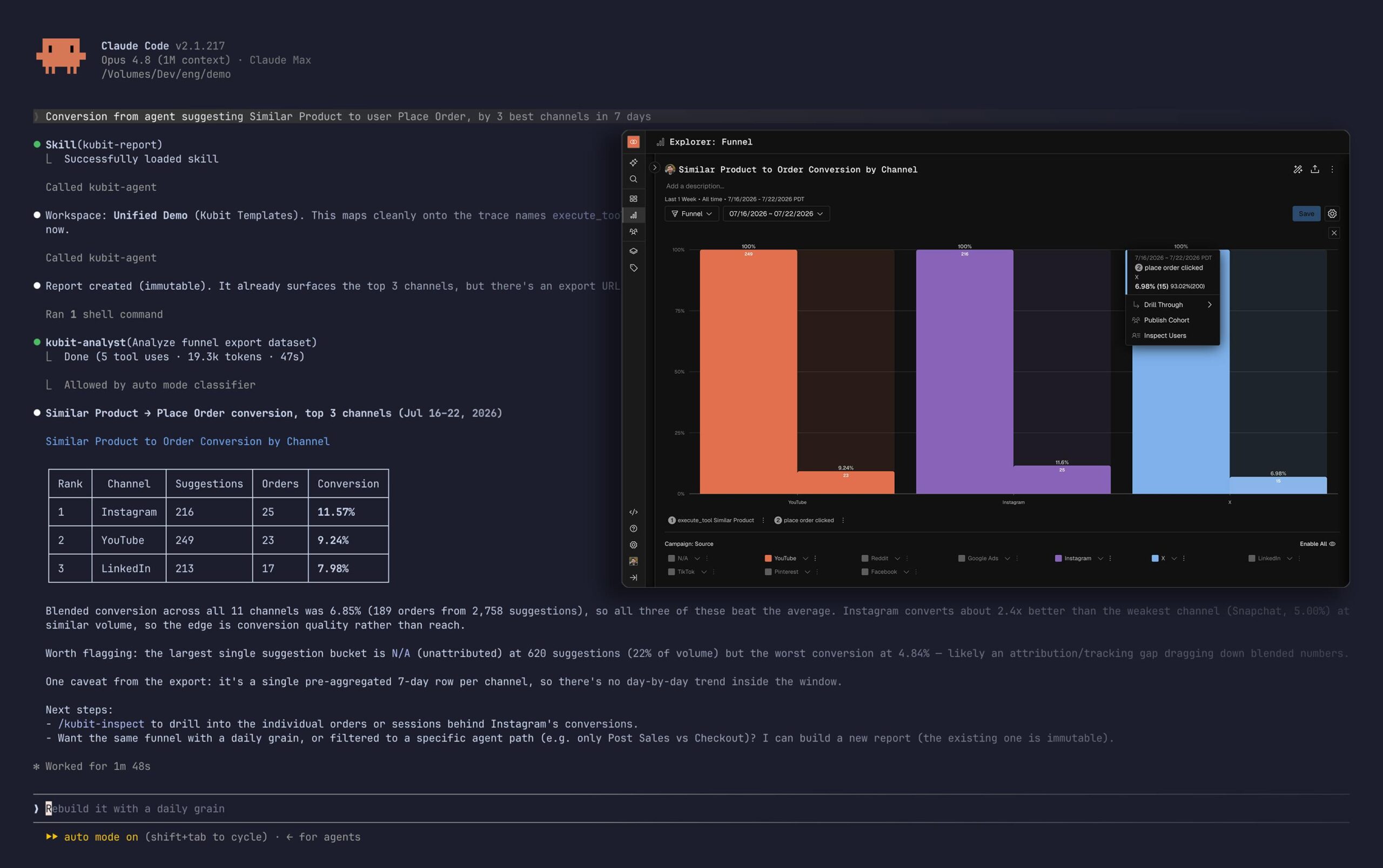
Kubit connects agent traces to clickstream, warehouse, experimentation, campaign, and business data. It can correlate measures such as token usage and P95 latency with daily active users, conversion, and retention; build user-agent funnels; identify problematic tool calls or hallucinations; segment users by agent and behavioral conditions; and feed findings into coding agents through MCP (official product page).
The architecture is warehouse-native. Customers can stream traces using OpenTelemetry, import behavioral events from a CDP, or query existing warehouse data. Kubit states that sensitive data can remain in the customer’s warehouse and that pipelines can mask, filter, or sample data. This reduces data duplication and offers a governance advantage for enterprises, although deployment architecture and security certifications should be verified during diligence.
Pricing is transparent and materially lowers the entry barrier relative to Kubit’s historical enterprise positioning:
- Starter: Free for 10,000 monthly tracked users, then $0.008 per additional MTU.
- Pro: $199 monthly for 100,000 MTUs, then $0.006 per additional MTU.
- Unlimited seats and events are included; Pro adds bring-your-own-warehouse capabilities and Slack Connect support.
- Enterprise terms are not publicly specified (pricing page).
The product is web-based and infrastructure-facing rather than a consumer mobile application. It replaces manual SQL analysis, custom trace-to-event pipelines, and the simultaneous use of separate observability and product-analytics interfaces.
Product Quality Assessment: Strong architectural coherence and credible enterprise functionality; the new agent-specific capabilities still need independent customer validation.
Founder and Team Assessment
Alex Li founded Kubit in 2018. His background is unusually relevant: he was CTO of Smule from 2011 to 2017, where his profile states that he managed a 90-person engineering organization, infrastructure supporting 50 million monthly active users, and data systems processing approximately two billion events daily. He was previously VP of Engineering at Booyah, a principal architect at Jasper, and an engineer on eBay’s Kijiji founding team (Alex Li’s LinkedIn).
This experience provides strong founder-market fit in analytics infrastructure, large-scale consumer applications, data engineering, and enterprise software. Li has remained Kubit’s CEO since inception, providing evidence of full-time commitment. No previous founder exit was verified, although several earlier employers experienced successful strategic outcomes.
LinkedIn places Kubit in the 11–50 employee category and shows approximately 38 associated profiles. This is a directional indicator rather than verified payroll headcount (Kubit LinkedIn). The current website solicits applications from AI builders and data engineers, indicating continued technical hiring, but the number of open positions and hiring pace are not clearly disclosed (About).
The key-person risk is moderate. The company’s positioning is closely associated with Li’s experience, while public evidence on the rest of the executive team is limited.
Founder Assessment: Excellent technical and domain fit, with demonstrated ability to build large-scale data systems; current go-to-market leadership depth requires verification.
Market Opportunity
The initial customer is a software company with a production AI agent, an identifiable end-user base, and existing warehouse or product-event data. Likely buyers include heads of product, AI engineering, data, analytics, and developer infrastructure.
A reasonable bottom-up scenario is:
- 25,000–75,000 software organizations globally with sufficiently material AI-agent usage and analytics maturity;
- $5,000–$30,000 annual average revenue per customer across self-service, usage overages, and enterprise plans;
- Implied serviceable annual revenue opportunity of approximately $125 million–$2.25 billion.
These are analyst assumptions, not company forecasts. The lower end reflects smaller Pro customers; the upper end assumes material enterprise contracts. Organizations without production agents, reliable identity data, or warehouse infrastructure are not likely near-term buyers.
The adjacent market is broader. Kubit can continue serving conventional product analytics, customer-journey analytics, experimentation, and business-intelligence use cases even where agents are not central. It can also expand into automated quality verification, agent optimization, governance, testing, and remediation.
Market timing is favorable because production AI applications increasingly need to optimize outcomes rather than only model accuracy. However, the category may consolidate into existing observability, analytics, and cloud platforms. A large market therefore does not guarantee Kubit a durable share.
Traction and Growth Signals
Kubit’s 2022 Series A announcement stated that the company had grown 50-fold in 2021 and expected to triple revenue in 2022. These were company-reported forward-looking statements and are now too old to establish current momentum (Insight Partners announcement).
Customer evidence is more meaningful. The 2022 announcement identified Paramount/ViacomCBS, Wish, and Quizlet. Kubit’s current website names or quotes Miro, Vix, GameChanger, and Serko and displays additional enterprise logos including Samsung, Paramount, Skyscanner, Pluto TV, Synchrony, and CBS (Kubit, pricing). These relationships are company-presented; current contract status and revenue concentration are not publicly verifiable.
Kubit reports that Miro teams generate more than 2,500 queries monthly. Serko reportedly increased data visualizations tenfold, while an older case study states that Influence Mobile increased ROI by 30% (Miro case study, Serko case study). These examples support customer value but do not reveal account retention, ACV, or expansion.
Gartner Peer Insights shows a 4.2/5 average from four ratings, including a January 2026 review describing the platform as flexible and effective for fast analysis without heavy engineering dependency (Gartner). The sample is too small for broad conclusions.
The August 2026 Product Hunt relaunch ranked approximately ninth for the day and received roughly 100 votes. This indicates launch interest only and has minimal weight in the traction assessment (Product Hunt leaderboard).
The most important missing metrics are current ARR, growth, customer count, net revenue retention, gross retention, self-service adoption, paid conversion, and Agent Analytics usage.
Traction Assessment: Credible enterprise adoption, but current growth and commercial health are not publicly verified.
Competitive Position
Direct LLM and agent-observability competitors include LangSmith, Langfuse, Arize, Braintrust, Phoenix, Humanloop, Weights & Biases Weave, Datadog LLM Observability, and Honeycomb. Product-analytics competitors include Amplitude, Mixpanel, Heap, PostHog, and Pendo. Data teams can also reproduce part of the workflow using OpenTelemetry, dbt, Snowflake or Databricks, and internal BI tools.
Kubit’s differentiation is the direct connection between agent traces and end-user outcomes, combined with warehouse-native execution and product-analytics functionality. It does not merely report whether an agent invocation failed; it attempts to explain how that failure changed user behavior and business performance.
Its warehouse architecture creates workflow integration and governance advantages. Enterprise customers may develop significant switching costs through semantic models, saved analyses, cohorts, trace mappings, and business definitions. However, network effects are absent, and Kubit’s reliance on open standards reduces technical lock-in by design.
If Amplitude, Datadog, or LangSmith launched the same capability within six months, customers might remain with Kubit because its product-analytics engine already handles complex customer journeys directly in the warehouse. That answer is credible, but Kubit must prove superior query performance, semantic accuracy, and implementation speed to sustain it.
Defensibility Assessment: Medium
Business Model and Economics
Kubit uses monthly tracked-user pricing rather than charging separately for events, integrations, or seats. This aligns revenue with the size of a customer’s end-user population and avoids penalizing high event volume.
At the public Pro price, base annual contract value is only $2,388, but usage can create significant expansion. For example, an organization with one million MTUs would pay approximately $5,599 monthly—$199 plus 900,000 overage MTUs at $0.006—or roughly $67,000 annually, before enterprise discounts or negotiated terms. This is an analyst calculation based on public pricing, not a disclosed customer contract.
Warehouse-native processing should reduce Kubit’s storage burden, but costs remain for query orchestration, metadata, control-plane infrastructure, customer support, AI classification, sentiment analysis, and MCP services. Large customer warehouses may also generate material compute costs paid directly by customers, potentially improving Kubit’s gross margin.
The self-service plan could create product-led distribution, while enterprise governance, support, security, and larger tracked populations provide expansion revenue. Actual gross margin, implementation cost, sales-cycle length, CAC payback, and professional-services requirements are unknown.
Unicorn Path
A 10× ARR multiple is appropriate for scenario analysis if Kubit achieves high growth, strong retention, and SaaS gross margins. A slower-growing analytics company would warrant a lower multiple.
Required ARR = $1 billion ÷ 10 = approximately $100 million.
Possible routes include:
- Approximately 41,900 Pro accounts at the $2,388 base annual price;
- Approximately 2,000 enterprise accounts at $50,000 ACV;
- Approximately 1,500 high-volume accounts at roughly $67,000 annualized revenue;
- Or a blended portfolio of self-service, usage-based, and enterprise customers.
The first route appears operationally unrealistic for an enterprise-oriented company. The more credible route is several thousand medium and large customers with usage expansion, high net revenue retention, and meaningful enterprise contracts.
Kubit must preserve its historical product-analytics revenue while becoming a category leader in agent outcome analytics. It also needs repeatable self-service activation, strong integrations, international enterprise distribution, and durable gross margins.
Unicorn Path: Plausible
Valuation Assessment
Kubit raised $18 million in April 2022 from Insight Partners, Shasta Ventures, and TSVC, following a $6 million seed round. Total disclosed funding is $24 million; no reliable public evidence of a later round was found (Insight Partners, TechCrunch).
The Series A valuation and current financing status were not disclosed. Current revenue is also unavailable.
Valuation Attractiveness: Not Assessable
Responsible assessment requires current ARR, growth, retention, gross margin, cash balance, burn, runway, prior preferred terms, cap table, proposed round size, post-money valuation, and liquidation preferences.
Key Risks
- Current commercial trajectory is unknown: Public growth evidence is primarily from 2021–2022.
- Repositioning risk: Agent analytics may be a strong expansion or a response to slower legacy growth; public evidence cannot distinguish between them.
- Competitive bundling: Amplitude, Datadog, LangSmith, PostHog, and cloud platforms can add similar functionality.
- Long enterprise sales cycles: Warehouse access, security reviews, and semantic modeling may delay deployments.
- Low self-service base ACV: Venture scale requires usage expansion or substantial enterprise contracts.
- Data and security sensitivity: Agent traces can contain customer prompts, proprietary information, and personal data.
- Implementation complexity: Joining traces, identities, clickstream events, experiments, and business outcomes may require substantial configuration.
- Capital and runway uncertainty: No later financing has been publicly identified after the 2022 Series A.
- Moderate technical lock-in: Open standards benefit customers but make migration and replication easier.
- Enterprise concentration: A limited number of large contracts could create renewal volatility.
Final Assessment
Venture Potential: 78/100
| Category | Score |
|---|---|
| Market Size and Expansion Potential | 18/20 |
| Traction and Growth Evidence | 13/20 |
| Founder and Team | 14/15 |
| Product Strength | 9/10 |
| Distribution Potential | 10/15 |
| Business Model and Economics | 8/10 |
| Defensibility | 6/10 |
| Total | 78/100 |
The strongest elements are founder-market fit, enterprise product maturity, warehouse-native architecture, and expansion into a strategically relevant category. The weakest are stale financial evidence, competitive intensity, and uncertainty about self-service distribution.
Evidence Confidence: 70/100
Founder history, disclosed funding, investors, legal name, pricing, headquarters, product architecture, and several customer references are supported by primary or reputable sources. Customer outcomes are company-reported. Market sizing and unicorn calculations are analyst scenarios. Current ARR, growth, retention, margins, burn, runway, customer count, and valuation remain unavailable.
Final Decision: DD
Kubit warrants formal due diligence because it combines a capable founder, credible enterprise deployment history, a differentiated product architecture, and a plausible route to $100 million ARR. It does not qualify for an investment decision because current financial performance, capital requirements, and round terms are unknown.
Upgrade Conditions
- Verify current ARR and at least 40%–50% annual growth.
- Demonstrate gross retention above 90% and net revenue retention above 110%.
- Show successful conversion from Starter to Pro or enterprise.
- Verify multiple production customers using the new agent-trace functionality.
- Maintain software gross margin above 75%.
- Demonstrate repeatable customer acquisition with acceptable CAC payback.
- Establish measurable advantages over LangSmith, Amplitude, and Datadog.
- Provide attractive financing terms relative to verified growth.
Downgrade Conditions
- Flat or declining revenue since the 2022 financing.
- Agent Analytics fails to convert existing product-analytics customers.
- High implementation or support costs materially reduce margins.
- Major observability or analytics platforms replicate the combined workflow.
- Loss of reference customers or weak renewal rates.
- Excessive warehouse-query costs or performance problems.
- Material privacy, security, or data-governance incidents.
- Insufficient runway without a highly dilutive financing.
Questions for Further Diligence
- What are current ARR, annual growth, and revenue split between legacy product analytics and Agent Analytics?
- How many paying customers are active, and how many use agent-trace functionality in production?
- What are gross retention, net revenue retention, and logo retention by cohort?
- What are Starter-to-Pro and Pro-to-enterprise conversion rates?
- What is median ACV, and how much revenue comes from MTU overages?
- What are gross margin and warehouse or AI-processing costs by customer tier?
- How long does implementation take, and how much solutions-engineering work is required?
- What is CAC payback by product-led and enterprise sales channels?
- How concentrated is revenue among the ten largest customers?
- What are monthly burn, cash balance, runway, and current fundraising plans?
- What are the proposed valuation, round size, cap table, and liquidation preferences?
- Which technical or data advantages prevent Amplitude, LangSmith, or Datadog from reproducing the product?