
Table of Contents
Click Investment Report
Category: AI research infrastructure / MCP data-connectivity platform
Company Stage: Pre-seed; Y Combinator Summer 2026
Founder or Founders: Aditya Asgaonkar
Headquarters: San Francisco, California, United States
Funding: Y Combinator’s published standard deal commits $500,000; no additional financing was verified
Business Model: Credit-limited SaaS subscription; prospective team, API and enterprise revenue
Product Hunt Launch Date: August 12, 2026
Report Date: August 15, 2026
| Investment Metric | Assessment |
|---|---|
| Venture Potential | 63/100 |
| Unicorn Path | Conditional |
| Valuation Attractiveness | Not Assessable |
| Evidence Confidence | 58/100 |
| Final Decision | Watch |
Executive Summary
Click is a hosted Model Context Protocol, or MCP, service that gives ChatGPT, Claude, Codex and other compatible agents access to specialized external data. Its connectors cover professional profiles, social networks, advertising libraries, financial filings, travel inventory, real-estate listings, maps, video transcripts and general web retrieval (official website; features).
The product is aimed initially at individual professionals who conduct sales research, competitive intelligence, market research, travel planning or investment analysis inside an AI assistant. Instead of purchasing and configuring separate data tools, users install one MCP connector and let an agent choose among Click’s sources.
The strongest investment signal is founder quality. Founder Aditya Asgaonkar worked at the Ethereum Foundation from 2018 to 2023, where he reports contributing to Ethereum’s proof-of-stake protocol, formal verification and distributed-systems research. He later worked as a senior research engineer at Offchain Labs and has multiple published research papers in consensus and blockchain security (founder profile; YC profile). This is strong evidence of technical depth relevant to building reliable agent infrastructure.
The primary investment concern is an almost complete absence of commercial validation. No revenue, paying-customer count, active-user figure, retention metric, connector usage or gross margin is publicly disclosed. Click launched its research product only days before this report, and Product Hunt engagement is not evidence of product-market fit. Its dependence on third-party data sources also creates uncertain margins, availability and platform-policy exposure.
The decision is Watch. Click has a strong solo founder, broad potential use cases and a credible technical product, but it remains too early for formal diligence based on public evidence alone. An upgrade to DD would require paid retention, repeat research usage, sustainable data-provider economics and a clearer enterprise wedge.
Product Overview
General web search often misses information located within professional networks, social platforms, advertising libraries, travel systems and structured financial databases. Users therefore leave their AI assistant, search each service manually and paste the relevant information back into the conversation. Alternatively, developers integrate multiple APIs independently.
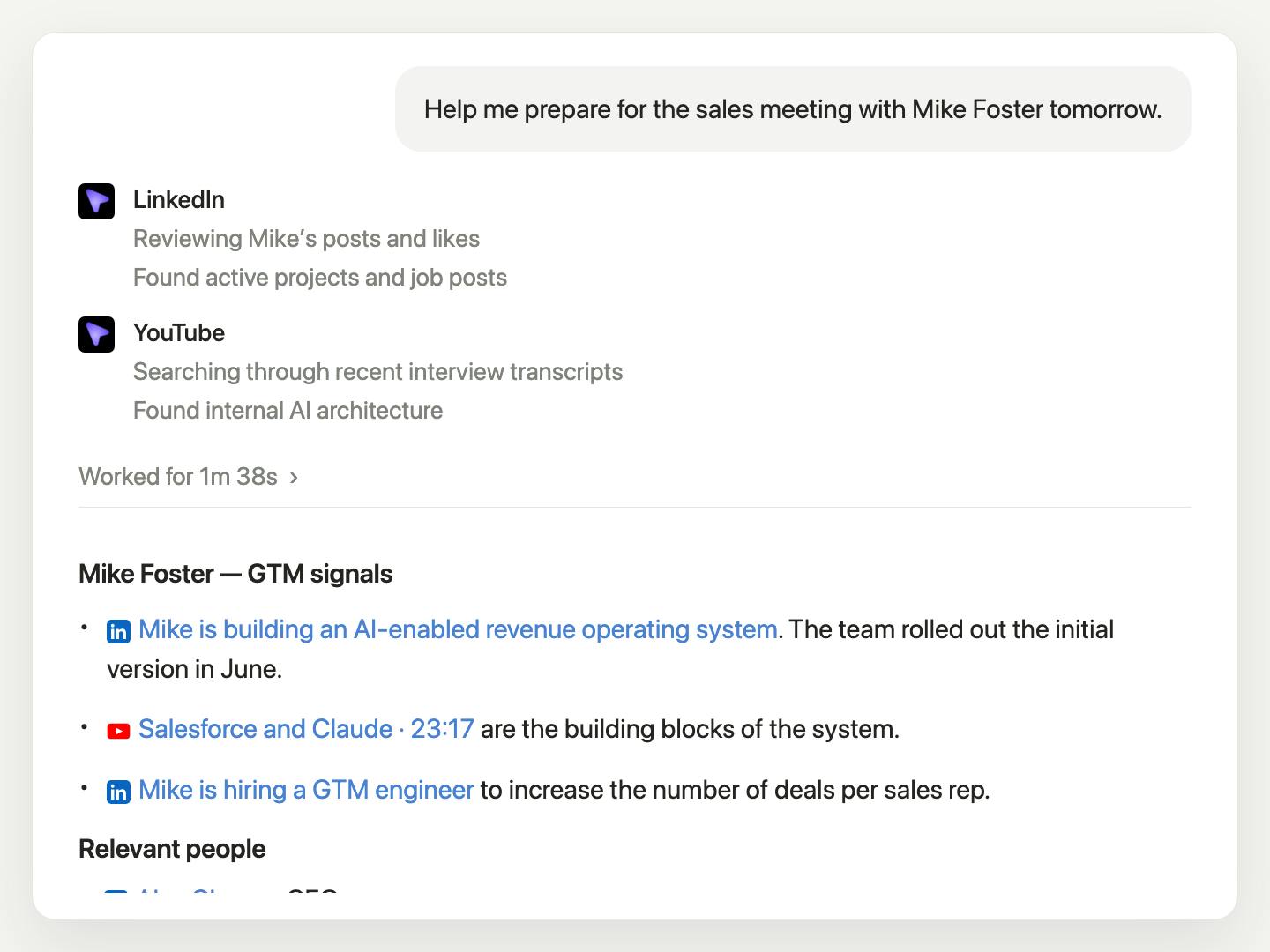
Click provides a single hosted MCP installation through which an AI agent can call multiple research connectors. Supported sources include LinkedIn, X, Facebook, Instagram, TikTok, Reddit, YouTube, Meta Ads, Google Maps, Zillow, public-company financial data, flights, hotels, advanced web search and web extraction (feature directory).
Example workflows include:
- Researching prospects before a sales meeting.
- Enriching lead lists with roles, professional activity and contact information.
- Analyzing competitor advertising campaigns.
- Monitoring topics across social platforms.
- Comparing flights and hotels.
- Screening companies and analyzing financial filings.
- Extracting structured information from websites and directories.
The product works through ChatGPT/Codex and Claude rather than requiring users to adopt a separate research interface. That reduces workflow friction, although it also makes Click dependent on those platforms maintaining accessible MCP support.
Published pricing consists of an Individual plan at $49 per month, including 500 credits. New accounts receive 70 signup credits, which generally expire seven days after the first metered provider call. Each accepted provider call consumes credits even when the underlying provider returns an error; Exa requests are normally 0.5 credits but are credit-free for paid subscribers (pricing; service terms).
The effective amount of research delivered by 500 credits is not sufficiently clear because different tools may consume different quantities. Team and enterprise pricing were not publicly displayed at the time of review.
Product Quality Assessment: A useful aggregation layer with broad connector coverage, but reliability, result quality and credit transparency require independent testing.
Founder and Team Assessment
Aditya Asgaonkar is Click’s founder and sole publicly listed employee. Y Combinator describes Click as founded in 2026 and based in San Francisco, while the founder’s LinkedIn history shows Click beginning in October 2025. The difference may reflect the date of incorporation or public launch rather than a substantive conflict.
Asgaonkar’s technical background is unusually strong. At the Ethereum Foundation, he worked on consensus, fork choice, distributed validation and formal verification. His published research includes work on attacks against proof-of-stake Ethereum and verification of the Beacon Chain. He subsequently worked at Offchain Labs on transaction ordering and Ethereum-client prototypes.
Click is part of Y Combinator S26 and the NVIDIA Inception program. YC states that every accepted company receives its standard $500,000 investment: $125,000 for 7% and $375,000 on an uncapped MFN SAFE (YC standard deal). No other Click financing was verified.
Commercial capability is less established. Earlier Click positioning focused on browser automation for operations teams. The current research-connectivity product represents a meaningful repositioning from automating workflows inside web applications to supplying external data to agents. Iteration can be positive, but it also means historical product activity cannot be assumed to validate the current offering.
There is substantial solo-founder risk across product engineering, data-provider management, compliance, sales and support. No active hiring, co-founder or broader team was verified.
Founder Assessment: Exceptional technical depth, but commercial execution, team-building and product focus remain unproven.
Market Opportunity
The initial segment is individual sales, investment, recruiting and market-research professionals who use ChatGPT or Claude frequently and need data unavailable through ordinary web search. The customer problem is time spent switching between research services and assembling context manually.
The number of high-intensity AI research users is not publicly verifiable. An illustrative bottom-up scenario is:
- 250,000–1 million addressable professional users
- $588 annual list price per individual subscription
- Implied annual revenue pool: approximately $147 million–$588 million
These are analyst assumptions rather than verified market statistics. They assume users are willing to maintain Click in addition to their ChatGPT or Claude subscription.
Enterprise expansion could increase the opportunity through shared credit pools, audit controls, zero-data-retention options, APIs, customer-specific data sources and workflow integrations. Click could also sell to agent developers that prefer one data layer over contracting with multiple providers.
Geographic reach is broad, but some connectors may have weaker coverage or different legal constraints outside the United States. Market timing is favorable because MCP is becoming a standard method for connecting agents to tools. The same standard, however, lowers switching costs and helps competing connector services enter the market.
Traction and Growth Signals
Publicly observable traction is limited:
- Click is a verified Y Combinator S26 company.
- The current research product launched on YC and Product Hunt in August 2026.
- Click ranked approximately #9 on Product Hunt’s August 12 leaderboard, with around 146 votes displayed in indexed results (leaderboard).
- The company’s LinkedIn page had approximately 152 followers, while its X account had fewer than 100 followers near launch. These are awareness metrics, not product usage.
- The official product and signup flow are live, and a formal SaaS agreement and privacy policy are available.
- The founder has posted examples of browser workflows and research tasks, but no customer case studies with independently verifiable outcomes were found.
Product Hunt’s page displayed a maker score or launch-comment count, but this does not establish sustained use. Revenue, subscriptions, free-to-paid conversion, monthly active users, calls per user, failed-call rates and post-launch retention are all not publicly disclosed.
The most important missing signal is repeated paid usage. Research tools can generate initial curiosity while experiencing high churn if users need them only occasionally or if underlying AI platforms add equivalent connectors.
Traction Assessment: Product and accelerator participation are verified, but commercial traction is not.
Competitive Position
Direct and adjacent competitors include Exa, Tavily, Firecrawl, Parallel, Bright Data, Apify, Browserbase and specialized MCP servers. Perplexity, ChatGPT, Claude and Gemini provide built-in research capabilities and could expand their first-party connector catalogs. Users can also install individual MCP servers for particular sources.
Click’s advantage is breadth and convenience: one installation, one credit balance and a unified interface for heterogeneous sources. It can combine LinkedIn activity, social discussions, financial filings and travel information within one agent task rather than requiring separate integrations.
However, the underlying data appears substantially sourced from third-party connector and data providers. Click’s privacy policy confirms that requests and relevant content may be shared with connector providers (privacy policy). No proprietary index, exclusive data license or uniquely trained model was verified.
Switching costs are low because MCP servers are modular. There is no demonstrated network effect, and enterprise workflow integration is currently limited. Brand potential exists around being a trusted research bundle, but the product is too new to have established that position.
If the largest AI platform launched the same feature within six months, why would customers continue using Click? A defensible answer would require broader cross-platform coverage, consistently better source access, auditable citations and lower bundled data costs. These advantages have not yet been demonstrated.
Defensibility Assessment: Low
Business Model and Economics
Click’s current revenue model is a $49 monthly subscription with metered credits. At list price, annual contract value is $588 for an individual customer. Team, API and enterprise plans would be logical extensions, but their availability and pricing are not publicly disclosed.
Variable costs are unusually important. Click may incur fees for:
- Search and extraction providers such as Exa.
- Social, professional and contact-data services.
- Flight and hotel inventory.
- Browser automation or scraping.
- Hosting, databases and security.
- Payment processing and customer support.
Comparable data providers charge on a per-request or per-result basis. For example, Exa lists search and agent calls from fractions of a cent to approximately $1 per advanced run, depending on effort and enrichment (Exa pricing). Tavily and Firecrawl also use metered-credit models (Tavily; Firecrawl).
Click must ensure subscription and overage revenue increase faster than provider costs. Heavy users could create adverse gross-margin selection, while light users may churn because $49 exceeds the cost of installing individual free MCP connectors.
Unicorn Path
A fast-growing software and data-infrastructure company might receive approximately 8–12× ARR. Using a 10× midpoint:
Required ARR = $1 billion ÷ 10 = approximately $100 million
At the current $588 annual individual price:
Required subscribers = $100 million ÷ $588 ≈ 170,000 paying subscribers
Alternative enterprise scenarios include:
- 10,000 customers at $10,000 ACV
- 5,000 customers at $20,000 ACV
- 2,000 customers at $50,000 ACV
The enterprise values are analyst assumptions, not published Click pricing.
Reaching this scale requires more than an individual connector bundle. Click would need team administration, APIs, source-level permissions, compliance controls, enterprise contracts, proprietary retrieval quality and favorable provider economics. Gross margin would likely need to exceed approximately 70% to support a premium SaaS multiple.
Unicorn Path: Conditional
Valuation Assessment
YC participation and its standard $500,000 investment terms are public. Click’s MFN SAFE has no disclosed valuation cap until affected by later financing. No other investors, priced round, secondary transaction or current fundraising terms were found.
Current ARR, growth, gross margin and retention are unavailable. Consequently, Click cannot be compared responsibly with public data platforms or private AI-infrastructure financings.
Valuation Attractiveness: Not Assessable
Assessment requires current ARR, usage growth, provider costs, gross margin, retention cohorts, burn, runway, cap table, proposed SAFE cap, round size and liquidation terms.
Key Risks
- No verified commercial traction: Paid adoption and retention are unknown.
- Data-provider dependency: Price increases or service restrictions could damage margins and coverage.
- Platform-policy exposure: Professional and social-network data access may be restricted or challenged.
- Incumbent bundling: OpenAI, Anthropic, Google or Perplexity could add equivalent connectors.
- Low switching costs: MCP makes replacing individual services relatively easy.
- Solo-founder risk: Engineering, compliance, sales and support depend on one person.
- Unclear usage economics: The relationship between credits, provider costs and customer value is opaque.
- Product-focus risk: Click has already changed from browser automation to research connectivity.
- Privacy and security: Research prompts and results can pass through multiple external providers.
Final Assessment
Venture Potential: 63/100
| Category | Score |
|---|---|
| Market Size and Expansion Potential | 17/20 |
| Traction and Growth Evidence | 6/20 |
| Founder and Team | 14/15 |
| Product Strength | 8/10 |
| Distribution Potential | 8/15 |
| Business Model and Economics | 6/10 |
| Defensibility | 4/10 |
| Total | 63/100 |
Founder quality and market timing are the strongest factors. Commercial validation, margins, distribution and defensibility are the weakest.
Evidence Confidence: 58/100
Founder history, legal entity, YC participation, product functions, pricing and privacy terms are verifiable. Product Hunt and social metrics indicate launch visibility only. Revenue, users, retention, provider contracts, gross margin, burn and current financing valuation remain unavailable.
Final Decision: Watch
Click is technically credible and potentially useful, but the public evidence does not yet justify formal diligence. The venture case depends on proving repeated paid usage and durable economics despite upstream data costs and major-platform competition.
Upgrade Conditions
- At least $1 million ARR or a credible trajectory supported by financial records.
- More than 2,000 paying users or multiple enterprise deployments.
- Six-month paid retention above 70%.
- Gross margin above 70% after all data-provider costs.
- Demonstrated multi-source research usage rather than one-time experimentation.
- Enterprise-grade data controls and provider agreements.
- Addition of a strong commercial or product co-founder.
Downgrade Conditions
- Weak conversion after the YC and Product Hunt launches.
- High churn following initial research tasks.
- Material connector shutdowns or platform enforcement.
- Provider costs rising faster than subscription revenue.
- Equivalent first-party connectors from major AI platforms.
- Another major product repositioning without customer validation.
- Privacy or data-licensing incidents.
Questions for Further Diligence
- What are current MRR, paying users and weekly active users?
- What are 30-, 90- and 180-day paid retention?
- How many connector calls does the median paid customer make monthly?
- What percentage of calls fail, and are failed calls refunded?
- What is gross margin after every data-provider and infrastructure cost?
- Which connectors use licensed APIs versus scraping or intermediaries?
- What contractual protections exist against provider access or price changes?
- Which use case—sales, investing, travel or social research—shows the highest retention?
- What are free-to-paid conversion and customer-acquisition cost by channel?
- What are burn rate, runway and current hiring plans?
- What is the fully diluted cap table after the YC SAFEs?
- What valuation cap, round size and terms are currently being offered?