
Table of Contents
MagiCrew Investment Report
Category: Open-source enterprise AI-agent and productivity platform
Company Stage: Early-stage / commercial launch
Founder or Founders: Huang Chaohui; Chen Caoqihao; Enzy Tian
Headquarters: Shenzhen, Guangdong, China
Funding: Not publicly disclosed or independently verified
Business Model: Freemium cloud subscriptions, usage credits, commercial licensing, and enterprise private deployment
Product Hunt Launch Date: September 3, 2026
Report Date: September 6, 2026
| Investment Metric | Assessment |
|---|---|
| Venture Potential | 59/100 |
| Unicorn Path | Conditional |
| Valuation Attractiveness | Not Assessable |
| Evidence Confidence | 45/100 |
| Final Decision | Watch |
Executive Summary
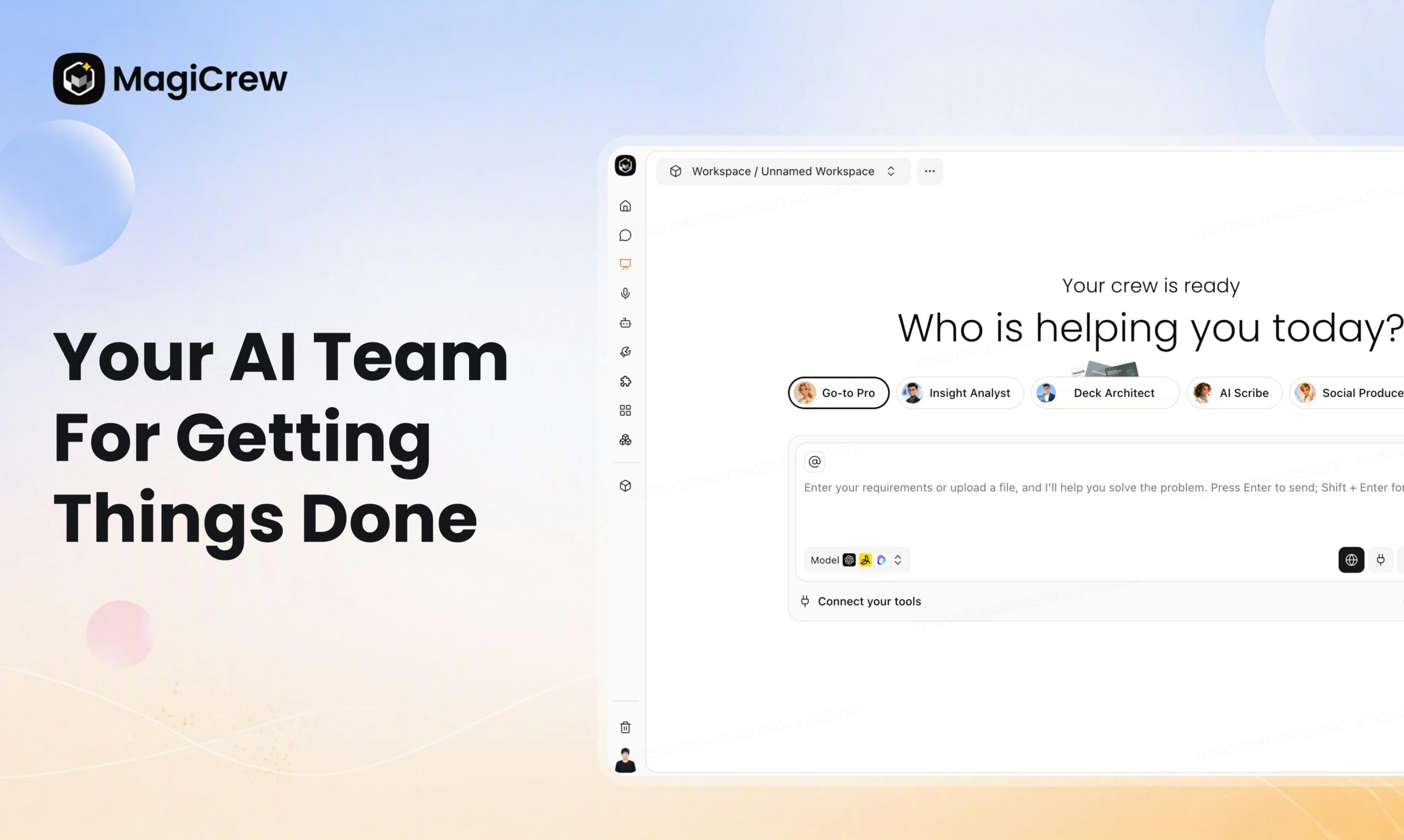
MagiCrew is the international version of an open-source AI-agent platform developed by Guangdong Lighthouse Engine Technology Co., Ltd. The platform combines general-purpose agents, specialist “digital workers,” workflow orchestration, organizational knowledge, messaging, and collaborative workspaces. Its agents can research, analyze data, create presentations and reports, operate connected systems, and produce finished files rather than only conversational responses (MagiCrew; GitHub).
The initial value proposition is attractive for small businesses and enterprise teams that currently use multiple AI assistants, workflow tools, and document-generation products. MagiCrew supports cloud use, self-hosting, and private enterprise deployment. It also offers budget controls, sandboxed execution, human approval for sensitive actions, and integrations with Chinese workplace platforms (official website).
The strongest positive signal is public developer interest. The primary repository had approximately 5,016 stars and 558 forks as of the report date, with code activity as recently as August 2026 (GitHub API). The company also has an operating Chinese consumer product, mobile applications, and experience delivering retail digital-transformation systems.
The primary concern is the almost complete absence of verifiable commercial metrics. Revenue, paying organizations, active users, retention, enterprise contracts, growth, gross margin, funding, and runway are not publicly disclosed. Public information concerning the founders is incomplete, international pricing is unavailable, and the company’s global data-governance model is unclear.
MagiCrew could become a meaningful open-core software business, but its current scope is unusually broad and overlaps with well-funded agent platforms, productivity suites, and general-purpose AI assistants. The appropriate decision is Watch until the company demonstrates commercial adoption, clearer governance, and a defensible advantage beyond feature breadth.
Product Overview
MagiCrew addresses the gap between generating an AI answer and completing a business workflow. Users can deploy specialist agents for research, data analysis, reports, presentations, meetings, marketing, legal review, and operational tasks. Agents can access shared organizational knowledge, collaborate within projects, and produce PPT, Excel, dashboard, image, and document outputs (GitHub README).
The platform offers three deployment paths: a self-hosted community version, a hosted cloud service, and private enterprise deployment. The self-hosted product uses Docker and supports macOS and Linux, while the cloud product runs through a browser. A Chinese mobile application is also available for iPhone and iPad (App Store).
The Chinese service sells Plus for ¥58 per month, Pro for ¥128, Max for ¥268, and Ultra for ¥668. Plans include monthly credits, parallel tasks, storage, and access to supported models (Chinese pricing). International MagiCrew pricing was not publicly displayed, while enterprise pricing is custom.
The principal benefit is consolidating several workflows and AI subscriptions into one managed environment. Existing alternatives include separate general-purpose AI subscriptions, manual research and document production, internal scripts, and workflow products.
Product availability is verified, but the depth and reliability of individual specialist agents are not independently established.
Product Quality Assessment: Broad and technically credible, with strong deployment flexibility; production accuracy and reliability remain insufficiently verified.
Founder and Team Assessment
The legal provider is Guangdong Lighthouse Engine Technology Co., Ltd., established in 2023 and headquartered in Shenzhen (company page; terms). Its earlier business provides digital systems for retail chains, including store, warehouse, merchandising, and procurement management. Its official website lists KKV, THE COLORIST, and X11 as retail-solution customers, but these are not verified MagiCrew customers (Lighthouse Engine).
Public sources identify Huang Chaohui as CEO and founder. His LinkedIn profile reports earlier responsibility for products and technology at KK Group (LinkedIn). Chen Caoqihao is identified by an open-source conference as co-founder and CTO, a PHP core contributor, founder of the Swow project, and former technology leader at KK Group (Open Source Conference profile). This provides a credible technical foundation.
Enzy Tian identifies herself as MagiCrew’s co-founder and COO. She reports previous journalism work at the United Nations and building and selling a company, but the company name, transaction, and commercial outcome could not be independently verified (Product Hunt; LinkedIn).
Exact team size and current hiring are not publicly disclosed. A Chinese corporate-data directory reported five employees for 2025, but this may exclude contractors, affiliates, or the broader development organization and is therefore not treated as a verified current headcount.
Founder Assessment: Strong technical and enterprise-software experience, but the complete leadership structure, international go-to-market capability, and prior exit claims require verification.
Market Opportunity
The initial segment should be defined as digitally sophisticated SMBs and mid-market organizations that want to self-host or centrally govern several AI-agent workflows. Likely buyers include IT leaders, operations teams, agencies, and Chinese companies already using WeCom, DingTalk, or Lark.
The market is large but highly fragmented. As a scenario rather than a verified TAM, 50,000 organizations paying an average of $10,000 annually would represent a $500 million serviceable market. This assumes successful enterprise packaging; the current consumer subscription levels would produce substantially lower annual revenue per customer.
Willingness to pay depends on whether MagiCrew replaces other subscriptions, reduces employee time, and safely executes repeatable work. The platform’s previous experience with retail-management systems may create access to Chinese enterprise buyers, although no cross-selling data is public.
Expansion opportunities include a marketplace for specialist agents, paid commercial licenses, managed hosting, private deployments, implementation services, API usage, and international distribution. Market timing is favorable, but competition is intense and enterprise buyers will require strong security, compliance, and support evidence.
Traction and Growth Signals
MagiCrew launched on Product Hunt on September 3, 2026. Product Hunt’s daily leaderboard placed it third, while the separate awards page labels it first for the day, creating a minor inconsistency in the platform’s own records (daily leaderboard; awards). The discrepancy is not commercially material, and neither ranking establishes product-market fit.
The strongest sustained signal is the open-source repository. It was created in May 2025 and had 5,016 stars, 558 forks, 40 subscribers, and 17 open issues as of September 6, 2026 (GitHub API). However, the repository’s GitHub Releases feed was empty, so versioning and deployment cadence must be assessed through commits rather than formal releases.
The Chinese App Store listing shows a 5.0 rating from only eight ratings—too small a sample to demonstrate satisfaction. It offers subscriptions and credit purchases, proving that monetization infrastructure exists but not that meaningful revenue has been generated (App Store).
No reliable public information was found for downloads, active users, paying subscribers, enterprise customers, revenue, growth, retention, or customer acquisition. A third-party funding database produced implausible and internally inconsistent funding information, so it is excluded.
Traction Assessment: Meaningful developer attention but commercially unverified.
Competitive Position
Direct competitors include open-source agent-development and orchestration platforms such as Dify and CrewAI. Dify supports production agent workflows and self-hosted enterprise deployment (Dify), while CrewAI offers a governed enterprise agent build-and-run layer (CrewAI).
General-purpose competitors include Manus, Genspark, ChatGPT Business, and Microsoft Copilot Studio. Microsoft sells Copilot Studio capacity at $200 per 25,000-credit pack per month, illustrating the ability of large productivity vendors to bundle governed agents into existing enterprise distribution (Microsoft). Free alternatives include open-source agent frameworks and locally hosted model interfaces.
MagiCrew’s potential advantages are its integrated workspace, deliverable generation, Chinese workplace integrations, private deployment, and existing open-source community. Switching costs could emerge if customers encode proprietary knowledge and workflows into agents. No verified network effect or proprietary data advantage exists today.
The open-source positioning requires clarification. The website describes the software as fully open under Apache 2.0, but the actual license is modified: operating a multi-tenant SaaS service requires permission, branding cannot be removed, and the licensor may modify the license (website; license). This is source-available rather than unrestricted Apache 2.0 and could limit community trust or commercial adoption.
If a major productivity platform launched equivalent specialist agents, customers would remain only for superior self-hosting, Chinese ecosystem integration, workflow portability, or accumulated organizational knowledge. Those are possible differentiators but are not yet proven.
Defensibility Assessment: Low to Medium
Business Model and Economics
Revenue can come from cloud subscriptions, credit purchases, commercial licenses, managed hosting, and private enterprise deployment. Consumer annualized pricing ranges from ¥696 for Plus to ¥8,016 for Ultra, before additional credits.
Variable costs include model inference, search, data processing, sandbox compute, storage, and support. Self-hosting shifts some infrastructure expense to customers, which can support better gross margins, but enterprise integration may require substantial services work. No gross-margin or inference-cost data is public.
The critical economic question is whether credit revenue expands faster than inference and sandbox costs. The company also needs to separate recurring software revenue from lower-margin implementation work.
Unicorn Path
Assuming an 8× forward-revenue multiple for a high-growth enterprise AI and workflow company, MagiCrew would require approximately:
Required ARR = $1 billion ÷ 8 = $125 million.
Using an analyst simplifying assumption of approximately ¥7 per U.S. dollar, this equals roughly ¥875 million ARR. At current Chinese annual subscription prices, that would require approximately:
- 1.26 million Plus subscribers at ¥696 annually;
- 570,000 Pro subscribers at ¥1,536;
- 272,000 Max subscribers at ¥3,216; or
- 109,000 Ultra subscribers at ¥8,016.
Those consumer-scale requirements are demanding. At an assumed $25,000 enterprise ACV, MagiCrew would need approximately 5,000 enterprise customers.
A credible path therefore requires substantial enterprise contracts, repeatable private deployments, international sales, strong retention, and an ecosystem of reusable agents and integrations. It also requires maintaining high software margins despite model and support costs.
Unicorn Path: Conditional
Valuation Assessment
No primary-source funding announcement, valuation, SAFE cap, institutional investor, or current financing term was found. One Chinese article indicated that the company was seeking financing, but no completed round was verified.
Valuation Attractiveness: Not Assessable
A responsible assessment requires current ARR, revenue growth, gross margin, recurring versus services revenue, burn, runway, cap table, round size, valuation, investor rights, and any ownership relationships between MagiCrew and Lighthouse Engine.
Key Risks
- No verified commercial traction: Revenue, retention, and paying-user metrics are absent.
- Crowded market: Major AI and productivity platforms can bundle similar capabilities.
- Overly broad scope: Research, presentations, workflows, messaging, and enterprise governance may dilute execution.
- License inconsistency: Marketing says Apache 2.0, while the repository imposes additional commercial restrictions.
- Global data governance: The privacy policy says mainland Chinese data is stored in China and not currently transferred abroad, but treatment of international customer data is unclear (privacy policy).
- Security claims: Sandbox and VPC controls are company-reported; no independent certification was found.
- Low switching costs: Customers may export workflows or use competing open-source frameworks.
- Margin pressure: Model inference and sandbox execution could consume a large share of subscription revenue.
- International distribution: The English-language brand is new and has limited independent coverage.
Final Assessment
Venture Potential: 59/100
| Category | Score |
|---|---|
| Market Size and Expansion Potential | 16/20 |
| Traction and Growth Evidence | 8/20 |
| Founder and Team | 10/15 |
| Product Strength | 8/10 |
| Distribution Potential | 8/15 |
| Business Model and Economics | 5/10 |
| Defensibility | 4/10 |
| Total | 59/100 |
The strongest elements are product breadth, open-source attention, technical leadership, and deployment flexibility. The weakest are commercial evidence, differentiation, transparent licensing, and international enterprise readiness.
Evidence Confidence: 45/100
The legal provider, headquarters, pricing, mobile application, repository activity, and several leadership identities are verifiable. Product-performance and security claims are company-reported. Market and customer calculations are analyst scenarios. Funding, revenue, growth, retention, team size, margins, burn, runway, valuation, and named MagiCrew enterprise customers remain unknown.
Final Decision: Watch
MagiCrew is promising but not sufficiently validated for formal investment diligence. GitHub adoption warrants monitoring, yet the absence of revenue and retention evidence, combined with unclear licensing and global data governance, prevents a stronger decision.
Upgrade Conditions
- Verified ARR of at least $1 million with clear recurring-software composition.
- At least 100 paying organizations or ten meaningful enterprise contracts.
- More than 70% six-month customer retention.
- Gross margin above 70% after inference and sandbox costs.
- Independent enterprise references with measurable time or cost savings.
- Clear international data-hosting and security documentation.
- An unambiguous open-source and commercial licensing policy.
- Repeatable acquisition beyond Product Hunt and Chinese technology communities.
Downgrade Conditions
- Declining repository activity or unresolved critical issues.
- Weak paid conversion despite strong GitHub attention.
- High inference costs or services-heavy deployments.
- Major platform replication without differentiated retention.
- Founder departures or unclear commitment to the international product.
- Material security, privacy, licensing, or misleading-claim concerns.
Questions for Further Diligence
- What are current MRR, ARR, and monthly growth for MagiCrew and Super Magic?
- How many paying subscribers, organizations, and weekly active users exist?
- What are 30-, 90-, and 180-day retention rates by customer segment?
- What percentage of open-source deployments convert to paid services?
- What are gross margins after model, search, storage, and sandbox costs?
- Which models and data providers generate the largest variable costs?
- How many enterprise private deployments are in production, and at what ACV?
- Which acquisition channels produce retained international customers?
- Why does the website claim Apache 2.0 while the repository license adds commercial restrictions?
- Where is international customer data stored, and what compliance certifications exist?
- What are the current team structure, burn rate, and runway?
- What are the cap table, fundraising status, valuation, and proposed round terms?
Sources
- Product Hunt page
- Product Hunt daily leaderboard
- MagiCrew official website
- MagiCrew GitHub repository
- GitHub repository metadata
- MagiCrew software license
- Chinese pricing page
- Lighthouse Engine company page
- Super Magic App Store listing
- MagiCrew privacy policy
- Enzy Tian profile
- Chen Caoqihao conference profile