
Table of Contents
Oasis Investment Report
Category: AI-agent collaboration workspace / workflow automation / future of work
Company Stage: Pre-seed / accelerator stage
Founder or Founders: Stefano Fantini Delmanto, Co-founder/CEO; Naveen Sharma, Co-founder/CTO
Headquarters: New York, New York, United States
Funding: Backed by a16z Speedrun; amount and complete funding history not publicly disclosed
Business Model: Freemium SaaS, paid team subscriptions, usage-based AI charges, and custom enterprise contracts
Product Hunt Launch Date: August 13, 2026
Report Date: August 16, 2026
| Investment Metric | Assessment |
|---|---|
| Venture Potential | 62/100 |
| Unicorn Path | Conditional |
| Valuation Attractiveness | Not Assessable |
| Evidence Confidence | 52/100 |
| Final Decision | Watch |
Executive Summary
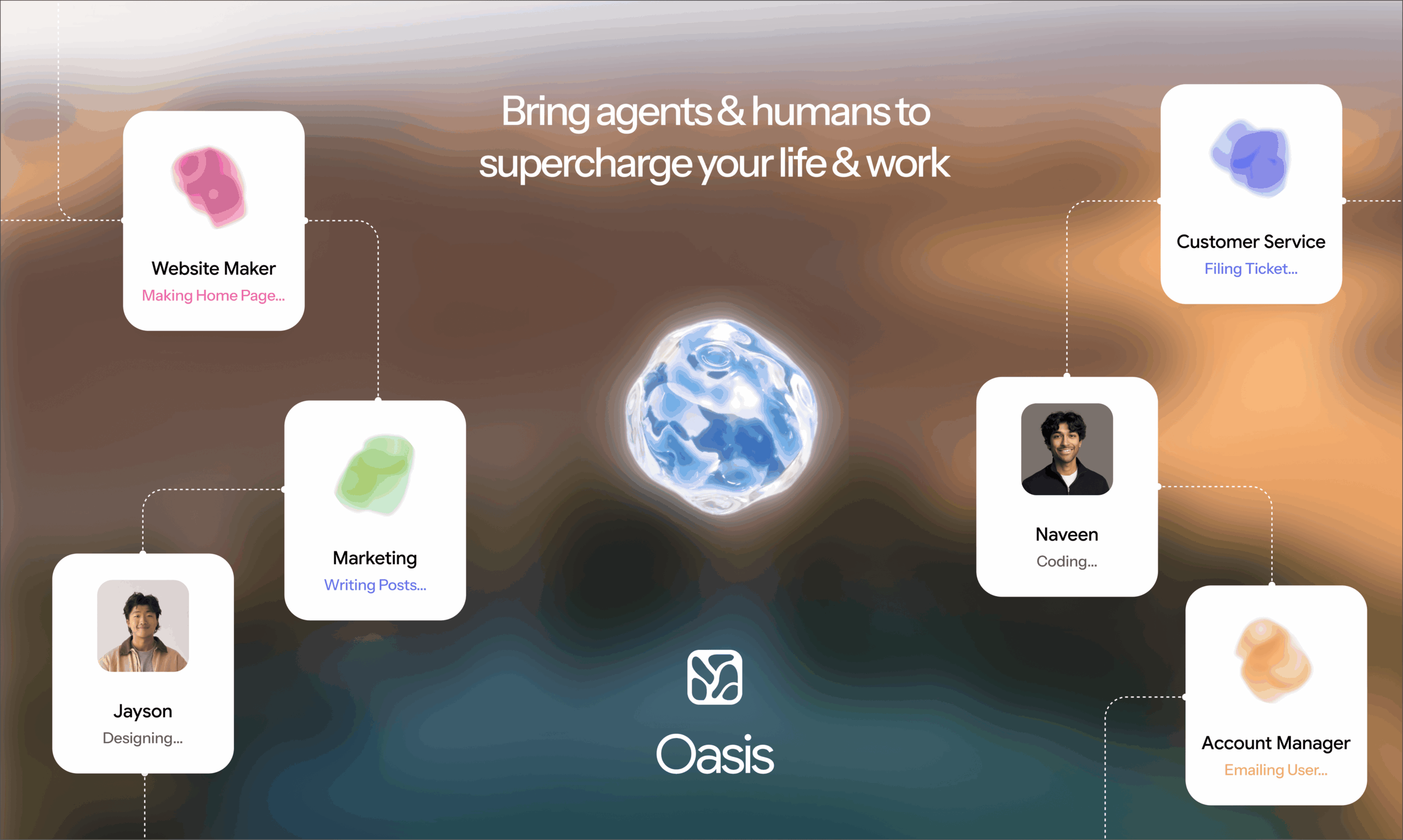
Oasis is a shared workspace in which employees and AI agents collaborate through persistent “rooms.” Teams can create cloud-hosted agents, connect external or local agents such as Claude Code, assign tools and models, schedule work, and edit documents, spreadsheets, or code artifacts alongside agents. The company positions the product as an operating environment for mixed human-agent teams rather than a conventional chatbot or single-user agent builder (official website; documentation).
The product targets technology companies and operational teams adopting multiple AI agents but lacking a unified interface for context, handoffs, permissions, and supervision. The underlying need is credible: as organizations deploy more agents, coordination, governance, approvals, shared memory, and cost control become increasingly important.
The strongest investment signal is the founding team. Both founders previously worked as forward-deployed engineers at Palantir, giving them relevant experience deploying software and AI systems into operational customer environments. Oasis is also part of a16z Speedrun’s sixth cohort, and the accelerator profile lists five employees in New York (a16z Speedrun).
The principal concern is the absence of commercial validation. No reliable public information was found for revenue, paying organizations, active teams, agent runs, retention, conversion, customer references, or gross margin. The product also competes directly with well-capitalized platforms, including OpenAI’s workspace agents, Dust, Microsoft Copilot Studio, Slack Agentforce, Relevance AI, Lindy, and Taskade.
Final Decision: Watch. Oasis has a capable team, a relevant product thesis, and a potentially large market, but current public evidence does not justify formal investment diligence. An upgrade to DD requires retained paying teams, evidence of differentiated multi-agent workflows, and credible unit economics.
Product Overview
Oasis addresses the fragmentation created when employees use separate AI applications, local coding agents, automation tools, and communication systems. Context must often be copied between agents, and teams lack a common view of what agents are doing, which systems they can access, and when human approval is required.
Its basic organizational unit is a “room,” a group conversation containing people, agents, messages, tasks, files, and shared artifacts. Agents can message one another, hand off tasks, and maintain plans for multi-step work. Oasis also describes a shared memory layer that accumulates context across workspace activity (documentation).
Agents created in Oasis run in its cloud by default. The platform can also connect external services such as Devin and Manus or local agents such as Claude Code and Codex. The native Mac application bridges local agents into shared rooms; the product is also offered through web, desktop, and mobile interfaces, although only a dedicated macOS download was independently verified (agents page; Mac download).
Templates cover sales research, email, CRM administration, customer support, product analytics, code review, incident response, recruitment, and personal productivity. Integrations include business applications such as Gmail, Slack, Salesforce, Zendesk, PostHog, GitHub, Jira, Linear, and other services, depending on the agent template (template library).
Public pricing is:
- Free: Three seats, ten integrations, ten scheduled rooms monthly, and open-source models.
- Starter: $19 per month for up to ten seats, 25 integrations, 20 scheduled rooms, and pay-as-you-go access to additional models.
- Pro: $199 per month for up to 50 seats, 50 integrations, 50 scheduled rooms, policies, SSO, exports, and auditing.
- Enterprise: Custom pricing, unlimited seats and integrations, data residency, dedicated support, and additional governance controls (pricing).
The unusually low base price per seat may encourage adoption, but it also suggests that meaningful revenue must come from usage charges or enterprise contracts.
Founder and Team Assessment
Stefano Fantini Delmanto is CEO, and Naveen Sharma is CTO. The a16z Speedrun profile identifies both as former Palantir forward-deployed engineers. Delmanto studied electrical engineering and religious studies at Stanford, while Sharma reports a background in AI, robotics, and applied mathematics (a16z Speedrun; Sharma profile).
Forward-deployed engineering is relevant founder-market experience: Oasis must integrate with customer systems, translate operational requirements into software, and gain trust for agents that can take business actions. The founders’ backgrounds therefore support technical execution and early enterprise discovery.
Oasis was founded in 2026. Both a16z and LinkedIn indicate a team of approximately five, while LinkedIn categorizes the company as having 2–10 employees (a16z Speedrun; LinkedIn). The careers page advertises a Member of Technical Staff role in New York, providing a limited but current hiring signal (careers).
No previous founder exits, independently verified revenue leadership, or experience scaling a large SaaS organization was found. A five-person team also creates substantial key-person dependency across infrastructure, enterprise security, integrations, selling, and support.
A legal-entity inconsistency requires clarification. The website footer refers to “Oasis, Inc.,” but the privacy policy and terms identify the service provider as Mercury Intelligence Inc. (privacy policy; terms). This may reflect a name change or trade name, but the relationship is not explained publicly.
Founder Assessment: Strong technical and customer-deployment backgrounds, but commercial scaling experience and legal-entity structure require verification.
Market Opportunity
The initial target segment is technology-enabled companies with 10–500 employees that already use multiple AI models or agents and need shared workflows, permissions, integrations, and human approvals. These customers may pay if Oasis reduces duplicate subscriptions, manual context transfer, failed automations, or agent-management overhead.
An illustrative bottom-up market scenario is:
- 50,000–200,000 addressable organizations
- $2,400–$24,000 annual revenue per organization
- Indicative addressable revenue: $120 million–$4.8 billion annually
These are analyst assumptions, not verified market figures. The low end approximates a Pro subscription, while the high end assumes usage charges or a small enterprise contract.
Expansion opportunities include regulated enterprises, agent monitoring, evaluation, identity and access management, workflow marketplaces, API revenue, data residency, private deployments, and cross-agent cost governance. Geographic expansion is technically feasible because the software is cloud-delivered, but enterprise data-residency and compliance requirements could slow international sales.
The market is large enough to support a venture-scale company. The harder question is whether Oasis can capture the coordination layer before model vendors, collaboration suites, or automation platforms bundle it.
Traction and Growth Signals
Oasis launched on Product Hunt on August 13, 2026, ranking fifth for the day with approximately 182 points at the observed snapshot (Product Hunt awards). This shows launch interest but provides no evidence of payment, retention, or sustained usage.
The product is publicly accessible with a free tier, documented functionality, a Mac application, templates, and a visible update history. The changelog records multiplayer rooms in July 2026, shared agent memory in June, local-agent connections in June, and room-performance improvements in May (changelog). This supports active product development.
Oasis is part of a16z Speedrun’s cohort 006, providing external selection and founder support. However, the accelerator page does not disclose company-specific investment terms or operating traction (a16z Speedrun).
No named customer case studies, independent marketplace reviews, verified user counts, revenue figures, or usage statistics were found. LinkedIn reported only several hundred company followers before launch, which is not commercially meaningful evidence.
The most important missing metrics are paid workspaces, weekly active teams, agent runs, free-to-paid conversion, cohort retention, AI usage revenue, enterprise pipeline, and customer concentration.
Traction Assessment: Active product development and credible accelerator backing, but commercially unverified.
Competitive Position
Direct competitors include Dust, Taskade, Relevance AI, Lindy, and other no-code agent platforms. Indirect competition includes Zapier, n8n, Slack, Microsoft Teams, Notion, and traditional workflow-management products. Free alternatives include combining open-source agent frameworks such as CrewAI or LangGraph with Slack, Discord, or internal interfaces.
The most material platform threat is OpenAI. Its workspace agents can be shared across organizations, operate in ChatGPT and Slack, use connected tools, run scheduled or long-duration tasks, maintain memory, request approvals, and provide enterprise administration—the same core problem Oasis is addressing (OpenAI workspace agents). Slack also embeds Salesforce Agentforce agents directly into existing team conversations (Slack).
Dust is a particularly close private-company competitor. It markets “multiplayer AI,” supports company context and human review, offers more than 70 connectors and multiple model providers, and claims adoption by over 3,000 organizations (Dust). Taskade offers shared projects, agent teams, automations, internal applications, and low-cost subscription plans (Taskade).
Oasis differentiates through agent-native rooms, agent-to-agent messaging, shared editable artifacts, connections to local agents, and a vendor-neutral interface. These features may be attractive to teams that do not want their workflows tied to one model provider.
Switching costs could develop through shared memory, custom agents, integrations, policies, and accumulated workflows. Currently, however, there is no verified evidence that these assets create meaningful lock-in or proprietary data. Network effects are weak because one customer’s adoption does not obviously improve the product for another.
If the largest platform launched the same feature within six months, why would customers remain? Oasis would need superior cross-model orchestration, better local-agent support, faster integrations, transparent economics, and a more usable collaborative interface. OpenAI has already launched much of the overlapping functionality, making this defense possible but unproven.
Defensibility Assessment: Low
Business Model and Economics
Oasis combines free and fixed-price SaaS plans with pay-as-you-go model usage and enterprise contracts. Bring-your-own API-key support may reduce Oasis’s working-capital and model-cost exposure, while managed usage can create expansion revenue.
Base subscription monetization is weak at current pricing. The Pro tier costs $2,388 annually and supports up to 50 seats, equivalent to less than $4 per seat per month before usage. This may be an intentional adoption strategy, but it leaves limited room for onboarding, support, storage, orchestration, and monitoring costs.
Variable expenses include model inference, tool calls, cloud agent execution, memory storage, integration maintenance, artifact storage, observability, and support. Long-running or multi-agent workflows can multiply costs because several agents may repeatedly read context and call external systems.
Enterprise economics could be more attractive through governance, SSO, SCIM, data residency, private deployment, audit logs, and support. Oasis advertises these controls, but no evidence of completed security certifications or enterprise contracts was found (enterprise page). The public security link leads primarily to a vulnerability-reporting program rather than a detailed compliance or audit report (bug bounty).
Unicorn Path
An 8× forward-ARR multiple is appropriate as a planning assumption for a high-growth SaaS and usage-based AI platform in a crowded category.
\[
\$1\text{ billion} \div 8 = \$125\text{ million required ARR}
\]
At current base pricing:
- Starter at $228 annually: approximately 548,000 customers
- Pro at $2,388 annually: approximately 52,300 customers
- Hypothetical $25,000 enterprise ACV: approximately 5,000 customers
- Hypothetical $100,000 enterprise ACV: approximately 1,250 customers
The Starter route is unrealistic for a venture-scale outcome. Oasis must therefore move upmarket, generate material usage revenue, or become an infrastructure layer that captures spending across many agents.
A unicorn outcome would require enterprise-grade security, substantial ACV expansion, thousands of retained organizations, gross margins likely above 70%, repeatable distribution, and defensible cross-model orchestration. It would also need to remain strategically valuable despite bundling by OpenAI, Microsoft, Salesforce, and Google.
Unicorn Path: Conditional
Valuation Assessment
Oasis is publicly identified as an a16z Speedrun company, but the company-specific financing amount, instrument, valuation, and ownership are not disclosed. Other investor references appear in social-media posts, but a complete financing announcement or cap table was not found.
Revenue, growth, gross margin, burn, runway, and current fundraising status are also unavailable. Comparable companies are at different maturity levels, making a valuation range unsupported.
Valuation Attractiveness: Not Assessable
Assessment requires current ARR, usage revenue, retention, gross margin, cash balance, burn, cap table, accelerator terms, outstanding SAFEs, proposed round size, post-money valuation, option pool, and liquidation preferences.
Key Risks
- No verified commercial traction: Paying customers, usage, retention, and revenue are unknown.
- Platform replication: OpenAI has already launched materially overlapping workspace-agent functionality.
- Weak current defensibility: Models, integrations, and agent frameworks are broadly available.
- Low base monetization: Pro pricing supports up to 50 seats for only $199 per month.
- Uncertain AI economics: Multi-agent workflows may create substantial inference and execution costs.
- Enterprise security gap: Compliance certifications and completed independent audits were not found.
- Crowded distribution environment: Oasis must displace products already embedded in Slack, Microsoft, OpenAI, and Salesforce.
- Small-team execution risk: Five employees must support a broad product and integration surface.
- Legal-entity ambiguity: Public pages inconsistently reference Oasis, Inc. and Mercury Intelligence Inc.
- Agent reliability and liability: Agents acting in email, CRM, finance, HR, or code systems can create costly errors.
Final Assessment
Venture Potential: 62/100
| Category | Score |
|---|---|
| Market Size and Expansion Potential | 18/20 |
| Traction and Growth Evidence | 6/20 |
| Founder and Team | 13/15 |
| Product Strength | 8/10 |
| Distribution Potential | 8/15 |
| Business Model and Economics | 5/10 |
| Defensibility | 4/10 |
| Total | 62/100 |
The strongest elements are founder-market fit, market timing, product coherence, and potential enterprise expansion. The weakest are absent commercial evidence, low monetization, powerful bundled competitors, and unproven defensibility.
Evidence Confidence: 52/100
Product availability, pricing, founder identity, a16z participation, team size, headquarters, documentation, and product updates are publicly supported. Product capabilities and security controls are primarily company-reported. Revenue, customers, usage, retention, financing amount, unit economics, valuation, burn, and runway are unavailable. The legal-entity inconsistency further reduces confidence.
Final Decision: Watch
Oasis is promising but too early and insufficiently validated for DD. Its product may become valuable if mixed human-agent work becomes a separate software category, but the company has not yet demonstrated that customers will adopt and retain a standalone workspace rather than use agent functionality embedded in existing platforms.
Upgrade Conditions
- At least $1 million in verified ARR or comparable usage revenue.
- More than 50 paying organizations with documented retention.
- Greater than 70% six-month logo retention.
- Referenceable enterprise customers using multi-agent rooms in production.
- Gross margin above 70% after inference and cloud execution.
- Repeatable acquisition beyond founder networks, a16z, and Product Hunt.
- Completed SOC 2 Type II or equivalent enterprise controls.
- Evidence that shared memory and cross-agent workflows create measurable switching costs.
Downgrade Conditions
- Weak free-to-paid conversion or declining weekly active teams.
- Customers using Oasis only for short experiments.
- AI costs increasing faster than usage revenue.
- Broad feature parity from OpenAI, Slack, or Microsoft.
- Failure to secure enterprise-grade compliance.
- Material agent errors involving customer systems or data.
- Reduced product-release cadence or founder departures.
- Misleading customer, security, or financing representations.
Questions for Further Diligence
- What are current ARR, MRR, usage revenue, and monthly growth?
- How many workspaces are paying, and how many are weekly active?
- What are 30-, 90-, and 180-day workspace retention rates?
- What percentage of free teams convert to Starter, Pro, or Enterprise?
- How many agent runs occur monthly, and how many involve multiple agents?
- What are model, storage, and cloud-execution costs per active workspace?
- What are gross margin and contribution margin by plan?
- Which acquisition channels generate retained paying customers?
- Why do customers choose Oasis over OpenAI workspace agents, Dust, or Taskade?
- What security certifications, penetration tests, and data-processing controls are complete?
- What is the relationship between Mercury Intelligence Inc. and Oasis, Inc.?
- What are current burn, runway, cap table, accelerator terms, and proposed financing valuation?