
Table of Contents
Shepherd Terminal Investment Report
Category: Developer tools — AI coding-agent workspace (macOS terminal)
Company Stage: Pre-company side project (free public beta); no legal entity identified
Founder or Founders: Junseo (Chato) Ko — solo developer, Seoul, South Korea
Headquarters: Not publicly disclosed (founder based in Seoul)
Funding: None identified; no funding disclosed
Business Model: None currently — free beta; monetization not disclosed
Product Hunt Launch Date: August 18, 2026
Report Date: August 21, 2026
| Investment Metric | Assessment |
|---|---|
| Venture Potential | 31/100 |
| Unicorn Path | No Credible Path |
| Valuation Attractiveness | Not Assessable |
| Evidence Confidence | 42/100 |
| Final Decision | Pass |
Executive Summary
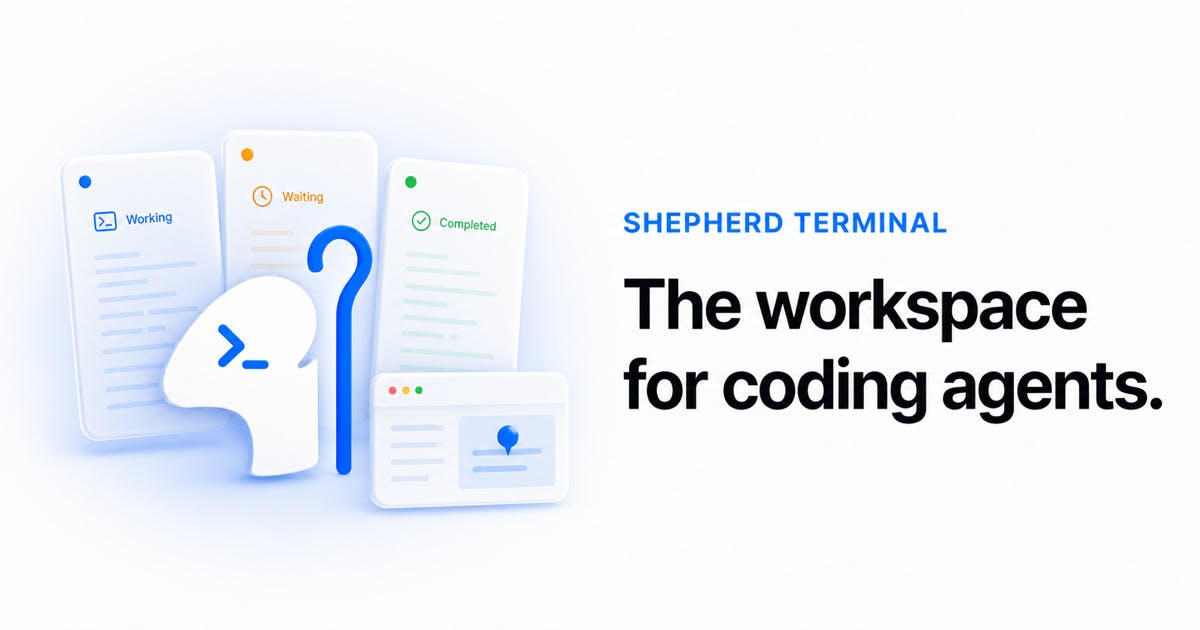
Shepherd Terminal is a free macOS app for running multiple AI coding agents (Claude Code, Codex) side by side. It keeps terminal sessions alive after the app closes, tracks which agents are working or waiting, resumes prior sessions with their files and Git history, connects to remote machines over SSH via a Rust session-keeper, and lets agents themselves inspect and control the workspace layout (Product Hunt).
The product is a thoughtful response to a real, current pain: developers running parallel coding agents lose track of state across terminal windows. The launch was credible — #7 on Product Hunt’s daily leaderboard for August 18, 2026 (leaderboard), roughly 122 upvotes and substantive technical comments (PH newsletter).
The strongest positive signal is product craft: the founder answered sophisticated security questions (cross-pane prompt-injection risk, untrusted sibling-pane output) with unusual care for a beta. The decisive negative is structural: this is a solo, part-time side project with no company, no business model, and no monetization plan, entering one of the most crowded and commoditized niches in developer tools.
The final decision is Pass. This may become a beloved indie tool or an acquihire credential; it is not currently a venture-scale opportunity, and nothing in the evidence suggests a path to one.
Product Overview
The customer problem: engineers running several coding agents concurrently lose sessions when apps close, can’t tell which agent needs input, and context-switch across terminals, Git tools, and browsers. Shepherd’s answer is a persistent agent-centric workspace: sessions survive app restarts; agents get real-time status monitoring; a plugin lets agents open panes, delegate work, and collect visual feedback through connected browser reviews; SSH targets run under a lightweight Rust keeper so dropped connections don’t kill remote processes (PH launch post; official site).
Core platforms: macOS 14+ on Apple Silicon only; an iOS monitoring companion is in development. Pricing: free (“first public beta”); no paid tier is published. It replaces ad-hoc tmux/iTerm window juggling and manual agent babysitting. The product is live and downloadable — verifiably real, though beta-quality by the founder’s own admission.
Founder and Team Assessment
Junseo Ko is identity-verified via GitHub and LinkedIn: a machine-learning engineer at PRND Company (operator of HeyDealer, a Korean used-car marketplace), previously an AI engineer at RAONDATA (2021–2024), with an IEEE-published traffic-prediction paper and Sungkyunkwan University coursework. Technical capability is credible for an ML/systems builder; the Rust session-keeper and local STT feature support that.
Two material concerns. First, commitment: LinkedIn lists his founder project as “Kotoro, AI cat companion in your chrome” (January 2026–present) — not Shepherd — while he remains employed at PRND, indicating Shepherd is a nights-and-weekends effort. Second, there is no team, no company entity, and no commercial track record. Key-person risk is total.
Founder Assessment: Skilled technical solo builder, but part-time commitment and absent commercial infrastructure cap the venture case.
Market Opportunity
The initial customer is narrow: individual Mac-using developers who run two or more CLI coding agents in parallel — realistically a subset of the few million developers using Claude Code/Codex-style tools. Willingness to pay is the problem: the category’s pricing evidence is weak. Vibe Kanban ended its paid cloud plans in April 2026; Conductor remains free; Nimbalyst charges $20/user/month for teams (category comparison). A plausible analyst estimate: even 100,000 paying individual developers at $60–100/year yields only $6–10M ARR at maturity — a fine indie business, not venture scale. Adjacent expansion (team orchestration, enterprise agent governance) is theoretically larger but is exactly where Anthropic, OpenAI, and funded platforms are building. The realistic addressable market does not currently support venture-scale revenue for a standalone entrant.
Traction and Growth Signals
Available evidence: #7 daily Product Hunt ranking (August 18, 2026), ~122 upvotes, 16 comments, 188 product followers, and a 4.0 rating from one review. Comment quality is high — users probed SSH mid-write recovery and cross-pane security, and the founder’s detailed answers drove follow-up engagement. A Japanese-language blog covered the launch independently (note.com). There is no evidence of downloads, active users, retention, revenue, or a public repository with measurable adoption. Some secondary coverage (Stork.ai, 24aiglobal) conflates this product with an unrelated academic open-source project also named Shepherd (shepherd-agents.ai, Northeastern/Stanford, launched August 8, 2026) — treat those reviews as unreliable. Missing metrics: downloads, weekly active users, retention, and any monetization signal.
Traction Assessment: A respectable launch-day showing; commercially unverified and three days old.
Competitive Position
This is the report’s decisive section. Direct competitors are numerous and mostly free: Vibe Kanban (~27,500 GitHub stars, Apache-2.0), Claude Squad (~8,200 stars, AGPL), Conductor (Melty Labs; macOS, proprietary, free), plus Crystal (deprecated), Superset, Paneflow, Nimbalyst, CodeAgentSwarm, Abralo, Pane, Sculptor, and DIY tmux setups (comparison 1; comparison 2). Funded adjacents include Warp ($73M raised from Sequoia/GV, now an agentic platform — Wikipedia); Sacra). Most importantly, the platform vendors themselves — Anthropic and OpenAI — are steadily absorbing session management, notifications, and mobile monitoring into Claude Code and Codex natively.
Shepherd’s genuine differentiators are persistence architecture (the Rust keeper), agent-controlled workspace layout, and browser-review feedback loops. None are defensible: all are replicable features, and open-source incumbents ship weekly. If Anthropic shipped native multi-agent session management within six months, there is no credible reason most users would keep a separate third-party terminal. A further unforced risk: the name collides with a same-month, same-category academic project, and the official site sits on a personal subdomain (“sheperd.kojunseo.link”) — weak brand foundations.
Defensibility Assessment: Low
Business Model and Economics
There is no business model. The app is free; no pricing page, paid tier, or monetization statement exists. The founder’s costs are minimal (local app, no obvious inference spend — STT runs locally), so sustainability is not the issue; venture-scale revenue is. Category evidence suggests weak willingness to pay: the most-starred competitor abandoned paid plans, and the leading proprietary alternative remains free. Any future model (Pro subscription, team tier, enterprise governance) would need to be validated from zero against free open-source substitutes. Gross-margin potential would be high for software, but customer acquisition in a category where GitHub stars drive adoption favors open-source distribution, which Shepherd has not chosen (no public repo was found).
Unicorn Path
No revenue model exists to apply a multiple to. Even granting a hypothetical $10/month Pro tier, a $1B valuation at a generous 10x ARR would require $100M ARR — roughly 830,000 paying developers — in a category where the most popular tool is free and open-source with 27,500 stars, and where platform vendors give the core capability away. There is no reasonable route to venture-scale revenue under the current or foreseeable model. The realistic ceilings are: a sustainable indie product (low six figures ARR), a talent acquisition, or portfolio value for the founder’s next venture.
Unicorn Path: No Credible Path
Valuation Assessment
No funding, valuation, investors, or financing terms exist or were found. There is no entity to invest in as far as public evidence shows.
Valuation Attractiveness: Not Assessable. Required to assess: incorporation, founder’s full-time commitment, a monetization plan, user and retention data, and proposed round terms. Any valuation discussion today would be pure speculation.
Key Risks
- No business model or monetization plan in a category with demonstrated weak willingness to pay.
- Platform absorption: Anthropic/OpenAI can bundle session persistence and monitoring into Claude Code/Codex at any time.
- Free, open-source incumbents (Vibe Kanban, Claude Squad) with 30–100x the community adoption.
- Solo, part-time founder with full-time employment and a different listed founder project — continuity risk is acute.
- Brand/name collision with the academic “Shepherd” agent project launching the same month; personal-subdomain hosting compounds weak brand infrastructure.
- Security surface: agents controlling sibling panes introduces prompt-injection risk; safeguards are roadmap items, not shipped defaults.
- Platform narrowness: Apple-Silicon macOS only, excluding Linux-heavy power users and enterprises.
- No organization, cap table, or governance — there is currently nothing to fund.
- Beta quality with a single maintainer; support burden scales faster than capacity.
- Distribution depends on one launch channel; no evidence of sustained organic acquisition.
Final Assessment
Venture Potential: 31/100
| Category | Score |
|---|---|
| Market Size and Expansion Potential | 9/20 |
| Traction and Growth Evidence | 3/20 |
| Founder and Team | 5/15 |
| Product Strength | 6/10 |
| Distribution Potential | 4/15 |
| Business Model and Economics | 1/10 |
| Defensibility | 3/10 |
| Total | 31/100 |
Strongest element: a genuinely well-designed product answering a real workflow pain. Weakest: no company, no model, no moat, in a commoditizing category.
Evidence Confidence: 42/100
Verified: product existence and launch results (Product Hunt), founder identity and employment (GitHub, LinkedIn), competitive landscape. Company-reported: architecture claims (Rust keeper, local STT). Unavailable: users, downloads, retention, revenue, entity status, and any funding information — because none appears to exist.
Final Decision: Pass
Pass reflects structure, not product quality. The venture case fails on commitment (part-time solo founder), business model (none), defensibility (free incumbents plus platform vendors), and market ceiling. The founder could be reconsidered if he incorporates, commits full-time, open-sources or otherwise solves distribution, and shows sustained weekly-active growth with early paid conversion — at which point this becomes a different conversation, likely still at pre-seed scale.
Upgrade Conditions
- Founder goes full-time and incorporates
- 10,000+ weekly active users with published retention cohorts
- A paid tier with measurable conversion (even 2–3% would be signal)
- Open-source release achieving top-three GitHub star velocity in the category
- Differentiated enterprise angle (agent audit/governance) with pilot customers
Downgrade Conditions
- Commit frequency declining or the project going quiet post-launch
- Anthropic or OpenAI shipping native multi-agent session management
- Founder prioritizing Kotoro or other projects
- Security incident involving cross-pane agent control
- Continued absence of any monetization six months post-launch
Questions for Further Diligence
- Is Shepherd a company or a side project — and do you intend to incorporate and work on it full-time?
- What are current downloads, weekly active users, and week-1/week-4 retention since launch?
- How do you intend to make money, and what have users told you they’d pay for?
- Why will you win against Vibe Kanban (27.5k stars, free) and Conductor (free, Mac-native)?
- What happens to Shepherd if Claude Code ships native session persistence and a mobile monitor?
- Will you open-source any component to compete for GitHub-driven distribution?
- What is the permission model roadmap for cross-pane agent control, and will read-only be the default?
- How does the iOS companion fit a business model — is monitoring the paid wedge?
- What is your arrangement with PRND regarding IP and time commitment?
- Why the name Shepherd given the same-month academic project, and will you rebrand?
- What would you do with a $500K–$1M pre-seed check, and what milestones would it fund?
- Are you raising at all — and if not, what is the endgame for the project?
Sources
- Product Hunt — Shepherd Terminal and August 18, 2026 daily leaderboard
- Product Hunt newsletter — launch-day stats
- Official site
- Founder GitHub and LinkedIn
- Nimbalyst — agent-management tool comparison; CodeAgentSwarm comparison; Munder Difflin comparison
- Warp — Wikipedia) and Sacra profile
- Unrelated academic Shepherd project (name collision); OpenSourceForU coverage
- Independent Japanese coverage (secondary)