
Table of Contents
nenspace Investment Report
Category: AI personal productivity, note-taking, and reflective assistant
Company Stage: Bootstrapped, early product stage
Founder or Founders: Sam Morris
Headquarters: Not publicly disclosed; founder is based in London, United Kingdom
Funding: Company-reported as entirely self-funded
Business Model: Freemium consumer subscription
Product Hunt Launch Date: August 15, 2026
Report Date: August 18, 2026
| Investment Metric | Assessment |
|---|---|
| Venture Potential | 45/100 |
| Unicorn Path | Improbable |
| Valuation Attractiveness | Not Assessable |
| Evidence Confidence | 50/100 |
| Final Decision | Pass |
Executive Summary
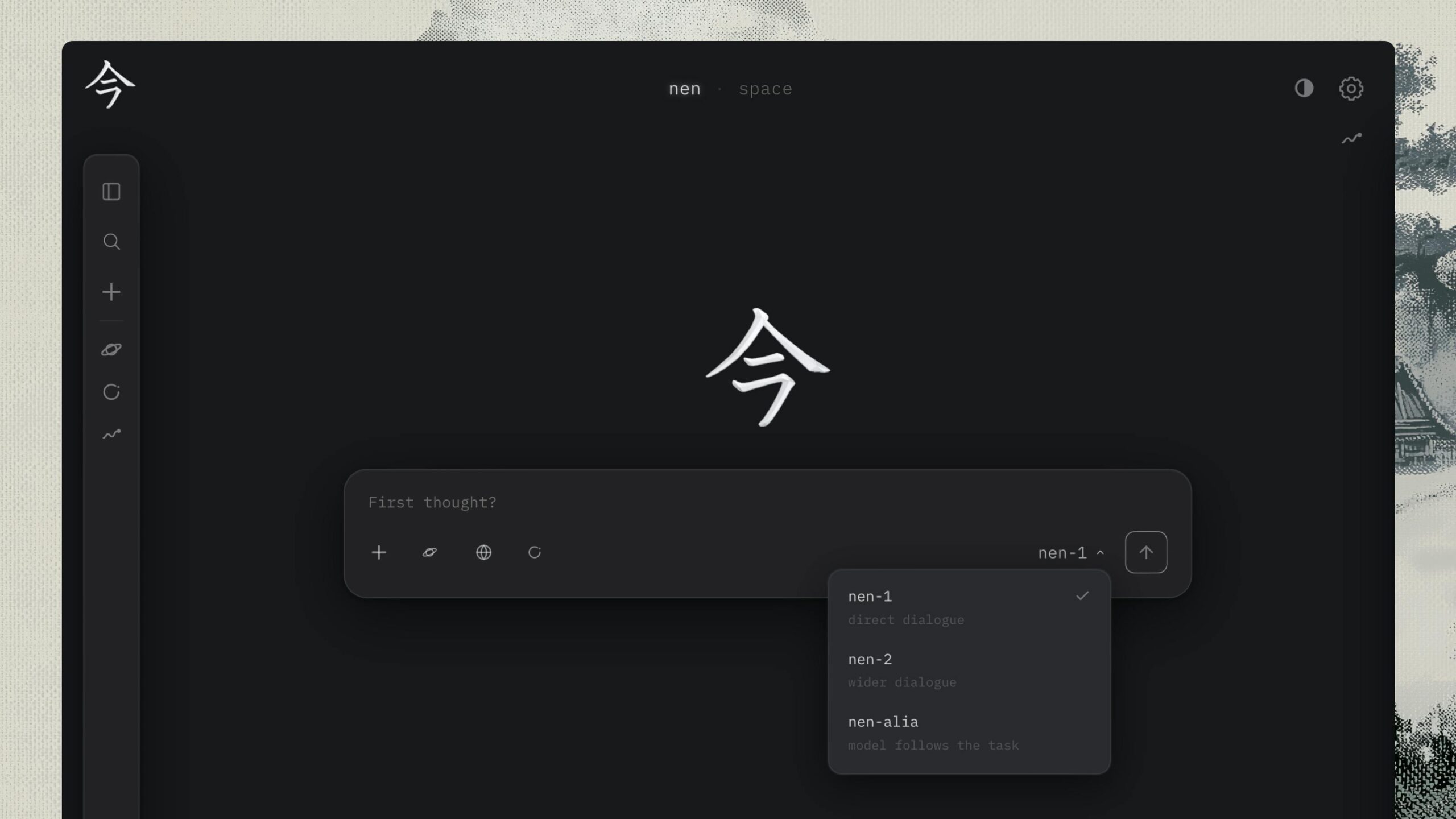
nenspace combines an AI dialogue product with notes, tasks, habits, a logbook, working-memory capture, and automated organization. Its principal differentiation is nen-1, a company-described fine-tuned model intended to question assumptions, avoid sycophancy, and respond more concisely than mainstream assistants. The product is available on the web and iPhone, with a free tier and a $13 monthly or $129 annual Pro subscription (official website; App Store).
The product is conceptually coherent and appears functional. Its “Sift” workflow—capturing thoughts without immediately categorizing them, then proposing destinations such as notes, tasks, or habits—addresses a genuine usability problem in personal knowledge management. Integrating AI directly into the resulting workspace may be more useful than operating a chatbot and productivity applications separately.
The strongest positive signal is founder-led product execution. Sam Morris appears to have built and launched a web and iOS product, created a paid subscription system, and developed a distinctive product philosophy as a solo, self-funded founder. The App Store also shows a recent version update, indicating active development (App Store).
The investment case is substantially weaker than the product case. The app does not yet have enough App Store ratings to display an overview, and no reliable public evidence was found for revenue, paying subscribers, active users, conversion, retention, or repeatable acquisition. The founder’s LinkedIn history describes nenspace as a side project and shows simultaneous full-time or founding go-to-market work at another company, creating material commitment and key-person risks (Sam Morris LinkedIn).
The current business is more consistent with an attractive bootstrapped personal-software product than a venture-scale company. Reaching venture outcomes would require exceptional consumer retention, much broader distribution, and likely a team or professional product with higher annual contract values. The decision is Pass, with reconsideration possible following verified commercial traction and full-time founder commitment.
Product Overview
nenspace addresses fragmentation between AI chat, note-taking, task management, habit tracking, and journaling. Users capture thoughts into “working memory”; the Sift feature proposes where each item belongs, while users retain approval over changes. The workspace includes notes, tasks, habits, a logbook, saved dialogues, memory, file input, and cited web search (product overview).
The AI component includes nen-1 and other model experiences presented on Product Hunt. The company says nen-1 is fine-tuned “in the weights” to be concise, challenge assumptions, and avoid excessive agreement rather than relying only on a system prompt (founder essay). This is a company-reported technical claim; no independent benchmarks, model card, training methodology, dataset documentation, or comparative evaluation was found.
The free Practice tier includes core workspace functions and access to nen-1, subject to usage limits that are not fully explained on the public page. Pro costs $13 per month after a 30-day trial. Apple lists the annual plan at $129 (pricing; App Store).
The product is currently available on the web and iPhone. No verified Android, Windows, or macOS-native application was found. Alternatives include ChatGPT plus Notion, Obsidian, Todoist, Apple Notes, Google Keep, Reflect, Mem, and pen-and-paper workflows.
Founder and Team Assessment
The App Store identifies the seller as Samuel James Morris, while Product Hunt identifies the maker as Sam. Morris’s LinkedIn profile lists a philosophy degree from the University of Leeds and experience in growth or go-to-market roles at Notte and subsequently Overmind. It also identifies nenspace as a solo side project rather than his principal employment (LinkedIn; App Store).
The LinkedIn company page reports one employee, a 2025 founding year, and an entirely self-funded operation (company profile). This is consistent with a solo-founder product, although the exact legal entity is not disclosed in the terms. The iOS application is published under Morris’s personal name.
Morris demonstrates product taste, positioning ability, and enough technical execution to ship a working AI application. However, no prior startup exit, scaled subscription business, advanced machine-learning research record, or independently verified model-training background was found. His concurrent role elsewhere makes full-time commitment unclear.
There are no public hiring signals. Engineering, model operations, security, support, and marketing appear highly concentrated in one person.
Founder Assessment: Strong solo product execution and differentiated positioning, but technical depth, full-time commitment, and ability to build a venture-scale organization remain unproven.
Market Opportunity
The initial customer is an English-speaking knowledge worker, student, founder, or reflective-productivity enthusiast who currently combines an AI subscription with notes, tasks, habits, and journaling applications. The product’s $129 annual price is comparable with Mem’s reported $12 monthly Pro plan and Reflect’s approximately $120 annual pricing, while remaining below ChatGPT Plus at $20 per month (Mem pricing; Reflect; ChatGPT pricing).
A bottom-up scenario illustrates the opportunity but does not establish demand. If 5–20 million global productivity power users are realistically addressable and annual gross revenue per payer is $129, the theoretical segment represents approximately $645 million–$2.6 billion in annual billings. These user figures are analyst assumptions, not verified market data.
The practical market is constrained by free alternatives. Notion, Obsidian, Google Keep, Apple Notes, and general-purpose AI assistants cover substantial parts of the workflow at no cost. Obsidian, for example, is free for personal and commercial use (Obsidian pricing).
Adjacent opportunities include coaching-oriented reflection, student planning, creator knowledge management, and professional team workspaces. A B2B version could raise annual contract value, but nenspace currently presents itself as an individual, introspective product rather than a collaborative business system.
Traction and Growth Signals
nenspace launched on Product Hunt on August 15, 2026. An unverified third-party tracker recorded approximately 132 Product Hunt upvotes; this represents launch attention, not commercial traction (Product Hunt; secondary launch tracker).
The iOS application is live and was updated to version 1.1.0 shortly before this report. However, Apple states that it has not received enough ratings or reviews to display an overview. Downloads are not publicly disclosed.
Several Reddit comments mention using nenspace and praise its consolidated workflow. These comments are anonymous, receive minimal engagement, and include repeated recommendations from the same account, making their independence and representativeness uncertain (Reddit discussion). They should not be treated as customer references.
No reliable evidence was found for registered users, active users, paid subscribers, revenue, growth, retention, trial conversion, website traffic, or customer acquisition efficiency.
Traction Assessment: Product activity is verified, but commercial traction is effectively unproven.
Competitive Position
Direct competitors include Mem, Reflect, Notion AI, Tana, Capacities, Fabric, and other AI-native personal knowledge-management products. Indirect competitors include ChatGPT, Claude, Obsidian, Todoist, Apple Notes, Google Keep, journaling applications, and separate habit trackers.
nenspace’s strongest differentiation is the pairing of a deliberately non-sycophantic model with an integrated memory and productivity workspace. The capture-and-Sift workflow may reduce the organizational burden associated with conventional note systems.
However, switching costs are currently low. Users can export their data, and notes, tasks, habits, memory, and AI chat are widely available elsewhere. No network effects, proprietary distribution, exclusive integrations, or independently validated model advantage are evident.
If Notion, OpenAI, Anthropic, Apple, or Mem launched a comparable assumption-challenging mode with automated note triage within six months, users would continue using nenspace only if its model consistently produced superior reflective outcomes and its workspace accumulated highly valuable personal context. That advantage has not yet been demonstrated empirically.
Defensibility Assessment: Low
Business Model and Economics
nenspace operates a freemium subscription model. Pro pricing implies gross annual contract value of $129–$156, depending on annual or monthly billing. Web purchases use Stripe, while iOS purchases are subject to Apple’s payment rules and commissions.
Variable costs include inference from Together AI, OpenAI, Anthropic, and Overmind, plus Supabase hosting, storage, authentication, web search, file processing, and support. The company states that nen’s fine-tuned models are hosted by Together AI and that user messages may be processed by multiple model providers (privacy policy).
Gross margin is not publicly disclosed. Heavy users could generate substantial inference and search costs while paying a fixed subscription, making rate limits and model routing important. Conversely, concise responses may reduce inference expense if the product successfully encourages shorter outputs.
Consumer economics also depend on trial conversion, annual renewal, App Store mix, and paid acquisition. None is publicly known. Team subscriptions, coaching plans, or professional knowledge-management offerings could improve revenue per account but do not currently exist publicly.
Unicorn Path
An 8× revenue multiple is assumed for a rapidly growing subscription software company with durable retention and gross margins above approximately 70%. This is lower than premium enterprise SaaS because nenspace currently has consumer concentration, low switching costs, and AI-variable-cost exposure.
Required ARR would be:
$1 billion ÷ 8 = approximately $125 million
At $129 annual list pricing, approximately 969,000 annual subscribers would be required before fees and discounts. Assuming effective net annual revenue of $100–$120 after payment fees, App Store commissions, promotions, and refunds, nenspace would need approximately 1.0–1.25 million paying subscribers.
That scale is improbable for a solo, English-only personal productivity application without proven organic distribution. Achieving it would likely require a full-time team, Android and desktop availability, international expansion, independently validated model differentiation, strong consumer retention, and higher-ACV team or professional plans.
Unicorn Path: Improbable
Valuation Assessment
The company reports being self-funded. No external rounds, investors, SAFE cap, secondary transaction, current fundraising process, or valuation were found.
Mem provides category evidence, having raised a $23.5 million round led by the OpenAI Startup Fund, but its financing does not establish a defensible valuation for nenspace because commercial metrics and team maturity differ materially (TechCrunch).
Valuation Attractiveness: Not Assessable
Responsible assessment requires current ARR, growth, retention, gross margin, inference cost, burn, runway, capitalization, proposed round size, SAFE cap or post-money valuation, and financing terms.
Key Risks
- No verified revenue, paid-customer, conversion, or retention evidence.
- Founder appears to maintain another principal employment commitment.
- A one-person team creates extreme operational and key-person dependency.
- Differentiated model behavior is not supported by independent benchmarks.
- Major AI and productivity platforms can replicate the core features.
- Consumer productivity applications often experience weak long-term retention.
- Fixed subscription pricing may be pressured by inference and search costs.
- iPhone-only native availability limits distribution; Android is absent.
- Sensitive journals, memories, and personal reflections create significant security and privacy obligations.
- Positioning against mainstream AI may attract a niche audience without supporting mass-market demand.
Final Assessment
Venture Potential: 45/100
| Category | Score |
|---|---|
| Market Size and Expansion Potential | 13/20 |
| Traction and Growth Evidence | 4/20 |
| Founder and Team | 6/15 |
| Product Strength | 7/10 |
| Distribution Potential | 5/15 |
| Business Model and Economics | 6/10 |
| Defensibility | 4/10 |
| Total | 45/100 |
The strongest elements are product coherence, differentiated positioning, and solo execution. The weakest are commercial evidence, founder commitment, distribution, and defensibility.
Evidence Confidence: 50/100
The product, pricing, platforms, seller identity, privacy architecture, recent release activity, and founder profile are publicly verifiable. Self-funding, product philosophy, and model behavior are company-reported. Market sizing and unicorn-customer requirements are analyst estimates. Revenue, usage, retention, costs, funding terms, legal entity, and valuation remain unknown.
Final Decision: Pass
nenspace may become a sustainable bootstrapped product, but it does not currently support a compelling venture case. Product quality is promising; company readiness and venture-scale evidence are weak. The founder’s apparent side-project status, absence of commercial metrics, low defensibility, and requirement for roughly one million paying subscribers make the current risk-return profile unattractive for institutional venture capital.
Upgrade Conditions
- Founder commits full time and clarifies the company’s legal and ownership structure
- At least $1 million ARR with strong organic growth
- More than 60% twelve-month paid retention
- Gross margin above 70% after all model and search costs
- Independently validated evidence that nen-1 outperforms prompt-based alternatives
- Repeatable acquisition outside Product Hunt and founder-led community posts
- Android and desktop distribution
- Credible higher-ACV team or professional offering
Downgrade Conditions
- Continued operation solely as a side project
- Weak trial-to-paid conversion or high early churn
- Material reduction in release frequency
- Rapid replication by a major AI or productivity platform
- Unsustainable inference costs or restrictive usage limits
- Security, privacy, or inappropriate mental-health guidance incidents
- Unsupported or misleading claims about proprietary model performance
Questions for Further Diligence
- What are current MRR, ARR, and monthly revenue growth?
- How many registered, monthly active, weekly active, and paying users exist?
- What are trial-to-paid conversion and monthly subscriber churn?
- What are 30-, 90-, 180-, and 365-day retention by cohort?
- How often do retained users engage with nen-1, Sift, notes, tasks, and habits?
- What model and dataset underlie nen-1, and what independent evaluations support its differentiation?
- What are inference, search, storage, and support costs per free and paid user?
- What percentage of subscriptions comes through Apple versus Stripe?
- Is Sam Morris committed full time, and who maintains engineering and model infrastructure?
- What are the legal entity, cap table, burn rate, and runway?
- Is the company raising capital; if so, what are the round size, valuation, and terms?
- How does the roadmap create durable differentiation if major platforms add similar workflows?