
Table of Contents
Deepmark Investment Report
Category: Consumer productivity / AI-powered personal knowledge management (bookmark search)
Company Stage: Pre-seed / bootstrapped indie product (launched publicly August 2026)
Founder or Founders: Solo founder, publicly identified only by the handle “Shafkathullah” (shafu.xyz); full legal identity not independently verified
Headquarters: Operated from India (per Terms of Service); founder has indicated Dubai/remote availability
Funding: Not publicly disclosed; no funding found — appears bootstrapped
Business Model: Consumer subscription SaaS — $10/month or $84/year, no free tier
Product Hunt Launch Date: Week of August 20, 2026 (Show HN: August 13, 2026)
Report Date: August 21, 2026
| Investment Metric | Assessment |
|---|---|
| Venture Potential | 35/100 |
| Unicorn Path | Improbable |
| Valuation Attractiveness | Not Assessable |
| Evidence Confidence | 40/100 |
| Final Decision | Pass |
Executive Summary
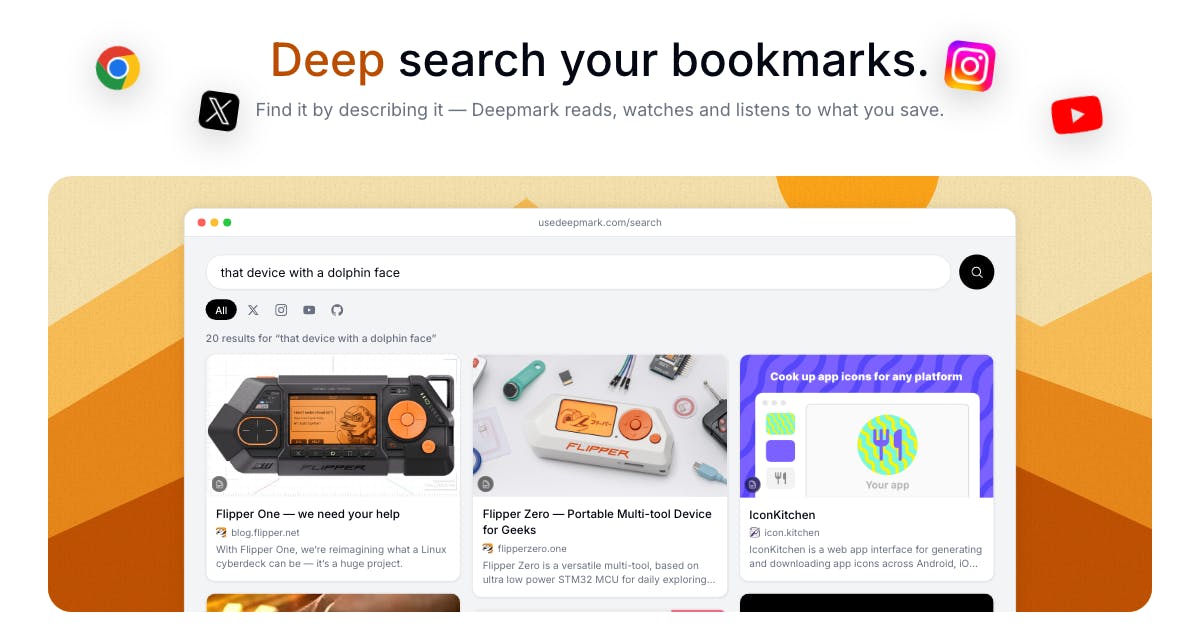
Deepmark is an AI-powered bookmark search tool: it imports browser bookmarks, X bookmarks, Instagram saves, and YouTube Watch Later/Liked lists into one private library, then indexes what is inside each save — page text, video transcripts in ~99 languages, OCR of on-screen text, and visual descriptions — so users can find saves with natural-language queries. It also exposes the library as a hosted MCP server so AI agents (Claude, Cursor, ChatGPT) can search it.[1][2]
The product is genuinely well-conceived. It attacks a real, widely felt problem (saved content is never retrieved), the deep-indexing approach is meaningfully differentiated from title-based bookmark managers, and the founder’s public communication is unusually candid — including honest answers about limitations such as all-or-nothing browser bookmark indexing. The strongest positive signal is product quality combined with a working, paid product shipped by a single developer in days since launch.[1]
The core investment concern is structural, not executional: this is a solo-built consumer subscription tool in a category — bookmark managers / personal knowledge management — that has never produced a venture-scale outcome. At $84/year with no free tier, the unicorn math requires on the order of 1.5–2 million paying subscribers, a figure no product in this category has approached. There is no disclosed revenue, user count, funding, or team.
Because the venture case is weak on market structure, defensibility, and scale path — while the product itself is credible — the appropriate decision is Pass for a venture strategy, with explicit reconsideration conditions. This is a judgment about venture fit, not product quality; Deepmark looks like a promising bootstrapped business.
Product Overview
The customer problem: people save links, reels, and videos across browsers and social apps and almost never find them again, because retrieval depends on remembering titles or folders. Deepmark replaces the “remember the title” workflow with “describe what you remember” — e.g., “the reel with the one-pan pasta trick”.[1]
How it works: a Chrome extension imports the full bookmark tree and auto-indexes new bookmarks; X, Instagram, and YouTube syncs are opt-in per site and run in the background through the user’s own browser session. Each save is fetched, transcribed, OCR’d, visually described, summarized, and embedded; a reel is reportedly searchable ~90 seconds after saving, and search over a 10,000-item library returns in under 100ms (company-reported figures). The stack is Neon Postgres with pgvector/HNSW, Cloudflare, and Polar for payments.[1][2][3]
Pricing is a single tier: $10/month or $84/year, no free plan, with a demo library behind sign-up. Known gaps the company itself discloses: no mobile apps, no self-hosting, export only by email request, and no per-folder bookmark exclusion yet. The product is live and verifiable; the Chrome extension is at version 0.3.1, updated August 7, 2026.[1][4][5]
Founder and Team Assessment
The founder is publicly identifiable only by the handle “Shafkathullah” (personal site shafu.xyz; Chrome Web Store contact hey@shafu.xyz; a LinkedIn post under the same handle describes building Deepmark after struggling with 10,000+ personal saves). Directories variously render the name as “Shafkat Hullah,” which appears to be a garbled parse; the full legal name and any corporate entity are not verified. Hacker News activity under the same handle shows a full-stack engineer (React, TypeScript, Cloudflare Workers) who has posted in “Who wants to be hired” threads as Dubai-based/remote and open to relocation — a signal that raises, but does not confirm, questions about full-time commitment.[4][6][7][8]
Team size: appears to be a solo founder; not verified. No prior companies, exits, or commercial track record could be confirmed. Technical execution capability is demonstrated by the shipped product; commercial capability is unproven.
Founder Assessment: Demonstrated solo technical execution and unusually honest communication, but identity, commitment, and commercial capability remain unverified.
Market Opportunity
The initial customer is narrow: a “power saver” — a knowledge worker or researcher with thousands of saves across a browser plus X/Instagram/YouTube, who feels retrieval pain strongly enough to pay $84/year. That is a real but thin slice of the consumer/prosumer productivity market.
A bottom-up view: bookmark-manager users number in the tens of millions globally, but paid conversion in this category is historically low. The category’s largest independent player, Raindrop.io, is estimated by one third-party directory at roughly $3.8M annual revenue (range $1.9M–$12.2M, self-described 27% confidence — treat as a low-confidence estimate) after more than a decade in market. Pocket, the category’s best-known name, was shut down by Mozilla in 2025 with user data deleted. Readwise Reader, mymind, and others serve overlapping niches at similar price points. No company built primarily on bookmark saving/search has reached venture scale.[9][10]
Adjacent expansion — positioning the library as the personal knowledge layer for AI agents via MCP — is the most interesting expansion vector, but it is speculative, contested by every major AI platform building its own memory, and not yet evidenced by any traction. The realistic addressable market supports a solid indie business; it does not obviously support venture-scale revenue.
Traction and Growth Signals
- Product Hunt product page shows 116 followers; the launch occurred this week, so launch-day ranking data is not yet meaningful.[1]
- A Show HN post on August 13, 2026 generated discussion, including pricing pushback (“is price too much?”) to which the founder floated one-time indexing payments.[8][11]
- Product Hunt comments are few but substantive; the founder’s candid answers (e.g., admitting browser bookmarks are all-or-nothing with no exclusion filter) drew positive responses.[1]
- Chrome Web Store listing exists but shows no disclosed user count.[4]
- Revenue, paying customers, registered users, retention: not publicly disclosed. No funding announcements exist.
Launch attention is present but minimal in absolute terms, and there is zero commercial data. The most important missing metrics: paying subscriber count, free-demo-to-paid conversion, and 90-day retention.
Traction Assessment: Early launch interest only; commercially unverified.
Competitive Position
Direct competitors: Raindrop.io, mymind, Karakeep (open-source, self-hostable), Linkwarden (open-source), SaveDay, and Readwise Reader; Product Hunt lists Stacks, IKI.AI, Fabric, and Heyday as adjacent alternatives. Free/manual alternatives: browser-native bookmark search, Chrome history search, platform-native saves, and simply pasting links into ChatGPT/Claude. Deepmark’s own comparison pages concede cases where Raindrop and mymind are better choices.[5][12][13][14]
Differentiation is real but narrow: deep media indexing (transcription, OCR, visual description) across four sources, plus an MCP server, is ahead of most incumbents’ keyword/full-text search. However, the platform-replication test fails: if Raindrop, Readwise, Google, or an AI assistant vendor shipped transcript-level search of saves within six months — all technically straightforward for them — there is no switching cost, network effect, or proprietary data moat keeping users. Sync depends on X, Instagram, and YouTube endpoints that those platforms can restrict at will.[1]
Defensibility Assessment: Low
Business Model and Economics
Single-tier consumer subscription at $84/year (or $10/month), payments via Polar, no free tier. Gross-margin structure is the key unknown: every save triggers fetching, transcription, frame description, OCR, summarization, and embedding, so variable AI inference costs scale with usage — heavy users with 10,000+ saves (the target persona) are also the most expensive to serve. The “fair-use media indexing” line in pricing implies the company is aware of this exposure. Consumer subscription dynamics — low willingness to pay (visible in the HN pricing pushback ), churn after novelty fades, no expansion revenue, no team/enterprise tier — cap lifetime value. Assumptions requiring verification: inference cost per indexed hour of video, average saves per user, and demo-to-paid conversion.[2][3][8]
Unicorn Path
Assumed multiple: 6–8x ARR, appropriate for a consumer subscription SaaS with typical churn and no network effects. Required revenue for a $1B valuation: roughly $125M–$165M ARR. At $84/year net of payment processing, that implies approximately 1.5–2 million paying subscribers — likely 30–100x the entire current paid subscriber base of the category’s leading independent players, and in a category where the most famous product (Pocket) was discontinued.[9][10]
Reaching that scale would require transforming from a solo-built consumer utility into the default personal knowledge layer for AI agents, winning distribution against platform owners, adding team/enterprise revenue, and raising substantial external capital — none of which is evidenced. This exceeds “Conditional” (a plausible model change) because even the transformed version faces structurally stronger competitors with the same idea.
Unicorn Path: Improbable
Valuation Assessment
No funding rounds, investors, valuations, or revenue figures are publicly disclosed; the product appears bootstrapped by a solo founder. Valuation Attractiveness: Not Assessable. It cannot be responsibly assessed without current MRR, subscriber count, growth rate, gross margin (inference cost per user), retention, and any financing terms. Note for avoidance of doubt: the €1.2M-funded “DeepMark” (deepmark.me, Montenegro, AI watermarking) and the UK education-marking “DeepMark” (getdeepmark.com) are unrelated companies sharing the name.[15][16]
Key Risks
- Category ceiling — bookmark/PKM tools have never produced venture-scale outcomes; willingness to pay is low.
- Platform dependency — X/Instagram/YouTube sync relies on endpoints those platforms can throttle or prohibit.
- Competitive replication — deep indexing is replicable by Raindrop, Readwise, Google, or AI assistants with memory.
- Solo-founder key-person risk — identity unverified; public signals suggest openness to employment.[8]
- Inference-cost exposure — heavy users cost the most; margins unverified and potentially thin at $84/year.
- No free tier + paid-only funnel — limits viral loops and top-of-funnel growth for a consumer product.
- Privacy surface — all-or-nothing browser bookmark indexing already raised concerns in launch comments.[1]
- No moat in data or distribution — MCP is an open standard; the library is the user’s own data, fully portable.
Final Assessment
Venture Potential: 35/100
| Category | Score |
|---|---|
| Market Size and Expansion Potential | 8/20 |
| Traction and Growth Evidence | 3/20 |
| Founder and Team | 6/15 |
| Product Strength | 7/10 |
| Distribution Potential | 5/15 |
| Business Model and Economics | 4/10 |
| Defensibility | 2/10 |
| Total | 35/100 |
Strongest element: a genuinely differentiated, working product shipped by a technically capable founder. Weakest: a category with no venture-scale precedent, near-zero defensibility, and no commercial evidence.
Evidence Confidence: 40/100
Verified: product existence and functionality, pricing, launch timing, tech stack, founder handle. Company-reported: performance figures (90s indexing, <100ms search, 89% recall). Unavailable: legal entity, full founder identity, team size, revenue, users, retention, funding, margins. Significant assumptions remain.
Final Decision: Pass
Deepmark is a good product and a poor venture case. The market structure, defensibility, and unicorn math fail independently of execution quality, and there is no traction evidence to offset them. This is a bootstrapped-business profile, not a venture profile.
Upgrade Conditions
- Reaching ~$100k+ ARR with month-over-month growth above 15% from non-launch channels
- Demonstrated 6-month paid retention above 70% and inference gross margin above 70%
- Evidence the MCP/agent-knowledge positioning wins users no platform incumbent can take
- A committed full-time team and verifiable corporate entity
Downgrade Conditions
- Stagnant subscriber growth after launch spike; product update cadence slowing
- X/Instagram/YouTube restricting the sync endpoints the product depends on
- A major incumbent shipping equivalent deep search of saves
- Founder taking employment or abandoning the product
Questions for Further Diligence
- What are current MRR, paying subscriber count, and weekly growth since the August 13/20 launches?
- What is the demo-library-to-paid conversion rate?
- What is the all-in inference and infrastructure cost per user per month, at median and at 10,000-save heavy use?
- What are 30/90/180-day retention and refund rates so far?
- What is the legal entity, and is the founder full-time with no other income commitments?
- What happens to sync if X or Instagram rate-limits or ToS-blocks the extension’s endpoint usage?
- Why will Raindrop, Readwise, or an AI assistant not ship this indexing within a year?
- What is the roadmap for per-folder bookmark exclusion and mobile, and what do waitlist signals show?
- Is any outside capital being sought, on what terms, and what runway exists without it?
- What is the deliberate strategy for the MCP/agent-knowledge opportunity versus the consumer bookmark niche?
Sources
- Product Hunt — Deepmark product page and launch comments[1]
- Deepmark official website[2]
- Chrome Web Store — Deepmark extension (pricing, version, contact)[4]
- Show HN: Deepmark (August 13, 2026)[11]
- Founder HN activity profile (shafkathullah)[8]
- Founder LinkedIn post announcing Deepmark[6]
- Deepmark — best bookmark manager comparison (company-authored)[5]
- Deepmark Terms / Privacy (India operation)[17]
- Product Hunt — Deepmark tech stack (Neon, Cloudflare, Polar)[3]
- StartupHub — Raindrop.io revenue estimate (low-confidence third-party estimate)[9]
- Deepmark — Pocket alternatives (Pocket shutdown context)[10]
- Disambiguation: DeepMark watermarking, Montenegro and DeepMark education marking, UK are unrelated companies[16][18]