
Table of Contents
- Cluing (Hosted Agents) Investment Report
Cluing (Hosted Agents) Investment Report
Category: Collaborative knowledge management / hosted AI agents (SaaS)
Company Stage: Seed-stage; founded December 2021; this is its 8th Product Hunt launch
Founder or Founders: Sandra Idjoski (CEO) and Ivan Ralic (CTO)
Headquarters: Collabwriting Inc., Dover, Delaware, USA (registered); team based in Belgrade, Serbia
Funding: €1.1M seed (April 2024, SMOK Ventures et al.) plus a €300K Katapult Accelerator grant; databases report up to ~€2.0M total (conflicting — see Valuation section)
Business Model: Freemium SaaS with per-seat plans, paid agent seats, and usage credits
Product Hunt Launch Date: August 19, 2026 (this launch); product page active since July 2022
Report Date: August 22, 2026
| Investment Metric | Assessment |
|---|---|
| Venture Potential | 56/100 |
| Unicorn Path | Conditional |
| Valuation Attractiveness | Not Assessable |
| Evidence Confidence | 55/100 |
| Final Decision | DD |
Executive Summary
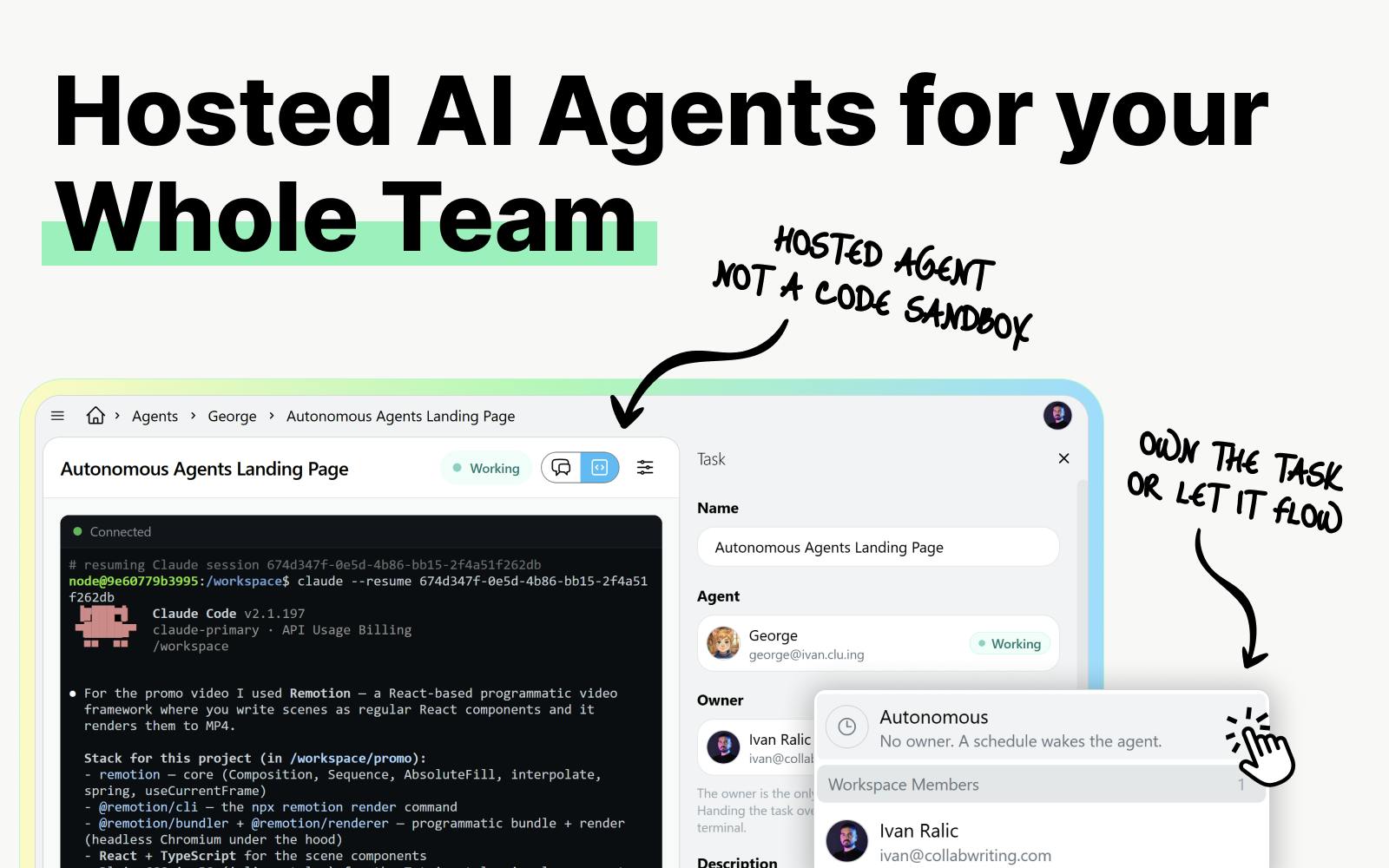
Cluing is a seed-stage Serbian-founded company (formerly Collabwriting) that began as a collaborative web-highlighting and research tool and has repositioned as a “knowledge layer for the AI era.” Its August 19, 2026 launch, Hosted Agents, moves AI agents off individual laptops into a shared, hosted workspace: agents run on Cluing’s infrastructure, can be created from a phone, assigned work by any teammate, scheduled autonomously, and can publish websites, dashboards, and apps to custom domains. The pitch is “Claude Code, but fully collaborative and virtually hosted”.[1][2]
The strongest positive signal is that this is a real company, not a launch-week project: four-plus years of iteration, a €1.1M seed led by SMOK Ventures with credible CEE funds participating, ISO/IEC 27001 certification, apps across Chrome, Edge, Firefox, iOS, and Android, and a claimed 18,253 teams and professionals on the platform. The agentic pivot is coherent with the existing asset — a team’s accumulated knowledge becomes the context layer for its agents.[3][4][5]
The most important concern is that commercially decisive evidence is missing. Public traction signals are thin relative to the company’s age: 32 Chrome Web Store ratings and 9 Product Hunt reviews over four years. Revenue, retention, and agent usage are undisclosed, and pricing changed visibly multiple times during launch week, suggesting monetization is still being worked out.[5][6]
Competitive pressure is severe from both directions: knowledge incumbents (Notion, Mem) adding agents, and agent platforms (Claude Code itself, Lindy, Relevance AI) adding collaboration. Cluing’s bet is that “shared knowledge + hosted agents” is one product, not two.
Final decision: DD. The team, funding pedigree, and differentiated thesis justify a founder meeting and data request; nothing in public evidence justifies skipping straight to Invest.
Product Overview
The customer problem: AI agents are increasingly capable, but they run locally, hold context on one person’s machine, and can’t be handed to teammates. Cluing combines three layers — capture (one-click saving of web pages, PDFs, videos, Kindle notes, social posts), a shared knowledge base (topics, clusters, live context), and hosted agents that work from that knowledge, connect to external tools via API or MCP through connectors with encrypted secrets, and publish output in one click.[1][3][7]
Target users are research-heavy SMB teams, consultants, marketers, and prosumers who want agentic workflows without terminal setup. Pricing is freemium: as of August 22, the official site lists Free at $0, Pro at $12/month ($144/year, includes 1 agent and $100 in credits), and Team at $140/month ($1,680/year, 3 people, 1 agent). The product replaces a patchwork of Readwise-style capture, Notion-style docs, and locally-run Claude Code — though each of those alternatives is stronger in its own lane.[3]
Founder and Team Assessment
Co-founder and CEO Sandra Idjoski has a marketing background (Faculty of Economics, University of Belgrade) and has led the company since December 2021; co-founder Ivan Ralic is CTO. The public team page lists five named members including a CMO and community lead — a small, Belgrade-based team behind a Delaware entity. Verified signals of capability: winning How to Web’s Spotlight 2023 competition, closing a €1.1M seed from institutional CEE investors, shipping and maintaining five client platforms, and achieving ISO 27001 certification — unusual rigor for a team this size. The CEO is publicly active (conference talks, founder interviews), indicating full-time commitment and reasonable founder-market fit for a knowledge-collaboration product. Key-person risk is high given team size, and technical depth beyond the CTO is unverified.[3][4][8][9][10][11][12][13][14]
Founder Assessment: Persistent, credible founding pair with institutional validation, but commercial scale-up ability remains unproven.
Market Opportunity
The initial customer segment is narrow: SMB and prosumer teams (roughly 2–20 people) who already use AI chat tools and want shared, always-on agents without infrastructure work — consultants, content teams, researchers, agencies. A bottom-up frame (analyst assumptions, not company data): if 1–2 million such teams globally would pay for a hosted agent workspace, at Cluing’s ~$1,680/year Team plan the theoretical serviceable market is $2–3B annually; realistic near-term capture for a seed-stage entrant is a small fraction of that. Adjacent expansion paths include enterprise knowledge governance (ISO 27001 supports this), agent-seat expansion revenue, and publishing/hosting fees. Market timing is favorable — MCP standardization and agent adoption are tailwinds — but the same timing is drawing every major platform into the space. The realistic addressable market can support venture-scale revenue only if Cluing wins a durable niche before platforms commoditize the feature.
Traction and Growth Signals
Verified: the product exists across five platforms; the Chrome extension holds a “Featured” badge with 4.8 stars from 32 ratings; the Product Hunt product page shows 4.9 stars from 9 reviews and ~1.7K followers across 8 launches; a Google Play app exists. Company-reported and unverified: “Trusted by 18,253 teams and professionals”. The launch-week community response includes at least one detailed, credible user account of an agent building and publishing a live website from an Instagram link. No revenue, paying-customer, retention, or traffic data is public, and no independent traffic estimates were found. The most important missing metrics: MRR, active teams, agent tasks executed per week, and cohort retention. Eight launches since 2022 show persistence but also that prior launches did not produce breakout momentum.[1][3][5][6][15][16]
Traction Assessment: Real product surface and longevity, but commercial traction is unverified and public engagement signals are modest for the company’s age.
Competitive Position
Direct competitors for “collaborative hosted agents” include Lindy, Relevance AI, and Motion; knowledge-layer competitors include Notion (with its own agents), Mem, and Capacities; capture competitors include Readwise; and the underlying capability competitor is Claude Code itself, which Cluing both hosts and positions against. Large platforms could bundle the feature: Notion, Microsoft, and OpenAI all have the pieces. Cluing’s current differentiation is the integration — captured team knowledge as living agent context, plus encrypted connectors and one-click publishing — and its cross-platform capture surface. Switching costs grow with accumulated knowledge and configured agents, which is the beginnings of a moat, but there is no proprietary data advantage beyond user content, and no network effects beyond team-level virality. If a major platform shipped the same feature in six months, Cluing’s answer would be depth of its knowledge graph and neutrality across models — plausible but unproven.[1]
Defensibility Assessment: Medium
Business Model and Economics
The model is freemium SaaS plus usage: per-seat plans, paid agent seats (reported at $25/month or $180/year), and credit add-ons (reported at $10–12 per 1,000 credits). A material conflict exists: during launch week, the Pro tier was reported at $42/month by two independent August 19–20 sources, while the official site fetched August 22 shows $12/month; the help center and teams page show still other figures ($20–25/user). This report uses the official site’s current numbers and treats pricing as unsettled. The key economic question is gross margin on hosted agents: running frontier models and Claude Code on Cluing’s infrastructure carries real inference cost, and a $12–42/month Pro tier with included credits could be margin-negative for heavy users unless credit metering is tight. Free-tier capture costs are low; support burden for non-technical agent users will be non-trivial. Assumptions requiring verification: credit burn rates, inference cost per active agent, free-to-paid conversion, and seat expansion within teams.[3][7][17][18]
Unicorn Path
Assume an 8× ARR multiple, appropriate for a SaaS company with agentic growth but unproven retention. Required revenue: $1B ÷ 8 = $125M ARR. At the current Team price of $1,680/year, that implies ~74,000 paying teams; at a blended $500/year across prosumers and teams, ~250,000 paying customers. For calibration, the company claims 18,253 total teams and professionals (free included) after four years. Closing a two-order-of-magnitude gap requires: successful upmarket movement into enterprise (higher ACV, aided by ISO 27001), agent-seat expansion revenue, international distribution beyond PH/SEO, and likely additional capital. A unicorn outcome is possible only if the hosted-agents pivot converts the knowledge base into a durable system of action — a genuine business-model expansion, not a straight line from today.[3]
Unicorn Path: Conditional
Valuation Assessment
Known funding history: a €1.1M seed closed April 2024, led by SMOK Ventures with Credo Ventures, Underline Ventures, Fiedler Capital, Fortech, Startup Wise Guys, V7 Capital, and angel Xenia Muntean, plus a €300K grant from the World Bank-backed Katapult Accelerator. Conflicts exist: one regional report references an earlier €880K commitment tied to the 2023 How to Web win; CAPLINK lists €2.0M total across two rounds; a February 2025 aggregator claims a $1.4M raise. The most reliable primary-consistent figure is the €1.1M April 2024 round; total disclosed funding is plausibly €1.4–2.0M. No valuation, round terms, or current raise status is disclosed. Valuation Attractiveness: Not Assessable. Required inputs: current ARR and growth, gross margin net of inference costs, burn and runway, and the terms (post-money or SAFE cap) of any active round.[4][11][19][20][21]
Key Risks
- Platform replication: Notion, OpenAI, Anthropic, or Microsoft shipping collaborative hosted agents would compress Cluing’s differentiation quickly.
- Unverified traction: the 18,253-user claim is company-reported, and independent signals (32 Chrome ratings, 9 PH reviews) are thin for a four-year-old product.[5][6]
- Monetization instability: at least four conflicting price points appeared during launch week, indicating unresolved packaging.[3][7][17]
- Inference-cost exposure: hosting agents on Cluing’s infrastructure risks gross-margin compression under heavy use.
- Positioning sprawl: capture + second brain + agents + publishing may spread a ~5-person team too thin.
- Security burden: storing encrypted connector secrets and running autonomous agents raises the stakes of any breach (ISO 27001 mitigates but does not eliminate).[3]
- Category churn: second-brain tools historically suffer weak long-term retention.
- Runway uncertainty: last verified round closed April 2024; current cash position unknown.[4]
- Key-person concentration in the CEO/CTO pair.
- Distribution dependence on Product Hunt, SEO, and extension-store featuring.
Final Assessment
Venture Potential: 56/100
| Category | Score |
|---|---|
| Market Size and Expansion Potential | 13/20 |
| Traction and Growth Evidence | 8/20 |
| Founder and Team | 10/15 |
| Product Strength | 7/10 |
| Distribution Potential | 8/15 |
| Business Model and Economics | 5/10 |
| Defensibility | 5/10 |
| Total | 56/100 |
Strongest elements: a validated founding team and a genuinely differentiated product thesis in a large, timely market. Weakest: unverified commercial traction and unresolved monetization economics.
Evidence Confidence: 55/100
Verified: founders, entity, funding round, product surface, certifications, launch history. Company-reported: user counts, testimonials. Conflicting: total funding and current pricing. Unavailable: revenue, retention, usage, burn, valuation.
Final Decision: DD
Cluing clears the bar for formal diligence: capable and committed founders, institutional seed backing, a coherent and differentiated agentic pivot, and a market large enough to matter. It does not clear Invest because every commercially decisive number — ARR, retention, margin on hosted agents, current terms — is unknown, and pricing instability suggests the business model is still being settled.
Upgrade Conditions
- Verified ARR approaching $1M with month-over-month growth post-launch
- Evidence that hosted agents drive conversion and retention (agent tasks per active team per week)
- Stabilized pricing with demonstrated willingness to pay at the Team tier
- Enterprise or mid-market logos leveraging the ISO 27001 posture
- A new round with clean terms from the existing investor syndicate
Downgrade Conditions
- Launch-week engagement fades without sustained agent usage
- Continued pricing churn or heavy discounting signaling weak willingness to pay
- A major platform shipping an equivalent collaborative-agent feature
- Gross-margin erosion from inference costs; runway distress before a new round
Questions for Further Diligence
- What are current MRR/ARR and the monthly growth rate over the past 12 months?
- How many paying teams and paying Pro users exist today, and what is free-to-paid conversion?
- What are 90-day and 180-day logo and revenue retention for teams?
- How many agent tasks were executed in the first week of Hosted Agents, and by how many distinct workspaces?
- What is the gross margin on the Pro and Team tiers after inference and hosting costs, and how do credits meter heavy users?
- Why did pricing change multiple times during launch week, and which packaging is final?
- What are current burn rate and runway, and is a round being raised now — on what terms?
- Can you reconcile the “18,253 teams and professionals” figure with registered, active, and paying accounts?
- What is the full-time headcount and engineering capacity beyond the CTO?
- What is the security architecture for connector secrets, and have there been any incidents?
- Why will teams choose Cluing over Claude Code plus Notion, or Notion’s native agents, in 12 months?
- What does the cap table look like after the SMOK-led round and the Katapult grant?
Sources
- Product Hunt — Cluing product page and Hosted Agents launch
- Cluing — official website and current pricing
- Cluing — team page
- Cluing Help Center — Who built Cluing?
- Sandra Idjoski — LinkedIn launch announcement
- Vestbee — Collabwriting raises €1.1M seed
- The Recursive — €1.1M round details
- CAPLINK — Collabwriting funding summary (secondary)
- IT Logs — company profile and history
- ChatGate — launch coverage with pricing detail (secondary)
- Karo Zieminski — Cluing review and agents preview (secondary)
- Chrome Web Store — Cluing extension
- Google Play — Cluing app