
Table of Contents
- Scholé Learn by Building: Investment Report
Scholé Learn by Building: Investment Report
Category: AI-native workforce learning and upskilling for enterprises (in-browser, task-based AI tutoring)
Company Stage: Seed. The company says it has raised $3M
Founders: Vinitra Swamy, PhD (CEO) and Paola Mejia, PhD (CTO)
Headquarters: San Francisco, with an office in Écublens/Lausanne, Switzerland (LinkedIn)
Funding: $3M led by ACE Ventures, with The House Fund and FundF participating (announced January 28, 2026). Round terms are not publicly disclosed.
Business Model: Seat-based B2B SaaS, a $99/month individual Pro plan, and a white-label platform deal
Product Hunt Launch Date: September 24, 2026 (Learn by Building). Earlier launches were in May 2026 and August 17, 2026.
Report Date: September 29, 2026
| Investment Metric | Assessment |
|---|---|
| Venture Potential | 60/100 |
| Unicorn Path | Plausible |
| Valuation Attractiveness | Not Assessable |
| Evidence Confidence | 45/100 |
| Final Decision | DD |
Executive Summary
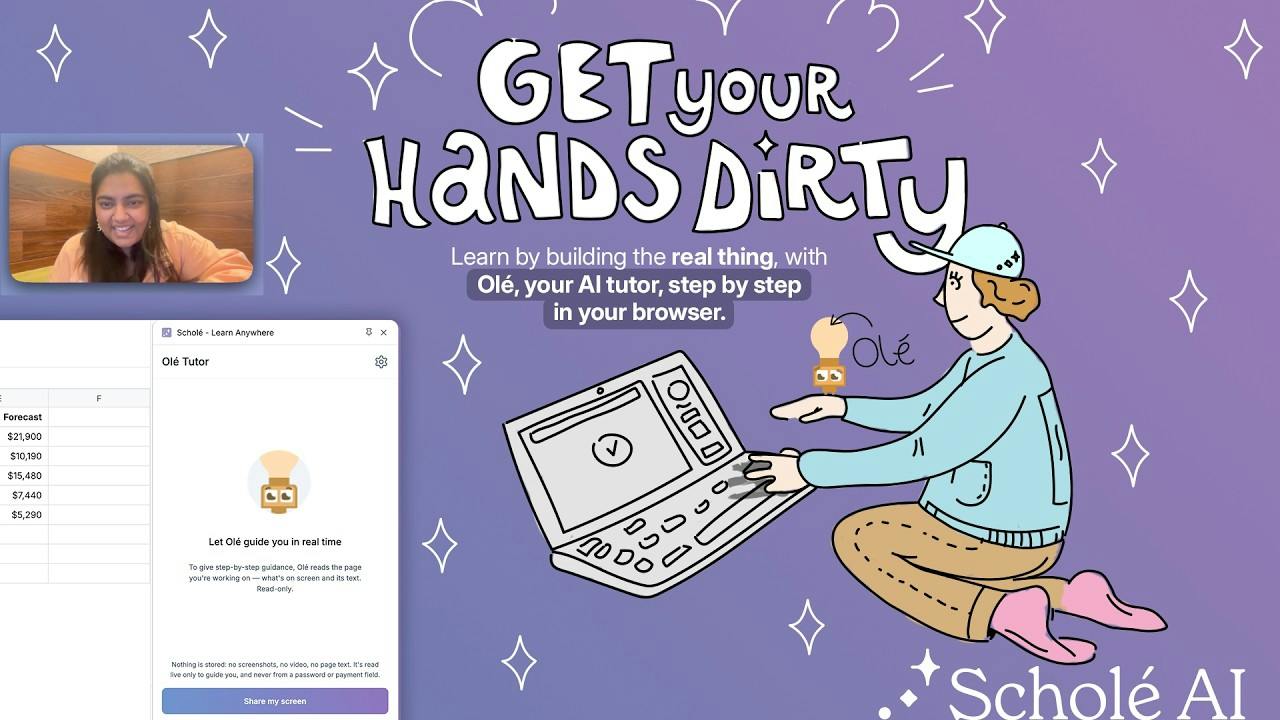
Scholé builds personalized AI lessons for employees, fitted to each person’s role, tools and company documents. The newest feature, “Learn Anywhere” or Learn by Building, is a browser side panel. The AI tutor, called Olé, gives the learner a real task inside a real tool such as Colab, Claude, GitHub or Zapier, watches the active tab, and guides them step by step (product page).
It is sold mainly to HR and L&D (learning and development) teams whose companies bought ChatGPT, Copilot or Claude licenses but see low adoption (homepage). Its first use case is AI literacy training.
The strongest positive signal is the team combined with early institutional validation. Both founders hold PhDs from EPFL’s Machine Learning for Education lab. The company raised a seed round from institutional investors and reports pilots with Swisscom, Decathlon and Coop (press release). Decathlon Switzerland gave a named testimonial. OSTraining launched a paid white-label platform built on Scholé (PRWeb).
The biggest concern is that there is no public commercial evidence. Revenue, paying customers, whether the pilots turned into contracts, and retention are all undisclosed. The market also has well-funded incumbents. Workday acquired Sana, whose Sana Learn product offers AI tutoring. Multiverse raised money at a $2.1B valuation as an AI adoption platform.
Decision: DD. The team, product pace and enterprise pilots justify a founder meeting. That diligence should focus on whether the pilots converted into paid contracts.
Product Overview
The problem Scholé addresses is that generic, fixed courses don’t teach employees how to use AI tools in their own jobs. Scholé generates lessons on the fly in “24 ways to learn”: quizzes, role-plays, code exercises, generated video, concept maps and live coached scenarios. Lessons can draw on company documents through retrieval, and an HR dashboard tracks progress (homepage).
The Learn Anywhere extension runs in Chromium browsers and Firefox and works in English, French, German and Italian. The company says it does not store screen frames, only text logs (Learn Anywhere).
Pricing is published (pricing page):
| Plan | Price |
|---|---|
| Free | 2 lessons |
| Pro | $99/month |
| Teams | $95 per person per month (2-person minimum), then $75 per additional person; $950/$750 per person if paid annually |
| Enterprise (100+ users) | Custom, described as “very large volume discounts” |
The company claims to be “certified under Article 4 of the EU AI Act.” It does not say who certified it, and this should be verified. It also says SOC 2 and ISO audits are “ongoing,” which means they are not complete.
Scholé replaces vendor webinars, LinkedIn Learning or Coursera-style course libraries, internal L&D content, and informal learning through ChatGPT or YouTube.
Founder and Team Assessment
Vinitra Swamy (CEO) studied at UC Berkeley. Her personal site says she spent two years at Microsoft AI as a lead engineer on ONNX before her EPFL PhD, and her Google Scholar record shows a substantial research output. Paola Mejia (CTO) earned an EPFL CS PhD between 2020 and 2025 (EPFL Infoscience). The company says she has “12+ AI-powered learning products used by more than 200,000 learners” (Lernnavi, Classtime); this is company-reported and not verified.
Founder-market fit in adaptive learning is strong. Neither founder has a verified previous company or exit. Commercial capability rests on a hired CRO, Michael Repnik, whose background was not verified.
LinkedIn lists 11 employees, which matches the roughly 11 engineering and product staff named on the website. The company posted engineering job openings in February 2026 and opened a San Francisco office in August 2026. Both founders appear to be full-time.
Founder Assessment: The founders are credible experts in the field with real technical depth, but their commercial and enterprise sales execution is unproven.
Market Opportunity
The narrow initial segment is mid-to-large European and US companies that have deployed generative AI tools and need role-specific AI literacy training. EU compliance pressure is part of the pitch.
A bottom-up estimate, which is an analyst assumption:
- About 20,000–40,000 companies with more than 1,000 employees in Western Europe and North America.
- Of those, 10–20% of employees are covered at first (roughly 200–2,000 seats per company).
- Effective price of $200–500 per seat per year after volume discounts, well below the $900–1,140 list price.
This gives an initial serviceable market of about $1B–$10B a year. The range is wide on purpose. It would support a venture-scale business only if AI training becomes a recurring budget line rather than a one-off compliance purchase.
Adjacent opportunities include:
- Onboarding for any software tool, which overlaps with digital adoption platforms like WalkMe and Whatfix.
- White-label engines for training providers, as with OSTraining.
- Teacher training (the company has a research collaboration with UNESCO’s IIEP).
- Consumer learners.
Timing is favorable, but demand may peak and fade if AI tools become easier to use on their own.
Traction and Growth Signals
Launch attention:
- The first Product Hunt launch in May 2026 finished #1 Product of the Day, according to the company’s LinkedIn. The Product Hunt page lists it as May 2; company posts suggest May 1. This is a minor discrepancy.
- Scenarios ranked #5 on August 17.
- Learn by Building got 399 votes on September 24 (a secondary aggregator) and was named Launch of the Day.
- There is only one Product Hunt review.
Stronger signals:
- Three product launches in five months shows high shipping speed.
- Swiss enterprise pilots and a named Decathlon testimonial that describes about a year of collaboration.
- The OSTraining white-label launch on September 1, 2026.
- Harvard Data Science Review’s Agentic AI Intensive, which Forbes listed, runs on the platform.
- A 2023–24 Tools Competition win.
Caution: The claim that learners come from Bank of America, NASA and Apple refers to people taking the Harvard course. It does not show those companies are customers. The claims of “hundreds of organizations” and “learners from 1,000+ roles” are unverified.
Missing: revenue, paid seats, pilot-to-contract conversion, active users and retention.
Traction Assessment: The product is shipping quickly and has credible enterprise pilots, but there is no evidence yet that it makes money.
Competitive Position
Direct competitors: Sana Learn, now part of Workday; Multiverse; enterprise AI training providers like Correlation One and DataCamp.
Indirect competitors: Coursera, LinkedIn Learning, and digital adoption platforms such as WalkMe, now owned by SAP, and Whatfix.
Free alternatives: learning modes built into ChatGPT, Claude and Gemini; vendor academies; YouTube.
Scholé’s current differentiation is its learning-science approach to adaptive teaching, the in-tool guidance in the browser, multilingual support tuned for Europe, and data hosted in Switzerland.
Key question: if Microsoft or OpenAI built a guided in-product tutor, or Workday bundled Sana Learn into existing HR contracts, why would customers keep paying for Scholé? The only credible answer is neutrality across tools plus measurable learning outcomes, and neither is proven yet. Switching costs are low. The extension also depends on browser platforms and on the websites it overlays. The learner knowledge graph could become proprietary data over time, but that is not yet shown.
Defensibility Assessment: Low to medium.
Business Model and Economics
Seat pricing at $75–95 a month is high for learning software. Enterprise volume discounts will likely cut the effective price a lot. Pro at $99 a month is expensive for individual consumers, so willingness to pay is unproven.
The main variable cost is AI inference. That includes multimodal models reading screen frames in real time, generated video and audio, and voice chat, all on Azure. Heavy users on unlimited plans could hurt gross margin. Gross margin is not disclosed; SaaS-like margins of 60–75% are plausible but not verified.
Selling to enterprises means long pilot cycles, heavy onboarding work (the company promises setup in “less than a day”), and a need for completed SOC 2 certification. White-label deals like OSTraining could add a channel with lower acquisition cost.
Unicorn Path
A multiple of 10–15x ARR is assumed. That fits a growing AI-native enterprise SaaS company with net revenue retention above 110%.
- Required ARR = $1B ÷ 10–15 ≈ $67–100M
- At an effective $300 per seat per year: about 220,000–330,000 paid seats
- Or about 350–500 enterprise customers at $200K average contract value
- Required gross margin: 70% or more, which means managing inference costs carefully
Reaching that scale would require:
- Moving from pilots to company-wide deployments.
- Expanding beyond AI literacy into general software onboarding and skills training.
- Building distribution in the US.
- Growing the white-label and API channel.
- Proving learning outcomes in a way that justifies renewals.
- Raising a Series A and probably a B.
A large strategic acquisition, similar to Workday buying Sana, is a realistic alternative exit, though a lower one.
Unicorn Path: Plausible. The seat numbers above are achievable within the company’s current enterprise SaaS model, but none of that path has been proven yet.
Valuation Assessment
Known funding: $3M led by ACE Ventures, with The House Fund and FundF. The instrument, post-money valuation, SAFE cap and current fundraising status are not disclosed.
Comparables:
- Multiverse raised $70M at a $2.1B valuation in May 2026.
- Workday acquired Sana; the terms were not in the retrieved release. A Reddit thread mentions about $1.1B, which is unverified.
These comparables are much later stage and do not help price Scholé.
Valuation Attractiveness: Not Assessable. Pricing it would require:
- Current ARR and growth
- Pilot conversion rates
- Gross margin
- Retention
- Burn and runway
- Seed round terms (instrument and cap)
- Proposed round size, pre- and post-money valuation
- Liquidation preferences
Key Risks
- Pilots may not convert. Enterprise interest is not shown to have become recurring paid contracts.
- Bundling by incumbents. Workday and Sana, SAP and WalkMe, Microsoft Copilot and LinkedIn Learning can bundle AI tutoring into existing contracts at little extra cost.
- Demand may be temporary. AI literacy may be a compliance-driven or one-time budget item.
- Inference costs. Real-time multimodal screen guidance and generated media could erode gross margin under unlimited plans.
- Pricing pressure. List prices are high compared with course libraries, and volume discounts may cut per-seat revenue sharply.
- Unverified compliance claims. The EU AI Act “certification” source is unstated and SOC 2 is not complete, which could slow enterprise procurement.
- Browser platform dependency. The extension depends on browser policies and on the websites it guides users through.
- Positioning confusion. Harvard and big-company logos could mislead buyers about who the actual customers are, which creates a credibility risk.
- Thin commercial team. With about 11 staff spread across Switzerland and San Francisco, the company may struggle to run long enterprise sales cycles on two continents.
Final Assessment
Venture Potential: 60/100
| Category | Score |
|---|---|
| Market Size and Expansion Potential | 15/20 |
| Traction and Growth Evidence | 7/20 |
| Founder and Team | 12/15 |
| Product Strength | 7/10 |
| Distribution Potential | 8/15 |
| Business Model and Economics | 6/10 |
| Defensibility | 5/10 |
| Total | 60/100 |
The strongest parts of the case are the founders’ expertise, shipping speed and access to enterprise pilots. The weakest are verified traction and defensibility against bundled incumbents.
Evidence Confidence: 45/100
Verified: the founders’ identities and academic records; pricing; the product; that the funding was announced (company and investor release); team size of about 11 per LinkedIn; the OSTraining launch; Product Hunt results.
Company-reported only: the pilots; the claim of “hundreds of organizations”; the CTO’s learner numbers; the EU AI Act certification.
Unavailable: revenue, customers, retention, margin, burn, valuation and the legal entity.
Final Decision: DD
The team and product pace, institutional seed backing, named enterprise pilots and a live white-label customer are enough to justify a founder meeting. The Venture Potential score (60) and Evidence Confidence (45) show that the case depends on verifying commercial results. This is a narrow, limited DD, not a signal to invest.
Upgrade Conditions
- Verified ARR of $1M or more, or at least three converted enterprise contracts worth $50K+ ACV each.
- 12-month logo retention above 80% and net revenue retention above 110%.
- Gross margin of 70% or more at current usage.
- Completed SOC 2 Type II.
- A repeatable channel, such as white-label partners or a sales team, that is not driven by Product Hunt.
- Measured learning or AI-adoption results at named customers.
Downgrade Conditions
These would move the decision to Watch or Pass:
- Pilots end without converting to paid contracts.
- Heavy discounting shows effective seat prices below $150 a year.
- Major platforms release equivalent guided in-tool tutors.
- Inference costs push gross margin below 50%.
- Compliance or customer claims turn out to be overstated.
- A founder leaves.
Questions for Further Diligence
- What are current ARR and monthly growth, and how are they split between enterprise, Teams, Pro and white-label?
- Which of the Swisscom, Decathlon and Coop pilots have turned into paid contracts, and at what ACV and seat count?
- What is the effective per-seat price after discounts for your five largest customers?
- What are 30-, 90- and 180-day active-learner retention rates, and are contracts renewing after AI-literacy compliance needs are met?
- What is the inference cost per active learner per month, particularly for Learn Anywhere screen guidance and generated video?
- What are the economics of the OSTraining deal (revenue share, minimums), and how many similar white-label deals are in the pipeline?
- What is the Harvard relationship: revenue, licensing, or a research partnership?
- What is the basis of the “certified under Article 4 of the EU AI Act” claim, and when will SOC 2 be complete?
- How do you win against Workday/Sana or Copilot when they are bundled into existing contracts at little extra cost?
- What are current burn and runway, what are the seed terms, and what is the planned Series A size and timing?
- How is the team split between Switzerland and the US, and what is the plan for building enterprise sales?
Sources
- Product Hunt: Scholé and Awards
- Scholé homepage, Pricing, Learn Anywhere
- Funding press release (PR Newswire) and ACE Ventures
- Scholé LinkedIn company page
- Vinitra Swamy personal site, EPFL founder profile
- OSTraining launch (PRWeb)
- Tools Competition winner page
- Workday completes Sana acquisition
- Multiverse $70M raise at $2.1B
- Product Hunt Daily, Sept 25, 2026 (secondary aggregator)