
Table of Contents
- Chat Agent by Trigger.dev — Investment Report
Chat Agent by Trigger.dev — Investment Report
Category: Developer Infrastructure / AI Agent & Durable Execution Platform
Company Stage: Series A (raised December 2025)
Founder or Founders: Matt Aitken (CEO), James Ritchie, Eric Allam, Dan Patel — previously built JSON Hero together (Orange Collective)
Headquarters: London, England (LinkedIn)
Funding: ~$19M total verified: $3M seed (Aug 2023, YC W23) and $16M Series A (Dec 2025, led by Standard Capital) (company announcement, YC)
Business Model: Open-core (Apache 2.0) with usage-based managed cloud: per-second compute + per-run fees, tiered plans ($0/$10/$50/custom) (pricing)
Product Hunt Launch Date: Chat Agent launched week of August 13, 2026 (3rd launch; company on PH since 2023)
Report Date: August 15, 2026
| Investment Metric | Assessment |
|---|---|
| Venture Potential | 68/100 |
| Unicorn Path | Plausible |
| Valuation Attractiveness | Not Assessable |
| Evidence Confidence | 68/100 |
| Final Decision | DD |
Executive Summary
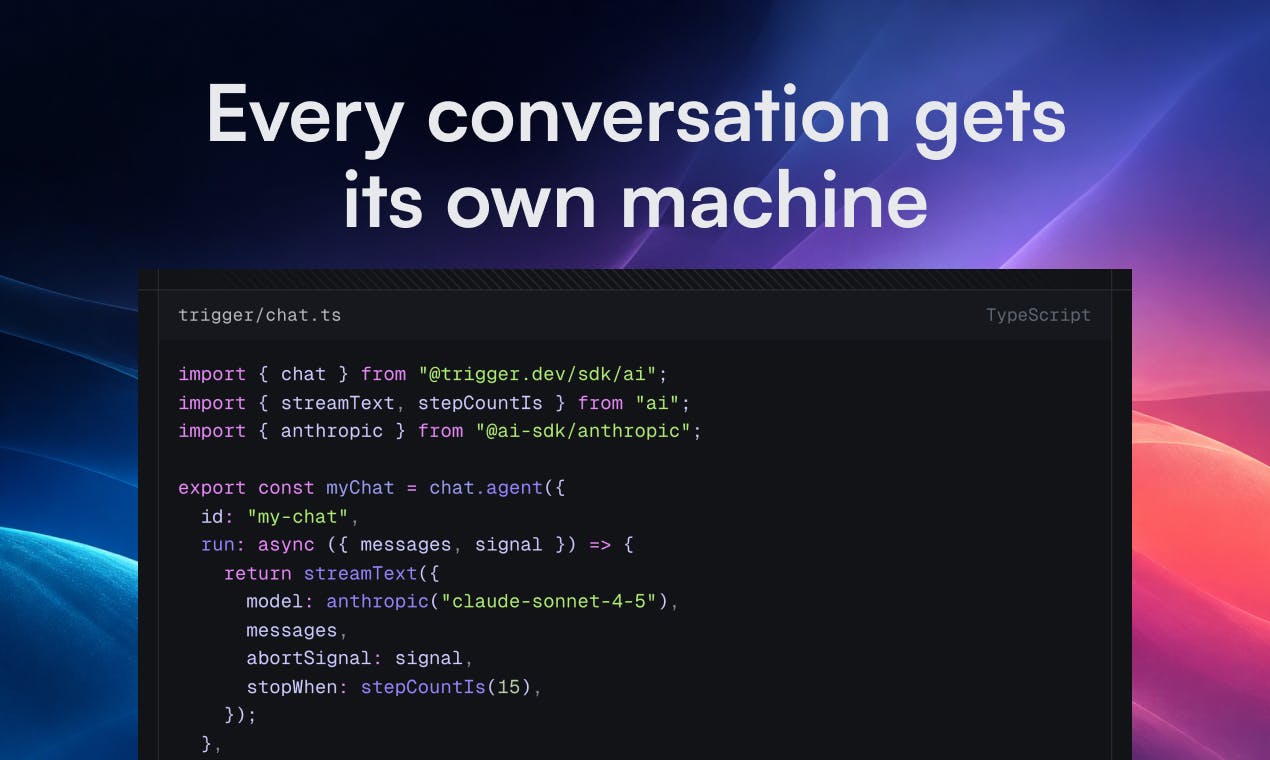
Chat Agent (chat.agent) is a new product from Trigger.dev, a London-based, YC W23 company whose platform lets developers build and run long-running AI agents and workflows in TypeScript with no timeouts, durable execution, queues, and observability. Chat Agent specifically gives every AI conversation its own durable machine that sleeps when idle, survives refreshes and crashes, keeps memory between turns as ordinary variables, and slots underneath the Vercel AI SDK as a transport — eliminating the request/response API route that breaks long-running chat.
The product addresses a real, painful problem: chat agents built on request/response endpoints hit timeouts and lose state, forcing developers to stitch together Postgres, Redis, and queues. Trigger.dev reports the feature has run in production since June 2026, including at Arena.ai, handling “millions of sessions and 84 years of compute,” with 1 in 20 turns exceeding 36 minutes — credible evidence the use case is real (PH launch).
The strongest positive signal is that this is not a launch-day startup: Trigger.dev has a verified $16M Series A from Standard Capital (Dalton Caldwell, Paul Buchheit, Bryan Berg), 16k GitHub stars, a company-reported 30,000+ developers running “hundreds of millions” of agent executions monthly, and named customers (MagicSchool, Icon.com, Arena.ai). The category is validated — Temporal, the durable-execution leader, reached a $5B valuation in February 2026.
The most important concern is competitive intensity and monetization proof: Temporal ($5B), Inngest ($21M Series A), Restate (used by Replit), and Cloudflare’s Agents SDK all attack the same durable-agent layer, and Trigger.dev’s revenue, retention, and Series A valuation are not publicly disclosed.
Decision: DD — the company clears the bar for formal diligence; commercial metrics and terms now need verification.
Product Overview
Problem: AI chat agents are sessions, not requests. Standard serverless/API-route architectures impose timeouts, lose in-memory state between turns, and break streams on refresh — forcing developers to build durability plumbing by hand.
How it works: Each conversation runs as one long-lived Trigger.dev task keyed on chatId. It wakes on new messages, checkpoints and sleeps (unbilled) when idle, and resumes in-memory state and workspace across refreshes, redeploys, and crashes. Developers keep streamText/useChat from the Vercel AI SDK; useTriggerChatTransport replaces the API route. Every turn is traced with prompts, tool calls, latency, and cost. A “Head Start” option cut first-token latency from ~2.8s to ~1.2s in company tests (docs, v4.5.0 changelog).
Target users: TypeScript developers and product engineering teams shipping AI agents/chat features. Pricing: free tier; Hobby $10/mo; Pro $50/mo; Enterprise custom (SSO, RBAC, SOC 2, BAA); usage billed per-second of compute ($0.0000169–$0.00068/sec by machine size) plus $0.000025/run; waiting time is free via checkpointing. Platforms: managed cloud or self-hosted (Apache 2.0). Replaces: hand-rolled Postgres+Redis+queue durability stacks, and simpler background-job tools. The product is live, documented, and verifiable.
Founder and Team Assessment
Four co-founders — Matt Aitken (CEO), James Ritchie, Eric Allam, and Dan Patel — who previously built JSON Hero together, indicating an established working relationship (Orange Collective). Aitken is a programmer-founder who previously built two iPad apps and has led the company since July 2022 (LinkedIn). James Ritchie fronted the PH launch with a technically credible, non-promotional post.
The company is YC W23, London-based, with 11–50 employees per LinkedIn and an active engineering team (7,789 commits; commits as of Aug 13, 2026; TypeScript 7 upgrade, ClickHouse integration, security releases). Hiring and commercial leadership depth beyond the founders is not publicly detailed. No prior exits. Technical capability is demonstrated; enterprise go-to-market capability is the unproven element.
Founder Assessment: Technically strong, cohesive founding team with YC pedigree; commercial scaling and enterprise sales capability remain unproven.
Market Opportunity
Initial segment (narrow): TypeScript product teams at AI-native startups shipping agentic chat/workflow features who need durable execution without managing infrastructure. Adjacent: broader backend workflow orchestration, enterprise AI platform teams, and eventually non-TypeScript ecosystems.
Bottom-up: there are on the order of hundreds of thousands of TypeScript shops building AI features; the paying slice is teams with production agent workloads. At an assumed $5k–$50k annual spend per paying team (consistent with $50/mo Pro up to enterprise custom plans), a realistic near-term serviceable market is in the low-to-mid hundreds of millions of dollars ARR, expanding rapidly as agent workloads grow. The category ceiling is validated by Temporal’s $5B valuation and $350M+ raised (Temporal, Series D). Timing is favorable: Trigger.dev reports >90% of its usage now comes from agent workflows (YC). The realistic market can support venture-scale revenue, but share must be won against well-funded incumbents.
Traction and Growth Signals
- Funding (verified): $3M seed (2023); $16M Series A (Dec 2025, Standard Capital; participation from YC, Liquid 2, Wayfinder, Pioneer, Rebel, Michael Grinich, CTO fund)
- Usage (company-reported): 30,000+ developers; “hundreds of millions” of agent executions/month; Chat Agent in production since June 2026 with “millions of sessions”
- Customers (company-reported, named): MagicSchool, Icon.com, DavidAI, Arena.ai
- GitHub (verified): 16.0k stars, 1.4k forks, Apache-2.0, very active development
- Product Hunt: 676 followers, 5.0 rating across 16 reviews; Chat Agent is the 3rd launch — modest PH signal, not evidence of PMF
- Revenue: not publicly disclosed; one secondary directory (OMNIUS) cites a “$2.7M revenue run rate” — unverified third-party estimate, not relied upon
Most important missing metrics: verified ARR/MRR, growth rate, paying-customer count, net revenue retention, and cloud-vs-self-host mix.
Traction Assessment: Credible, investor-validated developer adoption at meaningful usage scale, but commercial traction (revenue, retention) is not publicly verified.
Competitive Position
Direct: Inngest ($21M Series A, Altimeter; a16z-backed), Restate (durable execution for agents; Replit is a customer), Hatchet, Windmill. Indirect/platform: Temporal ($5B valuation — the category incumbent), Cloudflare Agents SDK/Durable Objects (per-session durable state at the edge — a direct architectural rival for durable chat), Vercel (AI SDK + its own workflow/durability efforts), LangGraph Platform, and sandbox providers (Modal, E2B).
Differentiation: TypeScript-native DX; no-timeout durable tasks with checkpointing (“waiting is free”); the chat-agent transport that removes the API route while preserving the Vercel AI SDK; self-hostable open source; and production proof at scale. Switching costs are moderate — tasks live in the customer’s codebase, but the runtime is portable in principle and self-hosting limits lock-in. Platform dependency: rides on LLM providers and the Vercel AI SDK ecosystem (a strength for distribution, a risk if Vercel bundles equivalent durability).
“If the largest platform launched the same feature in six months?” Cloudflare and Vercel are the credible threats; Trigger.dev’s answer is framework-agnostic depth, no-timeout compute with real machines (browsers, FFmpeg, Python), and observability — defensible but not unassailable.
Defensibility Assessment: Medium.
Business Model and Economics
Open-core with a usage-based managed cloud: per-second compute pricing, per-run invocation fees, seat tiers, and enterprise plans (SSO/RBAC/SOC 2/BAA). This is the standard, proven model for the category (Temporal Cloud, Inngest, Restate Cloud all monetize similarly). Key economics to verify in diligence: gross margin on compute (per-second billing must exceed underlying infrastructure cost — the company runs MicroVM/Firecracker-style isolation, which is capital-efficient but real COGS); free-to-paid conversion; expansion revenue as agent usage grows; and the self-host cannibalization rate. A structural positive: customers bring their own LLM keys, so Trigger.dev does not bear AI inference costs — usage growth scales compute revenue without direct inference COGS, though infrastructure costs still scale with usage. Enterprise revenue potential exists but the sales motion is nascent.
Unicorn Path
Assumed multiple: ~10× ARR, appropriate for high-growth developer-infrastructure SaaS with usage-based expansion (Temporal’s trajectory supports this). Required revenue ≈ $1B ÷ 10 = $100M ARR. Illustratively: ~2,000 enterprise customers at $50k ACV, or a larger base of high-usage teams on consumption billing. Given company-reported hundreds of millions of monthly executions and the secular growth of agent workloads, this is achievable if Trigger.dev converts its open-source/developer adoption into cloud revenue and holds share against Temporal, Inngest, Restate, and Cloudflare. The model does not need reinvention — it needs execution and share.
Unicorn Path: Plausible
Valuation Assessment
Verified funding: $3M seed (2023) and $16M Series A (December 2025, ~8 months ago). The Series A valuation and terms are not publicly disclosed, and revenue is not disclosed. Valuation Attractiveness: Not Assessable. Relevant comparables: Temporal ($1.72B Series C, March 2025; $5B Series D, Feb 2026) and Inngest ($21M Series A, Sept 2025) — these frame the category but not Trigger.dev’s entry price. To assess attractiveness, an investor would need: current ARR and growth, gross margin, NRR, burn/runway, the Series A post-money and ownership, and whether any new round or secondary is available. No valuation range is provided, as there is no verified financial basis for one.
Key Risks
- Competitive replication — Temporal, Cloudflare, and Vercel can bundle durable-agent primitives; Cloudflare’s per-session Durable Objects directly rival Chat Agent’s model.
- Unverified commercial traction — revenue, retention, and conversion are not public; usage scale may not translate to revenue.
- Compute gross-margin risk — per-second billing must outpace infrastructure costs at scale.
- Self-host cannibalization — Apache 2.0 lets larger users avoid the cloud.
- TypeScript-only focus — limits addressable market vs. language-agnostic rivals.
- Enterprise GTM unproven — founders are product/engineering-led; sales motion nascent.
- Platform dependency — relies on LLM providers and the Vercel AI SDK ecosystem.
- Key-person/team depth — commercial leadership beyond founders not evident.
- Valuation opacity — recent Series A terms unknown; entry price cannot be evaluated.
Final Assessment
Venture Potential: 68/100
| Category | Score |
|---|---|
| Market Size and Expansion Potential | 15/20 |
| Traction and Growth Evidence | 13/20 |
| Founder and Team | 11/15 |
| Product Strength | 8/10 |
| Distribution Potential | 10/15 |
| Business Model and Economics | 6/10 |
| Defensibility | 5/10 |
| Total | 68/100 |
Strongest: large validated market, credible investor backing, real product differentiation, and strong open-source distribution. Weakest: defensibility under platform threat and unproven commercial economics. This sits in the “potentially venture-backable, with material risks” band.
Evidence Confidence: 68/100
Verified: funding rounds and investors (company blog + YC), founders, London HQ, 11–50 employee band, pricing, GitHub activity, product existence. Company-reported: developer count, execution volume, customer names, production metrics. Estimated: market sizing, multiples, seat/ACV math. Unavailable: revenue, growth, retention, Series A valuation, cap table, burn. Good product/team/funding evidence; financial data materially incomplete.
Final Decision: DD
Trigger.dev combines a large and validated market, genuine product differentiation, credible traction, an experienced cohesive team, and top-tier investors — sufficient to justify formal due diligence. DD should focus on verifying revenue, retention, unit economics, the Series A terms, and the durability of its edge against Temporal and Cloudflare. It is not “Invest” because valuation, revenue, and round terms are unknown.
Upgrade Conditions (DD → Invest)
- Verified ARR (e.g., $3–5M+) growing >2–3× YoY with NRR >120%
- Gross margin >65–70% on compute and healthy free-to-paid conversion
- Enterprise contracts and referenceable customers beyond those named
- Reasonable entry valuation/terms relative to verified revenue
- Evidence of winning head-to-head against Inngest/Restate/Cloudflare
Downgrade Conditions (DD → Watch/Pass)
- Revenue materially below usage-implied potential, or weak conversion/retention
- Compute gross margins structurally thin
- Cloudflare/Vercel/Temporal shipping equivalent durable-chat primitives, eroding differentiation
- Series A terms that make the current entry price unattractive
- Founder attrition or stalled product velocity
Questions for Further Diligence
- What are current ARR/MRR and month-over-month growth, and how much is usage-based vs. seat-based?
- How many paying customers, and what is the free-to-paid conversion and 6/12-month logo and revenue retention?
- What is NRR, and how does usage expand per customer over time?
- What is gross margin on compute, and how do per-second prices compare to underlying infrastructure cost?
- What share of the 30,000 developers and “hundreds of millions of executions” runs on paid cloud vs. free/self-host?
- What were the Series A post-money valuation and terms, and is any new round or secondary available?
- What are burn rate and runway following the $16M raise?
- How do you win against Cloudflare’s Agents SDK and Temporal as they target agentic chat?
- What is the enterprise pipeline, ACV, and sales motion beyond self-serve?
- What is the cap table and founder vesting/commitment status?
- What is the roadmap for non-TypeScript runtimes and secure sandboxes?
- Any material legal, security, or data-privacy exposure (SOC 2 status, BAA/HIPAA scope)?
Sources
- Product Hunt — Trigger.dev / Chat Agent
- Trigger.dev — official site and pricing
- Chat Agent docs and v4.5.0 changelog
- Trigger.dev $16M Series A announcement
- Y Combinator — Trigger.dev
- GitHub — triggerdotdev/trigger.dev
- LinkedIn — Trigger.dev and Matt Aitken
- Orange Collective — Trigger.dev portfolio
- Temporal — $146M Series C / $1.72B and Series D / $5B
- Inngest — $21M Series A
- Cloudflare — Agents SDK and Restate (competitors)