
Table of Contents
Aloud Investment Report
Category: Developer feedback and AI-agent workflow
Company Stage: Pre-revenue / solo-maker launch
Founder or Founders: Wojciech Dobry
Headquarters: Not publicly disclosed
Funding: Not publicly disclosed
Business Model: Free product today; future monetization not publicly disclosed
Product Hunt Launch Date: 2026/08/20
Report Date: August 26, 2026
| Investment Metric | Assessment |
|---|---|
| Venture Potential | 52/100 |
| Unicorn Path | Improbable |
| Valuation Attractiveness | Not Assessable |
| Evidence Confidence | 70/100 |
| Final Decision | Pass |
Executive Summary
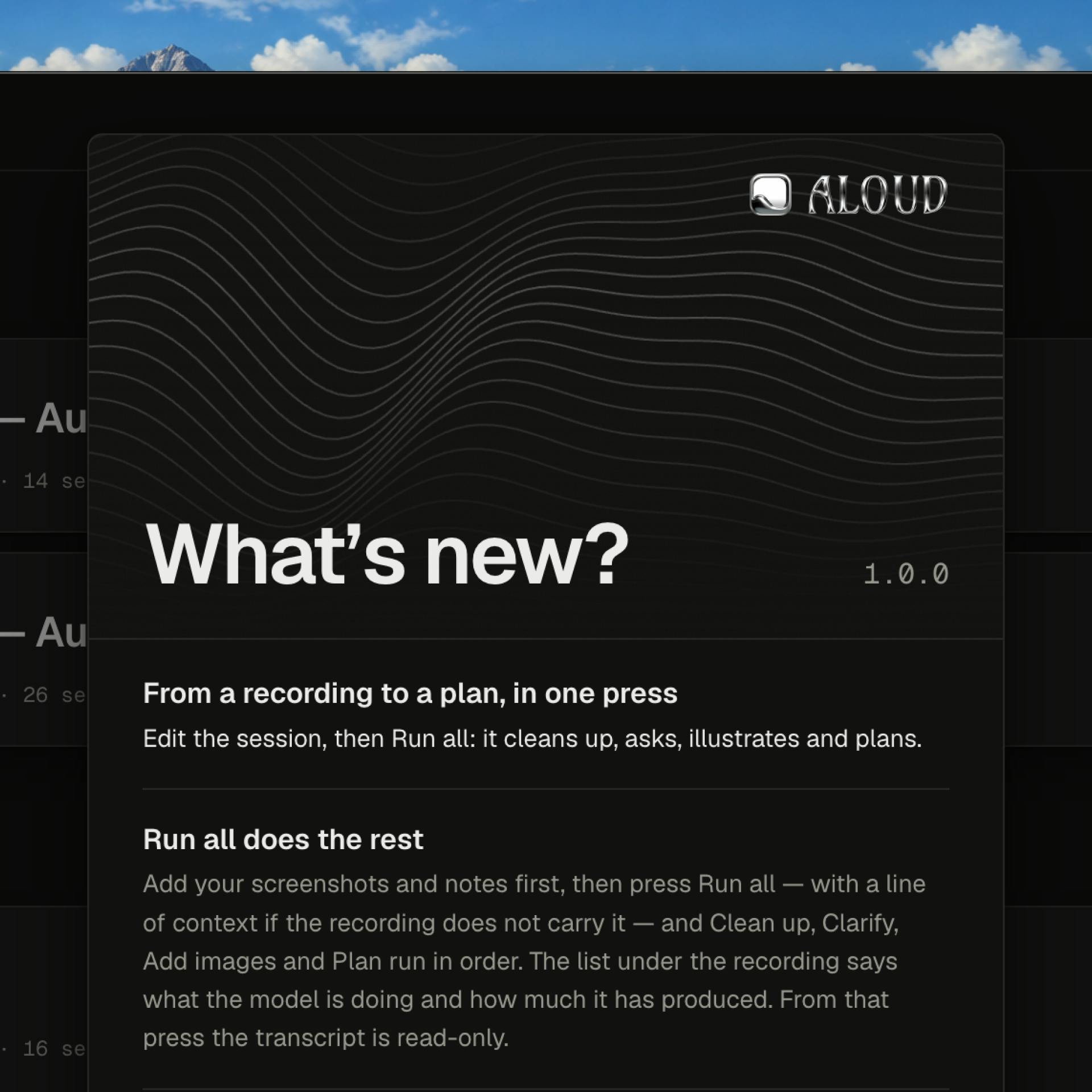
Aloud is a macOS application that records a user talking through an interface while capturing screen video and a synchronized transcript. It cleans the spoken feedback, resolves references such as “this button,” suggests frames from the recording, asks clarifying questions, and exports agent-sized tasks with screenshots for Claude Code, Cursor, Codex, or another coding agent.
As coding accelerates, describing changes becomes a bottleneck. Aloud synchronizes speech with transient screen states and asks before interpreting ambiguity.
The strongest signal is product craft and founder-market fit: Dobry has design-tool experience at Amazon, Vault/Sound, Phase, and Rezolve. Recordings stay local; server AI receives text and selected frames only when requested.
Commercial evidence is absent: Aloud is free, has one review, no disclosed users, retention, funding, or team. Dobry lists a current Rezolve role, so full-time commitment is unproven. Adjacent platforms can bundle the workflow.
The final decision is Pass. Current evidence supports an indie product, not a venture-scale company.
Product Overview
Aloud replaces manual issue writing, generic screen-recording links, and long dictation prompts. The official website shows a three-step flow: record voice, screen, and transcript; clean and clarify the feedback; then export a self-contained plan. It can preserve frames from a hover, animation, authenticated flow, or one-time error that an agent cannot independently reach.
A vision pass names objects behind “this”; ambiguous cases trigger clarification. Pixel capture works across native apps and design files but cannot directly map components to source.
Whisper transcription and recordings stay local. The privacy policy says optional AI steps send text and selected still frames to servers for up to 90 days. A user API key does not change handling.
Aloud is macOS- and Apple-silicon-only. Product Hunt labels it free, and no paid plan or team administration is disclosed. The site simultaneously offers “Download for Mac” and says “First build is coming,” creating minor availability ambiguity that should be tested directly.
Founder and Team Assessment
Wojciech Dobry describes himself as a designer educated in architecture and a programmer by inclination. His portfolio shows work on interaction systems and design tools. From 2021–2022 he worked at Amazon on internal design software; from 2022–2025 he worked on Sound and Vault; since 2025 he reports designing LLM interfaces at Rezolve, with one patent filed and one paper published.
His experience fits visual-feedback structuring, and Product Hunt responses are technically candid.
No co-founder, employee, entity, or hiring is public. External employment raises commitment and IP questions; enterprise security, support, and cross-platform work require more capacity.
Founder Assessment: Excellent product and interaction-design fit, but full-time commitment, commercial ownership, and team capacity are unverified.
Market Opportunity
The narrow initial customer is a developer, designer, product manager, or QA professional who works with coding agents daily and repeatedly describes visual changes. Assume 500,000 reachable power users and $120 annual willingness to pay; that creates a $60 million initial subscription market. Both figures are estimates, not company data.
A team product could add sharing, issue trackers, source mapping, governance, and analytics. At 50,000 teams paying $2,400 annually, revenue would be $120 million, but collaboration must become core.
Timing is favorable, but adjacent vendors own recording, IDE, design, and agent distribution. Venture scale requires becoming the system of record for human-to-agent decisions.
Traction and Growth Signals
The Product Hunt listing showed 120 points, a number-ten daily rank, 105 followers, and one four-star review when observed. Discussion indicates genuine interest in pointing, transient screen states, and clarification. These are launch signals, not product-market fit.
The founder answered objections substantively, but “First build is coming” conflicts with the launch. No App Store, public GitHub, case study, review corpus, or hiring signal was found.
Critical missing data includes downloads, activated accounts, recordings per user, weekly retention, task exports, agent acceptance, time saved, free-tier cost, paid conversion, revenue, and referral. There is no evidence of post-launch momentum beyond Product Hunt.
Traction Assessment: Demonstrated product interest but no verified sustained usage or commercial traction.
Competitive Position
Direct alternatives include Jam, Marker.io, Bird Eats Bug, Linear’s issue capture, Loom, CleanShot X, Screen Studio, Tella, and voice tools such as Wispr Flow. Indirect alternatives are screenshots plus a ticket, native macOS recording, direct dictation into Claude Code or Cursor, and agents that browse a local app. GitHub, Cursor, Anthropic, OpenAI, Apple, Atlassian, or Figma could bundle the workflow.
Aloud differentiates through synchronized frames, cleanup, clarification, long sessions, and agent-sized output. Local recordings help privacy; lack of DOM/code access limits source mapping.
If the largest platform launched the same feature within six months, customers would remain only if Aloud had materially better clarification, task quality, history, team workflow, or cross-tool neutrality. No proprietary dataset, network effect, integration lock-in, or brand evidence yet supports that answer.
Defensibility Assessment: Low
Business Model and Economics
Aloud is currently free. A plausible model is freemium personal software with Pro subscriptions and team tiers, but no price, limit, or enterprise offer is published. Annual contract value is therefore unknown.
Costs include cloud model inference for transcript cleanup and vision, storage for 90-day text and still frames, authentication, email, telemetry, support, and Apple development. Local recording and Whisper reduce server compute and storage, which is economically attractive. Long sessions with many vision frames could still create variable cost.
Product Hunt and the founder’s audience can seed users; durable growth needs agent marketplaces, integrations, and team referrals. No code integration means low switching costs.
A viable paid model should show gross margin above 80%, strong weekly usage, low model cost per export, and expansion from individuals into teams. None is currently measurable.
Unicorn Path
Assume an 8x ARR multiple for a high-growth developer-productivity company. A $1 billion valuation requires approximately $125 million ARR.
That requires 1.04 million users at $120 annually, 52,083 teams at $2,400, or 12,500 enterprises at $10,000. Current distribution cannot support these volumes.
Required changes include full-time leadership, Windows, team collaboration, source integrations, enterprise security, repeatable acquisition, and proprietary task-quality data.
Unicorn Path: Improbable
Valuation Assessment
No financing, revenue, cap table, valuation, round, or fundraising status is public. The product’s free status and Product Hunt performance cannot support a range.
Valuation Attractiveness: Not Assessable
Required information includes legal entity and ownership, founder commitment, IP assignment, revenue, retention, model costs, burn, runway, round size, SAFE cap, option pool, and investor rights.
Key Risks
- No monetization: Free usage has not demonstrated willingness to pay.
- Founder commitment: A current external role may limit focus and complicate IP.
- Feature bundling: Coding agents, IDEs, recorders, and OS vendors can replicate the flow.
- Low switching costs: Exported files and generic models make migration easy.
- Platform limitation: Apple-silicon macOS excludes Windows and Intel users.
- Privacy exposure: Transcripts and still frames can contain code, credentials, or confidential UI.
- Retention risk: Feedback capture may be occasional rather than habitual.
- Solo-team capacity: Enterprise support, security, and integrations may overwhelm one maker.
- Weak distribution: No channel advantage beyond launch attention is visible.
- Availability ambiguity: Website copy and launch claims are not fully aligned.
Final Assessment
Venture Potential: 52/100
| Category | Score |
|---|---|
| Market Size and Expansion Potential | 13/20 |
| Traction and Growth Evidence | 6/20 |
| Founder and Team | 11/15 |
| Product Strength | 8/10 |
| Distribution Potential | 6/15 |
| Business Model and Economics | 4/10 |
| Defensibility | 4/10 |
| Total | 52/100 |
Product insight and founder skill are strongest. Monetization, commitment, traction, distribution, and defensibility are weakest.
Evidence Confidence: 70/100
Features, platform, maker identity, privacy behavior, and public career history are verifiable. Product Hunt response and some architecture details are founder-reported. Market size and pricing scenarios are estimates. Usage, revenue, funding, company formation, IP ownership, and costs are unknown.
Final Decision: Pass
No investable company is yet evident: commitment, monetization, traction, and moat are missing. Revisit after paid team adoption.
Upgrade Conditions
- Founder commits full-time with clear IP ownership.
- A paid plan reaches at least $25,000 MRR.
- Weekly retained users exceed 40% after three months.
- Team or enterprise tiers show expansion and repeatable acquisition.
- Source mapping or workflow data creates measurable task-quality advantage.
- Gross margin exceeds 80% after AI costs.
Downgrade Conditions
- Users adopt only for occasional free recording.
- Cursor, Claude Code, Codex, Linear, or Loom bundles equivalent capture.
- Privacy incidents expose source code or confidential screens.
- The product remains macOS-only without a valuable team segment.
- Development slows because Aloud remains a side project.
Questions for Further Diligence
- Is the founder working full-time on Aloud, and who owns all product IP?
- How many downloads, activated accounts, and weekly retained users exist?
- What percentage of recordings produce an exported task that an agent executes?
- How much time and failed-agent cost does Aloud save versus direct dictation?
- What pricing tests and willingness-to-pay interviews have been completed?
- What is inference and storage cost per active user and per export?
- Why retain transcript text and still frames for 90 days, and can teams set zero retention?
- Which code, issue-tracker, and design-tool integrations are planned?
- What prevents an IDE or coding agent from reproducing the workflow?
- What are company entity, cap table, funding need, burn, and proposed terms?
- How will Windows and enterprise security be supported?
- Which usage data could become a proprietary task-quality advantage?